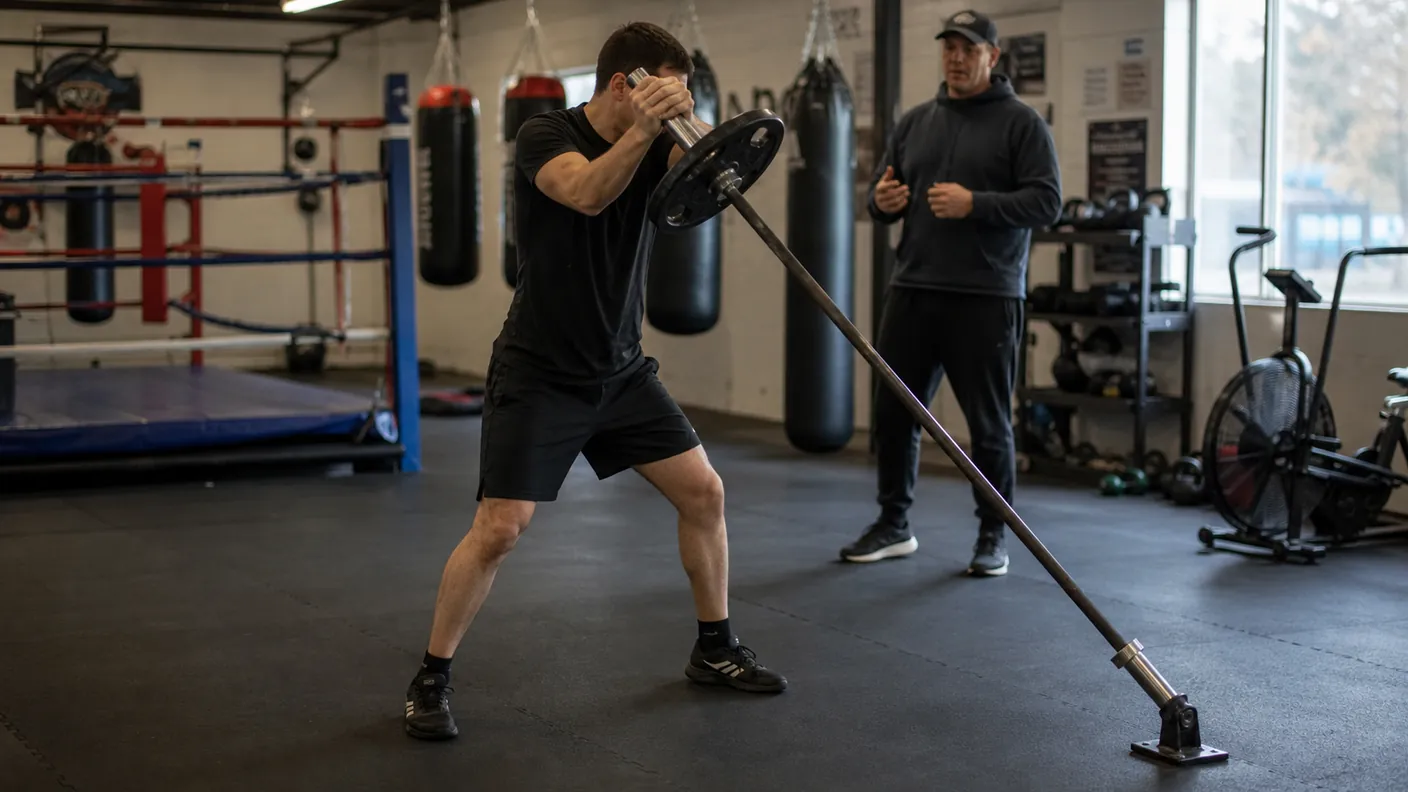
A landmine rotation can teach a useful boxing lesson, but only if you stop trying to turn it into a punch with a barbell in your hands.
The value is not in copying the shape of a hook or cross. It is in feeling the difference between a stable base, a deliberate trunk turn and a body that twists itself out of position. If the feet slide, the ribs flare and the bar drags you across the floor, you are rehearsing the same problem that makes punches fall apart.
The short demonstration below shows the basic movement. Use it as a strength-and-control drill, not a substitute for coached pads, bag work or sparring.
It is a strength drill, not shadow boxing with weight
A landmine is a barbell anchored at one end so the free end travels in an arc. With both hands on the bar end, you guide it from one side of the body to the other while keeping a usable stance.
That arc makes people want to fling the bar. Resist that urge. Trying to make it look like a rapid hook makes the shoulders pull first, the lower back bends sideways and the feet chase the bar.
The better question is simpler: can you move the bar and still reset your feet?
A recent study of punch-specific strength and conditioning found that targeted resistance work can improve punch impact more than conventional training alone, but the effects were specific to the type of work being trained (boxing strength-and-conditioning study). That is a useful warning. Landmine rotations can support strength work. They do not teach distance, timing, defence or punch selection for you.
Start with the feet and ribs
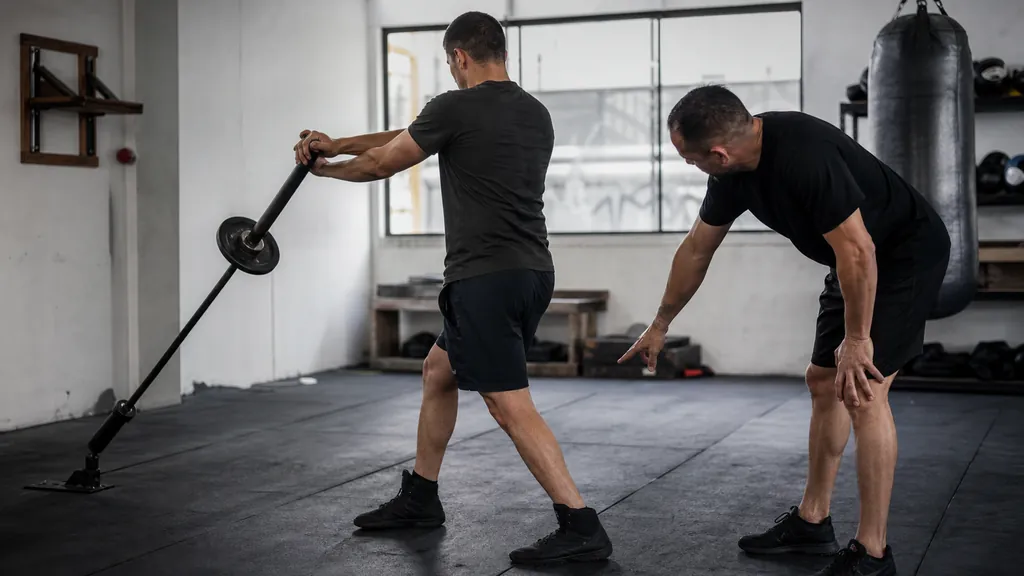
Set up in a comfortable athletic stance, with the knees soft and the weight spread through both feet. You do not need a deep boxing stance, and you do not need to stand square. You need enough width that the bar cannot pull you over one leg.
Before moving, breathe out gently and let the ribs settle over the hips. This is not a cue to brace as hard as possible. It is a reminder not to arch the back and stick the chest up just to make the weight feel lighter.
Now take the bar to one side with control. The arms guide the path, but they should not reach to the farthest possible point. Stop while the shoulders still feel connected and the spine stays long. Return through the centre, then move to the other side.
A good repetition is quiet: the feet stay planted, the knees do not collapse, the head stays level, and you can pause at either end without fighting to regain balance.
That same relationship between base and upper body matters when you punch. Our guide to setting your feet in boxing explains why a shot only stays useful when the stance can support the recovery afterwards.
Choose whether the hips move
There are two sensible ways to use this drill. Pick one before the set rather than drifting between them.
The first version keeps the hips mostly facing forward. The trunk rotates above a stable lower body while the feet stay still. This is the slower, more controlled option. It makes the torso work without allowing the lower body to escape every time the load gets awkward.
The second version allows a small hip turn as the bar moves from side to side. The feet still stay connected to the floor, but the hips and shoulders travel together in a more natural sporting pattern. This version can feel more athletic, but it also makes it easier to spin, lean or let the bar dictate the movement.
Neither version is a more authentic boxing punch. They simply ask different questions of the body. If the aim is controlled trunk work, keep the hips quieter. If a coach has chosen the drill as part of a wider strength session, a modest hip turn may make sense once the controlled version is clean.
A systematic review of core training found that outcomes depend heavily on the sport, programme and task being measured. That is another reason not to sell one exercise as a shortcut. The useful exercise is the one that fits your training, your current ability and the coaching around it.
Keep the bar close enough to control
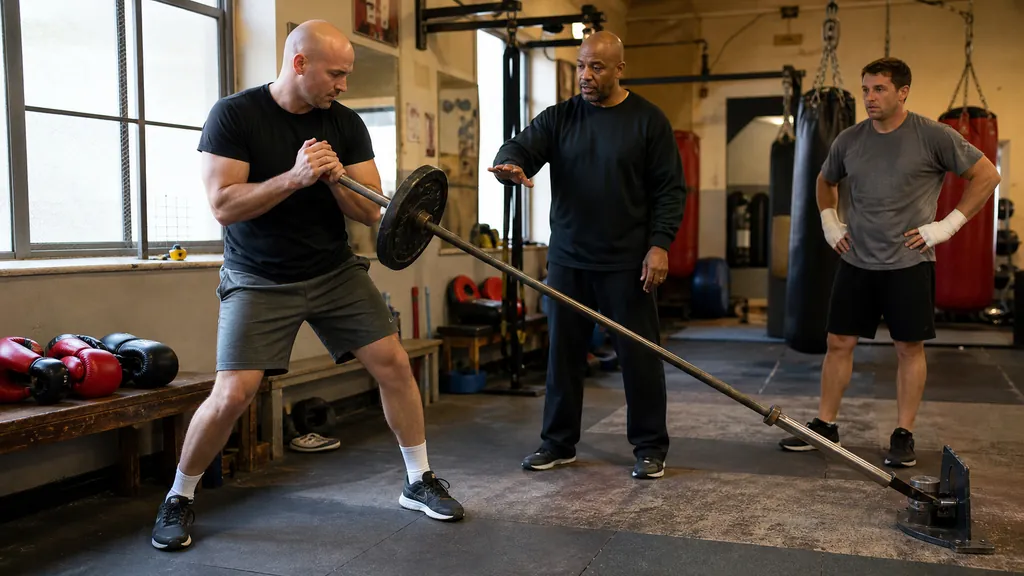
The main technical error is reaching too far away from the body. When the hands travel beyond a comfortable line, the lower back often bends sideways to find the last few inches. The bar may move farther, but the repetition has stopped being about controlled rotation.
Keep the elbows soft and the bar end close enough that you can guide it. Think about steering a heavy shopping trolley around a corner, not throwing a punch at full extension. The hands have a job, but the torso and stance decide whether the movement stays organised.
The return through the middle deserves the same attention as the end position. Do not let the bar crash back, then yank it across the other way. Bring it through smoothly, feel both feet, and move with the same pace to the other side.
If you feel sharp pain in the back, shoulder or ribs, stop rather than trying to correct it under load. A strength drill is not a test of whether you can ignore an uncomfortable position.
A simple three-round progression
Keep the load light enough that every repetition looks the same. This is a technical conditioning block, not a maximum-strength test.
Round one: find the path
Use an empty bar or a very light setup. Stand still, move the bar to one side, return through the middle, then move to the other side. Pause briefly at each end.
The coach should look for quiet feet, relaxed shoulders and a tall spine. If the bar makes the body lean, reduce the range before increasing the load.
Round two: control the centre
Keep the same slow rhythm, but add a deliberate one-second pause as the bar passes through the middle. This prevents the exercise becoming a pendulum swing.
The pause also gives you a useful check. Can you feel both feet? Are the ribs still over the hips? Is the head still level? If not, make the range smaller and start again.
Round three: add a modest hip turn
Only after the first two rounds are tidy, allow the hips to travel a little with the trunk. Do not spin on the toes or throw the rear foot behind you. The bar should move because the body is organised, not because you have turned the whole exercise into a fast twist.
Finish the round while the shape is still good. A few calm repetitions are more useful than chasing fatigue until the lower back is doing all the work.
Errors that make the drill less useful
The first error is loading the bar before you own the movement. A light bar tells the truth. If the feet move or the shoulders shrug with no load, adding plates will not fix it.
The second is forcing a huge range. More range is not automatically better. Stop where you can keep the spine long and the shoulders connected.
The third is pretending it is a punch. A boxing punch has a target, distance, timing and an opponent who can answer. The landmine has none of those. Use it to build strength and awareness, then practise actual punching in its proper setting.
The fourth is treating the exercise as a replacement for basic trunk work. Rotation matters in boxing, but so does being able to resist unwanted movement. Good programmes include a range of work, not one fashionable exercise repeated until it loses its purpose.
For a related strength drill that uses a different pattern, see our guide to the landmine punch catch-and-throw. Keep the same standard with both: use the load to expose the movement, not to hide it.
Where it fits in boxing training
Landmine rotations work best as a short, coached strength block after a warm-up or alongside other conditioning. They are useful for boxers who can already hold a stable stance and follow simple strength instructions.
They are not a first-session priority. A beginner will gain more from learning stance, guard, straight punches and basic footwork under a coach. The barbell can wait until the body has a clearer idea of what a balanced position feels like.
If you are in Greenwich, Kidbrooke or nearby, our Recreational Adults boxing classes teach the skills that strength work is supposed to support: balance, foot position, guard, punch mechanics and calm decision-making.
H&G Team
Writer at Honour & Glory Boxing Club, a community boxing gym in Kidbrooke, South East London.
KEEP READING

Should You Lift Before or After Boxing?
Train boxing or lift weights first? Use this practical guide to protect your technique, manage fatigue and make both sessions useful.

Does Boxing Build Muscle? What to Expect
Will boxing training build muscle? Yes, but probably not the kind you are imagining. Here is what actually happens to your body when you train boxing regularly.

Boxing and Abs: How Boxing Builds a Six Pack
Boxing works your abs harder than most gym routines. Here is exactly how it happens, which muscles are involved, and why crunches are the wrong approach.
Was this page helpful?
It takes one tap, and it genuinely helps.
Choose your next step
Turn this article into the right action
Some readers are ready to book. Some need the class route first. Pick the route that matches what you actually want.