The H&G All-Time Index v2.0.0, explained simply
A plain-language companion to the full methods paper. Same ideas, fewer technical terms.
The big idea
We rank the best 1000 men's professional boxers of all time and give each one a score out of 100. The new version, 2.0.0, fixes one important thing about how the maths works: now, if you build the whole ranking again from scratch, you get exactly the same answer down to the last digit. That sounds small. It is actually the whole point.
Think of it like a recipe. The old version made a great cake, but if two people followed the recipe they could end up with slightly different cakes, so we had to photograph one cake and always show that photo. The new recipe is written so carefully that everyone who follows it gets the identical cake. Now we can show the real thing, and anyone can check our work by baking it themselves.
How we proved it
We built the ranking twice, separately, on the same recipe, and compared them.
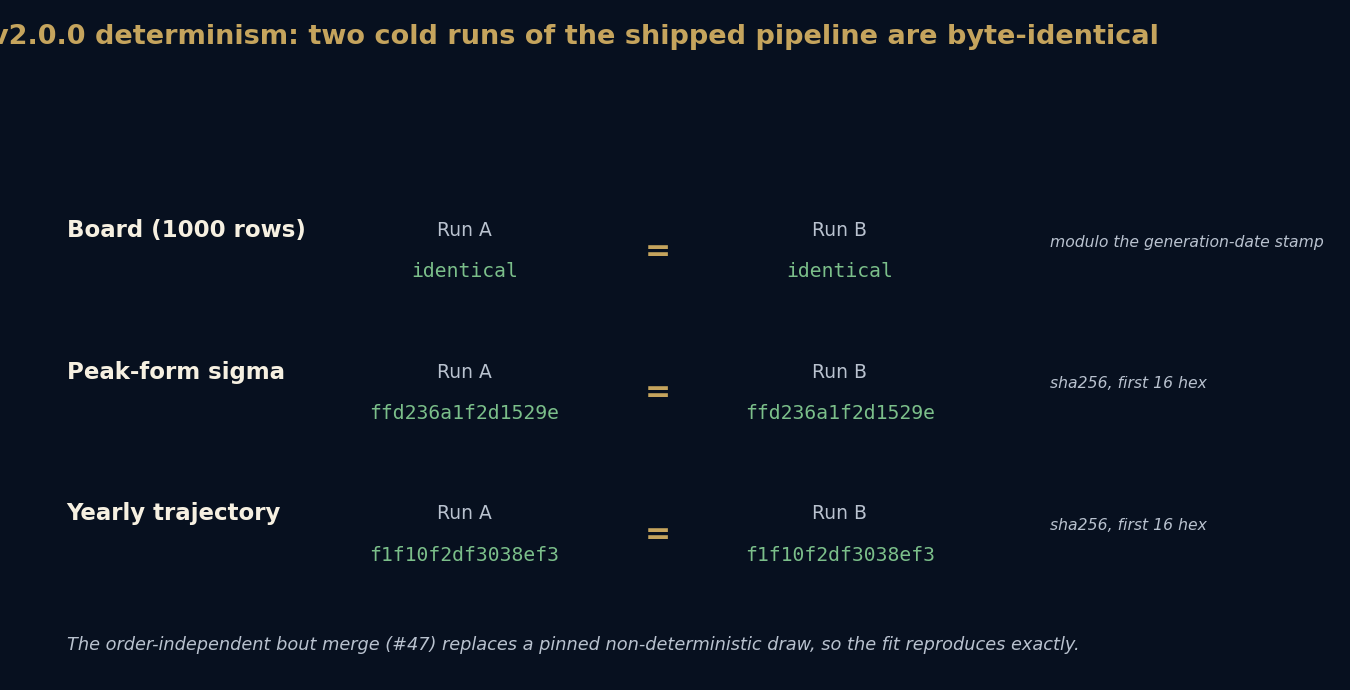
The rankings matched. The supporting files matched right down to their digital fingerprints. When two careful, separate builds agree to the last byte, the ranking stops being just an opinion and becomes something you can test.
What we are and are not claiming
We are claiming this: you can rebuild the ranking and the ranking pages and get the same thing, as long as you use a normal Python set-up. We are not claiming the whole website rebuilds itself by magic, and we are not claiming everything is sealed in a box. The claim is the ranking and its pages. Saying exactly where the claim stops is part of keeping it true.
We did not just say "trust us"
Before publishing, we attacked our own work on purpose, in rounds.
One round checked that the fight data had not changed without us noticing. One round hunted for cases where the same boxer got split into two people by a spelling difference, or two boxers got mixed into one because they shared a name. One round checked that an old-time "world champion" label was not being counted as a modern undisputed title unless the records back it up. One round asked whether each fighter really belongs in the top 1000 at all.
Every time we found and fixed a problem, we left a tripwire behind so the same problem cannot creep back in quietly. The ranking you see is the one that survived all that, which is a stronger thing to say than "we think it is right."
A fair word about old eras
Some great fighters lived when records were thinner, and some lived during the colour line, when Black fighters were often not allowed to face white champions. We handle this carefully. We do not pretend the barrier was not there, and we do not treat a fight that was never allowed to happen as if it tells us who would have won. We state what the records show and we stop there. We never accuse anyone of dodging a fight, because an empty space in the record book cannot prove why it is empty.
Where the "expert opinion" comes from
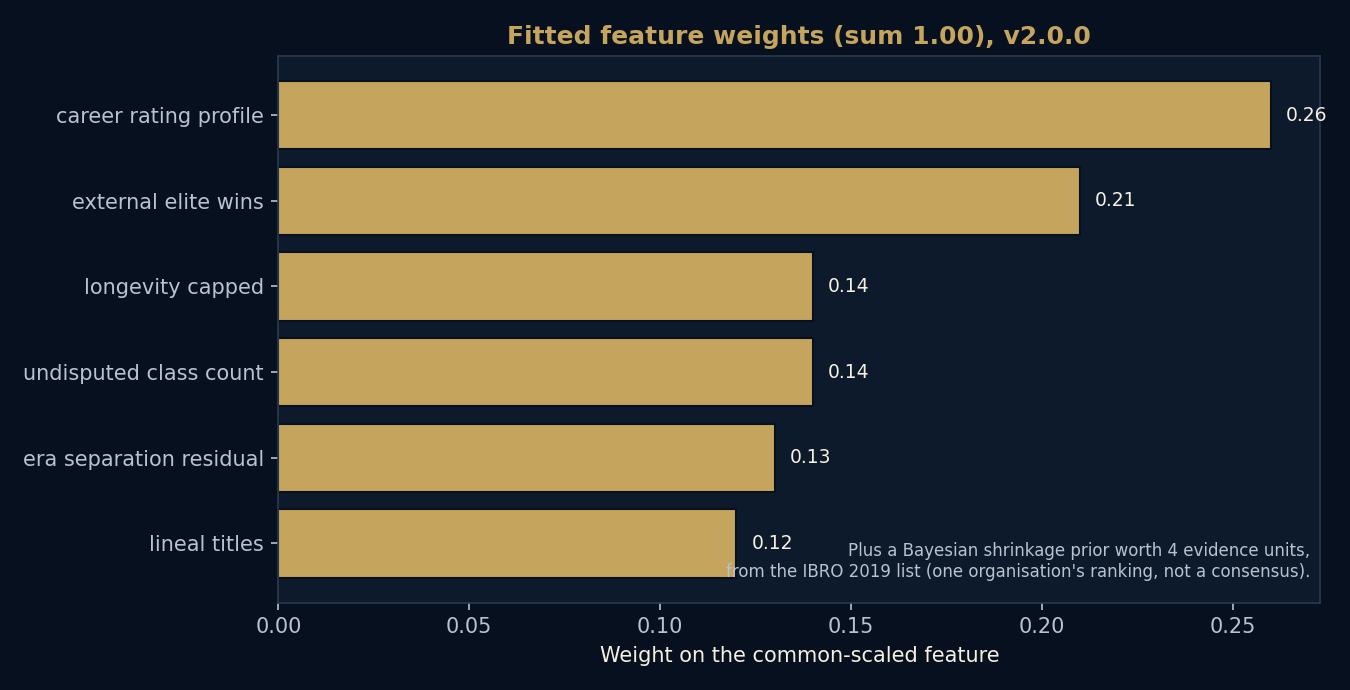
The model leans a little on a respected list: the International Boxing Research Organisation's 2019 all-time pound-for-pound ranking. We are honest that this is one group's list, not a giant average of every expert. It only nudges the scores gently, about as much as four fights' worth of evidence, and much less than that once a fighter has a real career of recorded bouts to judge.
Why the top peak is not number one
There are two different scores, and they answer different questions. One is the 0 to 100 all-time ranking. The other is the "peak-form" rating, which is how high a fighter climbed at their very best.
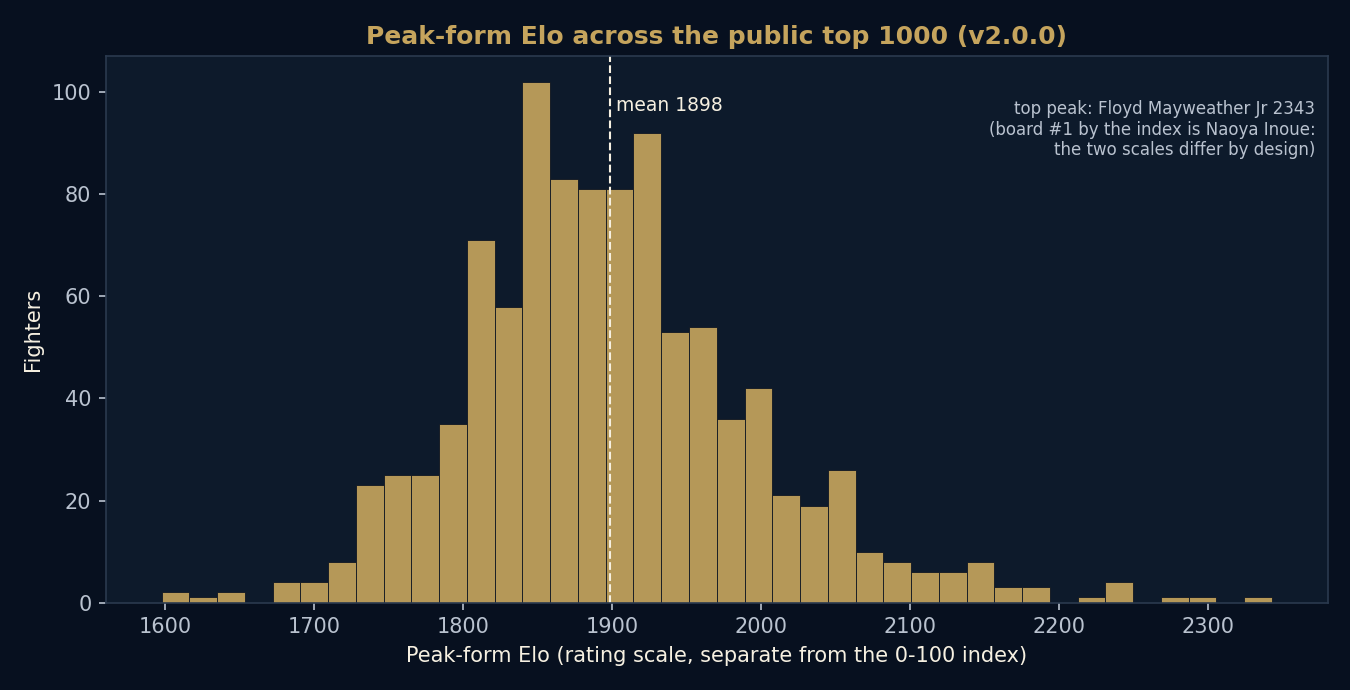
Floyd Mayweather has the highest peak. Naoya Inoue is number one on the all-time list. Both are true, because climbing the highest and ranking first all-time are not the same question. We tell you this on purpose, so the difference does not look like a mistake.
How sure are we about each fighter?
For every fighter we work out how complete their fight record is: out of all the bouts we know they had, how many do we actually have the details for? A fully recorded career scores 1.0; thinner records score lower.
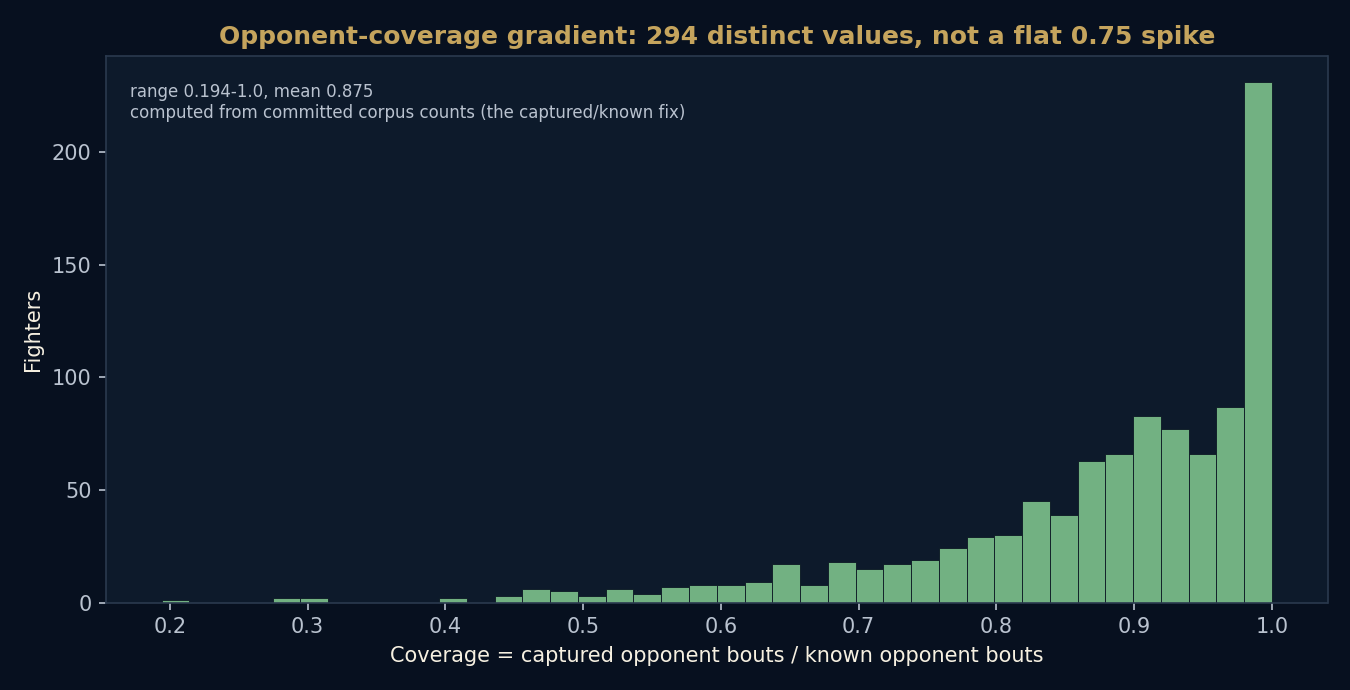
An earlier draft of our own paper got this wrong and showed nearly everyone at the same value, around 0.75. That was a bug, not a truth about boxing. Once fixed, the real picture is a proper spread: 294 different values from about 0.19 up to 1.0. That spread is why we are more careful about some early-era fighters, and why each profile shows a confidence label next to the rank.
How fighters from different eras get compared at all
You might wonder how a ranking can compare a fighter from the 1920s with one from the 2020s when they could never meet. The answer is that the fight records themselves join up. Fighter A beat fighter B, who beat fighter C, and those chains run on and on through the decades. The picture below shows that web for the ranked fighters.
The whole archive at once
Before any rating is worked out, the engine reads the full fight archive: 921,982 fights between 213,243 boxers, from 1880 to 2026. This picture is the whole graph at once: every boxer is a point, and every thread joins two boxers who really fought.
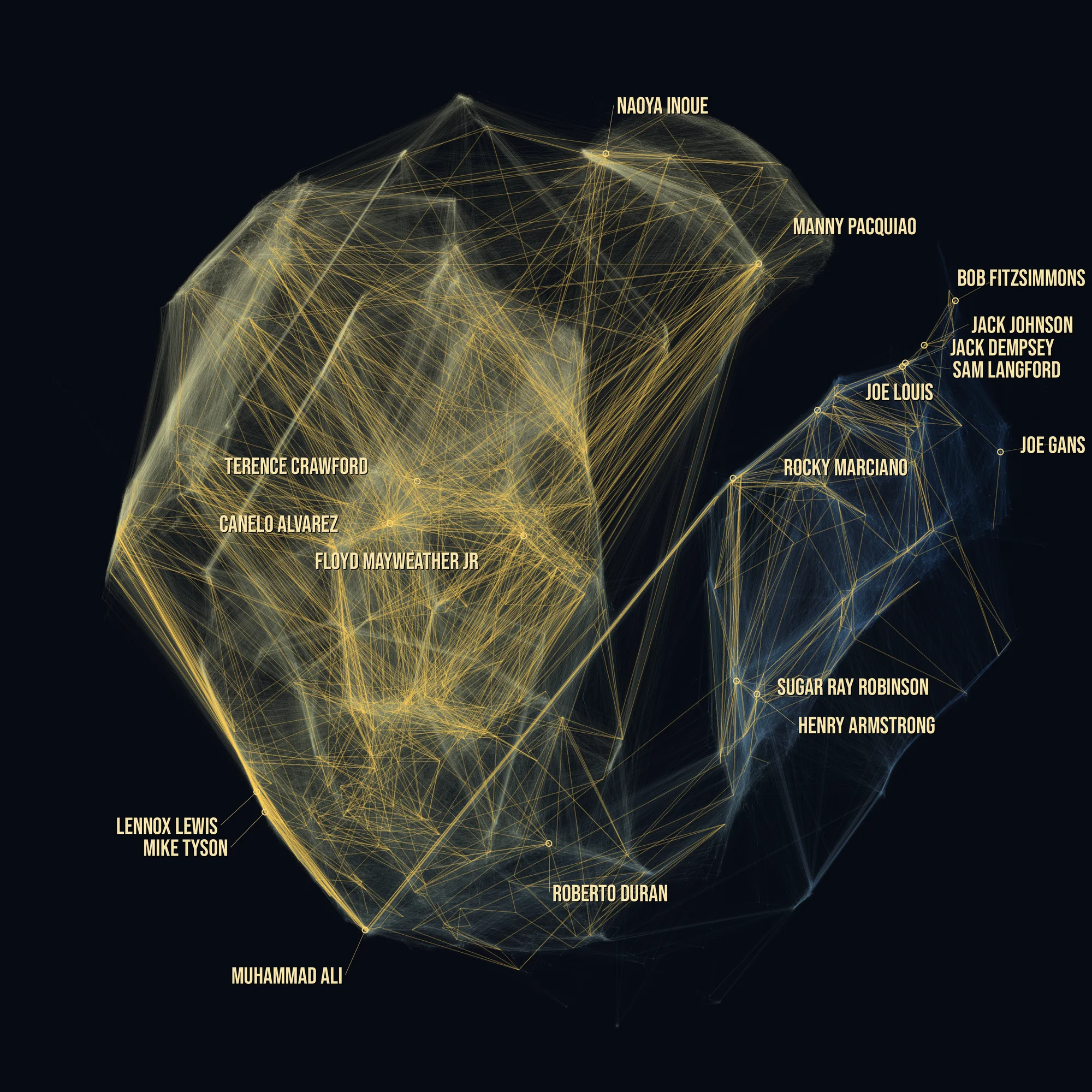
The layout pulls connected fighters together, so the shape you see is the structure of boxing itself. Colour is era: steel blue for the early decades, warm cream for the modern game. The gold running through everything is the 2,738 pairings between the 1,000 ranked fighters: the signal the rating pulls out of the mass, woven through the whole web. One fact the data surfaced on its own: Canelo Alvarez is the most connected fighter in the web, with 58 fights against other ranked names.
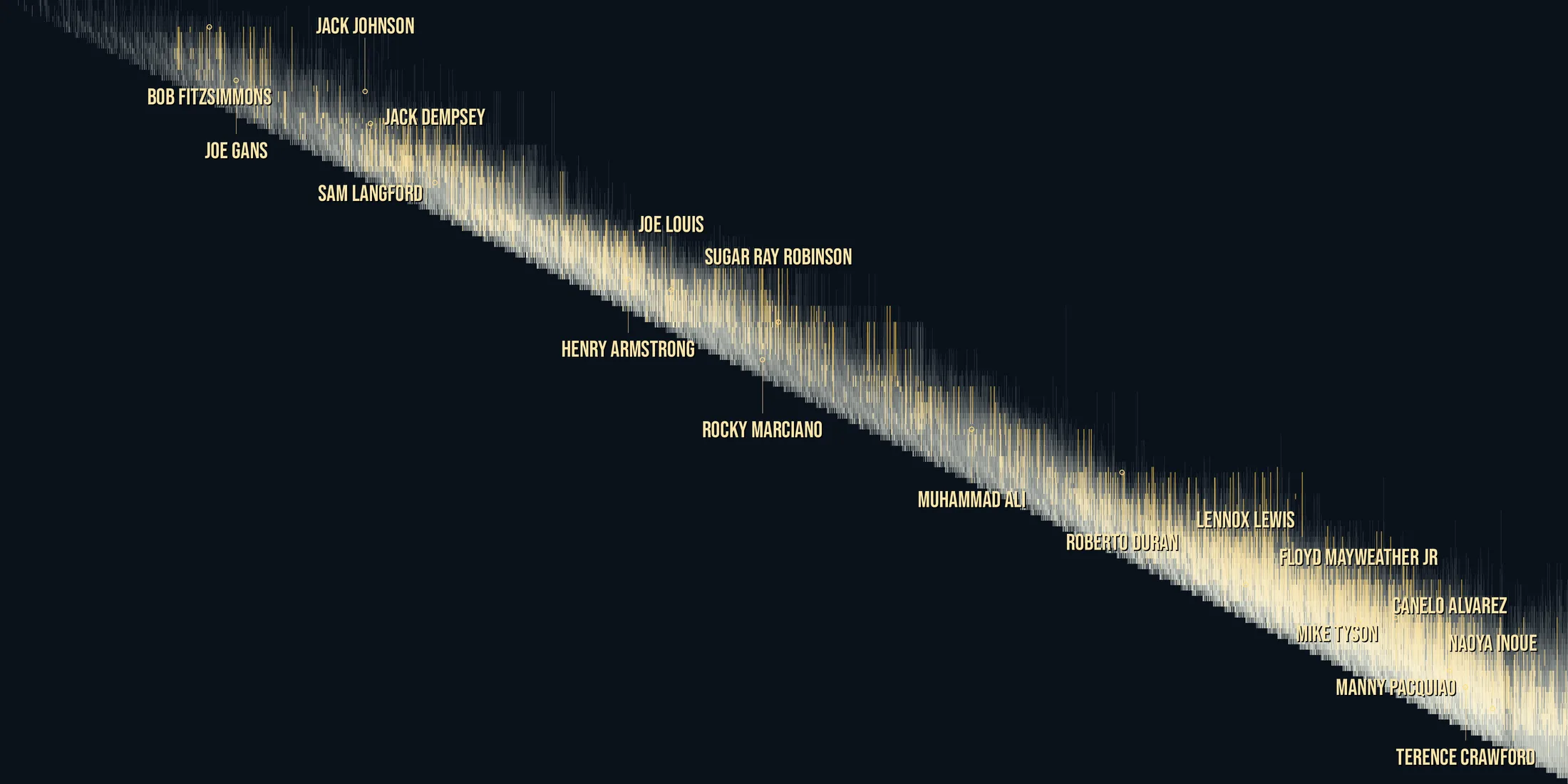
The same archive unrolled in time. Each fight is a thread at its year, joining the two careers that met that night: the bright band is each generation fighting itself, and the streaks above it are veterans crossing eras to meet the next wave. Gold is the ranked fighters again.
One web of real fights
We started from 1.36 million recorded bout rows. Between the 1,000 ranked fighters there are 4,157 real fights across 2,738 different match-ups. 974 of the ranked fighters faced at least one other ranked fighter, and 99 in every 100 of them connect into one web that stretches from 1896 to 2026. Every line below is a real fight.
This web is how the rating compares eras. A fighter from 1896 never met a fighter from 2026, but chains of real results join them, step by step, opponent by opponent.
Drawing the fight web, one moment.
Time runs left to right, from 1896 to 2026. Lighter weights sit near the top, heavier weights near the bottom. Bigger dots are higher scores. Drag to move around, pinch or scroll to zoom, and tap a dot to open that fighter's page.
The things we are upfront about
Three honest costs, said out loud and not buried.
One, the new identical-rebuild recipe costs us a tiny bit of fine-tuning, about 0.7 per cent on one internal measure. We chose reproducibility and paid that small price on purpose.
Two, the weight classes shown are correct, but for now they come from a fixed list of corrections rather than being worked out from scratch. The from-scratch version is a job for later, and we are not pretending it is done.
Three, we fixed two places where the data was matched up by name instead of by a fighter's unique ID. The unique ID is the right way, and the fix did not change anyone's rank.
So, should you trust it?
Yes, with your eyes open. The top of the list is solid. Close calls among old, thinly recorded fighters should be read with the confidence label in mind. The expert list is one list and only nudges things. The weight classes are right on the page but not yet computed from first principles. None of that means the ranking is shaky. It means we are telling you the exact conditions under which it means what it says.
You can read the full methods paper, and download a formal version, if you want all the detail.