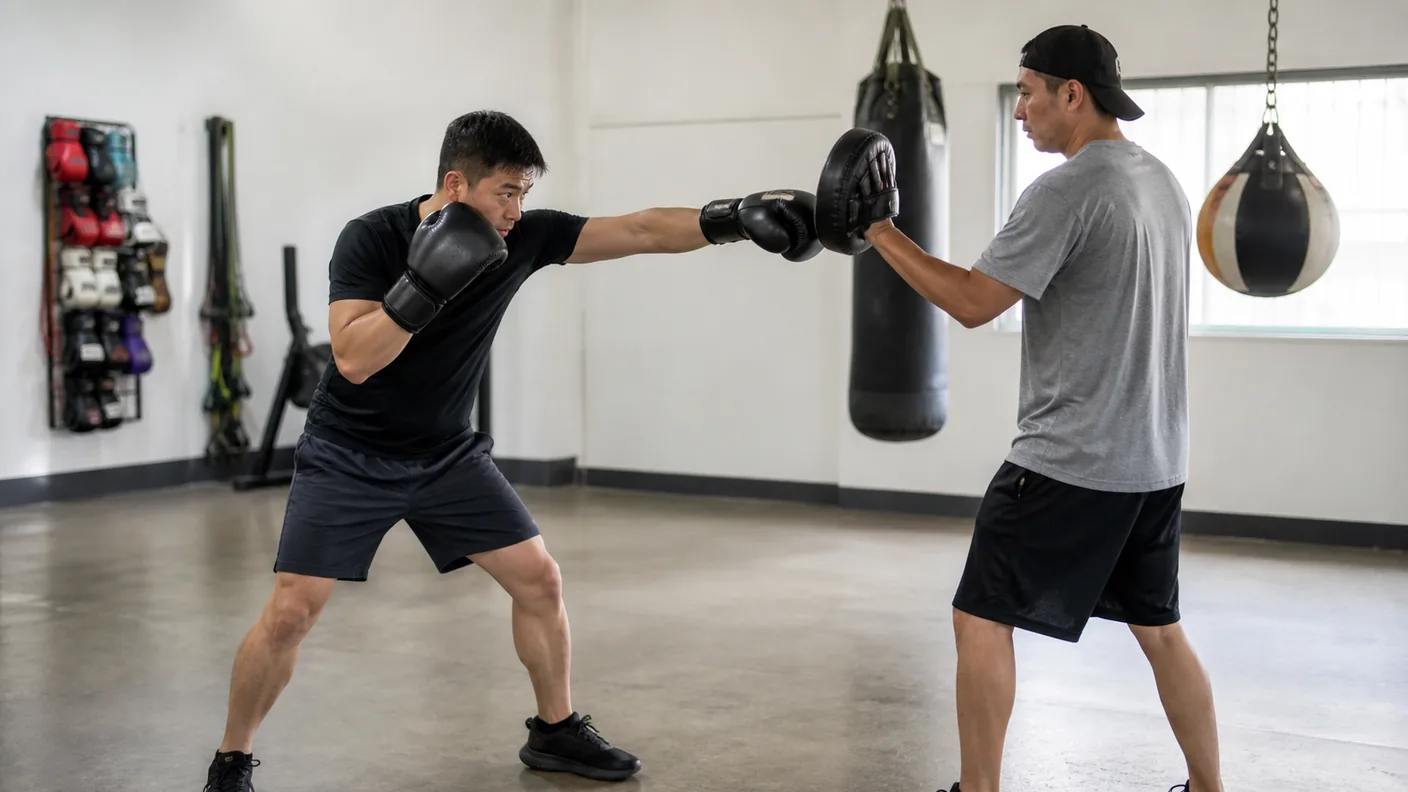
A duck is not an attempt to disappear below every punch.
Beginners often make it far too large. They jab, drop their eyes, fold at the waist and end up staring at the floor with both gloves drifting away from the face. The movement may feel like defence because the head has travelled a long way, but it has usually taken the boxer out of a useful stance.
The jab-duck drill teaches a better version. Throw a light jab, bend through the knees just enough to change level, keep your eyes on the person in front of you, then come back to a guard you can use. It is a small habit with a practical purpose: finish the jab ready to defend, reset or work at body level without collapsing.
Watch the short demonstration, then use the coaching notes to build the drill at a sensible pace.
The duck comes from the legs
A useful duck starts with the knees and hips. The back stays long, the chest stays calm, and the eyes remain forward. You are lowering your level, not bowing towards the canvas.
That distinction matters because your hands need the same base as your head. If the upper body folds forward, the rear glove often drifts away, the lead shoulder loses its cover and the feet become harder to move. A small knee bend leaves you able to rise, jab, cover or take a short step. A deep bow makes the next action slow.
This is the same principle behind any sound boxing movement. A review of boxing biomechanics describes punching as a linked action involving the legs, trunk and upper body. In gym language, the arms cannot rescue a stance that has already fallen apart.
Start without a punch. Take your normal stance, soften both knees by a small amount, then return to your usual height. Keep both gloves near the cheeks and look straight ahead. If you feel a pull in the lower back or find yourself looking down, the movement is too large.
Why add the jab first
The jab makes the drill more honest.
A stationary duck is easy to rehearse because nothing has disturbed your balance. The jab adds a moving hand, a lead shoulder and a reason to recover your guard. It asks whether you can finish a simple attack without becoming tall and open in the same lane.
The jab does not have to be hard. On a bag, touch it with enough shape that the shoulder can protect the chin and the glove returns cleanly. On pads, ask the coach to hold one mitt at a distance where you do not need to reach. Throw the jab, bring it home, then make the small level change.
The order is important. Jab first, then duck. If you bend before the jab starts, you show the level change early and make the lead hand harder to use. Let the jab finish its line, recover the glove, then lower through the legs as if a return straight punch is passing over a safe, controlled head line.
Our guide to throwing a jab in boxing covers the punch itself. This drill adds one small rule after it: the jab should not leave you upright and waiting for an easy reply.
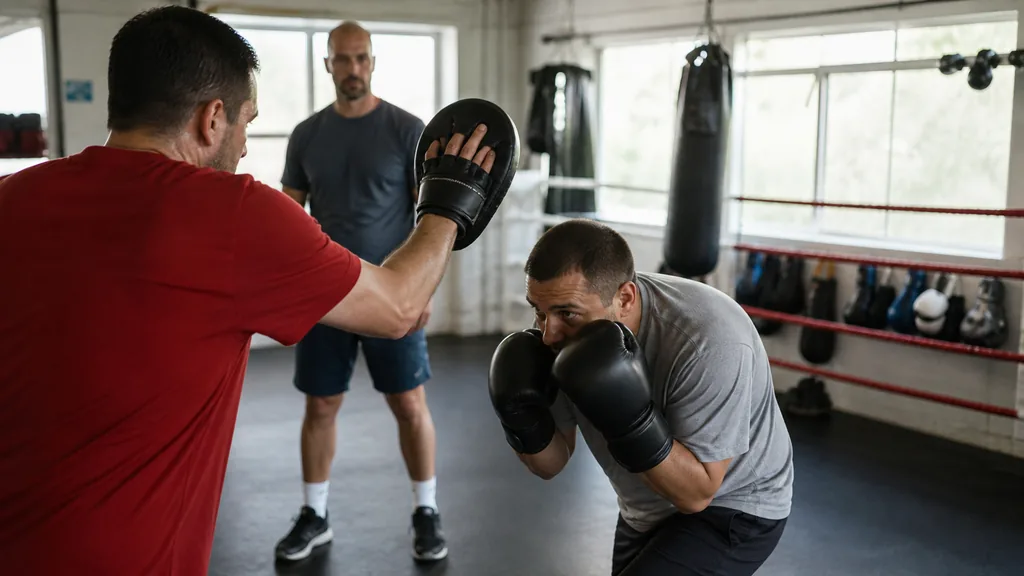
Keep your eyes on the coach, not the floor
Looking down is one of the clearest signs that the duck has turned into a fold.
Your eyes need to stay on the coach, partner or target because that is where the next decision comes from. If you stare at the ground, you cannot see whether the other boxer has stepped back, changed level, covered up or offered a safe pad target. You are moving without information.
Keep the chin slightly tucked, but do not bury it into the chest. The eyes should be looking through the eyebrows, not at your own shoes. A coach can help here by holding a mitt or a soft visual cue at a safe height. If you can still see it at the bottom of the movement, the duck is probably small enough.
That is also why this drill is not a reason to let someone swing freely at a beginner. Start with a pre-agreed mitt position or a slow visual cue. The England Boxing coaching handbook stresses controlled skill development and sound positions. The useful version is repeatable technical practice, not a contest to see who can duck fastest.
The three-step jab-duck drill
Use this on the bag, pads or in a slow partner drill. Keep the first rounds quiet. The point is to make the shape reliable before you try to make it quick.
Step one: jab, return, duck
Stand at an honest jab range. Throw one relaxed jab, return the lead glove towards the cheek, then make a small knee bend. Freeze for one second before rising back to stance.
At the freeze, check four things:
- Your rear glove is still near the cheek.
- Your eyes are forward.
- Your feet are still staggered and under the body.
- Your head has lowered without travelling far beyond the front knee.
If the feet have narrowed or the shoulders have tipped forward, take power out of the jab and reduce the dip. A smaller, repeatable movement is far more useful than a dramatic one.
Step two: jab, duck, choose the height
Now put a high mitt and a body-level mitt in front of you. Jab the high mitt, duck slightly under the imagined return, then let the coach show one target. If the high mitt appears, rise into a calm jab. If the body mitt appears, stay only low enough to touch it with a light punch, then return to guard.
Do not decide the second shot before you move. The value of the drill is noticing whether you are in a position to choose. If the body-level target feels too far away, step or reset. Do not lean into it just because the drill says a body shot might be available.
This connects with our guide to body punching with aim, angle and exit. Body work begins with a controlled level change and an honest range, not a dive at the target.
Step three: jab, duck, reset or leave
The final step is the most important. After the duck, make one clear decision: return to the original stance, take a small step out, or touch one pad at the correct height before covering up.
Do not follow the duck with a long, automatic combination. A duck is a defensive and positional beat. Sometimes it lets you continue. Sometimes it tells you the safest option is to regain range. The boxer who can make that distinction will learn faster than the boxer who fires because they feel they should.
Four mistakes that make the drill worse
The first mistake is folding at the waist. If the top of your head points towards the bag and the eyes leave the target, you are no longer practising a compact duck. Bend through the knees and keep the back long.
The second is dropping both hands. The lead glove has to return after the jab and the rear glove stays close while you change level. A duck that exposes the head has solved nothing.
The third is dipping too early. If you lower before the jab, the other boxer sees the change and the punch becomes a reach from a poor height. Finish the jab, bring the hand home, then duck.
The fourth is staying low after the movement. The duck is not a resting place. Rise into guard, step away or take the one target the position genuinely offers. Our article on what to do after you punch in boxing is a useful companion because the recovery after the jab is part of the technique.
Where this drill fits in a session
Use the jab-duck drill after a warm-up, before hard bag work or controlled partner rounds. It works particularly well for adults learning to stop standing tall after their jab. Two or three rounds of one minute are enough when each repetition is measured.
On a heavy bag, imagine a light return over the jab rather than actually trying to duck beneath the bag as it swings. On pads, the coach can make the shape clearer with a still mitt and a slow cue. With a partner, agree the timing and keep it non-contact until both people can stay balanced and see the next decision.
If you train in Kidbrooke, Greenwich or nearby, our Recreational Adults boxing classes use this kind of controlled progression to connect punching, defence and footwork without rushing anyone into hard sparring.
The cue is simple: jab, eyes up, knees soft, gloves home.
H&G Team
Writer at Honour & Glory Boxing Club, a community boxing gym in Kidbrooke, South East London.
KEEP READING
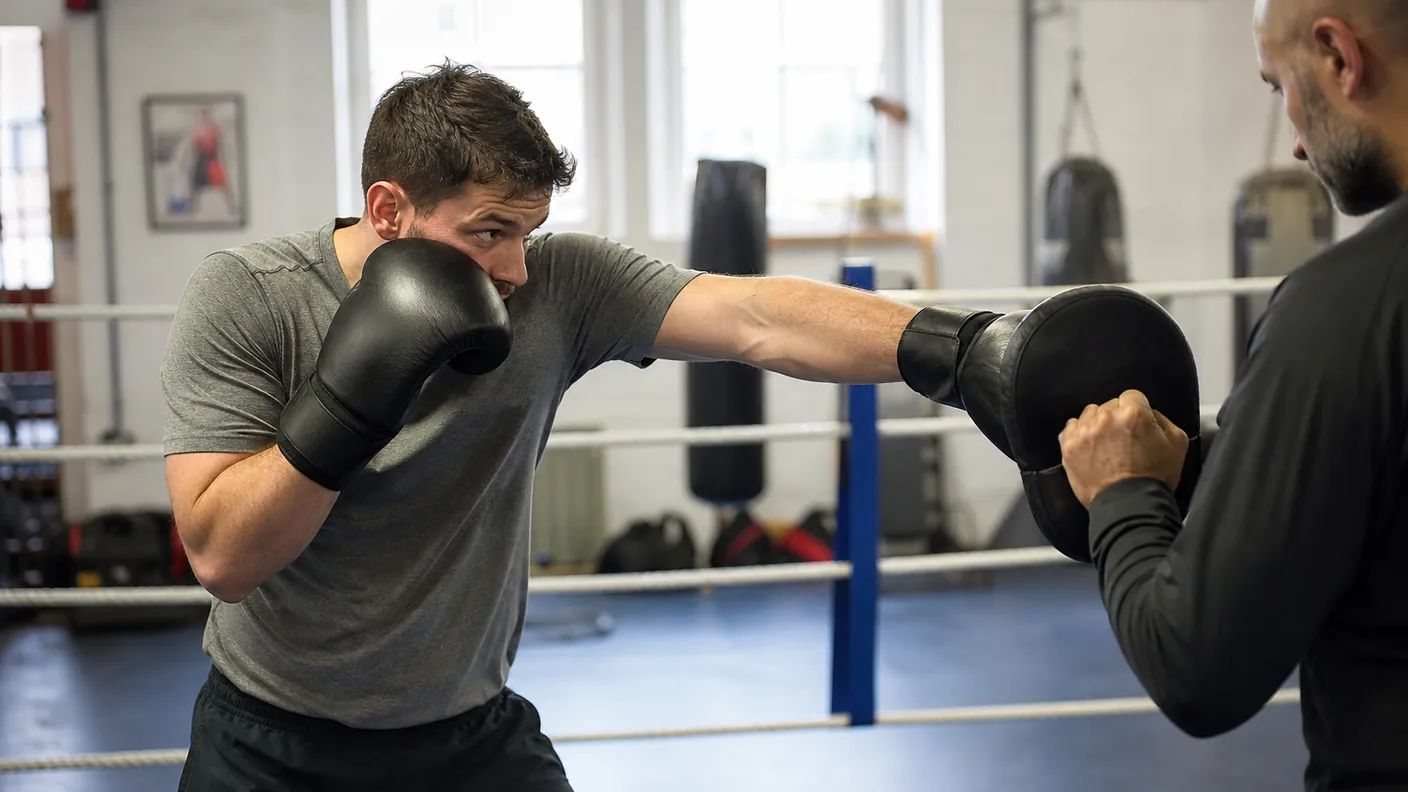
The Body Jab: A Safe Boxing Setup
Use a compact body jab to change the target, check range and set up the next decision without falling over your front foot.
How to Use an Up Jab in Boxing
Use a compact up jab to change the line, test a high guard and keep your stance ready for the next decision.
Hook-Duck Boxing Drill: Finish Without Standing Still
Use a compact hook and small duck to finish a technical combination with your eyes up, guard organised and feet ready to move.
Was this page helpful?
It takes one tap, and it genuinely helps.
Choose your next step
Turn this article into the right action
Some readers are ready to book. Some need the class route first. Pick the route that matches what you actually want.