Chessboxing Strategy: Clock Control Under Fatigue
Chessboxing punishes the player who treats the chess round as a quick break between boxing rounds.
The board is still a real game, and one rushed move can do more damage than a hard exchange. Do not chase calm or pretend the switch is easy. Use a routine for the switch and awkward positions.
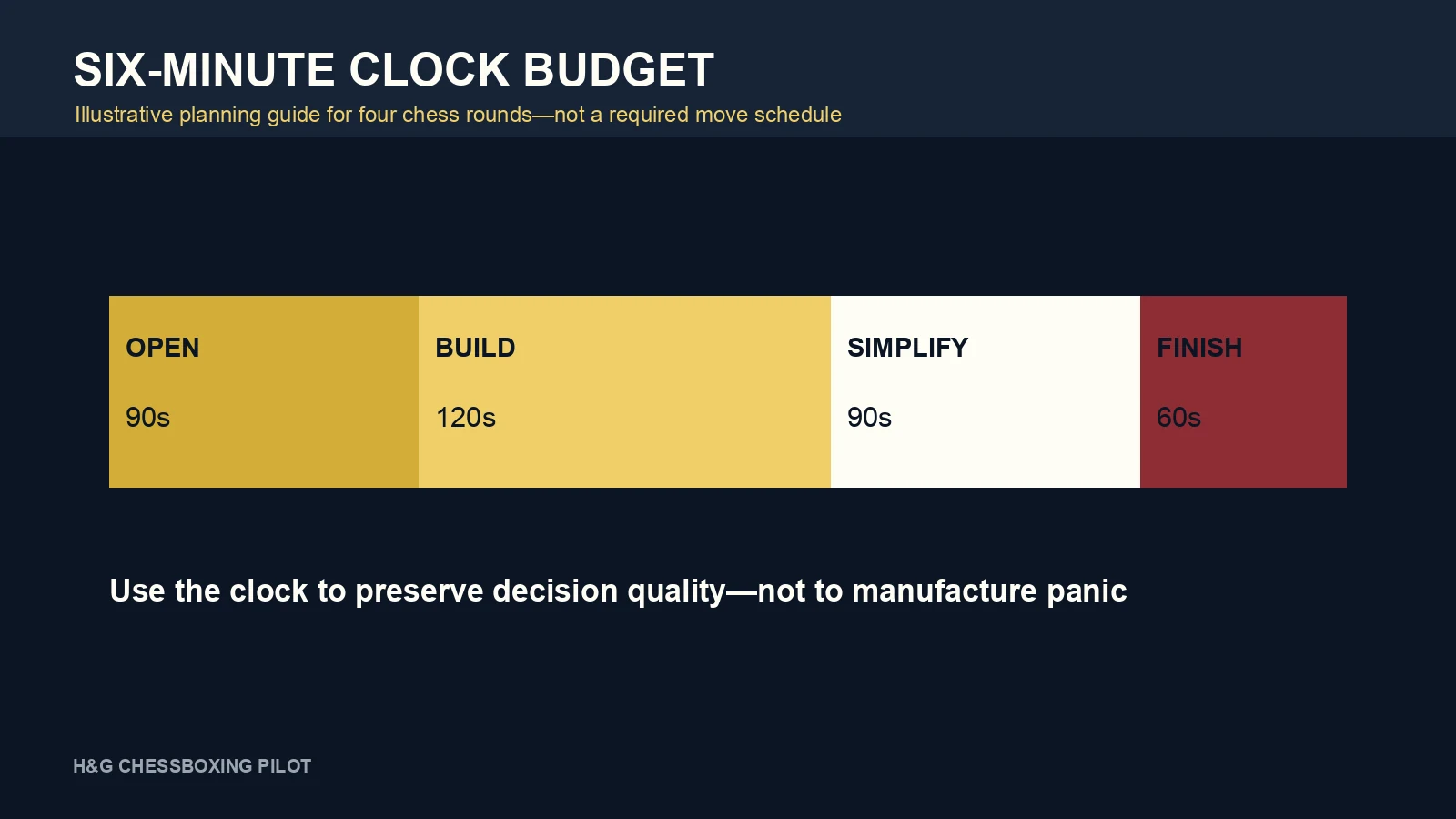
For H&G's full format, each player has six minutes total across four chess windows. That makes clock control part of the strategy from move one. You need a position you recognise, a short scan you can repeat and enough discipline in the boxing round to return ready to make a legal, useful decision.
Treat six minutes as one clock, not four little games
The first chess window is where players often waste the game. A familiar opening makes them hunt for the exact best move until two minutes disappear. After boxing, the final window becomes a race against the clock.
Use the opening to get organised, not to prove that you know the most theory. Choose a line you have played enough to understand its normal piece squares, pawn breaks and king safety. Spend time if the opponent gives you a genuinely new position; otherwise make the sound move and keep clock for the rounds that will ask more of you.
A simple check after every chess window helps:
- How much time remains?
- Did I spend it on a decision that changed the position, or on a move I already understood?
- If the next window began with a problem, could I identify and answer it?
There is no fixed split of six minutes. A sharp middlegame may deserve more time than an easy opening. Notice when you are spending a final-window budget in the first window.
The official FIDE Laws of Chess are worth reading for the basic clock and legal-move rules. For H&G's format, use the separate Chessboxing rating guide for placement context rather than trying to solve rating questions during a game.
Choose positions you can read twice
Chessboxing is not the right moment to test an opening you watched once on a video at midnight.
A sharp gambit can be good chess. It is a poor choice if you only know the first six moves and cannot explain what happens when the opponent declines it, trades queens or attacks your king. The switch back to the board makes vague memory expensive.
Favour positions with a clear job. That might mean developing the remaining piece, protecting the king, challenging an open file or making a sensible exchange. It does not mean avoiding all tactics. It means knowing what your pieces are trying to do before the clock asks for a decision.
Useful position choices usually have four features:
- Your king is not waiting for one obvious attack.
- Your pieces have natural squares rather than one narrow sequence of moves.
- You know the pawn break or exchange that changes the position.
- You can name a reasonable move if calculation is not clear.
That last point matters. A reasonable move is not random: it improves a piece, protects something important or reduces an immediate problem without creating another one. Practise that habit in ordinary rapid games first. Chess.com Help explains base time and increment, so set a time control you understand before using it for switch practice.
Use the same board scan after every boxing round
Do not sit down and move because it feels decisive. Sit, find the clock, then run this scan in the same order every time.
1. Check the king and the clock
Are you in check? Is your opponent in check? Whose clock is running, and how much time remains? This first look stops a surprising number of unnecessary errors.
2. Rebuild the threat
What did the opponent's last move change? Look for the direct threat before looking for your own clever idea. A hanging piece, an attacked queen or an open line to the king is more urgent than a plan you had before the boxing round.
3. Find two candidate moves
Name two moves, not six. One can be active and one can be solid. Compare them against the threat, your king and the clock. If one move fails the basic test, discard it rather than calculating fantasy variations.
4. Keep playing until the chess window ends
Keep playing legal chess until the chess window ends, then follow the supervised transition.
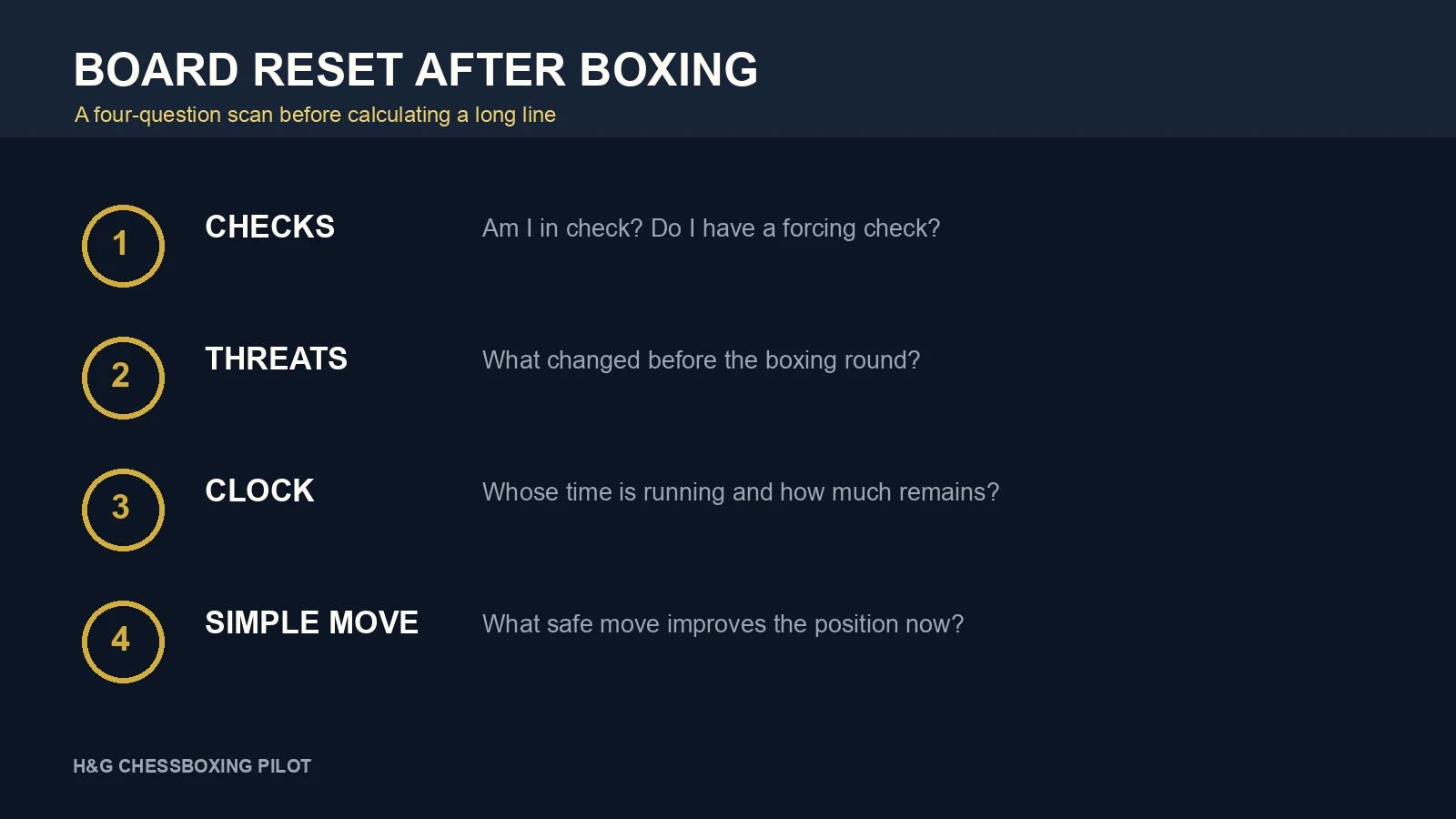
This scan is deliberately short. It is not an attempt to replace chess calculation. It gives you a reliable first scan so that the transition does not turn every position into an emergency.
Let the boxing pace serve the whole game
The boxing round is not a tax you pay before chess. It is part of the session, so box with a purpose rather than trying to empty yourself in every exchange.
In technical work, use the job set by the coach: hold your guard after the jab, finish in balance, make a clean exit, or keep a measured pace on the bag. A player who chases every punch often gives away their shape, their attention and the next few seconds of the transition. A player who works with control can still be busy without turning the round into a scramble.
That does not mean playing timidly. It means choosing a pace you can repeat. Straight punches, simple combinations and clean feet are more useful here than wild bursts that leave you standing square and guessing when the board returns.
H&G is gathering interest for an adult Chessboxing class in Kidbrooke. There is no confirmed date or price. The weekly format uses controlled technical boxing or non-contact tasks, so the switch can be practised without pretending that every round needs hard contact. Follow the coach's instructions throughout the session.
For the separate explanation of what is and is not scored, read the Chessboxing scoring guide. Keep this article for the decisions you make at the board and in the transition.
Common mistakes that burn time
| Mistake | What it costs | Better response |
|---|---|---|
| Searching for the perfect opening move | A large share of the six-minute clock before the game has changed | Play a familiar developing move and save thought for the first real decision |
| Moving before checking the opponent's threat | Loose pieces, missed checks and avoidable damage | Run king, threat and clock before choosing a candidate move |
| Making every boxing round a sprint | A messy transition and a weaker return to the board | Use the assigned technical job and keep the pace repeatable |
| Trading pieces just because the clock is low | A simplified ending you do not understand | Trade only when it removes a real threat or keeps a position you can play |
| Training only fast chess | A habit of moving before you have seen the board | Mix rapid games, short clock drills and deliberate transition practice |
Practice card: one continuing game, six transitions
Keep one game running. The working sequence is exactly 24 minutes: 12 minutes chess, 6 minutes transitions and 6 minutes boxing or non-contact work.
24-minute practice card
| Step | Time | Strategy cue |
|---|---|---|
| Chess window 1 | 3 minutes | Play familiar development. |
| Transition 1 | 1 minute | Stand, breathe, reset. |
| Boxing or non-contact round 1 | 2 minutes | Jab, recover, balance. |
| Transition 2 | 1 minute | Walk back, find clock. |
| Chess window 2 | 3 minutes | Scan king, threat, clock. |
| Transition 3 | 1 minute | Release shoulders; shorten plan. |
| Boxing or non-contact round 2 | 2 minutes | Cross, exit, steady pace. |
| Transition 4 | 1 minute | Breathe out; find clock. |
| Chess window 3 | 3 minutes | See threat, make sound move. |
| Transition 5 | 1 minute | Reset feet; drop last move. |
| Boxing or non-contact round 3 | 2 minutes | Straight punches, finish balanced. |
| Transition 6 | 1 minute | Sit square; start scan. |
| Chess window 4 | 3 minutes | Choose legal, clear moves. |
After 24 minutes, note one board error and one transition error; choose one adjustment.
Run it weekly with ordinary rapid chess. The Chessboxing training guide covers the wider plan.
Make the switch boring on purpose
The best chessboxing transition is not dramatic. You sit down, find the clock, see the threat, choose a move and get on with the next job.
That takes practice. It also gives you a fairer test of both halves of the sport. You are not hoping the board looks simple after a boxing round. You are using a familiar position, a controlled pace and a repeatable scan to make the next decision properly.
If you are near Kidbrooke, build the boxing base first in Adult Recreational boxing classes, then register interest through the planned Chessboxing class.
H&G Team
Writer at Honour & Glory Boxing Club, a community boxing gym in Kidbrooke, South East London.
KEEP READING

Boxing IQ: What It Means
Boxing IQ separates good fighters from great ones. Learn what ring intelligence actually means and practical ways to develop smarter fighting instincts.

Should You Lift Before or After Boxing?
Train boxing or lift weights first? Use this practical guide to protect your technique, manage fatigue and make both sessions useful.

Boxing and Abs: How Boxing Builds a Six Pack
Boxing works your abs harder than most gym routines. Here is exactly how it happens, which muscles are involved, and why crunches are the wrong approach.
Was this page helpful?
It takes one tap, and it genuinely helps.
Choose your next step
Turn this article into the right action
Some readers are ready to book. Some need the class route first. Pick the route that matches what you actually want.