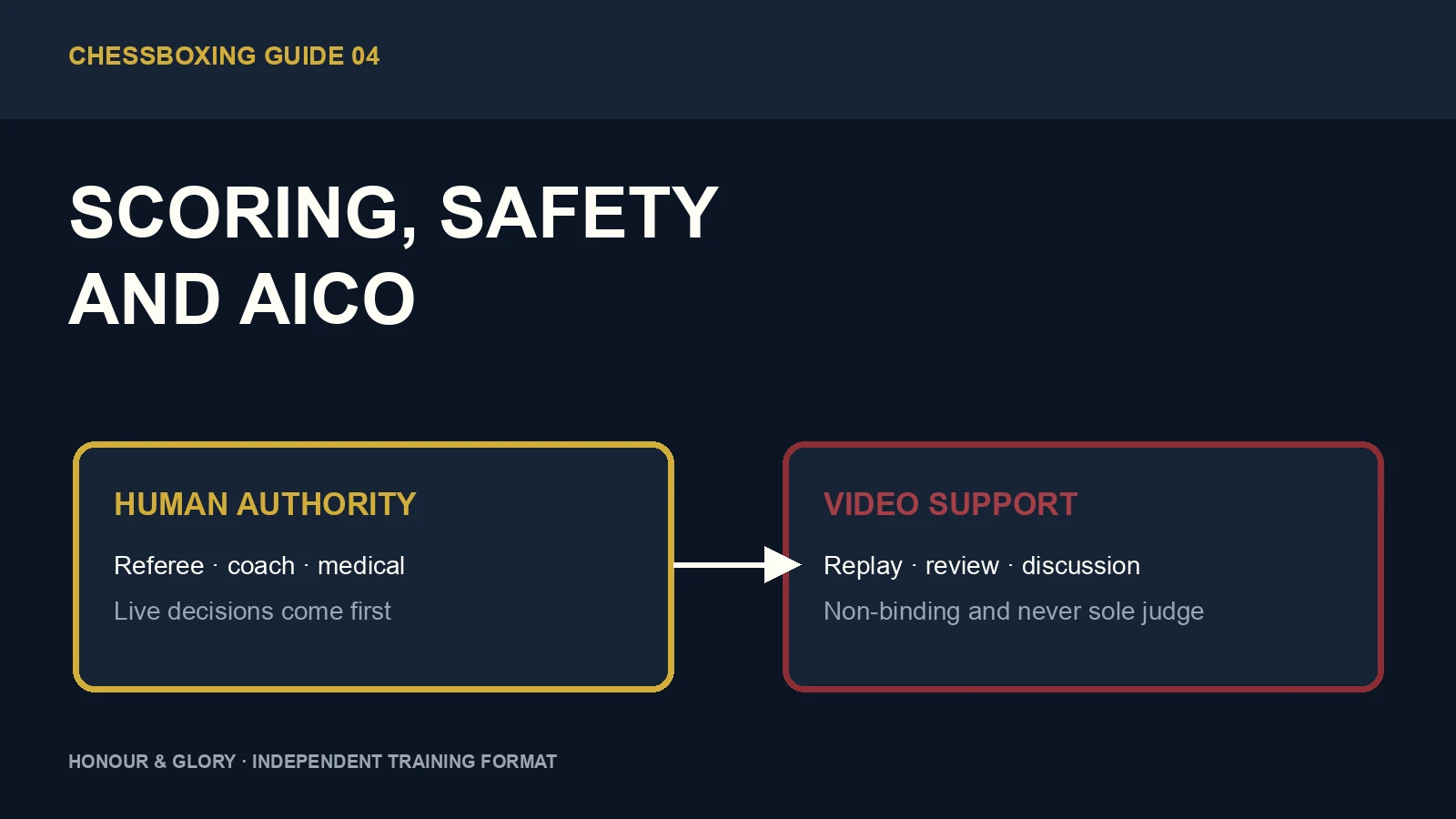
Formal chessboxing scoring can vary by organiser. That is the first thing to understand before anyone starts adding up punches after a chess game.
Some competitive events have a written route to a winner through the board, the clock or a boxing stoppage. The published format, round lengths and tie rules belong to that event. They are not universal rules that every club session has to copy.
The H&G weekly class format is simpler. One continuing game of chess runs through the class. Four three-minute chess windows provide exactly 12 board-minutes, matching two six-minute player clocks. The game finishes with a win or a draw under normal chess rules. The technical boxing rounds are not scored to manufacture a winner.
That is not a watered-down version of chessboxing. It is a sensible way to let adults practise both parts of the sport without turning every controlled round into a verdict.
Formal chessboxing events can use different scoring rules
Competitive chessboxing has never been one identical product. Organisers can set different round lengths, chess-clock allowances and boxing rules for their contests. The Federation Francaise de ChessBoxing rules list five, seven and eleven-round formats. They also state that judges can designate a winner after a drawn result, while judges do not count boxing points.
That matters because people often see one event clip and assume they have learned the whole rulebook. They have not. One organiser may use judges after a drawn result, while another may rely on a different ending structure. Before entering any formal event, read that organiser's current rules, including what happens after a draw or a stoppage.
H&G is not using weekly technical rounds to copy an event-night scorecard. The class is built around learning to return from controlled boxing to a live chess position with your breathing, attention and decision-making still in order.
The H&G class keeps the chess result honest
The chess game continues when the players come back to the board. The position stays the position. A player does not get a better board because they landed the cleaner jab, and a player does not lose chess time because they were less busy in a boxing round.
Under the FIDE Laws of Chess, a game can be won by checkmate, resignation or loss on time when the opponent has a possible sequence that could lead to checkmate. In ordinary terms, checkmate ends the game because the king is in check and has no legal answer. Resignation ends it because a player chooses not to continue.
The final time result needs one careful distinction. Once a player has completed a move, the opponent's clock runs. If a flag falls before its owner completes their next move, that player normally loses. The exception is important: the game is drawn if the opponent could not possibly checkmate by any legal sequence. A player with a lone king cannot win against another lone king simply because the other clock reaches zero.
Those are wins. They are not boxing scores dressed up as chess results.
The game can also be drawn. That word has a specific meaning, and it should not be used for every game that happens not to produce a winner before class ends.
Stalemate is a draw
Stalemate means the player whose turn it is has no legal move, but their king is not in check. It is not a narrow escape, a referee call or a boxing tiebreak. It is a draw on the board.
A dead position is a draw
A dead position is one where neither player can possibly checkmate by any legal sequence of moves. The familiar example is king against king, but the principle is broader. If checkmate cannot happen from the position, the game is drawn even if there is still time on both clocks.
Agreement and repetition can also produce a draw
Players may agree a draw. That is a normal chess result, not an admission that the game did not matter. Repetition is another route: under FIDE rules, a player can claim a draw when the same position has appeared three times or is about to appear for the third time. A fivefold repetition makes the game drawn automatically.
Those details matter in chessboxing because a player can come back from a hard technical round and see the same position with a different level of clarity. If the position meets the draw rule, it is a draw. If it does not, play continues.
Why the boxing rounds stay unscored
The boxing rounds have a clear job: test technique, composure, distance and decision-making while the chess game is waiting. They are controlled technical rounds, not a separate contest with a winner at the end of each session.
Once punches decide the session result, people have a reason to chase the last exchange, force volume or turn a good technical round into a bad scrap. That is not useful for a weekly class where adults may arrive with very different boxing experience.
The coach can still give direct feedback. Did you keep your balance after the cross? Did you overreact to a feint? Did your defence disappear when you became tired? Did you come back to the board and rush a move? Those are practical questions that make the next round better.
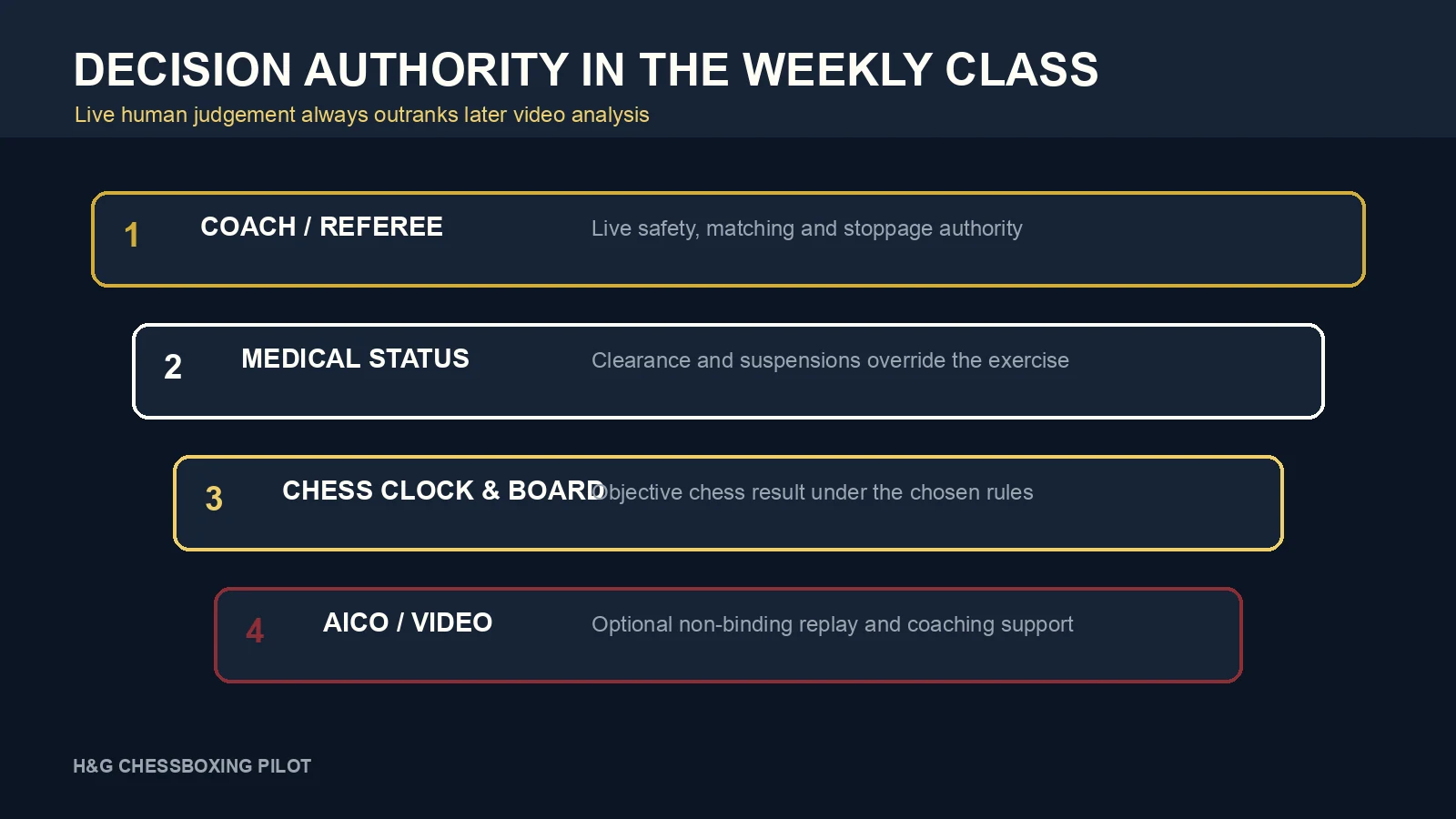
Safety is brief but non-negotiable: technical contact stays controlled, and the coach can reduce or stop it when control is slipping.
Three examples that make the format clear
Checkmate after a tidy technical round
Two players return to the board after a measured boxing round. One sees a forced mating sequence and delivers checkmate. They win the chess game. The boxing round may have been close, but it has not supplied the result.
A flag falls when checkmate is impossible
One player runs out of time with only a king left against the opponent's king. The flag has fallen, but neither player could possibly checkmate by a legal sequence. Under the FIDE Laws, the game is drawn. It is not turned into a boxing decision.
The same position keeps returning
The players repeat the same position. If the FIDE repetition conditions are met and a valid claim is made, or if the position appears five times, the game is drawn. It does not become a boxing decision because one player looked more aggressive while the board was away.
These examples are deliberately plain. Good chessboxing rules should make people more willing to train, not make a recreational session feel like a tribunal.
Video review is coaching, not scoring
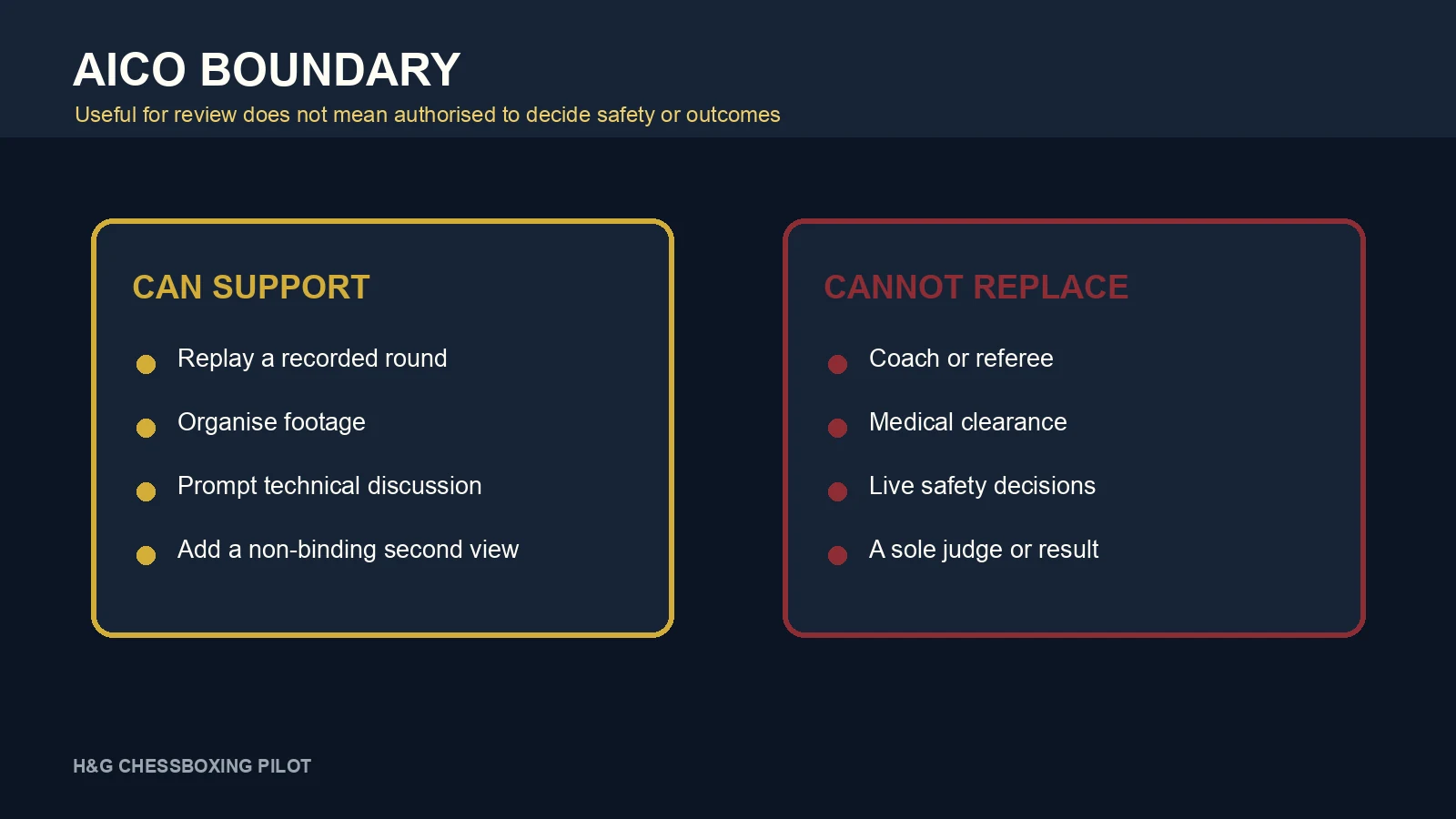
See how visiting boxers can try AICO at H&G. When available, H&G can record suitable boxing rounds with its installed AICO system and use the footage during coaching.
Recording and review require participant consent and usable footage. They are optional, not guaranteed, and never replace coach or referee authority over safety, matching, stoppage or injury decisions. A review may include selected highlights and available information about activity, attack, defence, movement and work rate. The board result remains the board result.
For adults who want the boxing base first, the Recreational Adults boxing classes cover stance, balance, bags, pads and controlled partner work. If you are in Kidbrooke or nearby, that is the sensible route into the physical side of chessboxing.
H&G is gathering interest in the Chessboxing class. No class date or price is confirmed. Read the H&G chessboxing rules guide for the wider format, then register interest if the mix of live chess and coached boxing rounds appeals to you.
H&G Team
Writer at Honour & Glory Boxing Club, a community boxing gym in Kidbrooke, South East London.
Was this page helpful?
It takes one tap, and it genuinely helps.
Latest boxing technology at H&G
Come to H&G and put AICO to work on your boxing
Start with an AICO visit, or explore H&G's professional and competitive amateur pathways.