A chess rating should help you start well. It should not make you wonder whether you are allowed in the room.
For the planned H&G chessboxing format, 1000+ on Chess.com Rapid is a useful guide for the full game: each player has six minutes in total, carried across four chess windows. That clock asks you to see the board, make legal moves and keep enough time for later rounds. It does not ask you to be a tournament player, and it is not a gate for adults who are still improving.
The number is a quick signpost, nothing more. Tell us how and where you usually play, or start with a short placement game. That gives a much better starting point than pretending ratings from different sites mean exactly the same thing.
H&G is gathering interest for an adult chessboxing class in Kidbrooke. There is no confirmed class date or price. If chessboxing interests you but your chess or boxing is still new, there is a sensible way in.
What 1000+ Chess.com Rapid means here
The full format is one continuing chess game broken by boxing rounds. Each player has six minutes on the chess clock across four three-minute chess windows. The position stays on the board between windows. You return to the same game with your breathing higher and the clock still running when it is your turn.
A Chess.com Rapid rating of 1000 or above is a useful marker that a player may already be comfortable with the basic jobs: moving legally, spotting check, using a clock and finishing ordinary timed games. Chess.com keeps Rapid separate from Blitz, Bullet and Daily because they are different pools with different time controls, as its rating guide explains.
That is why the guide names Chess.com Rapid, not just a vague chess number. A person who has played plenty of measured Rapid games usually has a better starting point for a six-minute total clock than someone who only plays very fast games or untimed puzzles.
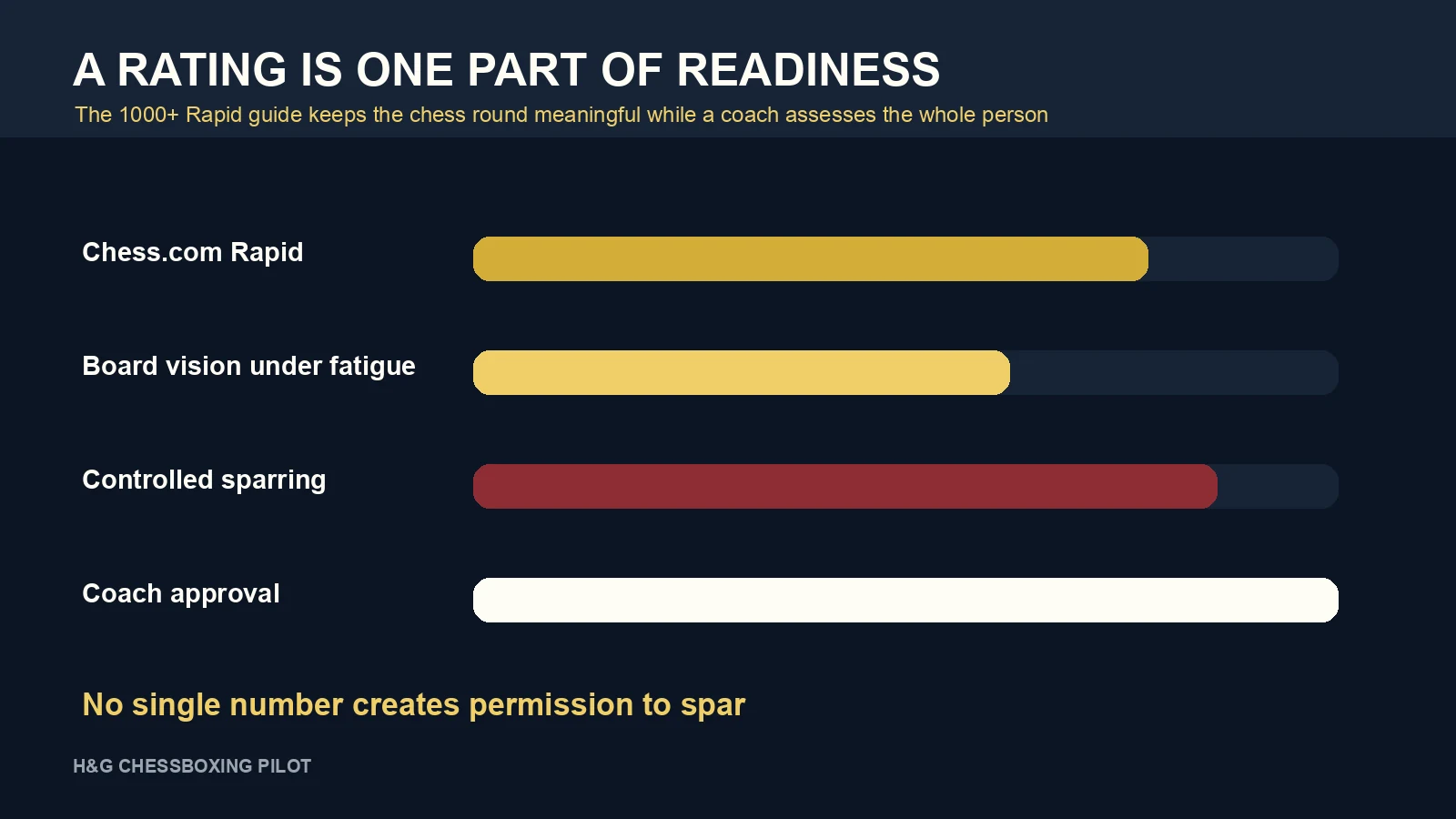
It is still only a starting point. A player at 980 may be completely comfortable. A player at 1100 may be returning after years away, may have played very few games, or may hate a physical clock. The short placement game is there to settle the practical question: can this person enjoy the full timed exercise now, or would a little more board time make it better?
The practical placement table
| Your usual chess experience | Sensible first chessboxing step | What to tell us |
| --------------------------------------------- | --------------------------------------------------------------------------------------------------------------------- | -------------------------------------------------------------------------- |
| Chess.com Rapid 1000+ and regular timed games | Try the full six-minute-per-player format when a suitable session is available | Your current Rapid rating and whether you use a clock comfortably |
| Chess.com Rapid below 1000 | Start with more board time and shorter non-contact transitions, then build towards the full clock | Your current rating and the parts of timed chess that feel rushed |
| Lichess, ECF, FIDE or club chess | Describe your normal level and play a short placement game if useful | The platform or organisation, the time control and how recently you played |
| No current rating, but you know the rules | Start with a short placement game and a relaxed timed exercise | Whether you can finish a legal game and use a chess clock |
| Strong chess player who is new to boxing | Start boxing as a beginner while boxing fundamentals are developed separately and existing chess strength is retained | Your chess background and that your boxing experience is new |
| Experienced boxer who is new to chess | Keep your normal boxing start and build chess confidence without contact | Your boxing experience and how familiar you are with timed chess |
None of those rows is a contact decision. Chess rating never determines contact. A good board player still starts boxing at the level their boxing experience supports. A good boxer still needs enough chess comfort for the clock to be enjoyable rather than frantic.
Do not force a rating conversion
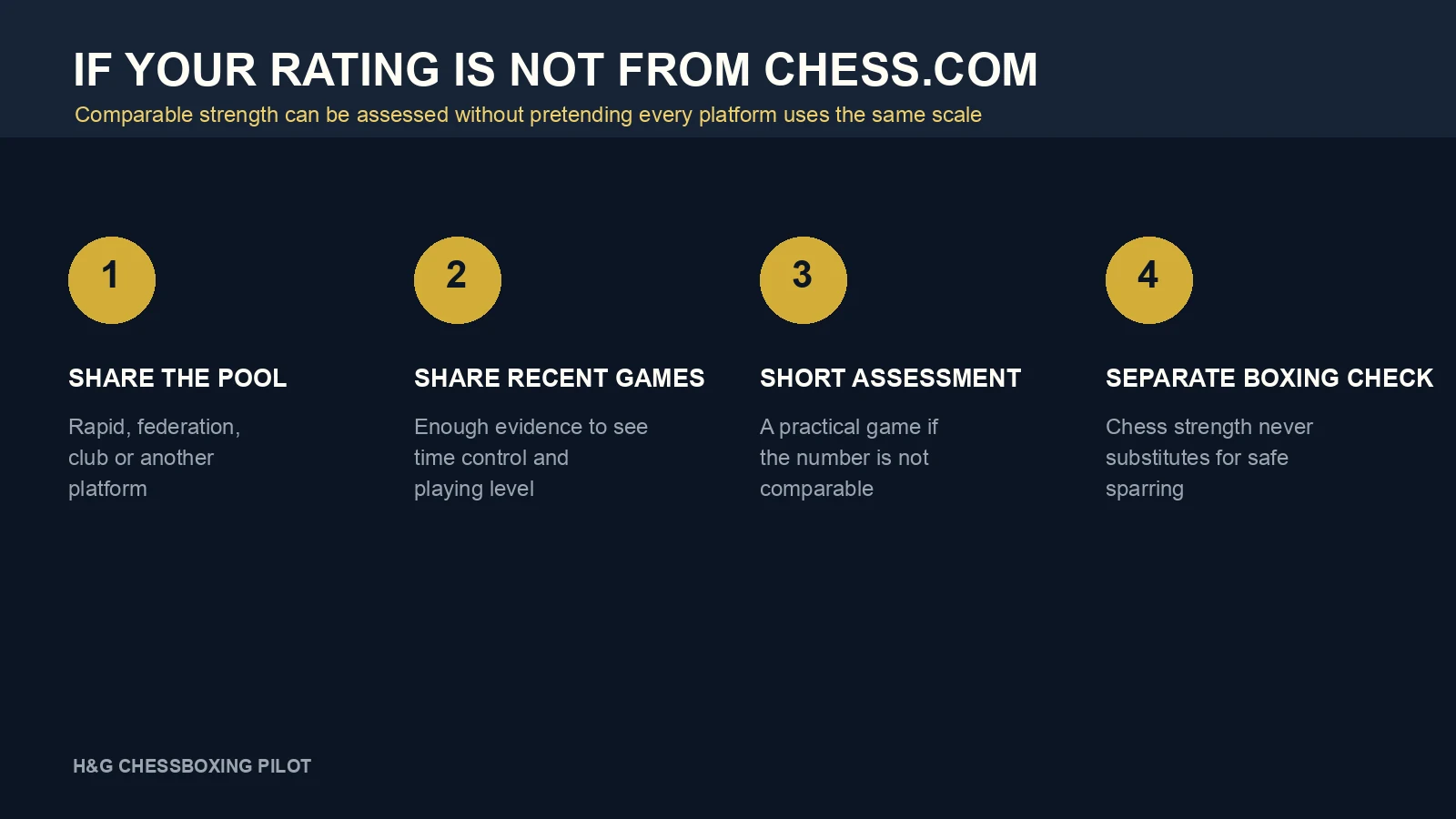
Chess.com, Lichess, ECF, FIDE and over-the-board club ratings are useful in their own settings. They are not interchangeable labels that can be reduced to one neat conversion chart.
Different sites use different player pools, rating systems and time controls. An ECF or FIDE number can describe serious over-the-board experience. A Lichess Rapid rating can show regular online practice. Neither needs to be translated into a pretend Chess.com Rapid number before someone can take part.
The useful description is plain: where you play, what time control you normally use, the rating if you have one, and how recently you have played. "Lichess Rapid, around this level, playing weekly" tells us more than a made-up conversion. So does "I play for a club but have no online account".
The FIDE Laws of Chess set out the underlying rules around legal moves, check, checkmate and clocks. You do not need a FIDE ID or a formal rating to register interest. The point is to see whether a timed game feels familiar enough for the full exercise, not to turn a local class into a paperwork contest.
What a short placement game can show
A short placement game is not an exam. It is a quick, ordinary game with enough clock pressure to show what feels natural and what does not.
Can you set up the board, make legal moves and press the clock without losing your place? Do you notice check before making a move? When you return to the position after a brief non-contact exercise, can you take a breath and find the basic threats? Those answers are more useful than arguing over whether one online rating should equal another.
If the clock is the problem, the answer is not to throw somebody into the deepest end. Start with more thinking time. Use a familiar opening. Keep the position simple. Add the transition work gradually through shadowboxing, pads, bags or conditioning. You can build the habit of returning to a board calmly without any need for sparring.
That approach also suits somebody who has not played for years. The rules often return quickly. Clock sense and board awareness under a little fatigue can take a few sessions to settle. There is no prize for making the first attempt miserable.
If you are new to boxing, start there honestly
A chess player with a strong Rapid rating is still a boxing beginner if they have not boxed before. That is normal, not a disadvantage.
Start through Recreational Adults boxing classes. You can learn stance, balance, guard, distance and controlled punching while exploring the chess side through non-contact work. Pads, bags, footwork and conditioning give you plenty to learn before any person-to-person boxing is considered.
Likewise, an experienced boxer who is new to chess does not lose their ordinary boxing place because they are learning the board. The chess work can start with legal timed games, a clock and short returns to a saved position. The two skills meet when both are ready for the exercise, not because one rating says they should.
Adults from Kidbrooke, Greenwich and nearby can begin with the boxing side now, whether their chess is at 600, 1000, unranked or much stronger. Chessboxing is supposed to reward composure and learning, not create a pecking order before the first session begins.
What to do next
If you are already around 1000+ on Chess.com Rapid, keep playing complete timed games and practise leaving enough time for the whole game. Our chessboxing clock and fatigue guide explains how to treat six minutes as one budget rather than four fresh starts.
If you are below that guide, unranked or playing somewhere else, say so plainly. A short placement game or a slower first exercise is enough to find the right start. Do not wait until you think your rating looks impressive.
For the planned format, see the H&G Chessboxing class page and register your interest with your normal chess level and boxing experience. There is no confirmed date or price yet. Beginners are welcome through the appropriate boxing start, and the chess side can build at a pace that keeps the game enjoyable.
H&G Team
Writer at Honour & Glory Boxing Club, a community boxing gym in Kidbrooke, South East London.
KEEP READING
Chessboxing Rules: Rounds, Clocks and Endings
How H&G chessboxing rounds, six-minute clocks, transitions and endings work, including a clear non-contact route for beginners.

Boxing for Commuters in South East London: How to Fit
Long commutes make consistent exercise difficult. Here is how people commuting from south-east London have made boxing training work around working hours.
How to Find a Good Boxing Gym in South East London
South East London has many boxing clubs. The difference between a good one and a mediocre one matters significantly. Here is how to evaluate a gym before committing.
Was this page helpful?
It takes one tap, and it genuinely helps.
Choose your next step
Turn this article into the right action
Some readers are ready to book. Some need the class route first. Pick the route that matches what you actually want.