Chessboxing is not boxing with a chessboard nearby. It is three jobs: box with decent shape, play a timed game, then switch without making the first move like you are trying to escape a fire.
Train those jobs separately before you combine them. A boxer needs a reliable board routine; a chess player needs stance, distance and control. Treat the changeover as a skill, not dead time between the interesting bits.
H&G is gathering interest for an adult Chessboxing class in Kidbrooke. There is no confirmed date or price. If boxing is new to you, start with Adult Recreational boxing. Contact is not required to train the switching skill.
Build the two halves before you mix them
Your boxing work should look like boxing, not punishment before chess. Start with stance, guard, straight punches, balance and a clean return to position. Shadowboxing, bags and pads are enough. Give every round one job: jab and recover, step after the cross, or finish in guard.
Your chess work should be ordinary timed chess. Play complete games. Use an opening structure you understand. Practise checking the board before you touch a piece: checks, threats, loose pieces, clock. The FIDE Laws of Chess are the proper reference for legal moves, check, clocks and endings.
Do not use a hard interval to hide a basic problem. If your stance falls apart when fresh, reduce the boxing task. If you miss hanging pieces in a quiet game, slow the chess down first. Hybrid work tests a routine you have already started building.
The four-week progression
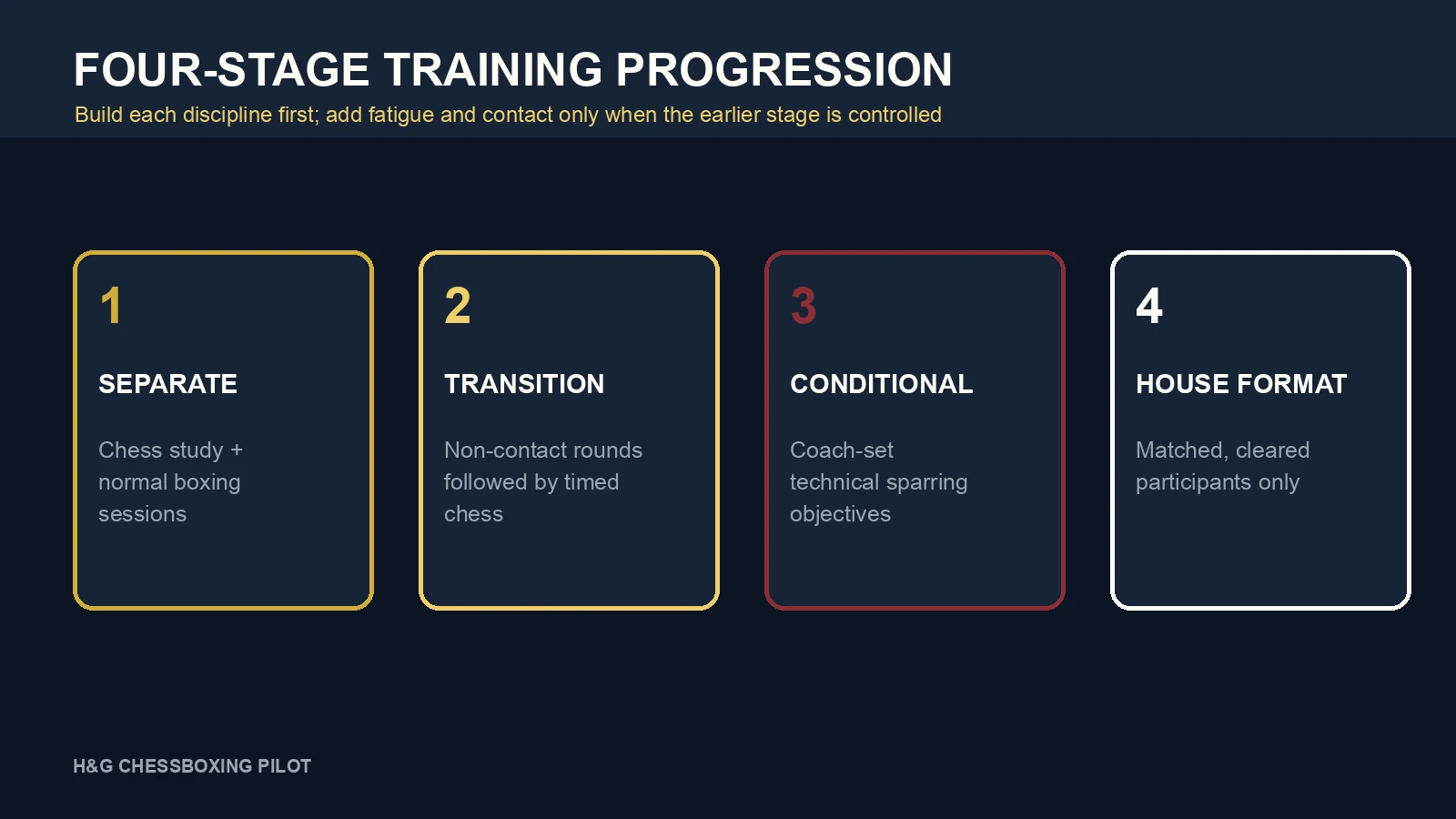
Train this block twice each week alongside normal classes or training. Keep at least one day between hybrid sessions. Repeat a week when the quality check is not there. Progress means doing the next job cleanly, not making every round harder.
| Week | Boxing task | Chess task | Switch drill | Progress when... |
| ------------------------- | -------------------------------------------------------------------------------------------------------------- | ----------------------------------------------------------------------------------------- | ------------------------------------------------------------------------------------------------------------------- | ----------------------------------------------------------------------------------- |
| 1 - Separate skills | 3 x 2 minutes of shadowboxing or bag work at a controlled pace. Finish every combination in stance. | Play two 10-minute Rapid games on separate days. Record one missed threat or rushed move. | After 60 seconds of light footwork, set up a saved position and run the board scan before moving. | You can name the last boxing cue and make a legal first chess move without rushing. |
| 2 - Repeatable changeover | 3 x 2 minutes of pads or bag work. Use one defensive finish after every combination. | Play one continuing 10-minute game, paused between blocks. | Chess for 3 minutes, boxing for 2 minutes, then one minute to sit down, check the board and continue. Repeat twice. | Gloves, chair, board and clock stop being a scramble. |
| 3 - Decision under a task | 3 x 2 minutes of coach-set or self-set technical rounds. Keep the same stance quality in the final 30 seconds. | Use familiar opening positions or simple endings. | After each boxing round, return with one job: spot the threat, protect the king or convert an extra piece. | You can say what the chess task is before the clock restarts. |
| 4 - Full rehearsal | Three controlled two-minute boxing rounds with a clear technical rule for each one. | One continuing game using the planned class clock. | Alternate four three-minute chess windows and three boxing rounds with six one-minute changes. | You keep the routine even when the position or round did not go your way. |
The full rehearsal uses one continuing chess game. Each player has six minutes across four chess windows, not a fresh six minutes each time they sit down. The H&G Chessboxing rules guide explains the sequence, clocks and possible endings.
Use the same board reset every time
The first move after boxing is where people donate time and pieces. Do not grab the obvious pawn because the room feels busy. Run the same scan every time:
- Is either king in check?
- What changed or was threatened before the boxing round?
- Whose clock is running, and how much time remains?
- What is the simplest legal move that improves the position?
That is not a grandmaster ritual. It is a practical brake against habit, irritation or noise.
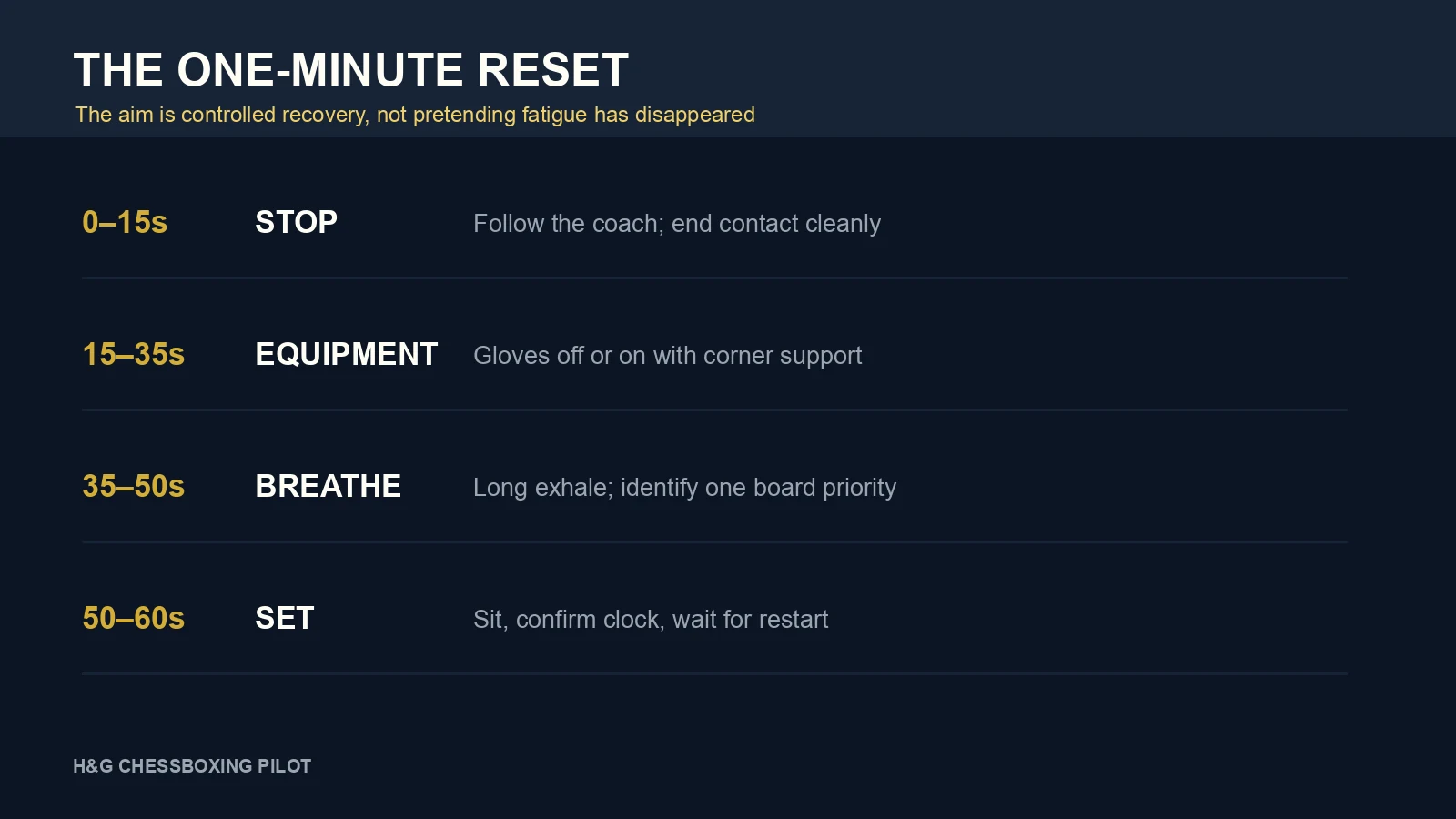
The transition needs a physical order. Stop where the coach tells you. Deal with gloves. Sit down. Check the board and clock. Then move. Do not replay the last exchange, ask for chess advice or move pieces before the restart.
A scannable Chessboxing session card
Print this, save it to your phone or write it at the top of your notes. One session needs a clear job, not a pile of tired activity.
39-minute non-contact session
- Warm-up - 5 minutes: set up board, clock, gloves and water, then use light footwork, shoulder rolls and easy shadowboxing. Have one saved chess position ready before the first chess window.
- Chess window 1 - 3 minutes: start the saved game. Before every move, check king, threat, clock, move.
- Transition 1 - 1 minute: step away from the board, put gloves on and take the boxing space. No analysis out loud.
- Boxing round 1 - 2 minutes: shadowbox or work pads. Today’s cue: jab, exit, hands home.
- Transition 2 - 1 minute: gloves off, sit down, check the board and clock, then restart the chess clock.
- Chess window 2 - 3 minutes: continue the same game. Choose one simple purpose: defend a threat or improve your worst piece.
- Transition 3 - 1 minute: step away from the board, put gloves on and take the boxing space. Keep the order the same.
- Boxing round 2 - 2 minutes: bag or pads. Today’s cue: do not let the rear hand drift after the cross.
- Transition 4 - 1 minute: gloves off, sit down, check the board and clock, then restart the chess clock.
- Chess window 3 - 3 minutes: continue the same game. Run the board scan before touching a piece.
- Transition 5 - 1 minute: step away from the board, put gloves on and take the boxing space. Do not invent a new routine.
- Boxing round 3 - 2 minutes: footwork and straight punches. Today’s cue: finish balanced.
- Transition 6 - 1 minute: gloves off, sit down, check the board and clock, then restart the chess clock.
- Chess window 4 - 3 minutes: finish the planned chess time in the same game. Save the position and note the first moment you felt rushed.
- Notes and cool-down - about 10 minutes: walk, loosen shoulders and hips, then write one boxing note, one chess note and one changeover note. Pick only one thing to fix next session.
Troubleshooting the bits that usually go wrong
You rush the first move
Use a five-second rule: hands off the pieces until you have checked both kings and the clock. If that is difficult, use a simpler saved position and longer chess time. Speed is useful only after you have seen the board.
You waste the transition
Do not spend the minute searching for gloves, discussing the last round or deciding where to sit. Lay out the kit first. A transition that needs a reminder is not a routine yet.
Your stance quality disappears
Your boxing task is too big for the round. Cut the combination down. Work at a pace where you can finish in stance and guard, then add speed. Train the switch, not how exhausted you can become.
You train fatigue without a clear task
A hard round followed by random chess is just hard work followed by random chess. Choose the question before the timer starts: spot a threat, make a legal move, preserve time or return to a familiar position. If you cannot say what the drill tests, change it.
You keep changing the plan
Use the same reset for several sessions. A new opening, bag drill and transition rule every week make improvement hard to see. Keep one part stable, then change one variable.
Safety
Keep all contact coach-led and matched to your boxing experience. Use suitable gloves and wraps for bag or pad work. If concussion is suspected after a head impact, stop activity immediately, tell the coach and do not return the same day. Follow the NHS head injury and concussion guidance and club medical guidance before returning. Stop for pain, dizziness or other symptoms that make continuing inappropriate.
Start from the right place in Kidbrooke
The planned format is for adults interested in chess and boxing, not a test of whether you belong in a hard sparring round. If you are local to Kidbrooke, begin with Adult Recreational, keep your chess practice honest and add the non-contact switch drill once each week.
Tell H&G where your chess is at and what boxing experience you have when you register interest in the Chessboxing class. There is no confirmed date or price, but you can start building the useful parts now.
H&G Team
Writer at Honour & Glory Boxing Club, a community boxing gym in Kidbrooke, South East London.
KEEP READING
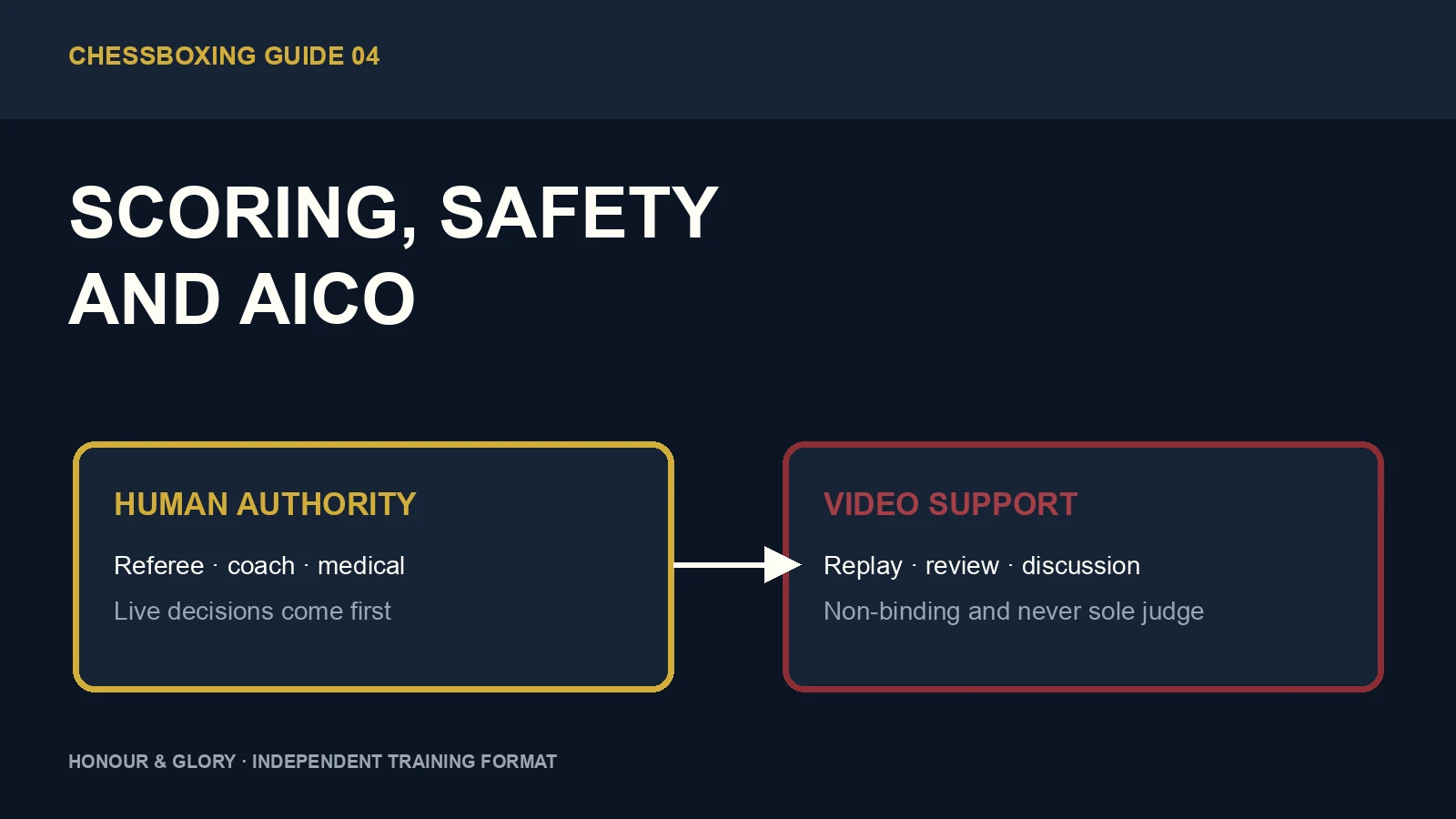
Chessboxing Scoring and Video Review
How formal chessboxing scoring can vary, and how H&G keeps weekly chess results separate from unscored technical boxing rounds.
Why You Drop Your Hands in Boxing
Hands dropping in boxing is usually a fatigue, tension and reset problem. Here is how beginners can fix the habit without forcing it.
Is Boxing Without Sparring Worth It?
Many people who box recreationally never spar and never compete. Is the training worthwhile without those elements? The honest answer from coaches and members.
Was this page helpful?
It takes one tap, and it genuinely helps.
Choose your next step
Turn this article into the right action
Some readers are ready to book. Some need the class route first. Pick the route that matches what you actually want.