Returning to Boxing After a Break: Your First Week Back

Coming back to boxing after a break is usually harder in your head than it is in the gym.
You remember the pace you had before. You remember the rounds that felt easy, the combinations you knew without thinking and the person you were trying to keep up with. That memory can make the first session back feel like a test you are already losing.
It is not a test. It is a restart.
Whether the break was two weeks, two months or longer, your first job is to get back in the room and give the coach an honest picture of where you are. The target is not to make up every missed round in one evening. It is to finish the session wanting to return again.
What changes after time away
Your boxing knowledge does not disappear because you missed a block of training. You may still know the jab-cross sequence, recognise the pad call and remember how a good stance feels. What usually goes first is the ability to repeat it under fatigue.
That is why returning members often feel sharp for thirty seconds, then suddenly heavy. The legs do not recover between bursts as quickly. The shoulders tighten earlier. A combination that used to arrive naturally needs a moment of thought.
That is normal. A systematic review of detraining and aerobic fitness found that time away from training can reduce maximum oxygen uptake. It does not mean you have gone back to square one. It means the first few weeks need a sensible pace.
The useful mindset is simple: you are not proving your old fitness. You are rebuilding your current fitness.
Tell the coach you are back after a break
Do not try to hide a long gap by joining the hardest round and hoping it comes back mid-session. Tell the coach before the warm-up. It gives them a chance to put the session in the right lane for you.
That does not mean standing at the side while everyone else trains. It can mean using lighter bag rounds, taking an extra reset between pad sequences or keeping the first partner drill simple. The coach can still correct your technique, but you are not spending every minute trying to survive the pace.
England Boxing's Level 2 coaching handbook makes the same practical point: learning tasks should be progressive and linked in manageable steps. That is not only for complete beginners. It is the right way to return when your timing and conditioning are no longer matching.
Be clear about the reason for the break if it matters. A busy month at work is different from time away because of an injury, illness or ongoing symptoms. A club coach can adjust a normal training session. They cannot clear you medically. If pain, dizziness, chest symptoms or unusual breathlessness are part of the picture, get appropriate medical advice before treating a boxing class as the test.
Make the first session deliberately boring
The smartest first session back is often less exciting than you want it to be.
Use the warm-up to check how your body feels. Skip at a manageable rhythm. Shadow box with the jab and one-two. Let the feet settle before you ask them to move quickly in every direction. If your calves are tight or the shoulders are burning early, lower the pace before the technique gets ragged.
On the bag, choose one job for each round:
- Round one: jab, step, reset.
- Round two: jab-cross, hands back, step away.
- Round three: add a short body-head combination only if your stance is still organised.
- Round four: return to the jab and finish with clean movement rather than a last-minute sprint.
That is enough work. You do not need a punishment round because you missed a month. Hard training only pays when you can hold the shape of what you are doing.
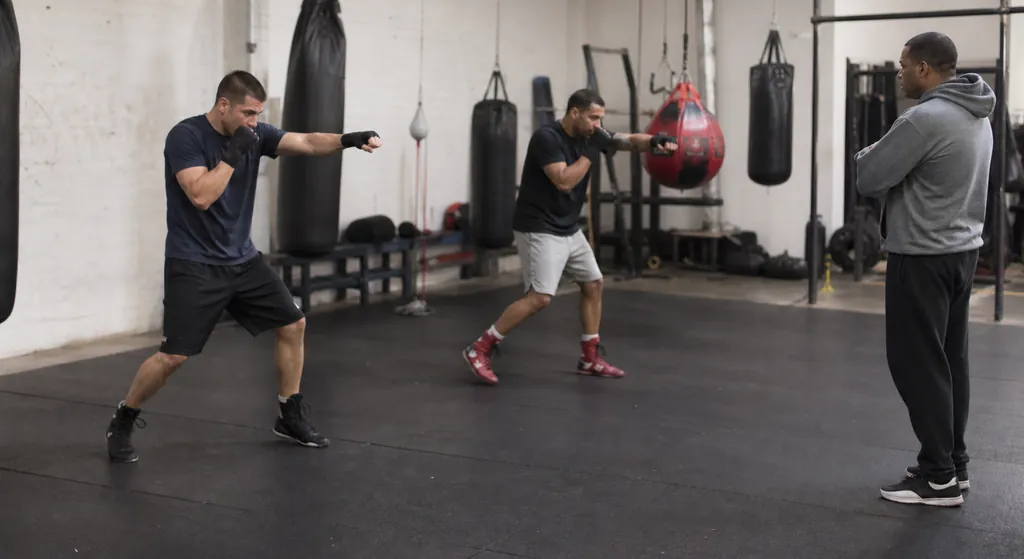
Do not chase your old pace in the first week
The main trap is trying to train as though the break never happened.
You might be able to force the first session. You can hit the bag too hard, push through a conditioning finisher and leave exhausted but pleased with yourself. The problem appears two days later when the legs are stiff, the hands are sore and the next session feels like something to avoid.
The better return is less dramatic. Start with one or two sessions you can recover from. Add work only when the last session left you tired but functional the next day. The general NHS advice on building activity back up is similarly plain: take small steps, see how your body reacts and build gradually rather than trying to compensate in one go (Guy's and St Thomas' NHS guidance).
For boxing, the order matters. Build the easy things back first:
- Turn up consistently.
- Keep the stance and guard reliable.
- Build round time at a controlled pace.
- Add speed and power after recovery feels normal.
- Add harder partner work only with a coach's view of where you are.
If you were sparring before the break, do not assume you need to jump straight back into it. Pads, bags, movement drills and controlled partner work are plenty while reactions and distance are returning. Sparring is an optional part of a recreational route, not a fitness benchmark.
Let technique be the win for now
Returning members often judge the session by how wrecked they feel. That is the wrong scorecard.
A better sign is that your jab came back to your cheek after each round. Your feet stopped crossing when the coach asked you to change direction. You heard the call on the pads and did not panic when the combination went wrong. Those are boxing wins, even if you are not moving as fast as you remember.
Pick one correction and carry it through the week. It might be relaxing the shoulders between punches, keeping your eyes up or taking smaller steps after the cross. Our guide to why beginners look at the floor when boxing is useful if your stance starts collapsing when you get tired.
Technical work also gives you a way to pace yourself without feeling like you are taking it easy. A clean three-minute round with an honest jab, sharp breathing and a usable guard is better training than a wild round you cannot repeat.
Give yourself a simple two-week rule
For the first two weeks back, do not judge the return by one tough night.
Judge it by whether you are showing up again. Are you less out of breath in the warm-up? Are the shoulders staying loose for longer? Do your feet find the right place without staring at them? Can you leave class knowing what you worked on?
If the answer is yes, the return is working. Fitness will follow the routine. Boxing timing will follow the repetitions.

Returning to boxing in South East London
If you are near Kidbrooke, Greenwich or Blackheath, the Recreational Adults boxing classes are a straightforward place to restart. You do not need to arrive at your old level. Let the coach know where you are, work through the basics and build the pace session by session.
If you are still deciding what your first session will involve, our guide to what to expect at your first boxing class explains the normal flow from warm-up to bags and pads.
H&G Team
Writer at Honour & Glory Boxing Club, a community boxing gym in Kidbrooke, South East London.
KEEP READING
How to Jab Without Getting Jabbed Back
Learn the jab-block and off-line jab: two simple habits that stop beginners landing a jab and eating one straight back.

Lower Back Pain in Boxing: Rotation, Bag Work and Return to Training
A careful boxing guide to lower back pain: why rotation, fatigue, hip stiffness and load spikes can irritate the back, NHS red flags, rehab phases and return to boxing.

How to Prepare for Your First Amateur Boxing Bout in the UK
The preparation for your first competitive amateur boxing bout involves technical, physical, and psychological elements. Here is the complete guide to the six weeks before competition.
Was this page helpful?
It takes one tap, and it genuinely helps.
Choose your next step
Turn this article into the right action
Some readers are ready to book. Some need the class route first. Pick the route that matches what you actually want.