Lower Back Pain in Boxing: Rotation, Bag Work and Return to Training

Lower back pain in boxing usually has less to do with one punch and more to do with how the whole body is loading.
A boxer might feel it after heavy bag rounds, missed hooks, slipping and rolling, skipping, strength work, running, sitting all day before training, or trying to create power by twisting through the spine instead of using the feet, hips, trunk and shoulders together. Sometimes it is a simple training-load problem. Sometimes it is not.
This is general information for boxers, not a diagnosis or medical advice. Stop training and speak to a qualified clinician if symptoms are severe, worsening, unusual, or not improving. For urgent symptoms, use NHS 111, A&E or 999 as appropriate.
This guide is part of our common boxing injuries series. It explains why lower back pain can happen in boxing, what warning signs matter, how sciatica-type symptoms change the decision, and how return to boxing normally needs to rebuild daily movement, rotation, stance and impact before hard rounds.
The short version: if back pain is severe and sudden, getting worse quickly, follows a serious accident, comes with feverish symptoms, chest pain, numbness or weakness in both legs, bladder or bowel changes, or loss of feeling around the genitals or anus, stop training and use urgent medical help. Do not test neurological symptoms on the heavy bag.
Why the lower back matters in boxing
Good boxing power does not come from the lower back alone.
It starts from the floor, travels through the legs and hips, is organised by the trunk, and finishes through the shoulder, arm and fist. The lower back is part of that chain, but it should not be asked to do the whole job.
In boxing, the back helps you:
- hold stance without collapsing or over-arching
- rotate the trunk during punches
- brace when you hit the bag or pads
- recover balance after missing
- slip, roll, duck and change level
- absorb conditioning work such as squats, burpees and medicine-ball drills
- tolerate running, skipping and strength training around boxing
- stay organised when tired
The NHS says back pain, particularly lower back pain, is very common, often improves within a few weeks, and is not always caused by something obvious. It also warns that back pain can rarely be a sign of something serious such as a broken bone, cancer or infection (source).
That is why the decision is not "back pain is always dangerous" or "back pain is always nothing". The job is to separate ordinary training aches from symptoms that deserve medical attention.
Why boxing can expose lower back pain
Most recreational boxing back pain is not from being punched in the spine. It is more often a mix of rotation, fatigue, load spikes and poor timing.
Common boxing scenarios include:
- throwing hard hooks while the feet stay stuck
- over-rotating on the bag when the punch misses or lands badly
- leaning back from punches instead of moving the feet
- flaring the ribs and arching the back during pad work
- trying to punch harder by twisting the spine rather than turning the hip
- repeated slips and rolls without hip control
- skipping or running volume jumping too quickly
- heavy strength work added on top of hard boxing weeks
- long sitting before class, then asking the hips and trunk to rotate fast
- fatigue making stance tall, stiff or lopsided
- sparring rounds where reactions become messy
A 2020 scoping review on athletes found evidence that training load is associated with back problems, especially where loads are high, repetitive, asymmetric or rapidly increased. It also notes that fatigue of trunk muscles from excessive spinal loading can be one source of back problems in athletes (source).
Boxing fits that pattern. A single class may be fine, but a week of bag work, running, strength circuits, long sitting and poor sleep can change what the back can tolerate.
A 2023 systematic review of boxing injuries found that injury incidence remains high in professional boxing and that amateur boxing injury rates appear lower in more recent years, with soft tissue contusion the most common injury type (source). That does not make lower back pain the headline boxing injury, but it does place it inside the wider reality of combat-sport loading, soft-tissue irritation and training decisions.
What lower back pain often feels like in a boxer
Symptoms overlap, so this section cannot diagnose you. A muscle strain, irritated joint, disc-related pain, sciatica, hip referral, rib or pelvic issue can all feel like "my back hurts".
In boxing, lower back pain often shows up as:
- dull ache after bag rounds
- tightness after hooks, slips or rolls
- pain when rotating one way
- stiffness after sitting, then training hard
- discomfort when bracing on impact
- pain when skipping, running or doing burpees
- one-sided ache after stance-heavy work
- back soreness that changes your guard or footwork
A mild ache that settles, does not change your movement, and keeps improving is different from back pain that is sharp, spreading, neurological, worsening or stopping daily life.
Back pain versus sciatica-type symptoms
Boxers often call everything a back strain. That is too simple.
The NHS sciatica page says sciatica happens when the sciatic nerve, running from the lower back to the feet, is irritated or compressed. It usually affects the bottom and the back of one leg, and can include sharp or burning pain down the leg, tingling, numbness or weakness. The NHS also says you probably do not have sciatica if you only have back pain (source).
For boxing decisions, that distinction matters.
Back tightness after a return-to-training week may be managed by reducing load, improving movement and getting advice if it does not settle. Pain with numbness, tingling or weakness down the leg is a different situation. Pain or weakness in both legs, severe or worsening numbness, or bladder and bowel symptoms are urgent warning signs.
When to stop boxing immediately
Stop the session if back pain changes how you move.
That includes:
- sharp pain during a punch, slip, roll or lift
- pain that gets worse as the round continues
- pain that makes you guard differently or avoid rotation
- pain spreading down the leg with tingling, numbness or weakness
- pain after a fall, collision or heavy impact
- severe pain that starts suddenly
- pain with feverish symptoms or feeling generally unwell
- numbness or weakness in both legs
- bladder or bowel changes
- loss of feeling around the genitals or anus
- chest pain with back pain
A useful coaching rule: if the back pain makes you negotiate with every movement, the round is over. You can adjust a session early. You cannot out-tough a red flag.
When to get medical help
Use NHS guidance, not gym folklore.
See a GP, physio or MSK service if
The NHS advises seeing a GP if back pain does not improve after treating it at home for a few weeks, stops day-to-day activities, is worrying or hard to cope with, comes with unexplained weight loss, a lump or swelling, a change in back shape, pain that does not improve after resting, pain that is worse at night, pain that is worse when sneezing, coughing or pooing, or pain coming from the top of the back between the shoulders rather than the lower back (source).
The NHS also says many adults in England can refer themselves to community musculoskeletal services, such as physiotherapy, for back, joint, muscle and ligament problems without needing a GP referral in some areas (source).
For a boxer, repeated back pain is worth acting on before it becomes your normal. If the same pain appears every time you hit the bag or rotate, the answer is not just a longer warm-up.
Use NHS 111 or urgent GP help if
The NHS advises urgent GP help or 111 if back pain comes with feeling hot, cold, shivery or generally unwell, if it is severe pain that starts suddenly, or if the pain is getting worse quickly (source).
Go to A&E or call 999 if
The NHS advises calling 999 or going to A&E if back pain comes with pain, tingling, weakness or numbness in both legs, loss of feeling around the genitals or anus, bladder or bowel changes, changes in sexual sensation or function, chest pain, or back pain after a serious accident such as a car accident (source).
The NHS sciatica page also says A&E or 999 is needed for sciatica on both sides, severe or worsening weakness or numbness in both legs, numbness around or under the genitals or around the anus, difficulty peeing, inability to pee, loss of bladder control, or loss of bowel control (source).
If you are unsure, use NHS 111.
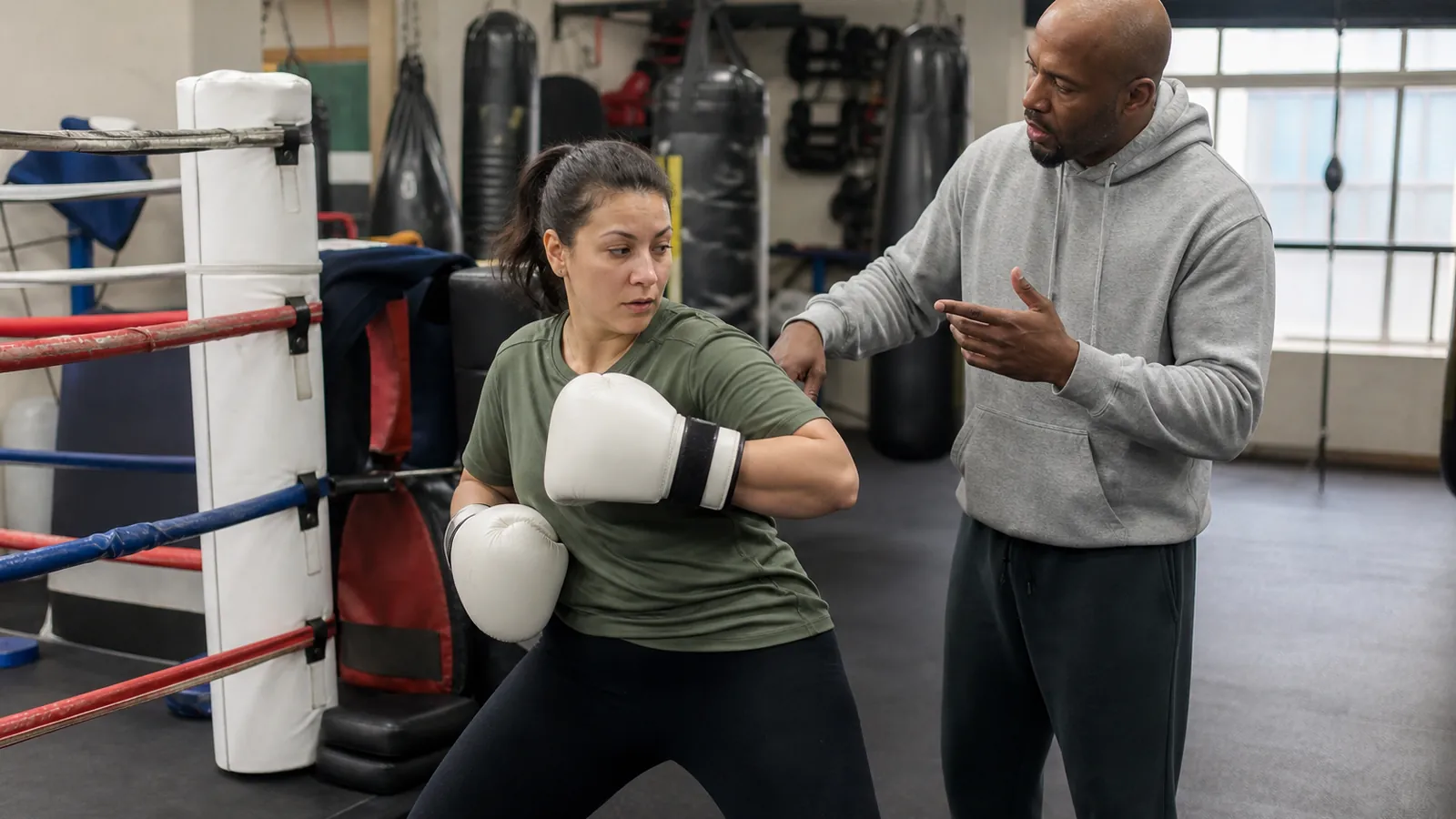
What treatment often looks like
Treatment depends on the cause.
For ordinary lower back pain, the NHS says it often improves on its own within a few weeks. It advises staying active and trying to continue daily activities, using anti-inflammatory medicine such as ibuprofen if suitable, checking with a pharmacist or GP if unsure which painkiller is suitable, using ice for pain and swelling, using heat for stiffness or muscle spasm, and trying exercises and stretches. It also says not to stay in bed for long periods (source).
NICE guidance for low back pain and sciatica in over-16s says clinicians should think about alternative diagnoses when symptoms are new or changed, and should not routinely offer imaging in non-specialist settings. It recommends advice and information to support self-management, including encouragement to continue normal activities, and says exercise programmes may be considered for specific episodes or flare-ups (source).
That means an early MRI is not automatically the clever move for every sore back, and total rest is not automatically the safe move either. The right response depends on symptoms, red flags, duration and how the back behaves.
For a boxer, treatment is not "ignore it" and not "panic". It is reduce the aggravating load, keep safe movement where appropriate, get clinical advice when warning signs are present, and rebuild gradually.
What rehab often looks like for boxing
Rehab should be led by an appropriate clinician when symptoms are significant, persistent or uncertain. The boxing side is about respecting stages.
A sensible return usually moves through phases like this:
- Normal daily walking and sitting-to-standing without symptoms escalating.
- Comfortable basic trunk movement within clinical guidance.
- Hip mobility, glute strength and trunk control work where appropriate.
- Shadowboxing in stance without hard rotation.
- Slow footwork with no slipping, rolling or explosive pivots.
- Light straight punches on pads, keeping effort low.
- Controlled rotation with hooks only if symptoms stay settled.
- Light bag work with reduced round length and no power chasing.
- Gradual return to skipping, running or conditioning if those were triggers.
- Faster defensive movement, slips and rolls.
- Sparring or contact only after the back tolerates movement, rotation, fatigue and impact reliably.
The mistake is returning because the back feels fine while walking around the house. Boxing asks the back to rotate, brace, react, absorb and repeat under fatigue. That needs more proof than one pain-free morning.
Boxing modifications while the back settles
If symptoms are mild and you have no red flags, a coach may be able to modify training while you get the right advice.
Useful modifications can include:
- no sparring
- no heavy bag power rounds
- no medicine-ball throws
- no burpees, sit-ups or high-fatigue circuits
- no hard hooks or overhands
- no deep slips or rolls
- shorter rounds
- technical shadowboxing only
- straight punches from a controlled stance
- more rest between rounds
- focus on breathing, guard, balance and foot placement
- pad work where the boxer does not chase the pad holder
This is not a workaround for serious symptoms. It is a way to keep suitable people training safely while removing the movements that are irritating the back.

How to reduce the chance of lower back pain coming back
You cannot remove every injury risk from boxing, but you can reduce avoidable back load.
Start with these basics:
- build training volume gradually after time off
- do not add running, strength work and hard boxing all at once
- warm up the hips, trunk and shoulders before fast rotation
- keep stance athletic rather than over-arched
- rotate from the floor and hips, not just the lower back
- avoid chasing power when tired
- make bag rounds technical before they become maximal
- do not turn every conditioning finisher into a survival test
- break up long sitting before class if possible
- tell the coach early if back pain is changing your movement
Our broader guide to how to prevent boxing injuries covers warm-ups, equipment, sparring control and technique habits. Our guide to boxing and injury prevention long term goes deeper on how to train consistently without stacking too much load too quickly.
Return-to-boxing checklist
Before returning to harder boxing after lower back pain, you should be able to answer yes to the right questions for your situation.
A conservative checklist:
- Can you walk normally without guarding your back?
- Can you sit, stand and sleep without symptoms escalating?
- Can you bend, extend and rotate within your current range without pain stopping you?
- Are there no red flags such as bladder or bowel changes, saddle numbness, chest pain, feverish symptoms or worsening neurological symptoms?
- Can you shadowbox from stance without bracing or flinching?
- Can you throw straight punches lightly without the back tightening?
- Can you rotate gently both ways without symptoms increasing?
- Can you move your feet without leaning away from the pain?
- Can you do light pads before bag work?
- Can you do bag work before skipping, conditioning or sparring?
- Have you had medical or physio clearance if symptoms were significant, traumatic, neurological or persistent?
Only then should harder rounds, power shots, conditioning and sparring come back into the conversation.
What a good boxing coach should do
A coach does not diagnose back pain, but a good coach should notice when movement changes.
They should be willing to:
- stop a round when the boxer starts guarding the back
- remove bag power, sparring, slips, rolls or conditioning when appropriate
- reduce impact, rotation and fatigue
- check whether stance, hip movement or punch mechanics are contributing
- encourage medical advice when symptoms are not normal
- keep ego out of injury decisions
They should not tell you to "loosen it up" with harder rounds, test sciatica-type symptoms on the bag, or turn back pain into a toughness contest.
At Honour & Glory, beginners and recreational adults can train in a coached environment where technique, pacing and sensible progression matter. If you are healthy enough to train and want to build boxing skill without guessing your way through every session, our adult recreational boxing classes are a good place to start. You can also book a free trial and speak to a coach before class about any training limitations.
If your back pain is severe, worsening, neurological, traumatic or not improving, deal with that first. The gym will still be here when the back is ready.
H&G Team
Writer at Honour & Glory Boxing Club, a community boxing gym in Kidbrooke, South East London.
KEEP READING
Knee Pain in Boxing: Footwork, Squats, Pivots and Return to Training
A careful boxing guide to knee pain: why stance, pivots, skipping, running and conditioning can overload the knee, NHS-backed warning signs, rehab phases and return to boxing.
Ankle Sprains and Achilles Pain in Boxing: Footwork, Warning Signs and Return to Training
A careful boxing guide to ankle sprains and Achilles pain: why footwork, pivots and skipping can overload the lower leg, NHS-backed warning signs, rehab phases and return to boxing.

Elbow Pain in Boxing: Hyperextension, Bag Work and Return to Punching
A careful boxing guide to elbow pain: why missed punches, bag work, gripping, tendon overload and hyperextension can irritate the elbow, NHS-backed warning signs and return to boxing.
Was this page helpful?
It takes one tap, and it genuinely helps.
Choose your next step
Turn this article into the right action
Some readers are ready to book. Some need the class route first. Pick the route that matches what you actually want.