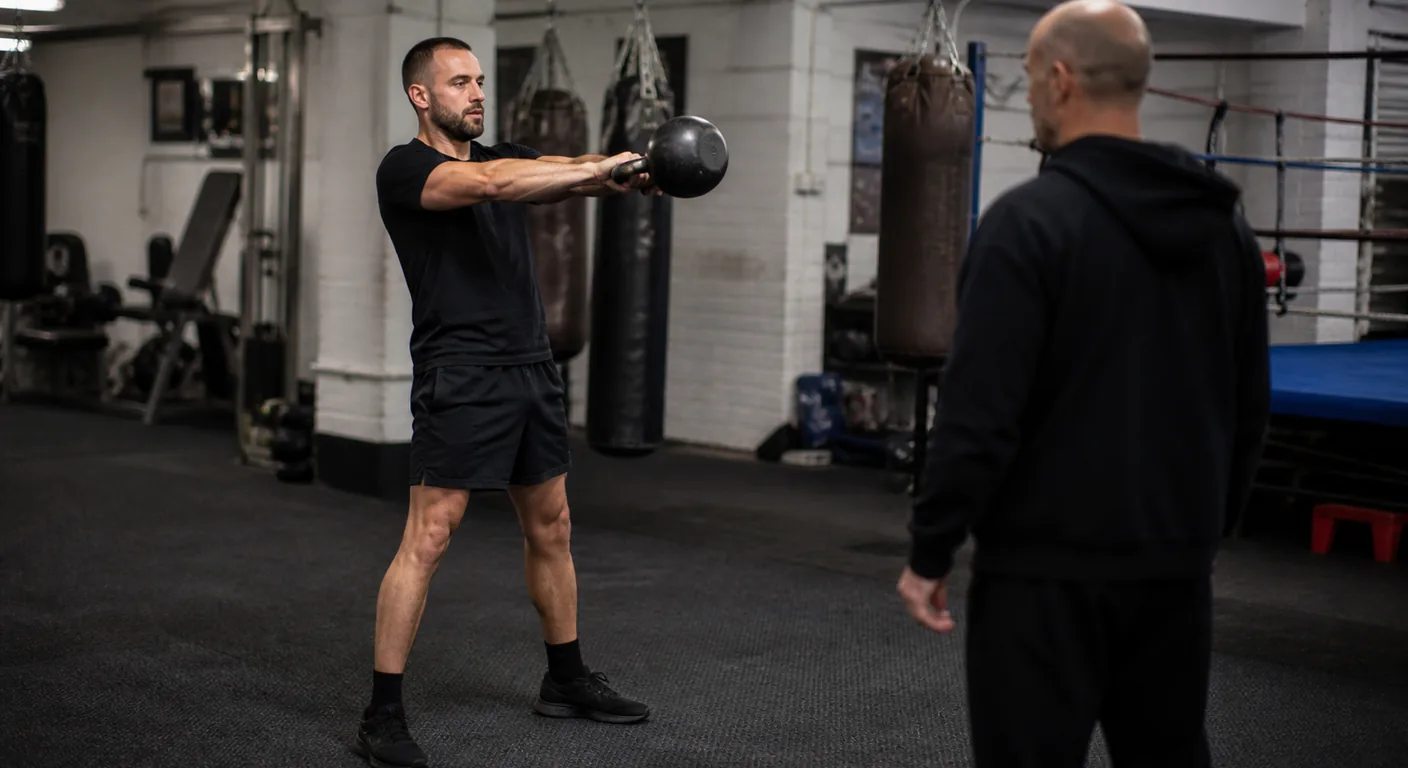
A kettlebell swing is not a punch with a weight in your hands.
That distinction matters. The swing can teach a boxer to load the hips, brace the trunk and stand up with intent. It cannot replace pads, bag work or a coach correcting the way you transfer force into an actual punch. Treat it as strength and conditioning, not a shortcut to a heavier right hand.
Used well, it is a simple drill with a useful question behind it: can you create force from the floor and hips without losing your posture?
Watch the short demonstration below, then use the coaching notes to decide whether the swing belongs in your own training.
The swing is a hip hinge, not a squat
The first error is turning every swing into a squat with the bell held in front of the knees.
A squat asks the knees to bend and the torso to stay fairly upright. A swing starts with the hips travelling back. The knees bend, but only enough to let the hips load. The chest tips forward as one firm piece, the spine stays long, and the bell passes between the thighs because the hips have made room for it.
Then the hips drive forward. The bell rises because the body has stood up quickly, not because the arms have lifted it.
That is why a swing can be useful alongside boxing. Punching uses a different shape and a different end point, but both ask the body to create force through the floor, legs and trunk rather than flicking the arm by itself. A study of lower-limb kinetics in boxing found that lower-body force generation, particularly rear-leg drive, is important for punch effectiveness and fatigue resilience.
The gym translation is modest: learn to use the hips without letting the arms or lower back take over.
Start with a dead-stop hinge
Do not begin by chasing a smooth, fast set of swings.
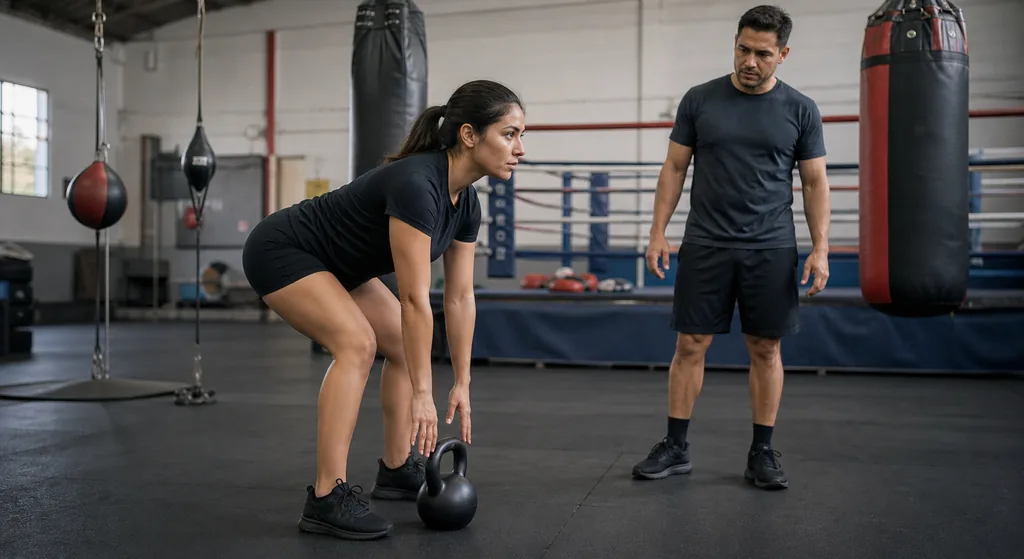
Start with the bell on the floor a little in front of you. Stand with the feet about hip-width apart. Push the hips back, reach for the handle with both hands and pull the shoulders gently down away from the ears. Your shins should not travel far forward. Your weight should feel spread through the feet, not dumped on the toes.
Before the first swing, tighten the middle of the body as if you are about to take a light body-shot cue on the pads. Then pull the bell back between the legs and stand up sharply through the hips.
At the top, finish tall. Squeeze the glutes, keep the ribs from flaring and let the bell float only as high as the hip drive carries it. For most people, that is somewhere between the waist and chest. You do not need to pull it overhead.
Pause. Put the bell down. Repeat.
That dead-stop version teaches the part that matters most: each repetition begins from a recognisable position. If you cannot make the first repetition tidy, doing twenty faster ones will not repair it.
Keep the arms connected but quiet
The arms have a job in the swing, but it is not to haul the bell upwards.
Think of them as straps. They keep the bell connected to the body while the hips produce the movement. If the shoulders shrug, elbows bend early or the bell flies high because the arms are pulling, the drill has changed. You are no longer using a clean hinge. You are turning it into a loose front raise.
A study comparing different kettlebell swing styles found that the hip-hinge version produced the greatest hamstring activity of the styles tested (PubMed study on kettlebell swing styles). That does not make it a magic boxing exercise. It does explain why the setup matters. The movement is supposed to load and release the back of the legs, not tire the shoulders by lifting a weight badly.
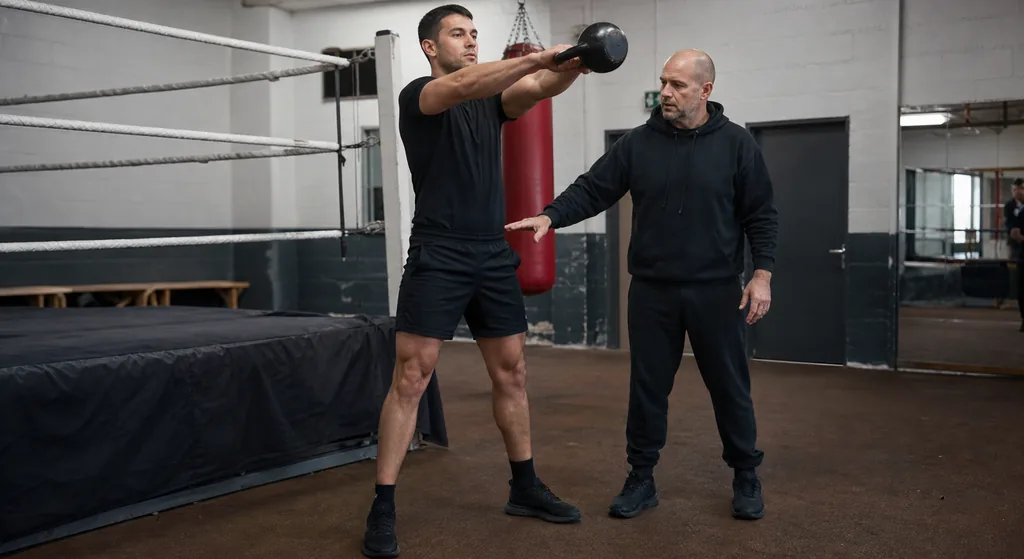
A coach should be able to watch from the side and see three things:
- the bell moves because the hips move
- the arms stay long until the bell is already travelling
- the body finishes stacked, not leaning backwards
If any one is missing, reduce the weight or return to the dead-stop hinge.
Do not chase height or speed
A high swing looks impressive. It is rarely the point.
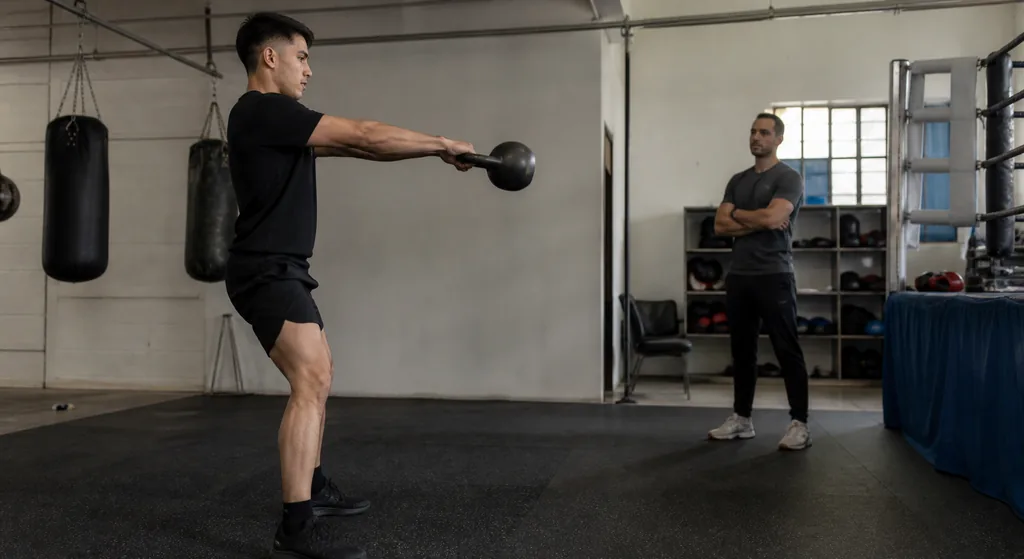
When the bell rises above shoulder height, many beginners pull with the arms, arch the lower back or lose the rib position. The movement becomes noisier, but not necessarily better. A solid chest-height swing with a clean hinge and controlled return is worth far more than a wild overhead rep.
The same rule applies to speed. You want intent through the hips, but a good swing still has a clear reset on the way down. The bell comes back under control, the hips travel back again, and the boxer keeps enough tension to own the next repetition.
Do not confuse a fast bell with a good rep. A fast bell can be the result of poor timing, a loose back or a weight that is simply too light to teach anything useful.
This is close to the lesson in setting your feet in boxing. You do not create power by becoming uncontrolled. You create it by finding a stable position, applying force and recovering quickly enough to repeat the action.
Where bands fit, and where they do not
A banded kettlebell swing adds resistance near the top of the movement. That can make the lockout feel more demanding and can expose whether the boxer is finishing with the hips or only lifting with the arms.
It is not a beginner exercise.
Bands also pull the bell back down more quickly. If the hinge is not reliable, that extra return can turn a simple drill into a rushed one. The boxer starts absorbing the bell with a rounded back, loses the hip position and repeats a bad pattern at speed.
Earn the banded version in this order:
- Learn a bodyweight hip hinge.
- Learn a dead-stop kettlebell swing.
- Keep the same shape through a short set of regular swings.
- Let a coach check whether the bell is controlled on the return.
- Only then consider a light band setup.
The band is not the progress. Better timing and better shape are the progress.
Put swings in the right part of a boxing week
A swing can fit well after a technical session or on a separate strength day. It does not belong immediately before a hard sparring session if it leaves the hamstrings, grip or lower back tired enough to spoil footwork and posture.
Keep the first sessions short. Use a weight you can control. Stop when the hinge gets shallow, the lower back starts doing the work or your hands begin to tear at the handle. More fatigue does not always mean more useful training.
For a recreational boxer, two or three tidy sets after a coached class can be enough. For a competitive boxer, the exact loading belongs inside a wider strength plan, not copied from a video without context.
Our guide to strength training for boxing explains the wider picture. Strength work should support the boxing, not make tomorrow's training worse.
Four mistakes that make swings a poor choice
The first is squatting the bell instead of hinging it. If the knees push far forward and the hips barely move, go back to bodyweight hinges.
The second is lifting with the shoulders. If your upper traps are burning more than the hips and hamstrings, the arms are doing too much. Keep them long and let the hips start the bell.
The third is leaning backwards at the top. Finish tall with the ribs down. Do not turn the lockout into a back bend.
The fourth is adding bands, speed or a heavier bell before the basic movement is tidy. Progression should make the same skill harder, not replace it with a different and messier exercise.
The coaching cue
Hips back, hips through, ribs down.
That is enough to remember. A swing should teach you to load the hips, stand up powerfully and return to a controlled hinge. It should not make your back ache, pull your shoulders forwards or persuade you that strength work is the same thing as boxing technique.
If you train in Kidbrooke, Greenwich or nearby, our Recreational Adults boxing classes use strength and conditioning to support proper boxing. The aim is not to collect exercises. It is to build a body that can hold stance, move well and keep its shape when training gets demanding.
H&G Team
Writer at Honour & Glory Boxing Club, a community boxing gym in Kidbrooke, South East London.
KEEP READING
Should You Lift Before or After Boxing?
Train boxing or lift weights first? Use this practical guide to protect your technique, manage fatigue and make both sessions useful.
Does Boxing Build Muscle? What to Expect
Will boxing training build muscle? Yes, but probably not the kind you are imagining. Here is what actually happens to your body when you train boxing regularly.
Landmine Rotations for Boxing
Use landmine rotations to train a steady base and deliberate trunk turn without mistaking a strength drill for a punch.
Was this page helpful?
It takes one tap, and it genuinely helps.
Choose your next step
Turn this article into the right action
Some readers are ready to book. Some need the class route first. Pick the route that matches what you actually want.