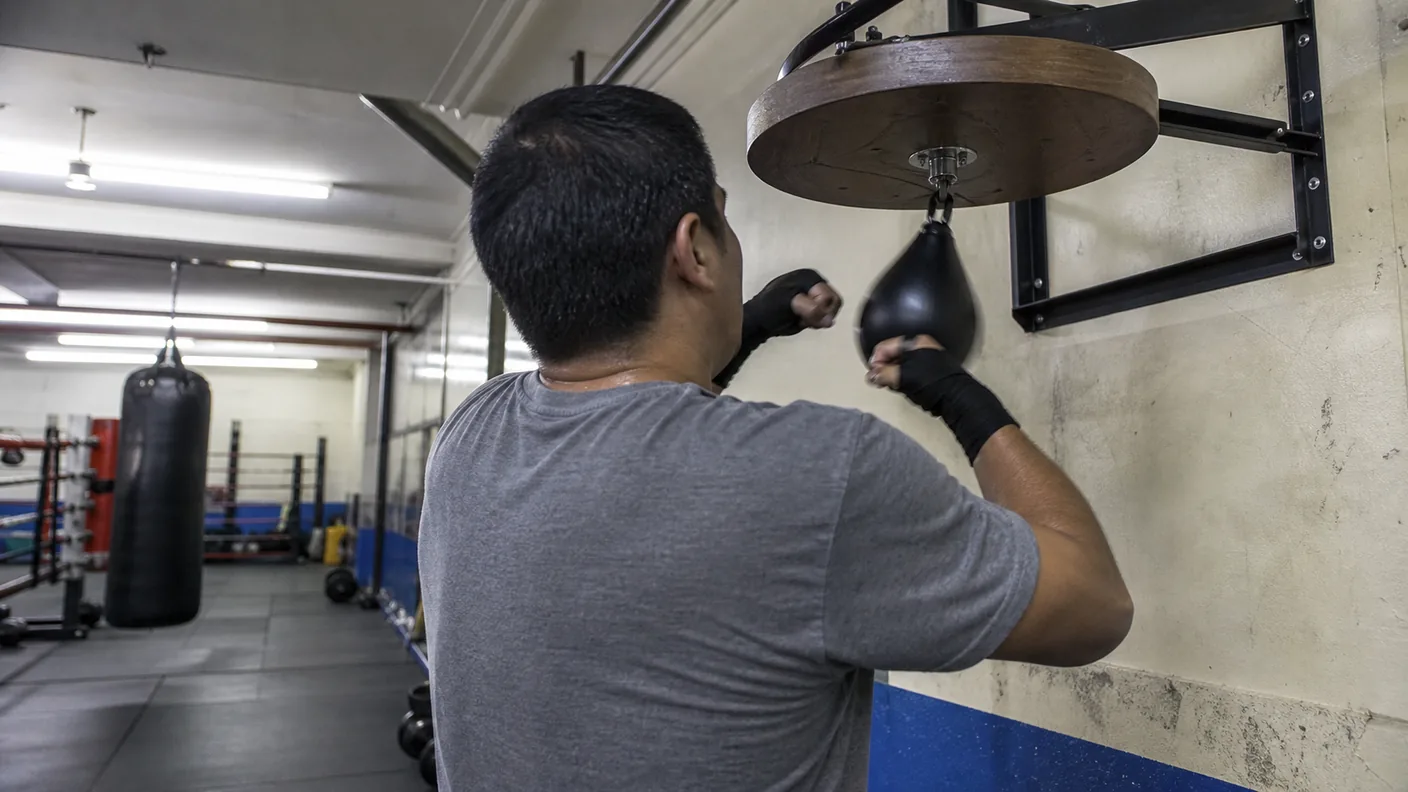
When the speed bag starts swinging sideways, most beginners make the same mistake: they step away from it and try to catch it with longer arms.
That feels sensible for about two seconds. You can see more of the bag, so surely you have more time. In practice, the extra space makes the hand travel further, the timing gets worse and the bag starts darting across the board like it is avoiding you. The harder you chase it, the less control you have.
The fix is not a quicker hand. It is a shorter path. Stand close enough that the bag stays in front of your face, keep the hands in the same small working area and let the rebound tell you when the next contact is due.
Watch the short demonstration below, then use these coaching points to make a speed bag round feel controlled rather than frantic.
The bag should come back to you
A speed bag is not a target you throw your arm at from across the room. It is a moving object on a predictable rebound. Your job is to make clean, light contact, then be ready in the same area when it returns.
That means the bag should stay close to you. Stand near enough that your forearms can work with a relaxed bend in the elbow. If you need to straighten the arm fully to touch it, you are too far away. If your shoulders are climbing towards your ears, you are probably trying to reach up or forward instead of letting the hand make a small circle.
The useful position is compact. Your chest is tall, knees have a slight bend and your eyes look through the bag rather than down at your own knuckles. One hand makes contact while the other waits just underneath, ready for its turn.
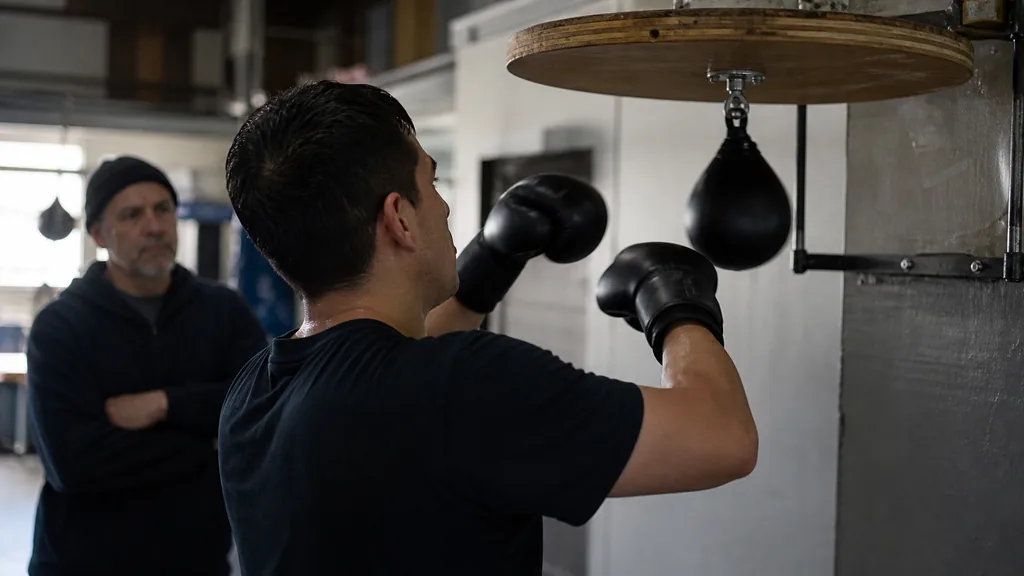
Why stepping back makes control harder
When you stand too far away, three problems arrive together.
First, each hand has farther to travel. A longer swing takes more time and gives you more chances to arrive early or late. Second, the arms start straightening, which makes the bag harder to guide. Third, your body begins leaning towards the target. Now the shoulders are working hard, the guard is nowhere near your face and the movement is no longer useful for boxing posture.
Keep the distance honest. The bag needs room to rebound, but you do not need room to perform a big circular swing. A small hand path is easier to repeat and easier to correct.
That does not mean you should crowd the board until the bag touches your forehead. You still need a clear view of the rebound and enough space for the hands to rotate comfortably. The point is to remove the unnecessary gap between you and the bag.
A review of visual skills in boxing identifies hand-eye coordination, reaction time and anticipation as important parts of the sport (boxing visual-skills review). The speed bag is not a substitute for seeing a real punch, but it is a useful place to practise watching a moving target without panicking when the rhythm changes.
Make the hand path smaller before making it faster
Speed bag work often looks fast because the hands travel very little.
Beginners usually do the opposite. They pull the hand away after every touch, then bring it back in a big loop. That turns a small timing task into a large shoulder exercise. The bag becomes unpredictable because the hand is arriving from a different place each time.
Start with the hand close to the bag. Use the heel of the palm or a relaxed, closed fist depending on the coach's instruction and the equipment. The contact should be light enough that you can feel the rebound rather than trying to overpower it.
After the touch, keep the hand nearby. Let the wrist and forearm make a compact circular route. The other hand stays ready beneath the bag, not hanging by the ribs. There is no prize for making the movement look theatrical.
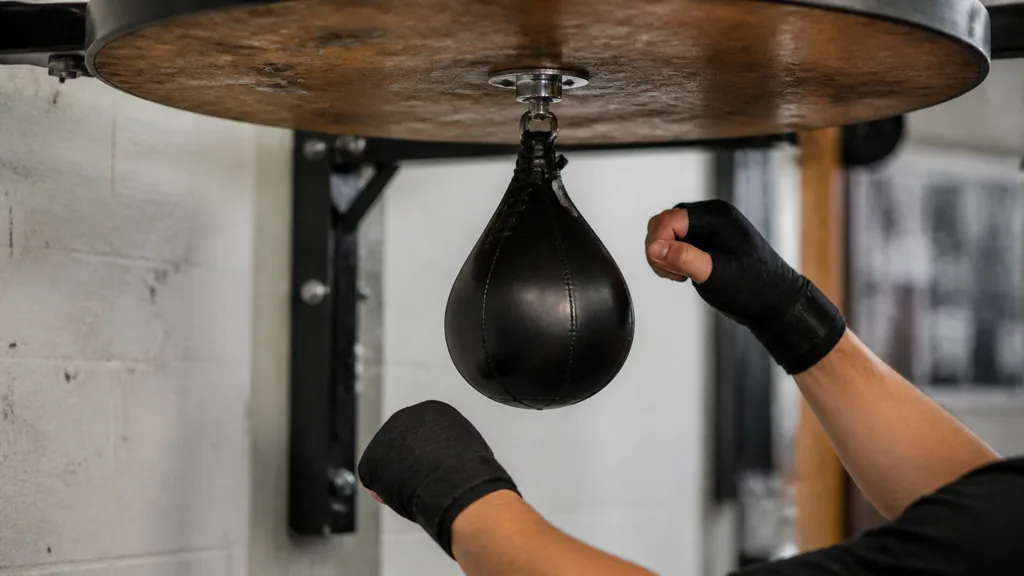
Let the rebound set your tempo
The speed bag has its own answer after every strike. It rebounds from the board, comes back through the centre and gives you the next moment to touch it. If you are trying to force a rhythm before you can see that answer, the bag will soon be swinging sideways.
Begin with one hand. Make one gentle contact, watch the bag complete its rebound and use the same hand again. Do not rush to alternate hands because you think that is what speed bag work is supposed to look like. One clean pattern is more useful than twenty noisy misses.
Once the single-hand rhythm is reliable, use two contacts with the right hand, then two with the left. This gives the body time to learn where each hand waits and how the bag returns. Only then move towards a more regular alternating pattern.
The cue is simple: touch, watch, meet it again.
A study of male amateur boxers found that visual measures including eye-hand coordination and reaction time related to punch performance in competition (visual ability and punch performance). That does not make the speed bag a shortcut to better fighting. It does explain why controlled visual attention belongs in ordinary boxing practice alongside footwork, pads and defensive drills.
Three rounds to stop chasing the bag
Work these at a pace where the bag stays under control. If it begins to swing wildly, stop, settle it and return to the earlier round. Do not try to rescue a bad pattern by hitting harder.
Round one: one hand, one spot
Use the dominant hand only for one minute. Stand close, bend the elbow slightly and make light contact from the same area each time.
Your only job is to keep the hand path short. If the bag drifts sideways, do not reach across your body to save it. Let it settle, then begin again with smaller movements.
Round two: two touches, then switch
Use two clean contacts with the right hand, then two with the left. Keep the non-working hand waiting near the bag, not dropped to your side.
This is where many people start stepping back. Resist it. If the bag is getting away, shorten the circle and soften the contact. Distance does not solve a timing problem.
Round three: add a quiet stance check
Work the same two-and-two pattern while checking the rest of your boxing shape. Keep the chin neutral, shoulders relaxed and feet under you. Every ten seconds, pause for one beat with both hands near face height, then restart.
The pause matters. It prevents the bag from turning into a separate skill where your arms are busy but your posture has disappeared. Our guide to punching without dropping your guard covers the same broader habit: the hands can move without leaving the rest of you unprotected.
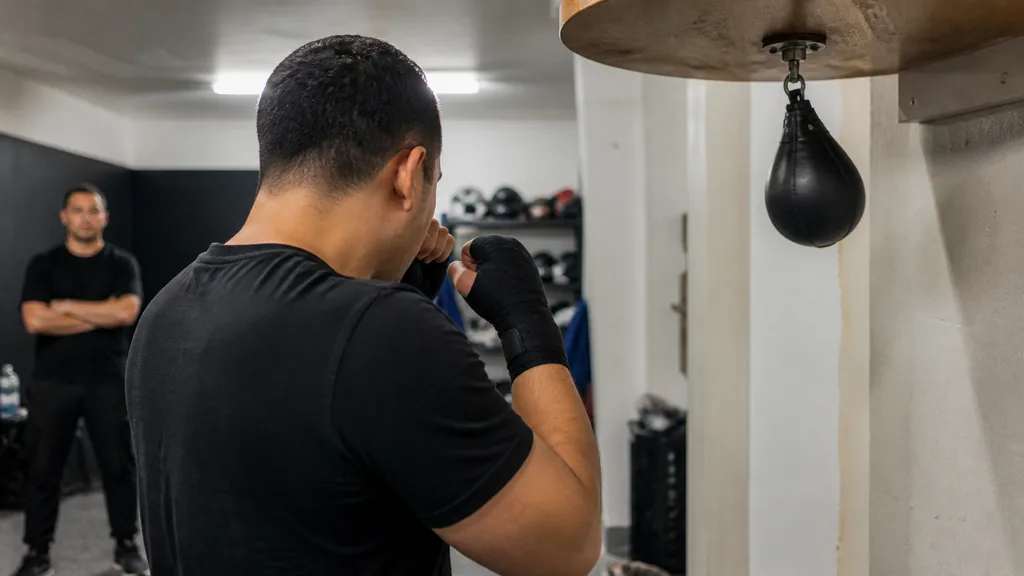
Keep the shoulders quiet
Sore shoulders are normal when you are new to the speed bag. Shoulders burning after thirty seconds because you are trying to hold the arms high and swing from the elbows is a different problem.
Watch for two signs. The first is the shoulders rising towards the ears. The second is the elbow opening and closing dramatically on every hit. Both usually mean the hands are too far from the bag or the rhythm has become a strength contest.
Let the shoulder stay relaxed. The forearm and wrist guide the small circle, while the upper arm remains quiet enough that you could stop and put both gloves back into a compact guard. A full round will still challenge the shoulders, but it should do so through steady work rather than tension.
For another moving-target drill, the floor-to-ceiling ball guide is useful once the speed bag rhythm feels settled. The two tools ask different questions. The speed bag rewards an even rebound pattern. The floor-to-ceiling ball makes you judge a less predictable line. Neither is a substitute for coached partner work, but both can sharpen attention when used properly.
Common mistakes that keep the bag out of reach
The first mistake is standing too far away. If your arm is fully straight when you touch the bag, step closer.
The second is trying to hit hard. A harder strike does not make a beginner more accurate. It normally sends the bag into a faster, messier path that is even harder to read.
The third is watching the hands. Your hands are close to you. The bag is the moving information. Keep your eyes on its travel and let the hands work underneath your sight line.
The fourth is treating every miss as a reason to speed up. Slow down instead. A small, repeatable circle teaches more than a fast minute where the bag never settles.
The fifth is forgetting the rest of the stance. You are not trying to become a speed bag performer. You are building coordination while maintaining the posture and hand position that make boxing useful.
The coaching cue
Stay close. Keep the circles small. Let the bag return.
That is enough to change a frustrating first speed bag session. You do not need dramatic hands or a fast rhythm on day one. You need a position that lets you see the rebound, meet it calmly and repeat the same movement without chasing it around the board.
If you are in Kidbrooke, Greenwich or nearby, our Recreational Adults boxing classes give beginners time on bags, pads and coordination drills with a coach nearby to correct the details before they become habits.
H&G Team
Writer at Honour & Glory Boxing Club, a community boxing gym in Kidbrooke, South East London.
KEEP READING
Wrist and Hand Injuries in Boxing: Pain, Knuckles, Fractures and When to Stop
A careful, coach-led guide to wrist and hand pain in boxing: common causes, warning signs, boxer's knuckle, fractures, wrapping, rehab and return to training.
How to Prevent Boxing Injuries
Prevent common boxing injuries with proper technique, equipment, and training practices. Protect your hands, wrists, shoulders, and joints.

Clocks Go Forward: What Losing an Hour Does to Your Body
Losing one hour of sleep raises heart attack risk, slows reaction time, and wrecks your training. Here is how boxing helps you recover faster.
Was this page helpful?
It takes one tap, and it genuinely helps.
Choose your next step
Turn this article into the right action
Some readers are ready to book. Some need the class route first. Pick the route that matches what you actually want.