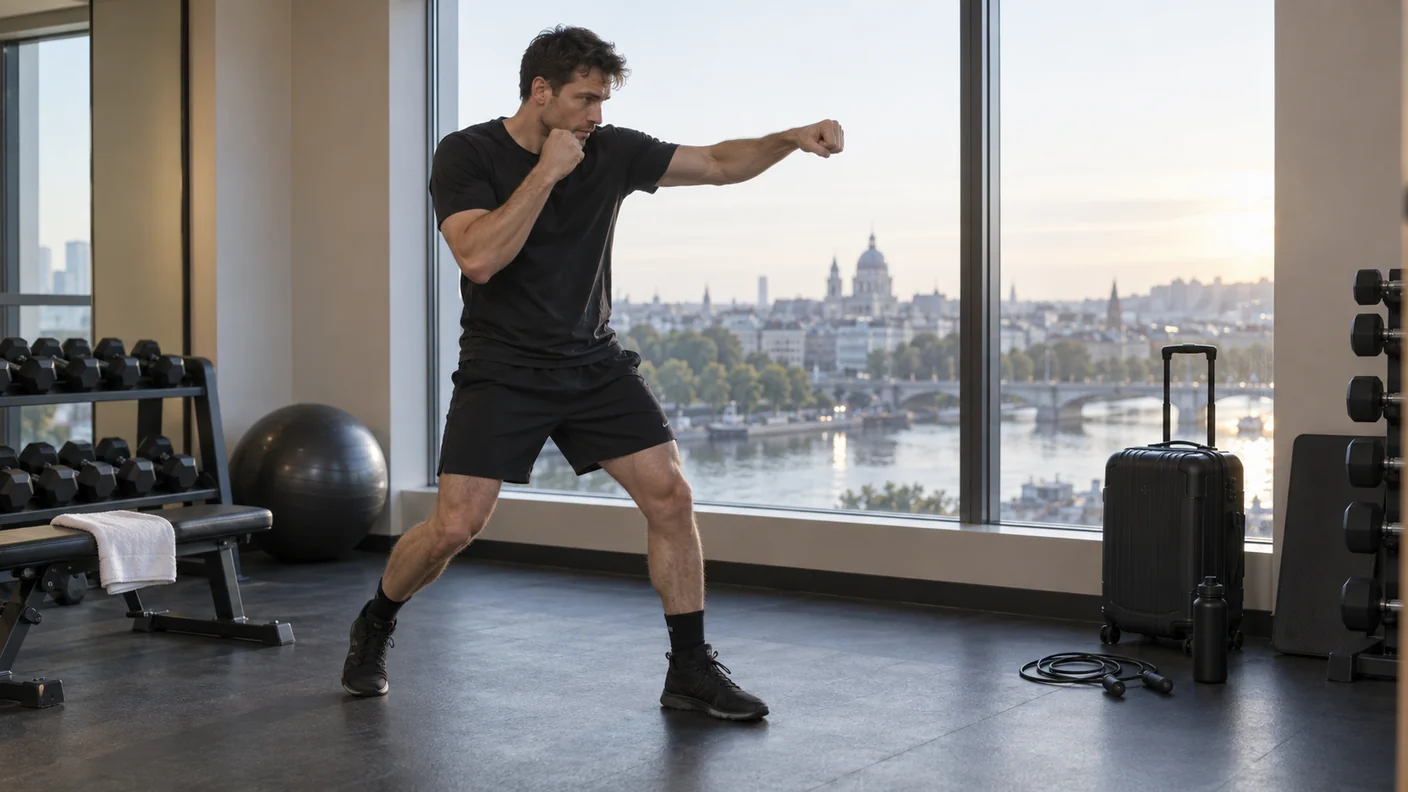
A few days away does not erase your boxing. It also does not need to become an awkward hotel-room boot camp where you are trying to prove something to a minibar.
The useful approach is smaller. Keep one or two habits alive, move well enough to feel like yourself, and come back ready to train rather than desperate to make up for lost time.
That matters because travel interrupts more than gym access. Sleep shifts, meals move around, walking totals change, and even a short trip can turn a normal week into a string of airports, family plans or long drives. The mistake is expecting a full boxing programme to survive unchanged. The better question is: what is the smallest amount of work that keeps the rhythm familiar?
Do not confuse a short break with lost fitness
The NHS recommends adults build towards 150 minutes of moderate activity each week, alongside strength work on two or more days (NHS exercise guidance). That is a useful health benchmark, but it is not a rule saying every trip needs a hard session.
For a boxer away for a weekend or a week, walking, swimming, a short shadow-boxing round and a little mobility can be enough to stop the body feeling switched off. The World Health Organization makes the same broad point: regular activity matters, and it is worth keeping some movement in the week even when the normal routine is broken (WHO physical-activity guidance).
The training mistake is trying to repay missed classes with one brutal session on a strange surface, in bad shoes, after poor sleep. That is how a light holiday turns into sore calves, a grumpy Achilles or a strained shoulder before you are back in Kidbrooke.
A short break is not lost ground. Treat it as a lighter week with a few useful touches of boxing.
Pack for a small session, not a fantasy camp
You do not need gloves, pads or a heavy bag in a suitcase. In fact, leaving the bag work alone is usually sensible. A hotel gym may have a bag, but you do not know its fill, how it is mounted or whether the gloves available have seen better years.
Pack trainers you trust, light clothing, a water bottle and, if you have room, a skipping rope. That is enough equipment for most people. If you are only taking cabin luggage, leave the rope at home and use your feet, breath and a timer instead.
The point is not to reproduce a club class. It is to retain familiar positions: stance, guard, balance, relaxed shoulders and a clean return to guard. The England Boxing Level 2 coaching handbook treats warm-up, bag work, skipping and running as core parts of a coach's toolkit (England Boxing coaching handbook). Away from the gym, you are keeping the low-risk parts of that toolkit available.
Use shadow boxing to keep the boxing feeling alive
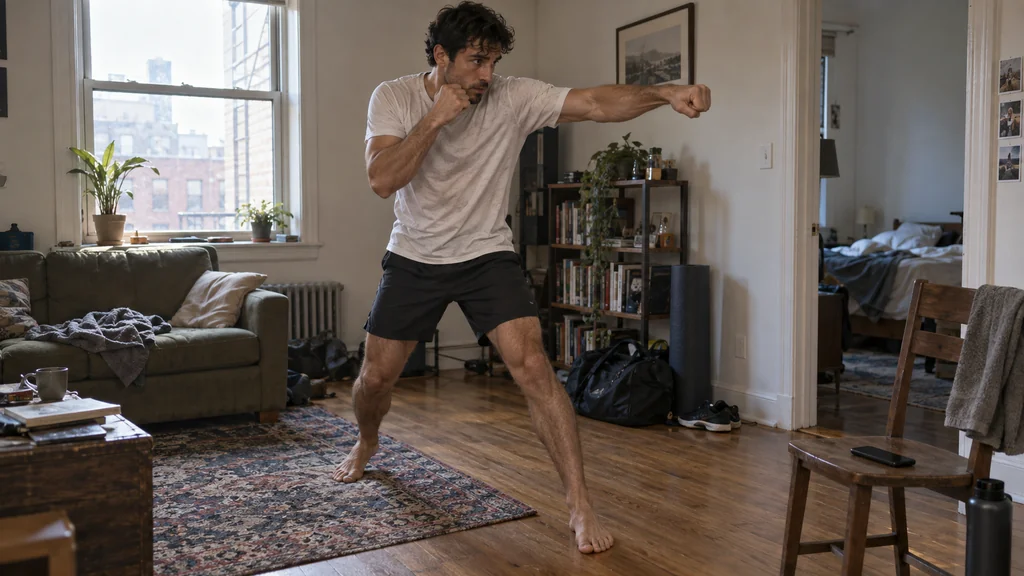
Shadow boxing is the best travel tool because it needs little space and exposes bad habits quickly. There is nowhere to hide a crossed stance, a wandering rear hand or a jab that pulls your head forward.
Keep it simple. Choose one job for each round:
- Round one: jab and small steps. Keep the rear hand near your cheek and return the jab before moving again.
- Round two: jab-cross with a quiet reset after each combination. No rushing and no big power.
- Round three: defensive movement only. Slip, cover, step back or take a small angle, then return to a useful stance.
Two minutes per round is plenty when you are in a hotel room or a borrowed space. If the floor is slippery, the ceiling is low or somebody is sleeping downstairs, do not bounce, skip or throw big hooks. Stand still and work the upper body slowly, or go for a walk instead.
This is not a replacement for coached training. A mirror cannot tell you whether you are reaching for a pad or standing too close to a partner. But it can keep your awareness switched on. When you get back to class, the stance and rhythm feel familiar rather than foreign.
Our home boxing workout guide has a fuller no-equipment session if you have safe space and want more than a few short rounds. If you have only ten minutes, the simpler version is often better.
The 20-minute travel session
Use this once or twice during a normal trip. It should leave you clearer, not wrecked.
Start with five minutes of walking, easy marching or gentle mobility. Roll the shoulders, circle the hips, move the ankles and let the body warm up before you ask it to punch quickly.
Then do four two-minute rounds with one minute of easy walking between them:
- Jab and step. Touch the air with a relaxed jab, bring it home and move your feet without crossing.
- Jab-cross and reset. Throw each shot cleanly, then stand back in balance before the next one.
- Guard and movement. Cover, slip or step away from imagined punches. Keep your eyes up.
- Choose your weak spot. It might be a tidy left hook, a calmer exhale or not looking at the floor.
Finish with three minutes of easy movement. Walk around the block, stretch lightly or simply breathe until the heart rate settles. The session is done when you still feel as though you could do another round. That is deliberate.
Let walking do more work than you think
Travel can create a strange split. Some people sit for hours in a car, train or plane. Others walk all day without noticing. Either way, a purposeful walk is often the best addition to a light boxing session.
Walk after breakfast, use a route that takes you through the place you came to see, and give your hips and calves a chance to move without impact. If you have been seated for a long stretch, do not step outside and start throwing hard kicks at imaginary opponents. Walk first, loosen up, then decide whether a few slow boxing rounds would help.
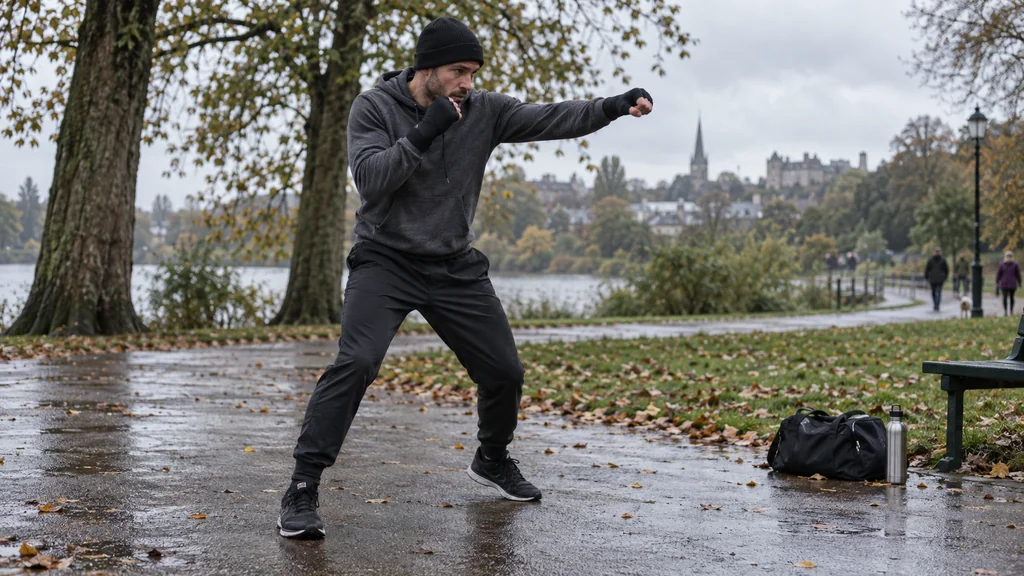
If you find a quiet park or open space, shadow box at low intensity. Keep the session technical rather than theatrical. You are not filming a montage. You are keeping the body organised.
What to leave until you are back at the club
Leave hard bag rounds, all-out skipping, sprints and serious conditioning for a familiar space. Travel already adds variables: unfamiliar surfaces, poor sleep, unusual food, long sitting and a timetable you do not control.
The same goes for trying to learn a new combination from a video. New technical work is easier to get wrong when you are tired, alone and keen to do more than you need. Keep travel training to skills you already understand, then let a coach add the next layer when you are back.
If you are returning from a longer break rather than a few days away, do not expect the first class to feel perfect. Our guide to boxing after a week off explains why a sensible first session back beats trying to prove you have not missed anything.
Come back ready, not guilty
Good training is built around months, not flawless weeks. A few days away can give your hands, shoulders and head a break while you keep enough movement to avoid that stiff first-session feeling.
Pick one or two short sessions. Walk more than usual if you can. Do not chase sweat for its own sake. Then return to proper coaching with something left in the tank.
If you are in Greenwich or nearby and want a regular place to build those habits, our Recreational Adults boxing classes give you the coached work that travel sessions cannot replace.
H&G Team
Writer at Honour & Glory Boxing Club, a community boxing gym in Kidbrooke, South East London.
KEEP READING

Boxing Recovery Tips After Training
Recovery tips for boxers after training. Learn what to eat, how to stretch, when to rest, and how to bounce back faster between sessions.
Gym or Boxing: Which Is Better for Fitness?
A practical answer to whether a gym or boxing is better for fitness, weight loss, confidence and long-term consistency.
Clocks Go Forward: What Losing an Hour Does to Your Body
Losing one hour of sleep raises heart attack risk, slows reaction time, and wrecks your training. Here is how boxing helps you recover faster.
Was this page helpful?
It takes one tap, and it genuinely helps.
Choose your next step
Turn this article into the right action
Some readers are ready to book. Some need the class route first. Pick the route that matches what you actually want.