Troy Williamson vs Callum Simpson: why British titles matter
Troy Williamson vs Callum Simpson II: Why British Titles Still Matter
A British title fight should make a boxer uncomfortable. That is the point.
It should put a capable fighter in with somebody who knows the same tricks, has earned the same hard miles and is not arriving to make up the numbers. It should ask whether the favourite can think when a game plan breaks down, whether the challenger can perform in hostile territory, and whether either man can keep making sound decisions when the arena gets loud.
That is why Troy Williamson versus Callum Simpson II matters.
On 8 August, Williamson and Simpson meet again at Leeds’ First Direct Bank Arena, with the British and Commonwealth super-middleweight titles on the line. The official BOXXER event listing has it as a major summer rematch, while ESPN’s fight guide confirms the return bout will be shown live in the UK on DAZN.
Those facts alone do not make it important. The first fight does.
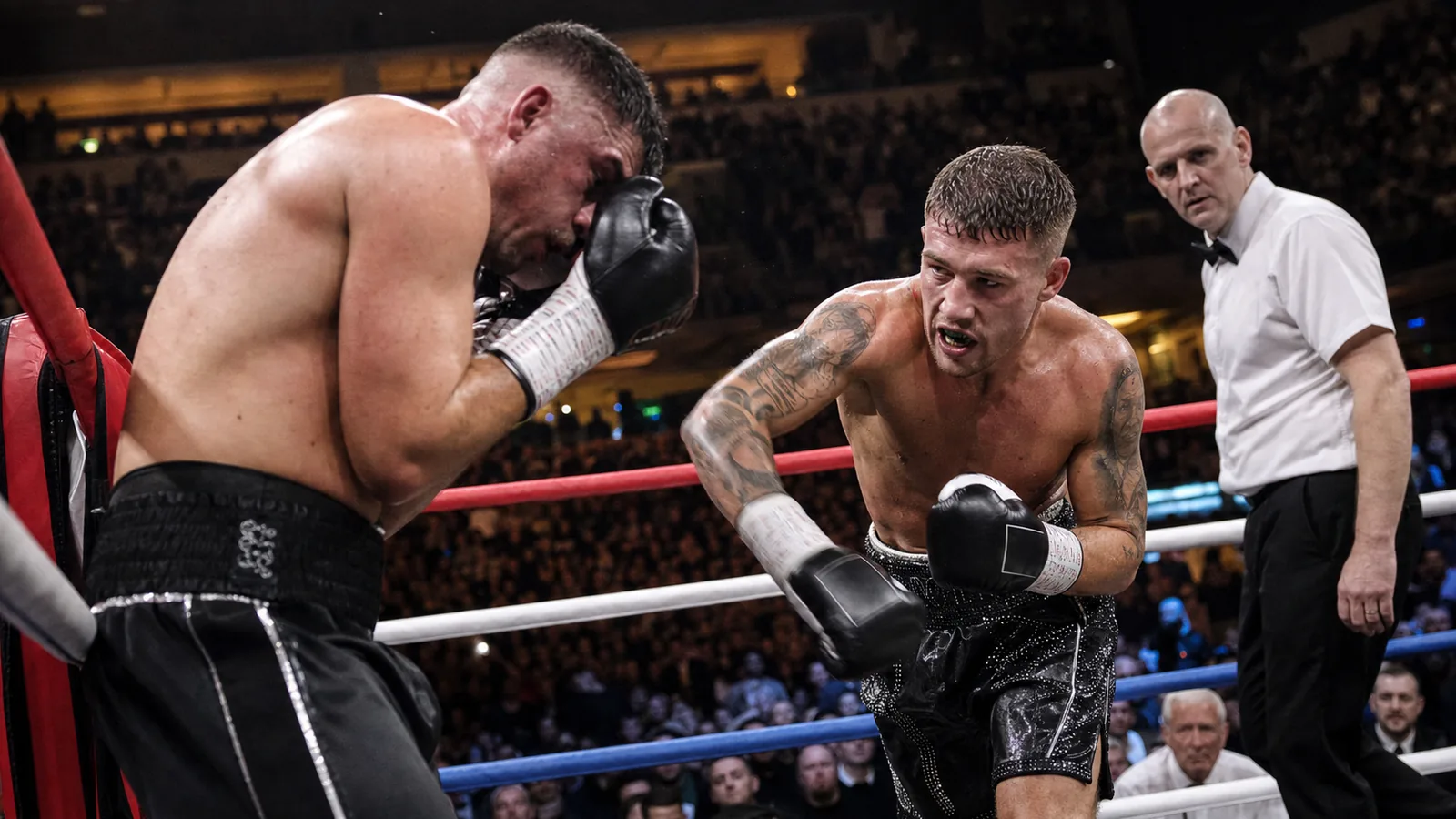
In December, Williamson travelled into Simpson’s Leeds backyard and stopped the local favourite in the tenth round. Simpson had been supported throughout by a full-blooded Yorkshire crowd, and appeared ahead on the scorecards, before Williamson changed the fight with his right hand. The finish was brutal and decisive: four knockdowns in the tenth, with the referee stepping in after Simpson was left defending without his mouthguard. BBC Sport’s report captured the significance clearly. Williamson won the British, Commonwealth and European super-middleweight titles, while Simpson suffered his first professional defeat.
That is domestic boxing at its best. No protective matchmaking. No soft route around a difficult rival. No illusion that a good record alone answers the serious questions.
The first fight answered the questions that records cannot
Callum Simpson is not a manufactured name. He built a real following in Barnsley, sells tickets, fights with intent and had become one of the more marketable fighters in the British super-middleweight division. His Box.Live profile records the progress that made the Williamson meeting attractive in the first place.
Yet a rising record is not the same as proof of readiness.
Williamson brought something different to Leeds. He was the older man, a former British light-middleweight champion, and he had already been through career turns that show up in a fighter’s judgement. He entered the first bout after three defeats in five contests, which made him easy to underestimate. But experienced fighters can be dangerous when the stakes are clear. They understand what a title can change, and they understand that a young home fighter carries pressure as well as support.
For nine rounds, Simpson looked as though he was doing enough. Then the fight became a test of recovery, composure and decision-making. Williamson saw the opening, trusted the overhand right that had troubled Simpson throughout, and refused to let him settle after the first knockdown.
That is not simply an upset. It is a lesson in why a properly matched domestic title contest has more value than a padded run of showcase wins. Simpson was competitive, talented and backed by his people. Williamson still found a way to take the fight away from him.

A home crowd can lift a fighter, but it can also raise the temperature
British boxing has always understood the power of place. A packed leisure centre, a civic hall or a major arena can change the whole feel of a contest. Fans know the fighter’s walkout music, know the family, know the gym and often know exactly how many tickets the boxer has shifted himself.
Simpson had that in Leeds. The crowd sang for him throughout the first fight, and after the defeat he took the microphone to thank supporters who had stayed behind. That response mattered. A boxer needs a fanbase when things are going well, but he learns what it means when they remain loyal after a difficult night.
Williamson, meanwhile, had to walk into that atmosphere and operate as the away fighter. That is a proper part of title-level development. Boxers who hope to move beyond Britain cannot expect every important contest to take place in a friendly arena. They may have to cross the country, cross a border or cross an ocean. They may have to hear thousands of people celebrate every jab that lands against them.
The British title gives them a version of that pressure before world level.
A fighter can look relaxed when the crowd is quiet and the opponent is selected to lose. It is much harder to stay patient while boos arrive after a close round, while the opponent’s supporters react to every exchange and while the sense of occasion starts dragging at the shoulders.
Williamson did it in December. Simpson now has the chance to show what he learned from it.
The belts are not souvenirs
There is a lazy argument that domestic titles are merely stepping stones, as though that makes them less meaningful. It is the opposite. A British title is valuable because it has to be earned against someone with enough ability to expose a fighter’s weak points.
The Commonwealth belt adds another layer. It carries a history that reaches beyond one town or one promotional stable, and it has long been a serious marker for fighters preparing for European or world opportunities. Winning either belt says more than winning an international trinket against an unknown opponent with a glossy record.
It says a fighter has accepted a meaningful risk.
Williamson’s first win over Simpson was a reminder that belts can bring out a different version of a boxer. The title gave him a target, but it also gave the fight an edge that a routine non-title bout would not have carried. Simpson had something real to defend. Williamson had something real to take. Both men had reputations exposed to a live crowd.
That is why the rematch has genuine tension. Simpson has insisted that he was not at his best and believes he can reverse the result. Williamson has made it clear that he sees the first win as proof, not fortune. BOXXER’s announcement of the DAZN show presents it correctly: this is a rematch born from a fight that changed both men’s standing.
The BBC’s programme page for the first meeting is worth revisiting because the finish tells the story without much need for argument. Simpson was winning rounds. Williamson was still dangerous. A title fight can turn in seconds when one man keeps belief in his tools and the other gets caught between attack and defence.

What Simpson must prove in the rematch
The second fight is not only about whether Simpson can beat Williamson. It is about whether he can respond to a defining loss with the right adjustments.
He does not need to become a different fighter. That is often the mistake after a stoppage defeat. A fighter starts trying to box like somebody else, loses the qualities that made him effective and becomes hesitant. Simpson needs to retain his aggression and his body work, while showing better control of distance against Williamson’s right hand.
He also needs to prove that the occasion will not rush him. The crowd will again be on his side, but a homecoming can create urgency. If Simpson tries to repay Leeds in the first three rounds, he may give Williamson the type of exchanges he wants. The smarter response is to make the ring bigger, build the rounds and force Williamson to work for every clean shot.
Williamson’s task is equally clear. He has the confidence of the first victory, but rematches punish complacency. Simpson knows now exactly how dangerous the overhand right can be. The champion has to create new routes to it, use feints well and ensure that he does not spend the early rounds waiting for a repeat of December.
The European title is no longer part of the second contest after Williamson vacated the belt, but that does not weaken the fight. In one sense, it sharpens it. The British and Commonwealth belts remain the core prize, and the more important question is still unanswered: who is the better super-middleweight when both men know exactly what the other can do?
The right route is not always the easy route
Young fighters are often told to think about world titles before they have fully established themselves at home. There is ambition in that, which is healthy. But ambition without hard domestic tests can leave a boxer underprepared when the level rises.
A British title bout provides many of the things world-level boxing demands: a good opponent, a big occasion, media attention, pressure from supporters and consequences after the final bell. It asks whether a fighter can win when there is nowhere to hide.
That applies far below professional championship level too. At every serious stage of boxing, development comes from honest tests. A boxer learns from opponents who can make them think, not only opponents they can overwhelm. At Honour & Glory, our boxing classes build that foundation from age 7 onwards: sound technique, composure, respect for the sport and the willingness to keep learning when a round does not go your way.
Williamson versus Simpson II is not a world title fight. It does not need to be.
It is two proven British fighters meeting again after one of them travelled into the other’s city and changed the story in ten rounds. It has a champion who has already shown he can handle the hostile arena, and a challenger who has to show he can carry a loss without being defined by it.
That is exactly what the British and Commonwealth titles should represent. Not a consolation prize. Not a line on a poster. A serious examination of whether a fighter is ready for the next level.
H&G Team
Writer at Honour & Glory Boxing Club, a community boxing gym in Kidbrooke, South East London.
KEEP READING

Pat Brown vs John Hedges: British cruiserweight title route
The September 19 clash is more than an unbeaten-record contest: the vacant British and Commonwealth titles offer a direct domestic route in a cruiserweight division with real movement at the top.

Bivol vs Callum Smith order: what mandatories teach
The Bivol-Callum Smith order shows how mandatory challengers pressure champions before a punch is thrown.
WBO orders Sheeraz vs Janibek: what a title fight would settle
A mandatory order turns middleweight speculation into a defined route. Explain what a 20-day negotiation window means, why the belt matters and the contrast in their styles without treating a fight as signed until contracts are confirmed.
Was this page helpful?
It takes one tap, and it genuinely helps.
Choose your next step
Turn this article into the right action
Some readers are ready to book. Some need the class route first. Pick the route that matches what you actually want.