
The first rule of watching Misfits Boxing is to check the rules for the particular fight. That sounds obvious, but it clears up most of the confusion. Misfits is a promotion, not one universal rulebook: a conventional boxing contest, a shorter crossover bout and a tag-team attraction should not be treated as the same format.
There is no single answer to how many rounds a Misfits fight lasts. The promotion's own results archive includes three-, four-, five- and eight-round contests. The practical questions are the scheduled distance, the length of each round, the permitted equipment and how the winner will be decided.
Here is how to read those details, follow the scoring and avoid mistaking an event-specific rule for something that applies to every boxer on the card.
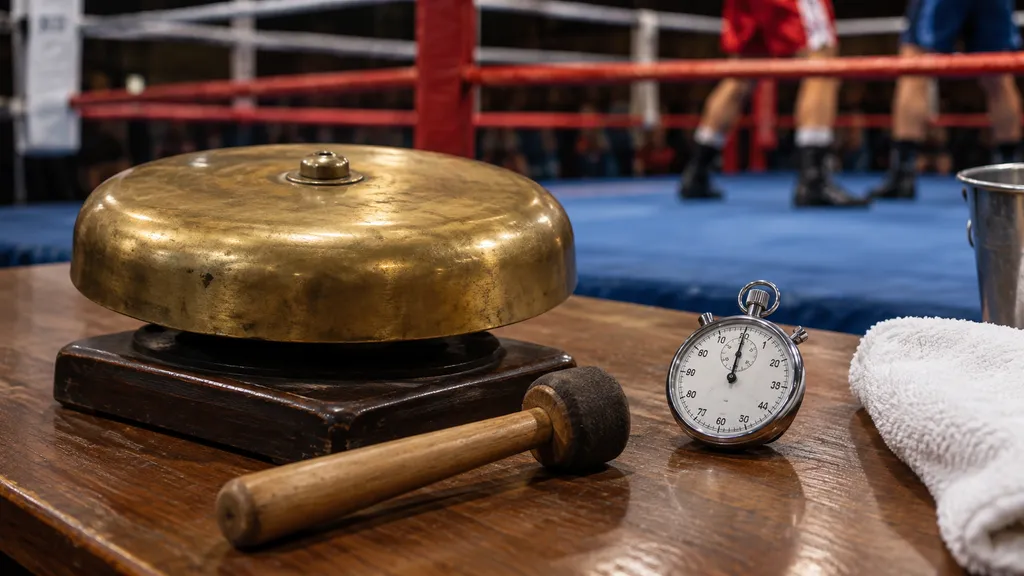
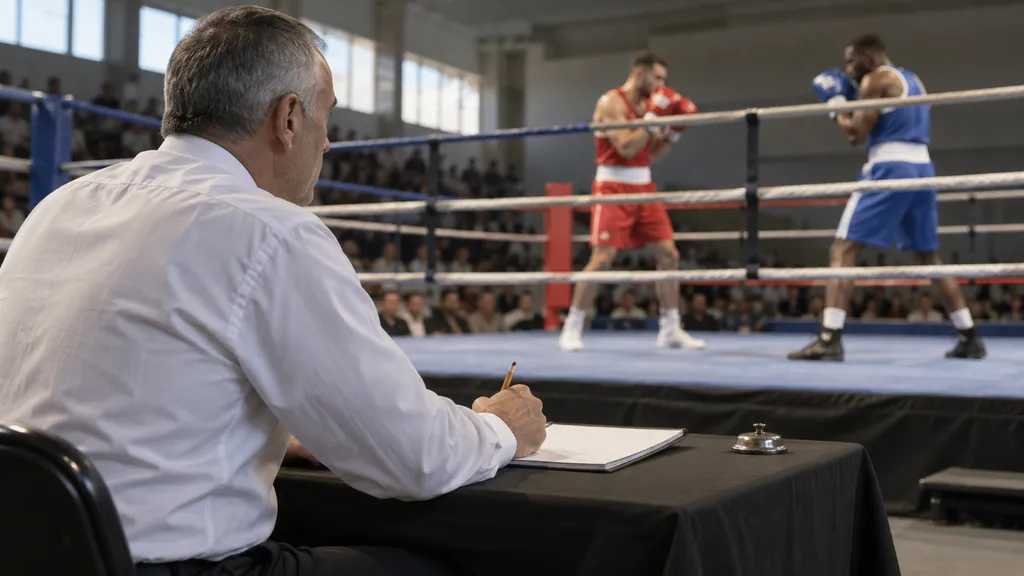
Images illustrate generic boxing scenes, not Misfits fighters or events.
How many rounds are there in Misfits Boxing?
Look at the individual matchup, not just the event poster.
At X Series 005, the official archive records Jay Swingler against NichLMAO as a four-round majority decision, while Astrid Wett against AJ Bunker went three rounds. At X Series 019, AnEsonGib against Slim went eight rounds, Jarvis against Ben Williams was scheduled for five, and Luis Pineda against Swarmz went three.
Those are completed examples, not a forecast for the next show. They demonstrate why a claim such as "all Misfits fights are four rounds" is wrong.
The distinction between scheduled distance and finishing round matters too. A result written as TKO 3/5 means a stoppage in round three of a planned five-round contest. It does not mean five rounds happened, or that the fight was originally scheduled for three.
Are the rounds two or three minutes?
Do not infer the round length from the number of rounds. Check the bout announcement and the on-screen clock when the contest begins.
For comparison, the Association of Boxing Commissions' regulatory guidelines specify three-minute rounds for men and two-minute rounds for women, with one-minute intervals. Two-minute rounds are therefore not unique to crossover boxing. These are professional-boxing reference rules, not proof that every Misfits attraction adopts them unchanged.
Four two-minute rounds contain eight minutes of scheduled boxing. Four three-minute rounds contain twelve. That difference changes how much time a fighter has to settle, recover from a poor start and work through a tactical problem. It does not make the shorter bout pretend boxing.
When assessing a performance, start with what was actually asked of the fighters. Winning a frantic short contest and controlling a longer fight are related skills, but they are not identical tests.
How do the judges score a boxing bout?
For a bout using the ten-point must system, the round winner normally receives ten points and the loser nine or fewer, before deductions. Judges score rounds, then add their totals. They do not simply choose whoever produced the most memorable moment of the evening.
The ABC's boxing judging guidelines identify clean punching, effective aggression, ring generalship and defence. Their examples include 10-9 for a round won through effective boxing and 10-8 for a round won with a knockdown. A dominant round can also justify 10-8 without a knockdown; the score is not just a knockdown counter.
Here is a hypothetical four-round card with no knockdowns or deductions. Red wins rounds one, two and four by 10-9. Blue wins round three by 10-9. The total is 39-37 to Red. Blue might have won the third round impressively, but that does not automatically erase three rounds lost narrowly.
Watching with a notebook helps. Write one reason for your choice after each round: cleaner jab, better counters, effective body work. "Looked busier" is worth questioning if most punches struck gloves or missed.
What do UD, SD and MD mean?
These abbreviations describe the judges' verdicts, not the size of the winning margin:
- Unanimous decision (UD): all three judges favour the same boxer.
- Split decision (SD): two favour the winner and one favours the opponent.
- Majority decision (MD): two favour the winner and one scores a draw.
A unanimous decision can still be close. Three judges can independently score a four-round fight 39-37. Conversely, one unusual scorecard can make an otherwise clear contest a split decision.
Read the actual totals when they are available. The abbreviation alone cannot tell you whether the judges disagreed about one difficult round or saw fundamentally different fights.
What counts as a foul or a stoppage?
An ordinary boxing bout permits punches, not the broader striking and grappling of MMA. An elbow or a takedown should not be excused because a competitor previously fought in another sport.
A KO commonly follows a failed count, but the referee may end a knockout immediately when urgent intervention is needed. A TKO can occur when a boxer cannot safely continue. A completed ten-count is not the sole distinction; use the official result. The ABC referee manual explains why continuing a count can be inappropriate in a clear knockout.
A disqualification is a rules outcome rather than a normal points defeat. A no contest is not another name for a draw.
The treatment of an injury caused by a foul depends on the applicable rules, including whether the foul was intentional and when the contest stopped. The ABC reference rules, for example, distinguish intentional-foul disqualifications from accidental-foul no-decisions and technical decisions. Do not lift one time threshold from that document and assume it applies to a differently scheduled crossover bout.
If a result is reviewed, use the regulator's final ruling rather than an early knockout clip. A punch landing dramatically does not establish that it was legal.
What about tag-team boxing and other formats?
Treat them as separately specified attractions, not permission to improvise during an ordinary contest.
The X Series 005 archive explicitly identifies its light-heavyweight tag-team matchup. The X Series 022 archive separately labels Dillon Danis against Warren Spencer as an MMA bout. The same event brand therefore does not even guarantee that every contest is boxing.
For a team or survival format, listen for who may enter, when a change is allowed, what eliminates a participant and whether the result belongs to an individual or a team. Those details must come from that event's instructions. A highlight montage rarely explains them adequately.
A useful checklist before the opening bell
Check these five things before judging a performance:
- The named sport and format: ordinary boxing, exhibition, team attraction or something else.
- Scheduled rounds and minutes per round.
- Contracted weight and announced glove requirements.
- How the result is decided, including any special scoring or elimination rules.
- The organisation regulating that particular contest.
Then watch the boxing rather than the follower counts. Who gets into range without falling forward? Who finishes an exchange in a position to defend? Who can follow a useful corner instruction after a difficult round? Those questions remain worthwhile even when the format changes.
Our Misfits Boxing explainer covers the promotion itself, while Misfits versus professional boxing explains the separate questions of records and belts.
If watching has made you curious about learning, our adult recreational boxing classes start with coached fundamentals. You do not have to enter a contest to understand the sport better. Book a free trial at Honour and Glory.
H&G Team
Writer at Honour & Glory Boxing Club, a community boxing gym in Kidbrooke, South East London.
KEEP READING

How to Get Into Misfits Boxing: A Realistic Route
Want to fight on Misfits? Understand crossover selection, the professional route, what to put in an approach, and why training must come first.

What Are the Queensberry Rules in Boxing?
The Queensberry Rules gave boxing gloves, timed rounds, the ten-count and a cleaner shape. They did not make boxing safe, but they made modern boxing possible.

What a Boxing Referee Actually Does and Why It Matters
The referee is the most important person in the ring but the least discussed. Here is what they are actually doing and why their decisions are harder than they look.
Was this page helpful?
It takes one tap, and it genuinely helps.
Choose your next step
Turn this article into the right action
Some readers are ready to book. Some need the class route first. Pick the route that matches what you actually want.