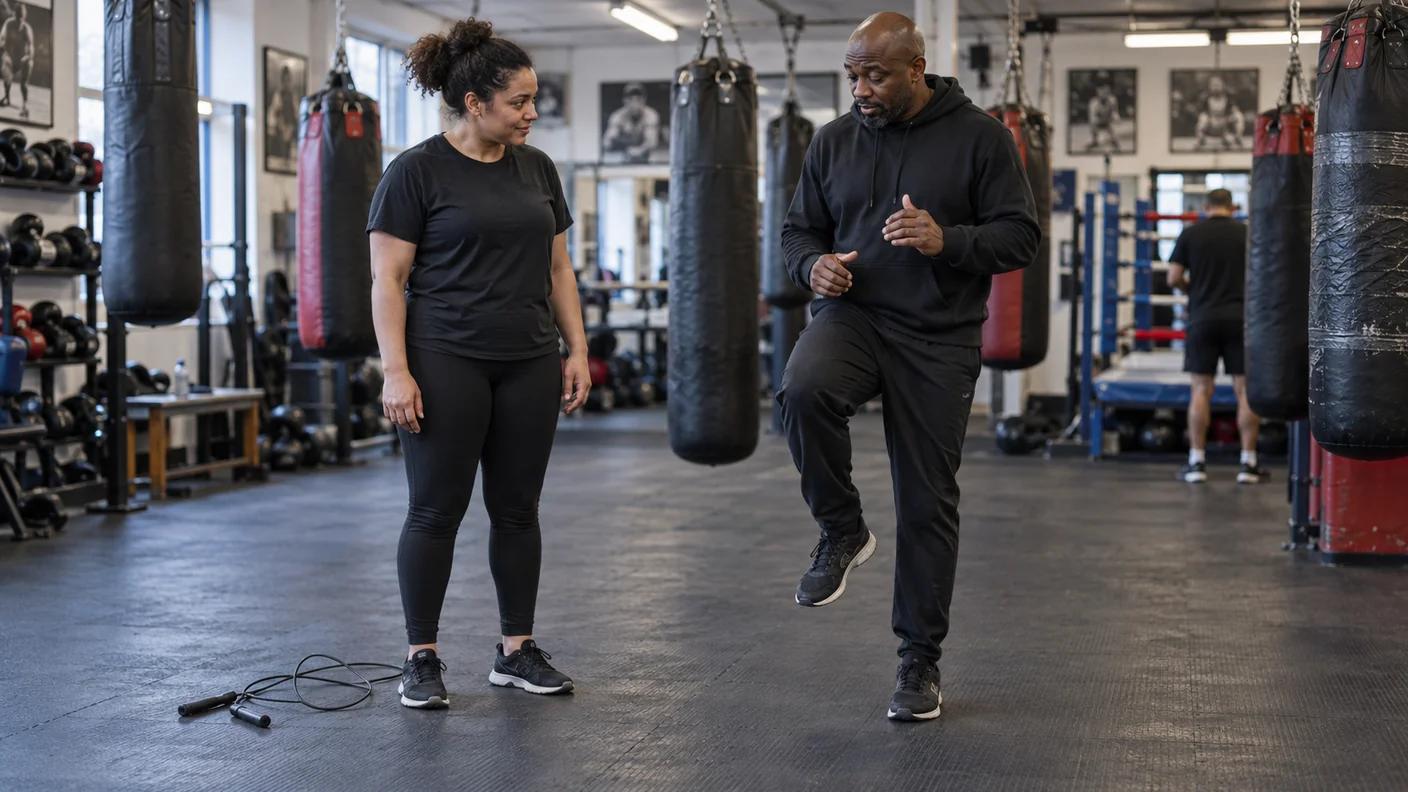
Yes. You can start boxing if you cannot skip.
A skipping rope is useful, cheap and part of the soundtrack of most boxing gyms. It is not an entrance exam. If your feet tangle, the rope catches your trainers, or you have never managed more than three jumps in a row, that tells a coach where to begin. It does not tell them that boxing is not for you.
The mistake is deciding you need to get good at skipping alone before you deserve a class. That is how people lose months to a problem they could solve in ten minutes with a rope, some space and a calm correction.
England Boxing's coaching handbook puts controlled movement, suitable equipment and clear coaching at the centre of safe learning. That is a better standard than looking smooth on your first warm-up. You are there to learn, not to perform competence you do not have yet.
Skipping is a tool, not the whole sport
Skipping helps with rhythm, lower-leg endurance and getting comfortable moving lightly. It also exposes timing problems very quickly. The rope does not flatter anyone. If your hands swing too far, if your jumps are too high, or if you stare at your feet, it tells you straight away.
That is useful, but it is only one tool. Boxing also asks you to hold a stance, take small steps, keep your balance, breathe while you work, listen to a cue, recover your hands and make decisions when the pace rises. Somebody can be excellent with a rope and still look lost on pads. Somebody who cannot skip yet may pick up the stance and jab very quickly.
Why skipping feels harder than it looks
Skipping asks the hands and feet to agree on a rhythm before either part has much time to think. That is why adults who can run, cycle or lift weights can still feel absurdly uncoordinated with a rope.
Most beginners make one of three errors. They jump far too high, spin the rope from the shoulders, or look down waiting for it to catch them. Each one makes the next attempt harder. High jumps create more time in the air but more impact and more panic. Big arm circles slow the rope. Looking down pulls the body out of a relaxed, upright position.
The first sensible target is smaller than people expect: a low bounce, quiet hands near the hips, and one clean turn of the rope. Then another. There is no prize for turning the warm-up into a fight with a length of plastic.
A study of rope training in young football players found improvements in balance and motor coordination after a jump-rope programme (Journal of Sports Science and Medicine study). That does not mean an adult beginner should expect a transformation after one class. It does support the obvious coaching point: simple rhythmic repetitions can be trained rather than treated as natural talent.
What to do when the rope keeps catching
Do not keep whipping the rope faster. Slow it down until you can tell what is going wrong.
Start with rope turns without jumps. Hold the handles low, let the rope pass under your feet, then step over it. That gives you the timing without asking for a jump at the same moment. Once that feels ordinary, use one low bounce for every turn. Keep the bounce low enough that it would barely clear a sheet of paper.
If that still feels impossible, leave the rope on the floor and march on the spot with your hands moving in a small rope-turning pattern. It is not glamorous. It is useful. You are giving the feet and hands a chance to find the same rhythm before you ask them to do it at speed.
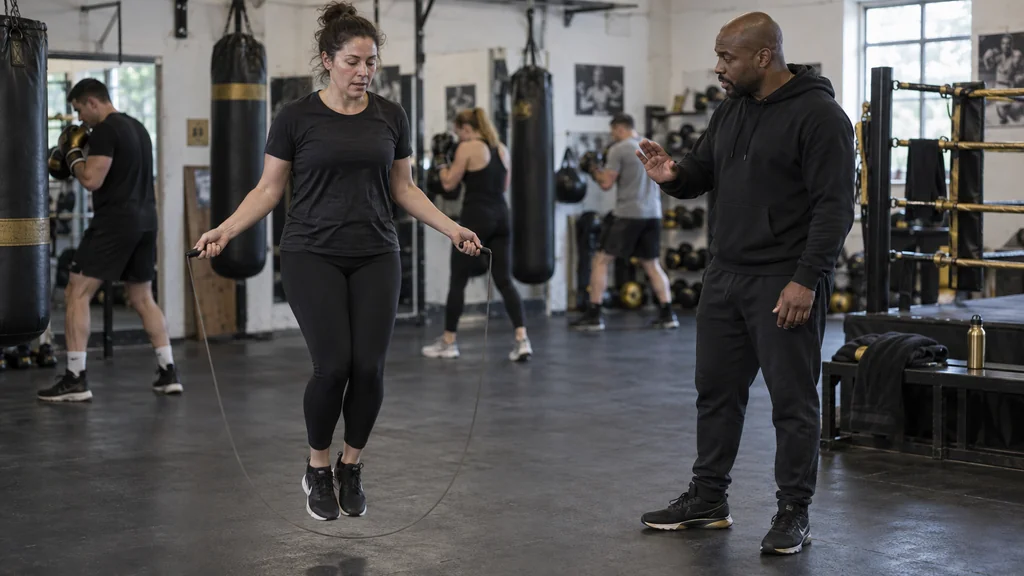
A decent coach will not stand over you demanding double-unders while you are learning a single bounce. They will give you one correction, let you try it, then change the task if the rope is becoming the only thing you can think about.
You can still train when the rope is not working
If skipping is not clicking in a session, there are other ways to warm up and learn the same useful habits.
Marching steps, light shadowboxing, controlled footwork, easy jogging, step-ups and simple movement drills can all raise your temperature and make the legs work. They are not identical to skipping, but they keep the session moving while the coach works on the part that is holding you back.
At Recreational Adults boxing, the point is to learn proper boxing and build fitness over time. You will use pads, bags, movement and coach-led drills. The rope belongs in that bigger picture. It is not the gatekeeper standing between you and a first session.
If you generally feel awkward in sport, our guide to boxing when you feel clumsy explains why controlled repetition is more useful than trying to force confidence. If you want a fuller breakdown of rope choice and progression, use our complete skipping guide for boxing after your first few sessions.
What to say to the coach
Say it plainly before the warm-up starts: "I am new, and I cannot skip yet. Can you show me a simple version?"
That sentence gives the coach useful information. It tells them not to assume that you know the rhythm, and it stops you hiding at the back trying to copy somebody who has skipped for years. Most coaches have seen this many times. They would rather give you a starting point than watch you jump higher and get more frustrated.
Also say something if the issue is not coordination. Calf pain, a recent ankle injury, dizziness, pelvic-floor symptoms, or a health condition that changes high-impact exercise needs a different conversation. The NHS says people who have not exercised for some time or have health concerns should make sure the activity and intensity are appropriate for their fitness (NHS adult activity guidance). That is not a reason to avoid movement. It is a reason to choose a sensible starting point.
For a straightforward coordination problem, the answer is usually much simpler. Start low, stay relaxed and accept that you may miss the rope a few times.
A first-month approach that works
In week one, aim for short attempts. Ten or twenty seconds of slow rope turns is enough if you have never skipped before. Stop before your shoulders rise, your feet start stamping, or you turn the rope into a weapon against the floor.
In week two, try to join a few clean bounces together. Keep the same low jump and small wrist turn. Do not change three things at once because you saw someone else doing fast alternate feet across the gym.
In week three, add a little rhythm. Two easy bounces, then a small reset. If you catch the rope, begin again without treating the miss as a disaster. Boxing is full of small errors and resets. Learning not to lose your head when the rope catches is a useful tiny version of that lesson.
By week four, you may be ready to string together longer stretches. Or you may still be working on the basic bounce. Both are fine if the movement is becoming calmer and more repeatable.
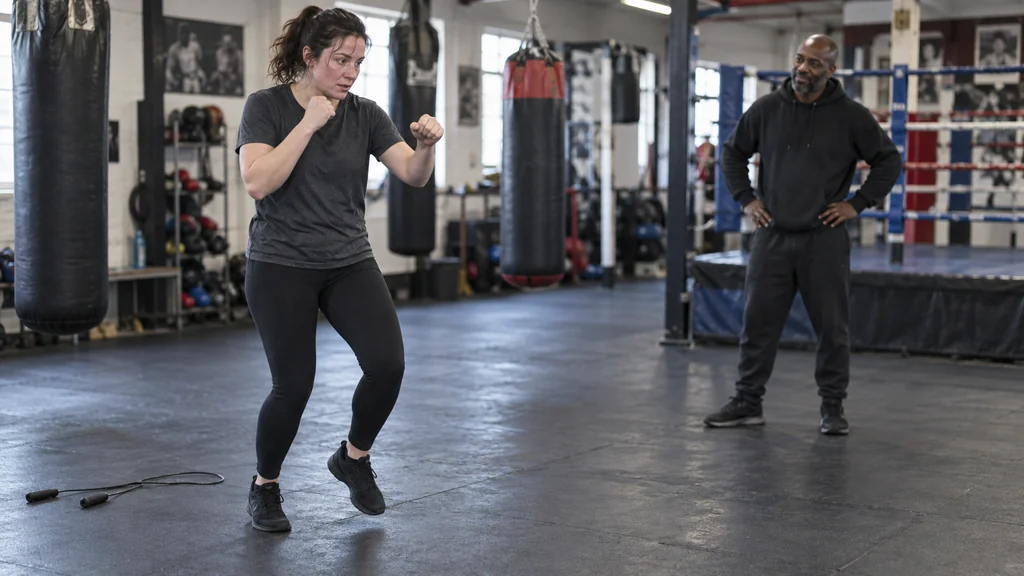
If you are near Kidbrooke, Greenwich or Blackheath, turn up as you are. Tell the coach what you can and cannot do. You do not need to solve skipping before you start boxing. You can learn both in the same room.
H&G Team
Writer at Honour & Glory Boxing Club, a community boxing gym in Kidbrooke, South East London.
KEEP READING
Skipping Rope for Boxing - The Complete Guide
Master skipping rope for boxing with this complete guide. Benefits, techniques, workout routines, and tips to improve your footwork and conditioning.

Skipping for Boxing - Why Every Boxer Does It
There is a reason boxers spend hours with a jump rope. Learn why skipping is essential for boxing and how to use it properly in your training.
Does Boxing Improve Coordination?
Boxing is one of the quickest ways to sharpen coordination because every round forces your eyes, feet and hands to work together under pressure.
Was this page helpful?
It takes one tap, and it genuinely helps.
Choose your next step
Turn this article into the right action
Some readers are ready to book. Some need the class route first. Pick the route that matches what you actually want.