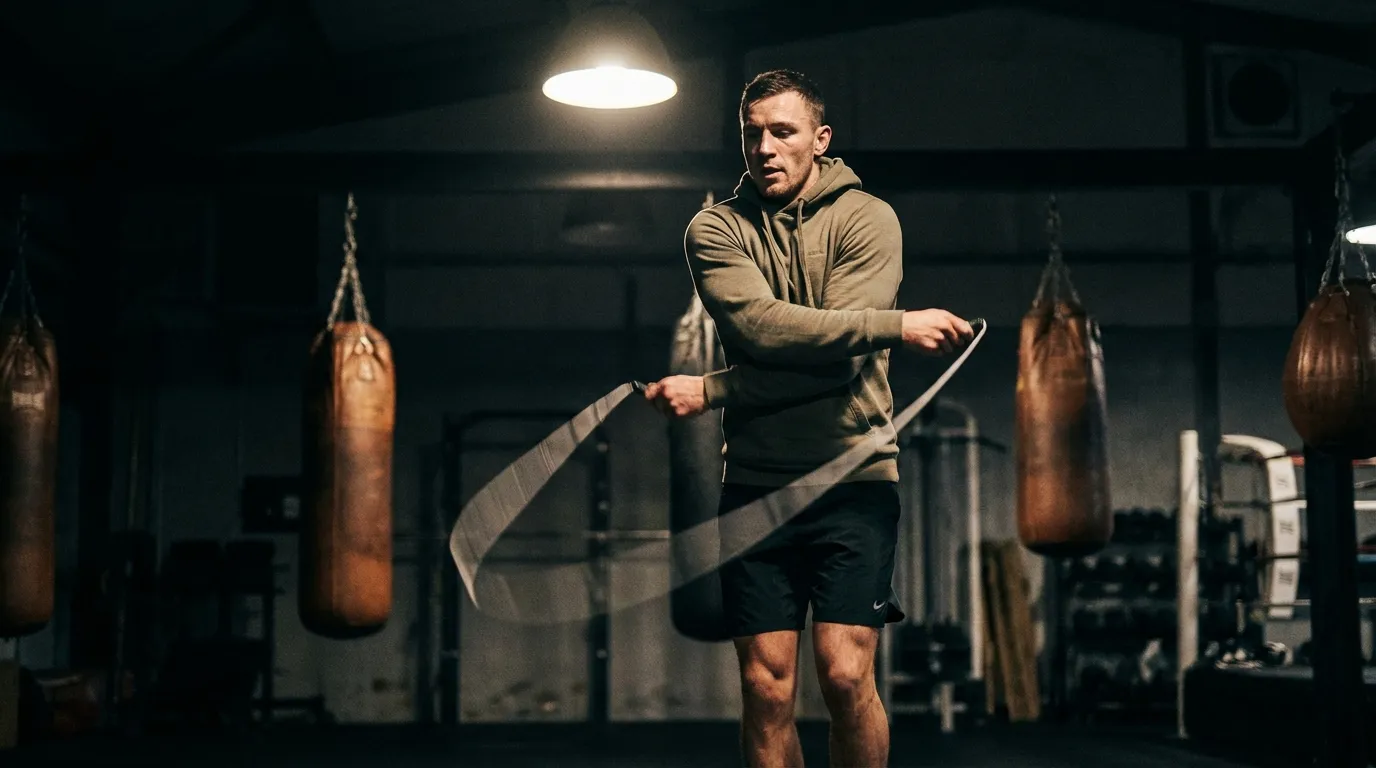
Boxing Science's conditioning research identifies skipping rope as a primary reactive strength exercise, improving the stretch-shortening cycle in the lower legs that supports boxing footwork. A 2025 study on plyometrics and boxing performance confirms that rope skipping develops the same neuromuscular qualities as more complex plyometric exercises.
Watch any boxer warm up before training and you will see them skipping. From Floyd Mayweather to Tyson Fury, from absolute beginners to world champions, everyone skips. There is a reason this simple exercise has been a boxing staple for over a century.
Skipping builds the specific fitness boxing demands. It improves the footwork patterns you need in the ring. It develops rhythm and timing. And it does all this with minimal equipment in minimal space.
Here is everything you need to know about skipping for boxing - from choosing a rope to building a complete workout routine.
Why Boxers Skip
Skipping is not just tradition. It serves specific purposes that directly transfer to boxing performance.
Footwork Development
Boxing footwork demands light, quick feet. You need to move on your toes, change direction rapidly, and maintain balance while throwing punches. Skipping trains exactly this.
When you skip, you naturally stay on the balls of your feet. You develop the calf strength and ankle stability that keeps you bouncing and moving in the ring. The coordination of timing your jumps becomes automatic - and this transfers directly to footwork timing during combinations.
Cardiovascular Conditioning
Skipping is demanding cardio. Depending on intensity, it can burn 10-15 calories per minute - comparable to running at a fast pace but with less joint impact (source).
The interval nature of skipping matches boxing's demands. Three minutes of skipping followed by a minute of rest mirrors the round structure of the sport. This specific conditioning prepares your body for the work-to-rest patterns of actual fighting.
Rhythm and Timing
Boxing is rhythmic. The flow from punch to punch, the timing of slipping and countering, the natural cadence of the sport - all require internal rhythm. Skipping develops this.
As you become more skilled, you learn to vary your skipping tempo - fast bursts, slower recovery, changes of rhythm. This rhythm manipulation is exactly what happens in the ring when you shift gears, speed up, or change pace to confuse an opponent.
Coordination
Skipping requires coordinating your upper and lower body while maintaining timing and spatial awareness. This whole-body coordination is fundamental to boxing, where everything from your feet to your hands must work together.
The coordination carries over to combinations, footwork patterns, and the simultaneous movement of attack and defence.
Shoulder Endurance
Keeping your hands up for three-minute rounds is exhausting. The shoulder fatigue from holding your guard can become a limiting factor in boxing.
Skipping builds shoulder endurance without the overhead pressing that can create problems. The constant rotation of the rope through your shoulders prepares them for the demands of keeping your hands up round after round.
Choosing Your Rope
Not all skipping ropes are created equal. The right rope makes learning easier and effective training possible.
Rope Materials
PVC (plastic) ropes are the standard for boxing. They offer good speed, durability, and feedback. The slight weight helps you feel the rope's position. Most boxing gyms use PVC ropes.
Leather ropes are traditional and durable. They have a nice feel and typically last longer than PVC. Slightly heavier, which some boxers prefer.
Speed ropes (thin cable) are extremely fast but less forgiving. Better for advanced skippers who want maximum speed. Can be painful when you miss.
Weighted ropes add resistance to build shoulder endurance. Useful as a progression but not ideal for learning or high-speed work.
Beaded ropes are durable and maintain shape well. Good for outdoor use on rough surfaces. The beads add weight and slow the rope slightly.
For most boxers, a quality PVC rope is the best choice. It balances speed, feedback, durability, and cost.
Sizing Your Rope
Proper rope length is essential. Too long and you waste energy on extra rotation. Too short and you constantly trip.
- Stand on the centre of the rope with one foot
- Pull the handles up along your sides
- The handles should reach your armpits (excluding the rope itself, just the handles)
Some recommend slightly longer for beginners (handles reaching the shoulders), then shortening as skill develops.
Many quality ropes are adjustable, allowing you to dial in the perfect length.
Recommended Ropes for UK Boxers
Budget options (under £15):
- Decathlon boxing rope - decent quality for beginners
- Amazon basics PVC ropes - adequate for starting out
Mid-range (£20-40):
- Geezers boxing ropes - solid quality from a respected UK boxing supplier
- RDX skipping ropes - good durability and feel
Premium (£40+):
- BoxRope - designed specifically for boxers, slightly heavier PVC
- Rush Athletics - high quality speed ropes
- Buddy Lee Aero Speed - professional grade
For beginners, a mid-range option like those from Geezers or RDX offers the best value. Once you are skipping regularly, upgrading to a premium rope can enhance training.
Skipping Techniques
Start with the basics and progress to more advanced techniques as your skill develops.
The Basic Bounce
This is your foundation. Master it before moving on.
- Stand with feet together
- Jump just high enough for the rope to pass under (an inch or two)
- Land softly on the balls of your feet
- Keep your elbows close to your sides
- Rotate the rope with your wrists, not your arms
- Stay relaxed - tension wastes energy
Common beginner mistakes:
- Jumping too high (wasted energy)
- Kicking feet backward (disrupts timing)
- Using arms instead of wrists (exhausting)
- Looking down (disrupts posture)
Practice the basic bounce until it feels completely natural before progressing.
The Boxer Step
This is what you see professional boxers do - shifting weight from foot to foot while skipping.
- Instead of jumping with both feet, shift your weight side to side
- As one foot lands, the other lifts slightly
- Creates a running-in-place appearance
- More natural rhythm once mastered
The boxer step is less tiring than the basic bounce and develops the weight transfer you need for boxing footwork.
Running in Place
Essentially jogging while skipping.
- Lift your knees slightly higher than the boxer step
- Similar to regular running motion
- Good for building intensity
High Knees
An intensified version of running in place.
- Drive knees up toward chest
- High intensity work
- Good for interval bursts
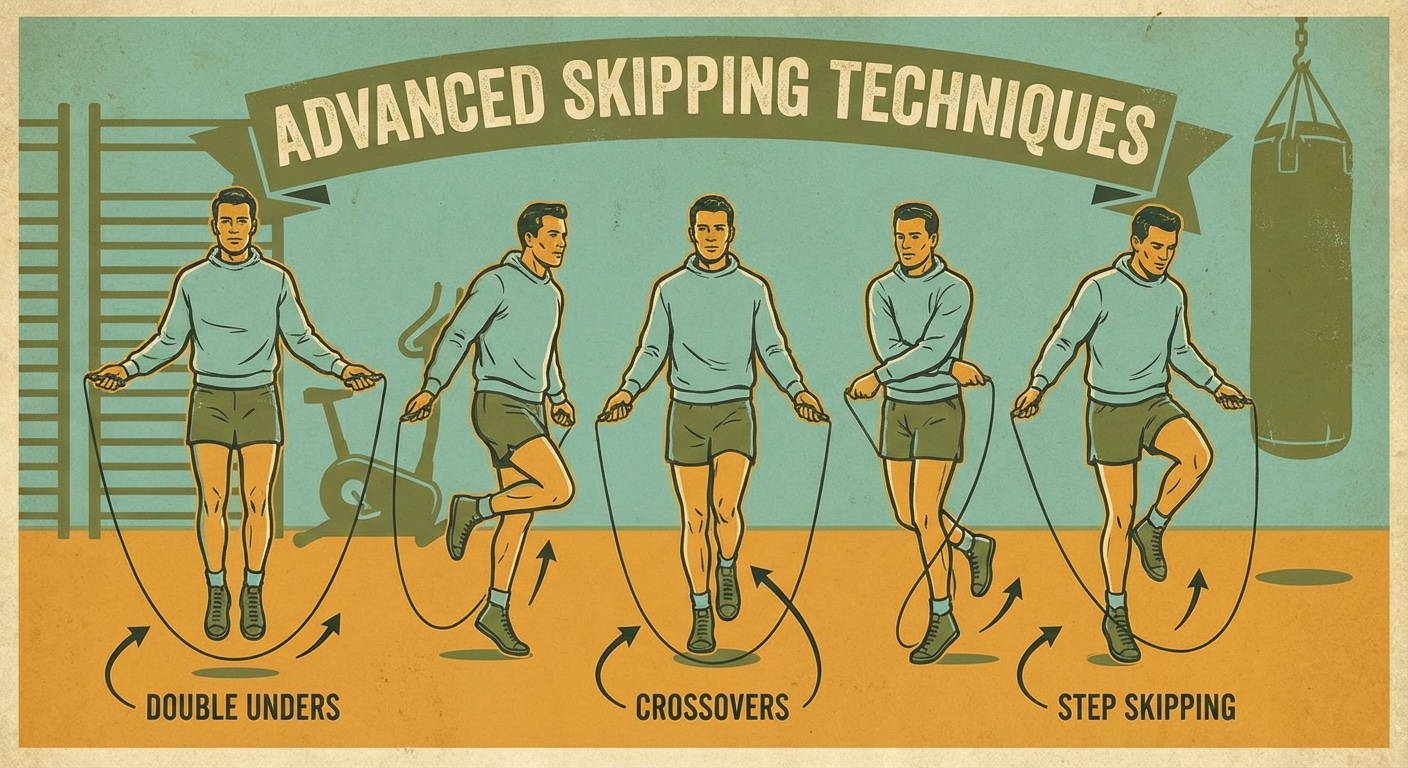
Double Unders
The rope passes under your feet twice per jump.
- Jump higher than normal
- Speed up wrist rotation significantly
- Requires timing and power
- Excellent for conditioning
Double unders are difficult to learn but valuable for building explosive power and coordination.
Crossovers
Crossing your arms in front of you while the rope passes.
- Start in basic bounce
- As rope comes overhead, cross arms at elbows
- Jump through the loop created
- Uncross on the next rotation
Crossovers develop coordination and add variety to your training.
Side Swings
Swinging the rope beside your body without jumping through.
- Keep rope moving beside you
- Useful for recovery during long sessions
- Transitions into jumps when ready
Building a Skipping Workout
Now let us put it together into actual training sessions.
Beginner Routine (First Month)
Focus on building skill and basic endurance.
- 3 rounds of 2 minutes skipping, 1 minute rest
- Basic bounce only
- Aim for consistency over speed
- Do this 3-4 times per week
If you cannot complete 2 minutes continuously, work in intervals: 30 seconds skipping, 30 seconds rest, building up.
Intermediate Routine (Months 2-4)
Increase duration and introduce variety.
Round 1: Basic bounce (3 minutes)
Round 2: Boxer step (3 minutes)
Round 3: Running in place (3 minutes)
Round 4: Mix of all techniques (3 minutes)
1 minute rest between rounds. Total: 16 minutes.
Boxing-Style Routine
Mirrors the demands of actual boxing rounds.
- 6 rounds of 3 minutes skipping, 1 minute rest
- Vary intensity through each round (start easy, build to fast, recover)
- Mix techniques
- Include 10-20 second bursts of maximum speed
Total: approximately 24 minutes.
HIIT Skipping Workout
For maximum conditioning effect.
30 seconds high intensity (high knees or double unders)
30 seconds recovery (side swings or easy bounce)
Repeat for 10-15 minutes
This develops the high-intensity work capacity boxing demands.
Integration with Boxing Training
A typical session structure:
- 10 minutes skipping as warm-up
- Boxing training (bag work, pads, sparring)
- 5-10 minutes skipping as cool-down or finisher
Alternatively, dedicate specific sessions to extended skipping work for conditioning.
Common Problems and Solutions
Constantly tripping: Slow down. Use a longer rope. Focus on consistent height and timing before speed.
Shoulders burning out: You are probably using your arms too much. The rotation should come primarily from the wrists. Keep elbows close to your body.
Rope hitting the ground hard: You are jumping too high or rope is too long. Just clear the rope - you do not need much height.
Cannot find a rhythm: Count as you jump ("one, two, one, two"). Use music with a clear beat. Start slower than you think necessary.
Rope tangles: Probably a rope quality issue. Cheap ropes kink and tangle. Invest in a decent rope.
Feet hurt: Ensure you are landing on the balls of your feet, not flat-footed. Use a mat or softer surface. Check your footwear.
Progressing Your Skipping
As you develop, challenge yourself with:
Speed work: Time how many jumps you can do in one minute. Track and try to improve.
Endurance extension: Build toward 15-20 minutes of continuous skipping.
Technique complexity: Master crossovers, double unders, and combinations.
Integration: Skip while moving around, changing direction, incorporating boxing footwork patterns.
Conditioning challenges: Tabata intervals (20 seconds work, 10 seconds rest, 8 rounds), EMOM (every minute on the minute start a new set).
The best boxers never stop developing their skipping. There is always another level of speed, endurance, or skill to achieve.
Final Thoughts
Skipping is simple but not easy. It takes time to develop the coordination and conditioning for effective training. Stick with it through the frustrating early stages.
Once you can skip competently, it becomes one of the most efficient training tools available. You can warm up anywhere, build conditioning without a gym, and develop boxing-specific fitness that directly transfers to your performance.
The boxers who skip consistently are the ones with good footwork, solid conditioning, and the rhythm that makes boxing look effortless.
H&G Team
The coaching and community team at Honour & Glory Boxing Club, a community boxing gym in Kidbrooke, South East London.
KEEP READING
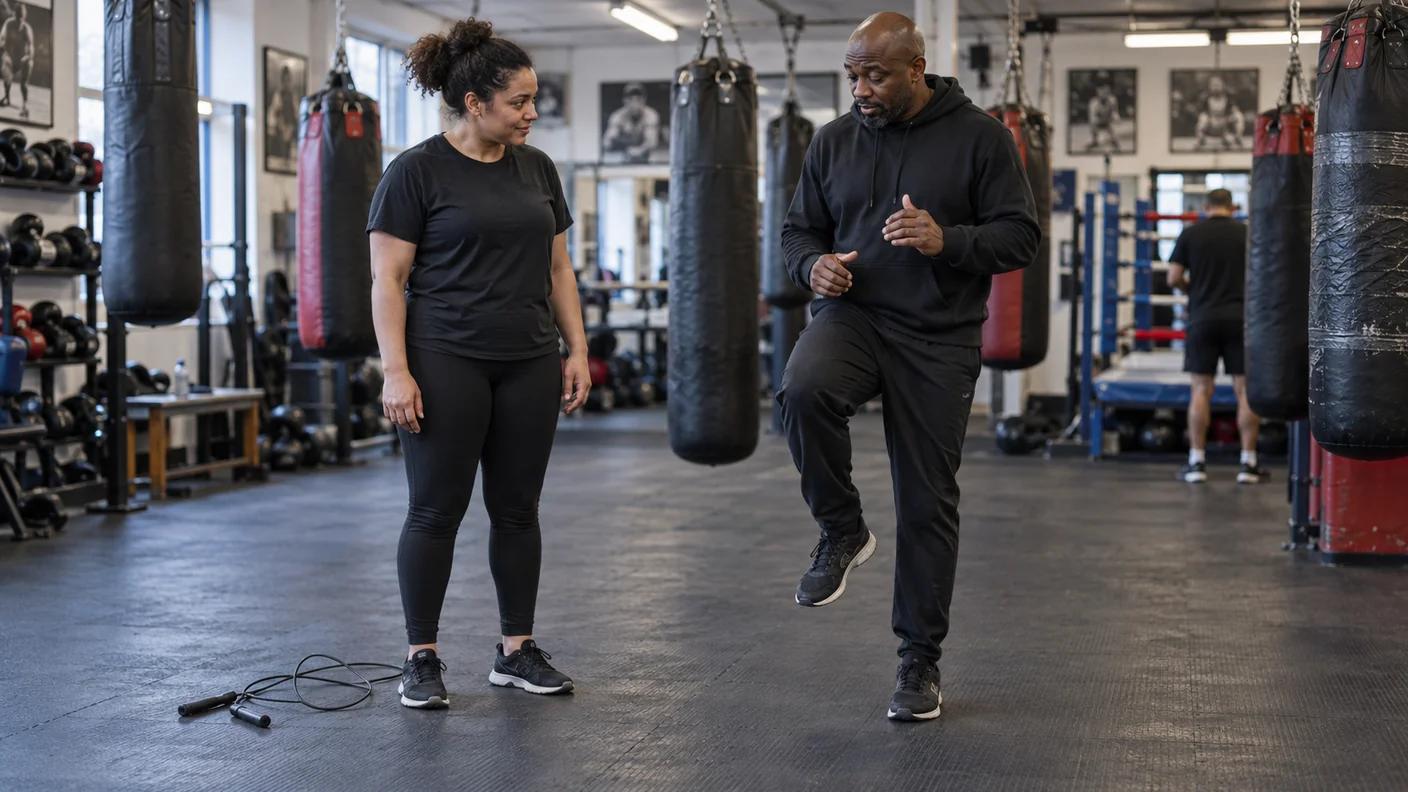
Can You Start Boxing If You Cannot Skip?
Yes. You can start boxing before you can skip. Learn what to say, how to begin, and why a missed rope is not a reason to stay away.

Skipping for Boxing - Why Every Boxer Does It
There is a reason boxers spend hours with a jump rope. Learn why skipping is essential for boxing and how to use it properly in your training.

Boxing Drills to Do at Home
No bag, no pads, no partner. Here are the drills that actually improve your boxing at home, and the ones that waste your time.
Was this page helpful?
It takes one tap, and it genuinely helps.
Choose your next step
Turn this article into the right action
Some readers are ready to book. Some need the class route first. Pick the route that matches what you actually want.