Berlanga vs Butler: Why Post-Fight Discipline Still Matters

Berlanga vs Butler: Why post-fight discipline still matters
Edgar Berlanga had earned the right to celebrate. He had been knocked down late in the second round, steadied himself, then dragged Steven Butler into a hard, messy fight that he eventually controlled. By the seventh, Butler was exhausted, hurt and taking too much. The referee stopped it. Berlanga had a comeback win in New York and a statement performance after a difficult year.
Then the ending became the story.
The official finish was strange enough on its own. Referee Eric Dali stepped in as Berlanga attacked, grabbed Butler to separate the fighters and went down with him. USA Today reported that the fight was officially stopped at 1:14 of the seventh round, with Berlanga winning after Butler and the referee hit the canvas together. In the confusion that followed, Berlanga stepped towards the fallen Butler and made a gesture as if he might throw again. No punch landed, but it was exactly the kind of moment that turns a deserved win into an argument about conduct.
That distinction matters. Boxing is a fighting sport, but it is a regulated one. The bell, the referee's intervention and the stoppage all mark a line. Once that line is crossed, a fighter has to switch off.
Primary video source: Berlanga vs Butler: Why Post-Fight Discipline Still Matters
A proper comeback, then an avoidable moment
The fight itself was worth watching. Berlanga did not cruise through Butler. He was put down in the closing seconds of round two and had to respond under pressure, in front of his home crowd, against a fighter with genuine stopping power.
Sky Sports' report described Berlanga recovering from the knockdown, wearing Butler down and producing the stoppage in the seventh. Butler had moments, including a big right hand early in the final round, but he was no longer defending himself properly when Berlanga trapped him near the ropes.
That is what the result should be remembered for. Berlanga showed resilience. He did not panic after the knockdown, did not retreat into safety-first boxing, and did not wait for Butler to fade on his own. He reset, pressed with purpose and took the finish when it came.
The fight listing on Tapology places the contest in the super-middleweight division, where Berlanga needs performances with jeopardy if he wants another route towards the top names. He now has a 24-2 record with 19 knockouts. He also has a very public example of why the emotional work does not stop when the referee waves a fight off.
The post-fight moment should not erase the comeback. It should also not be brushed away because Berlanga had fought bravely. Both things can be true.
The referee's job is to end the danger
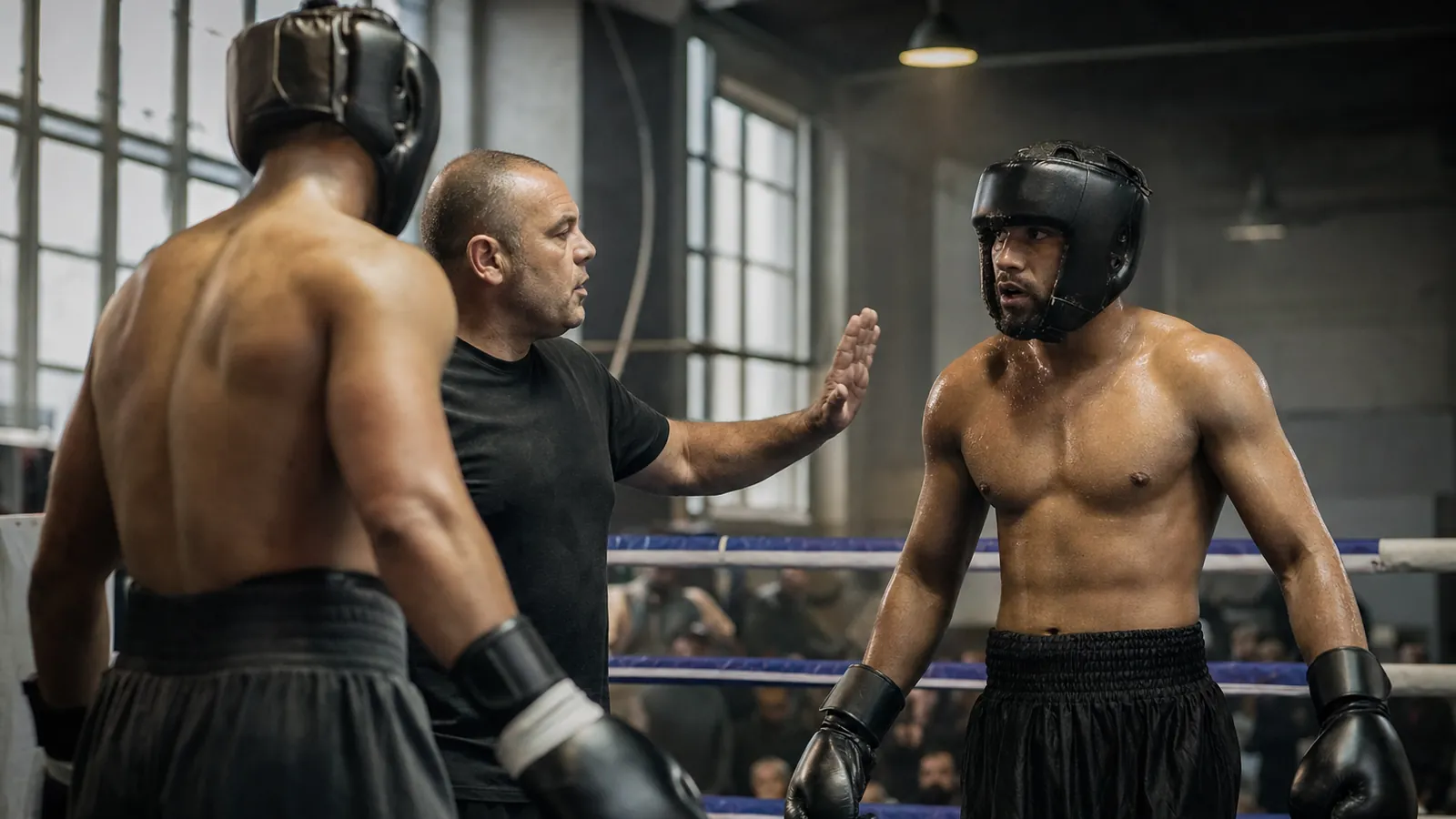
A referee who steps in takes responsibility for both fighters. The boxer who is hurt is no longer an opponent. He is the official's responsibility.
That is why the closing sequence was so uncomfortable. Boxing News 24's account said Berlanga did not land after the stoppage, but described him stepping over Butler and cocking his right hand as the referee and Butler were on the floor. The same report made clear that Butler had absorbed enough before the intervention for the stoppage itself to be justified.
The official's fall created a chaotic visual. It did not create permission for anyone else to lose control.
A fighter comes out of a finishing burst with their heart rate through the roof. Their hands have been firing on instinct. Their opponent may still be in front of them, still upright, still moving. That is why boxing has referees, corners and seconds. Everyone in the ring has a duty to recognise that the contest has ended before one more shot turns from legal punishment into something else.
This is not a demand for fighters to become calm robots. A stoppage win brings adrenaline, relief, anger and pride, often all at once. Berlanga had been dropped and had spent five rounds trying to break a dangerous opponent down. Of course the emotion was real.
But discipline is what separates real intensity from a loss of judgement. A professional must be able to throw hard until the fight is stopped, then stop immediately. That control is part of the skill.
Corners need a plan for the minute after the bell
The best corners do not only prepare a boxer for round one. They prepare them for the moments when their emotions are most likely to get them into trouble.
Before a fighter enters the ring, the corner should be clear about a few basics. If there is a knockdown, walk to the neutral corner. If there is a stoppage, turn away from the opponent and go to your own corner. If the opponent celebrates in your face, do not answer it. If an official is dealing with a hurt fighter, give them space.
Those instructions sound simple because they are simple. Under stress, simple instructions are the ones a boxer can actually follow.
A coach also has to read their fighter. Some boxers become loud when they are hurt. Some go quiet. Some carry resentment from the weigh-in, the press conference or a rough round earlier in the fight. If there has been bad blood, the corner should expect trouble after the bell rather than acting surprised by it.
The live coverage of Zuffa Boxing 9 from Yahoo Sports framed Berlanga versus Butler as a major super-middleweight main event at The Theatre at Madison Square Garden. Big nights bring bigger cameras and more pressure. They also bring more reason to get the basics right. One ugly clip can travel further than seven good rounds.
At club level, the lesson is even more useful. In sparring, a clean shot after a break is unacceptable. So is standing over someone after they slip, shouting across the ring, or carrying an argument into the next round. Those habits are not signs of toughness. They are signs that a boxer is not yet in charge of themselves.

Emotional control is a boxing skill
People often talk about composure as if it means looking calm. It does not. Plenty of excellent fighters look furious while making good decisions.
Composure means keeping your choices under control when you are tired, embarrassed, hurt or desperate to make a point. Berlanga showed some of that inside the fight. He recovered from a knockdown, kept applying pressure and found a finish rather than chasing one recklessly. The final seconds showed how quickly that same emotional intensity can spill over.
That is why a good gym treats respect as part of training, not a speech made after something goes wrong. When you learn to touch gloves, listen to the referee, stop on command and look after a sparring partner, you are learning habits that hold up when the stakes rise.
At Honour & Glory's recreational adult boxing classes, that starts with the fundamentals: stance, distance, defence, controlled drills and respect for the person opposite you. The same applies to anyone training from age 7 upwards. Boxing should build confidence and discipline together. One without the other is a problem waiting for a crowded ring and a hot moment.
Berlanga deserved credit for his recovery and his seventh-round stoppage. Butler deserves credit for taking the fight and making it difficult. The referee had a difficult job in a bizarre finish.
But the wider lesson is blunt. When the bell has gone, the fighting has gone too. The boxer who can control that final surge of emotion protects their opponent, their reputation and the sport itself.
H&G Team
Writer at Honour & Glory Boxing Club, a community boxing gym in Kidbrooke, South East London.
KEEP READING

Bam Rodriguez vs Antonio Vargas: fight-week lessons
Fight-week footage can teach young boxers composure, safe discipline and body language without copying professional theatre.
Daniel Dubois’s team split: why a corner change matters
Sam Jones discussing his departure from Daniel Dubois’s team opens a useful look at what changes when an established heavyweight changes the people around him: preparation, communication, matchmaking and accountability.

Dubois vs Wardley Result: What Changed the Fight
Daniel Dubois stopped Fabio Wardley in round 11 after two early knockdowns. Here is what changed the fight and why it matters.
Was this page helpful?
It takes one tap, and it genuinely helps.
Choose your next step
Turn this article into the right action
Some readers are ready to book. Some need the class route first. Pick the route that matches what you actually want.