Usyk’s last dance: what vacating three belts really changes
Usyk’s Last Dance: What Vacating Three Belts Really Changes
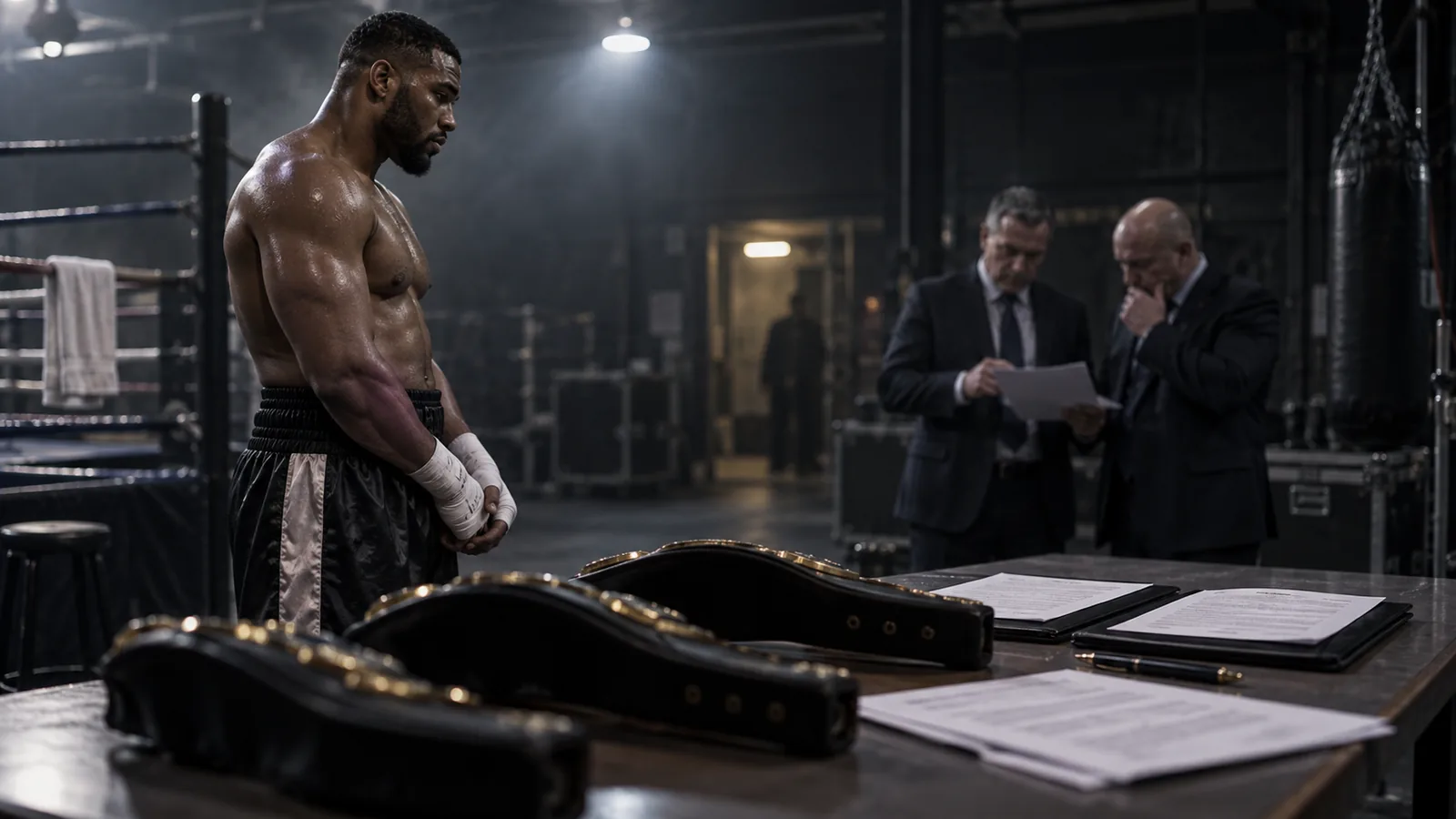
Oleksandr Usyk has done heavyweight boxing a favour, even if it does not feel like one at first.
The unbeaten Ukrainian has vacated the WBA, WBC and IBF heavyweight titles, having already relinquished the WBO belt, while insisting that he still has one final fight to come. In his announcement, Usyk said he wanted the titles available for “the guys who are next in line”, adding: “I’m leaving the belts, but I’m not leaving the sport because I still have my last dance.”
Sky Sports’ report on the decision carried the obvious headline. The belts are gone. Usyk is not retired. But the more important story is about responsibility.
A world title is not a souvenir. It is a contract with a division. It gives a fighter status, money and leverage, but it also creates obligations to challengers, sanctioning bodies and the public. Usyk has decided that his final fight should not be governed by that contract.
That is not ducking the division. It is an unusually honest way to leave it.
The belts and the boxer are now separate things
Boxing often pretends that the belt and the best fighter are automatically the same thing. They are not.
Usyk’s standing does not vanish because three sanctioning bodies no longer list him as champion. He remains the man who beat Anthony Joshua twice, Daniel Dubois twice and Tyson Fury twice. He became undisputed at cruiserweight, then repeated the feat at heavyweight. That body of work is not transferred to whoever next picks up a vacant title.
The BBC’s account of the vacancy puts the situation plainly: Usyk has stepped away from mandatory defences, rankings pressure and the politics that come with holding several belts at once. The next champions will have belts. They will still need to earn authority.
That distinction matters because heavyweight boxing is about to become noisier. There will be new champions, fresh claims and plenty of promotional declarations. Someone will call himself the new king of the division within about five minutes of winning a vacant strap.
He will not be.
Not yet.
A vacant-title win can be a major achievement. It can change a boxer’s purse, profile and bargaining position overnight. But it is the beginning of a title reign, not proof of greatness. The champion who comes after Usyk needs to fight credible opponents, defend when the difficult mandatory arrives and pursue unification when it is available.
Usyk did all of that. That is why he leaves a standard, not merely an opening.

Why vacating is cleaner than holding on
There is an easy criticism of Usyk’s choice. He is 39, he has had a long and demanding career, and mandatory challenger Agit Kabayel was waiting for the WBC opportunity. Some will say Usyk has stepped aside before a hard fight.
That reading is too shallow.
Every experienced fighter has the right to choose how he finishes, particularly one who has already taken the biggest available tests. More importantly, a champion who knows he does not want to fulfil the next title obligation should not keep the belt simply to add decoration to a farewell event.
The WBC had ordered Usyk towards Kabayel, its interim champion. The Athletic’s analysis noted that the WBC was next in the mandatory rotation. Usyk could have held the title while negotiations dragged on, perhaps chasing a more commercially attractive final bout and leaving Kabayel in a familiar boxing waiting room.
Instead, he made a decision.
That is better governance than the usual alternative: a champion retaining a belt while everyone below him spends months arguing about exemptions, interim titles, injury extensions and whether a big-money fight is somehow more important than the mandatory order.
Usyk has said, in effect, that his last dance is not a championship defence. Fine. It should be sold and judged as what it is: a final event for an exceptional boxer, chosen on his own terms.
The division can then carry on without pretending a farewell fight and an active title reign are the same thing.
This is a test for the sanctioning bodies too
It would be generous to say that boxing’s governing structure makes simple things simple. It does not.
The WBA, WBC, IBF and WBO each run rankings, mandatories, eliminators, deadlines and title rules. That gives fighters several routes towards a shot, which can be useful. It also means one unified champion can face competing demands from four organisations with different priorities.
Usyk’s departure puts the pressure back on those organisations to make their systems understandable.
The WBC has the clearest immediate case. Kabayel had won and defended the interim title, so elevating him is a logical continuation rather than a random piece of paperwork. The BBC reported that Kabayel was the mandated challenger, and Boxing News described Usyk’s intention to clear room for the men behind him.
But an elevation only works if it leads to a real championship route.
The WBC needs to identify Kabayel’s next obligation, explain why that opponent is next and set a credible timetable. The IBF needs to make its vacant-title process clear. The WBA needs to avoid adding further confusion to an organisation already known for multiple versions of its championship.
Supporters do not need every rulebook detail. They do deserve to know who has earned a shot, what fight must happen next and what happens if it does not.
That is not boring administration. It is how a belt retains meaning.

A final fight without a belt might be better for Usyk
There is a freedom in Usyk’s decision.
His recent victory over kickboxing great Rico Verhoeven in Egypt was competitive and controversial enough to create talk of a rematch. The Straits Times report noted that Verhoeven tested Usyk before the Ukrainian secured an eleventh-round stoppage, while Usyk’s sporting director Sergey Lapin spoke of a potential final chapter in the United States.
A Verhoeven rematch may happen. A different American event may happen. Usyk may choose an opponent who makes more financial or personal sense than a mandatory challenger.
None of that needs a world title attached to it.
In fact, it is better without one. If Usyk faces Verhoeven again, it should be because the first fight created enough sporting interest for a rematch, not because a recognised championship is being used to make a crossover bout appear more important than it is.
Sports Illustrated made the same central point: removing the sanctioning-body burden allows Usyk to focus on the ending he wants. There is no shame in that. He has already done the championship work.
The next champions need to risk something
The heavyweight division now has opportunities everywhere. Daniel Dubois holds the WBO title. Kabayel has a clear claim to the WBC position. Frank Sanchez, Murat Gassiev, Moses Itauma, Filip Hrgovic and others can see more direct routes to title-level fights than they could when Usyk held most of the division in one pair of hands.
That is healthy only if the new belt-holders actually meet each other.
Nobody needs to imitate Usyk’s southpaw footwork, timing or calm under pressure. Those qualities are rare. But the next generation should copy his willingness to answer difficult questions in the ring.
Beat the leading challenger. Take the unification. Travel if the right fight demands it. Do not protect an unbeaten record with soft defences while calling yourself the division’s leader.
Usyk has not left heavyweight boxing empty. He has left it accountable.
The belts are available. The routes are moving. Now the contenders have to prove that they deserve more than a vacant title.
For anyone inspired by the skill, discipline and courage that made Usyk special, book a free trial at Honour & Glory Boxing Club in Kidbrooke.
H&G Team
Writer at Honour & Glory Boxing Club, a community boxing gym in Kidbrooke, South East London.
KEEP READING

Usyk’s Last Dance: What Vacating Belts Really Means
Move beyond the already-covered mandatory routes: assess why an unbeaten champion would clear three belts while still planning one final fight, and what that says about the heavyweight division’s need for new leaders.
Usyk vacates titles: what it means for heavyweight boxing
A clear UK-club explainer on how Oleksandr Usyk giving up the WBC, WBA and IBF belts reshapes the heavyweight division, separates a vacant-title route from retirement, and explains why the contenders now matter.

Usyk vacates three heavyweight belts: what changes next
A focused explainer on how Oleksandr Usyk giving up the WBC, WBA and IBF titles changes the heavyweight queue, why governing-body routes now matter, and why vacant belts create opportunities without proving who is the best heavyweight.
Was this page helpful?
It takes one tap, and it genuinely helps.
Choose your next step
Turn this article into the right action
Some readers are ready to book. Some need the class route first. Pick the route that matches what you actually want.