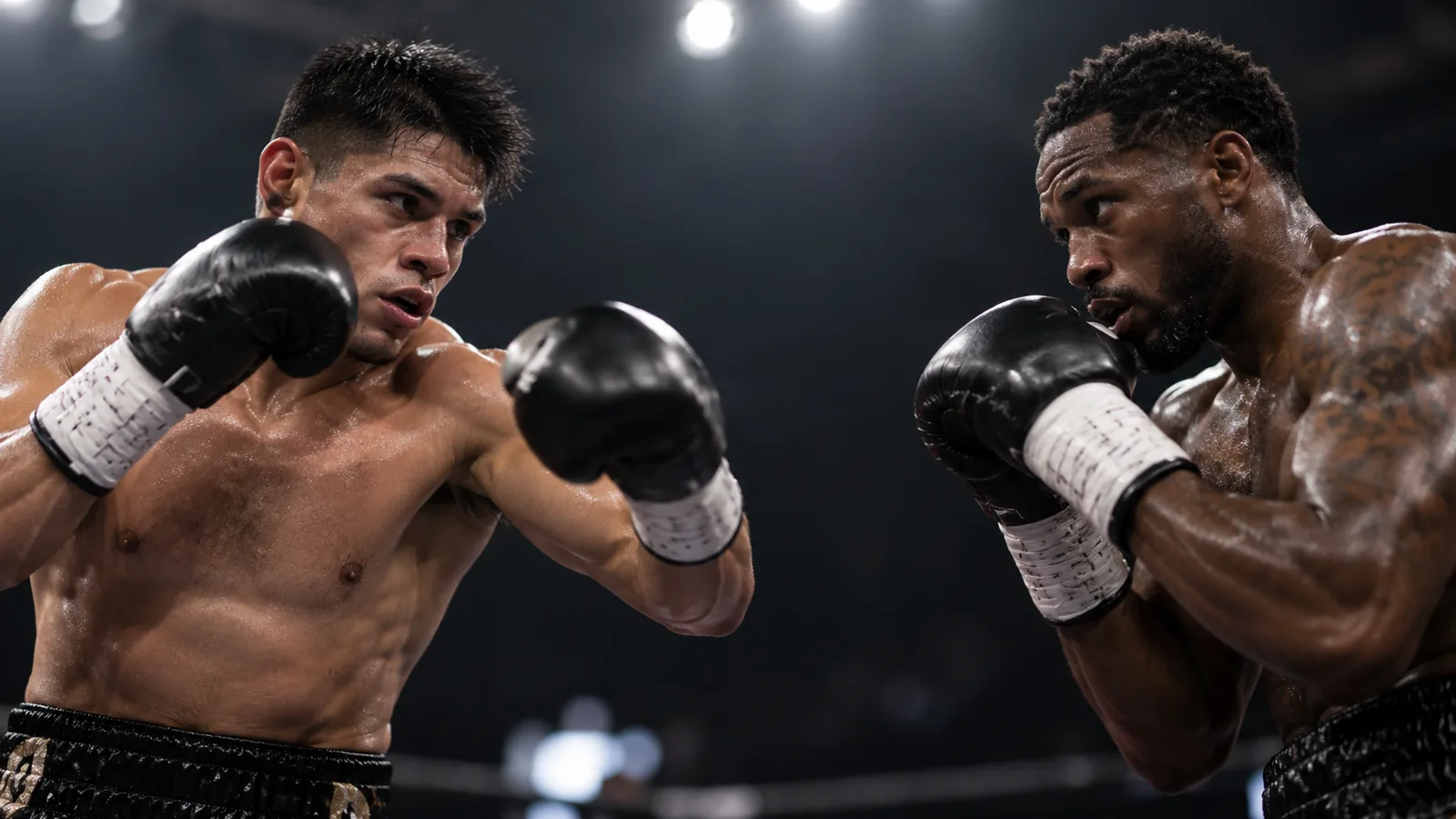
Navarrete vs Foster: fight-week guide for San Antonio unification
Super-featherweight has spent too long with champions working in separate lanes. On Saturday, 24 October, Emanuel Navarrete and O’Shaquie Foster finally meet at Frost Bank Center in San Antonio, Texas, with three major belts and The Ring title at stake.
This is not a rematch and it is not an old announcement being recycled. Navarrete and Foster have not previously fought each other. Their confirmed unification bout takes place in San Antonio on Saturday 24 October 2026, with the UK broadcast running into the early hours of Sunday 25 October. The full event listing and video coverage identifies the date clearly, while the wider 2026 fight schedule has it among the confirmed autumn cards.
Navarrete brings the WBO and IBF super-featherweight championships. Foster brings the WBC belt. The vacant Ring championship is also expected to be on the line, leaving the winner with three of the four major titles at 130lb. Anthony Cacace holds the remaining WBA belt.
It is the best fight that could have been made in the division. It is also a sharper tactical test for Navarrete than many are admitting.
The date, venue and UK viewing details
Top Rank’s card takes place at the Frost Bank Center in San Antonio, a venue which already holds good memories for Foster. The Texan won the WBC title in the city against Rey Vargas in 2023 and returned to outpoint Stephen Fulton at the same arena last December.
UK viewers can watch live on DAZN. The main card is scheduled to begin at 1am BST on Sunday 25 October, which is 8pm ET in Texas. Estimated main-event ring walks are around 3am GMT, although that is necessarily subject to the length of the undercard.
There is an important detail for anyone setting an alarm: Britain’s clocks go back during the broadcast. At 2am BST, the time becomes 1am GMT. The detailed UK time, ring-walk and undercard guide is worth bookmarking rather than relying on a generic “Saturday night” listing.
https://www.youtube.com/results?search_query=Emanuel+Navarrete+vs+O%27Shaquie+Foster
The DAZN show is expected to include Albert Gonzalez against Edward Vazquez at featherweight, Frank Martin versus Tarik Zaina at super-lightweight, and Steven Navarro against Emanuel Moreno. British Boxing News’ report from Navarrete’s camp provides the clearest published outline of the televised bill.

What is at stake at 130lb
Navarrete’s record stands at 40-2-1 with 33 stoppages. He is one of the sport’s most recognisable pressure fighters, a former champion at bantamweight, super-bantamweight and featherweight who has carried his awkward offence into a fourth division.
He is not conventional. That is the point.
Navarrete attacks from strange angles, releases punches when an opponent thinks an exchange has ended, and is happy to make a contest ugly if it gives him room to create. He will throw hooks and uppercuts from positions most coaches spend years telling amateurs to avoid. Against an opponent who freezes or retreats in straight lines, that chaos becomes suffocating.
Foster, 25-3 with 12 knockouts, represents the opposing style. He is a composed southpaw boxer, an excellent reader of range and a fighter who has proved he can maintain discipline over championship distance. His victories over Vargas and Fulton were not accidents or friendly decisions. Both showed a man who can control pace, take away an opponent’s preferred space and make small scoring moments count.
The Yahoo Sports fight-card preview captures the scale of the match-up: it is a genuine world-title unification rather than a belt-holder defending against a convenient mandatory.
The tactical question: can Foster hold his shape?
Foster has the cleaner fundamentals. That does not automatically make him the favourite.
Navarrete is dangerous because he refuses to give technically neat opponents the contest they prepared for. He breaks rhythm with long, looping shots, steps across his opponent’s feet and keeps throwing after taking a clean counter. A fighter can win a Navarrete round for two minutes and still lose it in 20 frantic seconds.
For Foster, the first instruction should be simple: do not admire your work.
He must jab Navarrete back before Navarrete begins his own attacks, then leave at an angle rather than backing to the ropes. Foster’s lead right hand and straight left should be key weapons against Navarrete’s open entries. Navarrete often accepts risk to land his own offence, and Foster is accurate enough to punish that.
But accurate punching is only half the job. Foster will need physical composure in clinches, on the ropes and after messy exchanges. Navarrete will try to turn the fight into a contest of reactions. If Foster becomes too eager to prove he can hurt him, he gives up the very calm that makes him difficult to beat.
His San Antonio record matters too. Fighting at home does not win rounds, but comfort counts in a 12-round title fight. Foster knows the building, knows the local support and knows he can perform there under pressure.

Can Navarrete make the champion work every minute?
Navarrete’s route to victory is volume, pressure and disruption. He cannot allow Foster to box at a measured pace, picking shots and resetting at his leisure.
The Mexican needs to target the body early, particularly when Foster circles away from his rear hand. He needs to make Foster pivot repeatedly and force him to punch while moving. A disciplined southpaw can look untouchable when an opponent follows him around the ring. Navarrete needs to cut exits off, not chase.
He has spoken boldly about the significance of the bout, saying Foster has not faced a fighter like him. His camp has also described an unusually punishing programme, with Navarrete training three times a day, six days per week. Fighters always say camp has been hard. In Navarrete’s case, the claim fits the assignment. He will need a strong final third.
The danger is that his willingness to throw from awkward positions can make him easier to score against. Foster does not need to out-brawl Navarrete. He needs to make Navarrete miss, answer cleanly, and make the judges see who is landing the meaningful punches.
My pick: Foster on points, narrowly
Navarrete is the more destructive fighter and probably the more natural finisher. If Foster’s legs slow or his concentration slips, Navarrete can overwhelm him quickly.
But Foster has already shown that he can frustrate good boxers and retain control when the stakes are high. His calm, southpaw timing and ability to make subtle adjustments should give him the better chance over 12 rounds.
The pick is Foster by close unanimous decision, perhaps eight rounds to four or seven rounds to five. It will not be easy or pretty. Navarrete will have success, especially in the middle rounds, but Foster should be the fighter landing the cleaner work.
The pre-fight conversation is already active, from the original fight announcement discussion to early Navarrete-versus-Foster predictions. That interest is justified. This is not a novelty unification. It is a difficult, meaningful fight between two champions whose styles should force answers from one another.
For young boxers at Honour & Glory, it is one to watch with a coach’s eye. Notice whether Foster exits on angles after he punches. Notice how Navarrete tries to turn a clean boxing match into an uncomfortable one. Then bring those observations into class. If you are aged seven or over and want to learn the fundamentals behind what you see on fight night, book a trial at Honour & Glory Boxing Club in Kidbrooke.
H&G Team
Writer at Honour & Glory Boxing Club, a community boxing gym in Kidbrooke, South East London.
KEEP READING
O'Shaquie Foster Debate: Navarrete, Ford and Shakur
Turn the current online debate into a judging-and-styles explainer: why Foster divides opinion, why Max Kellerman favours Navarrete, and how old Shakur Stevenson comments are being used in current fan arguments.
Fundora vs Hadribeaj: result and analysis
Report the verified result and analyse the contest at Las Vegas, USA on 2026-10-17. Verify the exact event date and do not confuse an earlier meeting with this bout.
Bam Rodriguez vs Antonio Vargas: fight-week lessons
Fight-week footage can teach young boxers composure, safe discipline and body language without copying professional theatre.
Was this page helpful?
It takes one tap, and it genuinely helps.
Choose your next step
Turn this article into the right action
Some readers are ready to book. Some need the class route first. Pick the route that matches what you actually want.