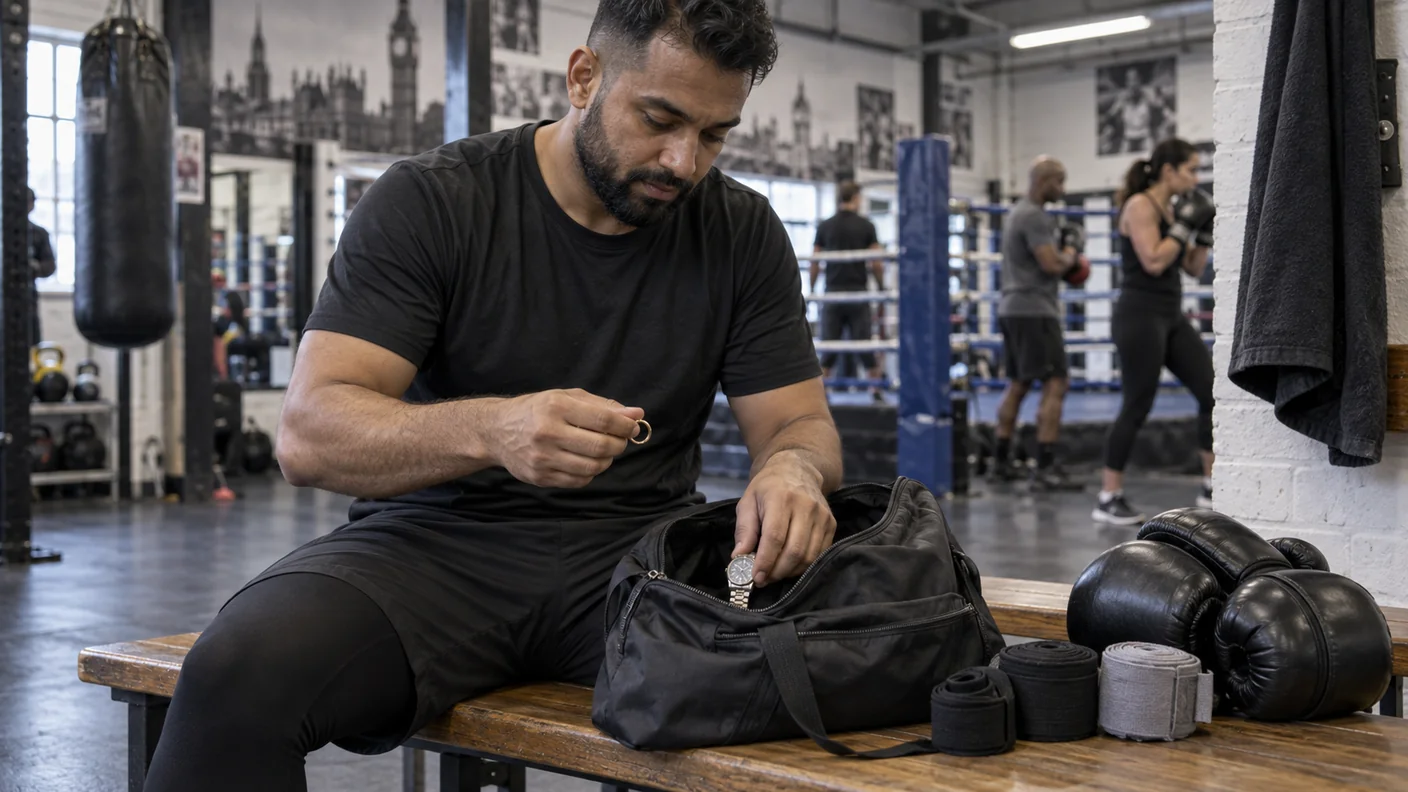
Take your jewellery off before you start boxing.
That includes rings, watches, chains, bracelets, hoop earrings and anything that can catch on a glove, hand wrap, bag, pad or another person. It is a small part of getting ready, but it stops a lot of avoidable trouble.
A wedding ring can feel harmless when you are standing still. In a boxing class, hands sweat, wraps tighten, gloves come on and off, and a ring can become uncomfortable before the warm-up is finished. A watch can press into the wrist when you punch. A necklace can swing or catch. Earrings and facial piercings are a different level again if there is any chance of accidental contact.
The practical rule is simple: arrive with somewhere safe to put it, take it off before training, then put it back on when you leave.
Why jewellery is a problem in boxing
Boxing makes ordinary objects less ordinary.
A ring does not need a hard punch to become a problem. It can catch on a hand wrap, pinch under a glove or make your hand swell feel worse after a hard round. A metal watch or bracelet can dig into the wrist when you bend it behind a punch. A chain can get caught as you pull a T-shirt over your head or move around a bag.
The issue is not that every session turns into sparring. Most beginners start with stance, footwork, bags, pads and conditioning. Those are still active, repetitive tasks with gloves, wraps and fast-moving hands. The safest approach is to remove the thing before it has a chance to get involved.
This is also about the people around you. A sharp earring, protruding ring or hard watch is not only your risk. It can scratch a partner during pad work or catch on their clothing when the space gets busy.
England Boxing's 2026 technical and competition rules require all body piercings to be removed for a bout. A class is not a bout, but the underlying logic is sound: equipment and body contact work better when nobody brings an unnecessary hard edge into the space.
Take off rings, watches and chains before you wrap up
The easiest time to deal with jewellery is before you start wrapping your hands.
Put rings, watches and bracelets into a zipped pocket in your gym bag or a small case. Do not leave them loose on a bench, the floor or a shelf beside the bags. Boxing gyms are busy, and it is very easy for a small item to disappear under a towel, a pair of gloves or somebody else's kit.
A watch is the obvious one to forget because many people wear it all day. Take it off before the wraps go on. You do not need it to time a round when the coach or gym timer is doing that job. The watch does not improve your jab, and it can make the wrist position less comfortable.
Chains and longer necklaces are not a sensible compromise under a T-shirt. Fabric moves. The chain moves. A glove, zip or hand wrap can still find it. Put it away rather than hoping it remains hidden.
If you are new to the room, this is not a test of whether you look like a boxer. It is one of the ordinary habits that makes training smoother. Our guide to boxing gym etiquette for beginners covers the same point alongside sharing space, wrapping hands and treating coaches and training partners with respect.

Piercings need a more careful answer
For healed piercings that can be removed easily, take them out before class. That includes earrings, nose rings, eyebrow jewellery and lip piercings.
Do not decide that a small stud cannot cause a problem. It can still catch a glove, pad, towel or finger. If it is near the face, accidental contact can push it into skin. That is avoidable, and it is not worth finding out how much it hurts halfway through a session.
A new piercing creates a different issue. You may not be able to remove it without irritation or without affecting healing. That does not mean you should cover it with tape and treat sparring or close partner drills as normal. Tell the coach before the class starts and keep the session non-contact until you have clear advice from your piercer or clinician about what is sensible.
The NHS advice on infected piercings says to leave jewellery in unless a doctor tells you to remove it. If a piercing is painful, swollen, hot, leaking or otherwise worrying you, the answer is not to force it out in the changing room. Pause the activity that risks catching it and get appropriate advice.
This is one reason beginner boxing should be scaled to the person in front of the coach. You can work on stance, bags, movement and fitness without turning every class into a contact decision.
Do not make the glove fit around the problem
People sometimes try to make jewellery work because they do not want to lose an item or spend two minutes sorting it out. They tape over a ring. They tuck a chain into a shirt. They pull a glove over a watch. None of these are good fixes.
A glove should fit around a wrapped hand, not around metal. Hand wraps should sit flat and support the wrist, not bunch around a bracelet. If the glove feels tight or the wrist feels awkward, stop and check what is underneath it before you start punching.
The same common sense applies to false nails and false eyelashes. They might not affect a bag round, but they can make gloves awkward to put on, pull at the face during a sweaty session or create a distraction when your focus should be on the coach and the next drill.
A good pre-class check takes less than a minute:
- Remove rings, watches, bracelets and chains.
- Remove any piercings that are healed and easy to take out.
- Put valuables into a zipped bag pocket or secure case.
- Tie hair back and keep loose clothing out of the way.
- Check that wraps lie flat and gloves fit comfortably.
- Tell the coach about a new piercing, a healing issue or anything you cannot safely remove.
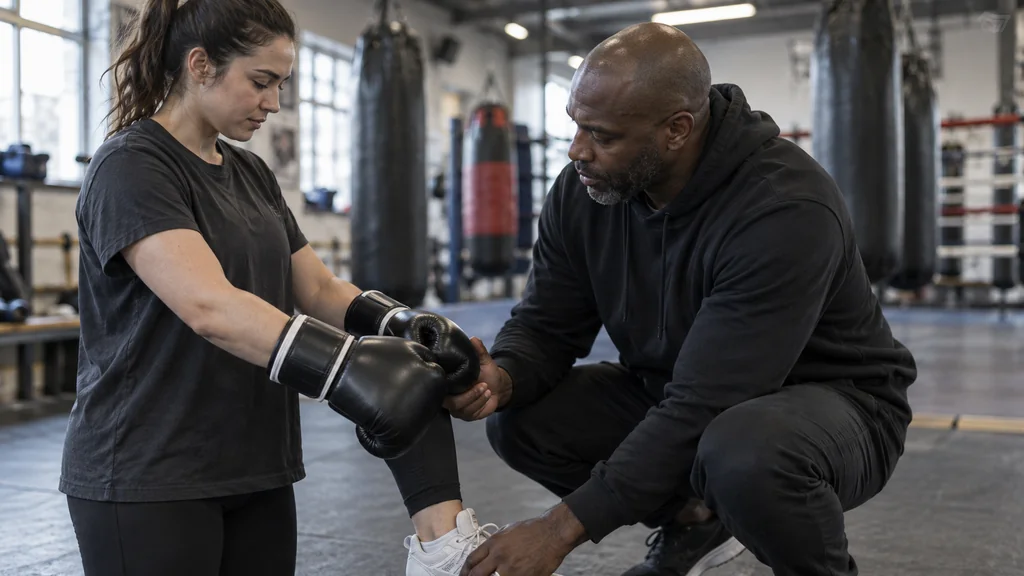
The rule changes as contact gets closer
A calm solo bag round is not the same as pad work, partner drills or sparring.
That does not mean you need to be frightened of the later stages. It means that the closer the work becomes, the less room there is for avoidable kit problems. Before any contact drill, a coach should be able to see that gloves, wraps, mouthguard and clothing are right for the task. Jewellery should already be out of the picture.
If you ever move towards sparring, read what to know before your first sparring session and follow the coach's safety checks without negotiation. Sparring is optional for recreational boxers. Wearing metal or loose items is not a way to make it more serious.
At Honour and Glory, Recreational Adults boxing classes give adults a coached place to learn technique, work bags and pads, and build fitness without needing sparring. If you are near Kidbrooke, bring comfortable training clothes, clean trainers, water and a place to store your valuables. Leave the jewellery in the bag.
H&G Team
Writer at Honour & Glory Boxing Club, a community boxing gym in Kidbrooke, South East London.
KEEP READING
Boxing Gym Etiquette for Beginners
New to boxing? Learn the unwritten rules of boxing gym etiquette so you fit in from day one and avoid common beginner mistakes.

The Unwritten Rules of a Boxing Gym: What Beginners Should Know
Every boxing gym has unwritten rules that new members are expected to know but nobody explains. Here is the complete guide to gym etiquette from day one.
Can You Box If You Wear Glasses?
Yes, many beginners can box with glasses. Here is what to wear, what to avoid, and when to ask your optician first.
Was this page helpful?
It takes one tap, and it genuinely helps.
Choose your next step
Turn this article into the right action
Some readers are ready to book. Some need the class route first. Pick the route that matches what you actually want.