Strength and Conditioning for Boxing Beginners: What to Add

Boxing Science's beginner conditioning protocols are designed specifically for boxing club members who are new to structured S&C work. Frontiers research on strength training in amateur boxers provides the evidence base.
Boxing training is physically thorough. Bag work, pad work, and conditioning circuits develop cardiovascular fitness, muscular endurance, and coordination simultaneously.
For beginners in the first three months, additional supplementary training is not necessary and may be counterproductive - the boxing training itself is sufficient stimulus for substantial adaptation. The same logic applies to supplements: if recovery products are on your mind, read legal recovery supplements for boxing after you understand the training basics.
After the initial adaptation period, selective supplementary work accelerates development in specific areas.
The Foundation Period - Do Not Add Yet
In the first twelve weeks, additional training is not the priority. Learning technique, attending consistently, and recovering adequately is.
If you are sore from boxing sessions, adding supplementary training before soreness has resolved undermines recovery and increases injury risk. The mistake many beginners make is treating boxing as insufficient and immediately adding gym work on top of it. The body's adaptation capacity is finite. Too much stimulus too early produces overtraining rather than accelerated development.
After the Foundation - What to Add
Once your body has adapted to regular boxing training - typically at three months - selective supplementary work becomes valuable.
Core strength. Boxing's power generation depends on core strength and stability. Planks, dead bugs, pallof presses, and rotational core exercises directly transfer to punching power and defensive stability.
Hip hinge strength. Deadlifts and Romanian deadlifts develop the posterior chain that generates ground force through punching. This is the single supplementary exercise with the most direct transfer to boxing power.
Shoulder stability. External rotation exercises with resistance bands develop the rotator cuff muscles that protect the shoulder under boxing's high-volume punching demands. This is injury prevention, not power development.
Grip strength. Wrist roller, farmer carries, and towel pull-ups develop the forearm and grip strength that reduces hand and wrist injury risk under heavy bag work.
What to Avoid
Heavy benching as primary upper body work. The chest-dominant press pattern of heavy bench pressing is not the movement pattern of boxing and can interfere with shoulder positioning.
Maximum effort leg exercises the day before boxing training. Squatting to a heavy maximum the day before a hard session compromises the boxing session's quality.
HIIT sessions as supplementary training. The conditioning system is already being developed by boxing. Adding HIIT on top increases cardiovascular overtraining risk without adding boxing-specific development.
The Recommended Supplement - Two Sessions Per Week
Two sessions of thirty to forty-five minutes each, on non-boxing days, focusing on:
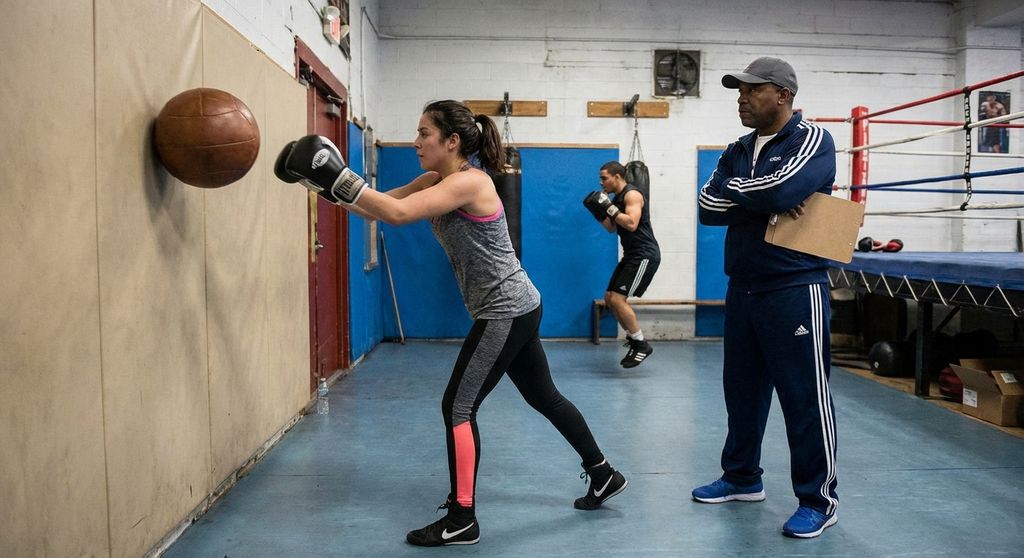
Session 1: Hip hinge (Romanian deadlift 3x8), core rotation (pallof press 3x12 each side), shoulder stability (external rotation 3x15 each side).
Session 2: Core stability (plank variations, dead bugs), grip and forearm (wrist roller, farmer carries), upper back (face pulls, band pull-aparts).
This is modest in volume but specifically targeted. More is not better at this stage.
At Honour and Glory, the coaches can advise on supplementary work appropriate to your specific development stage.

H&G Team
Writer at Honour & Glory Boxing Club, a community boxing gym in Kidbrooke, South East London.
KEEP READING
How to Build Neck Strength for Boxing
A stronger neck will not make you punch-proof, but it can help boxers hold posture, brace better and train more safely. Here is a practical gym routine for amateurs.

Why Beginners Gas Out in Boxing
Gas early in boxing even though you can run? Here is why beginners fade fast, and what usually fixes it quicker than more miles.

Boxing for Overthinkers: Get Out of Your Head
If your brain keeps running after work, boxing gives it a cleaner job: move, breathe, listen, hit pads and reset.
Was this page helpful?
It takes one tap, and it genuinely helps.
Choose your next step
Turn this article into the right action
Some readers are ready to book. Some need the class route first. Pick the route that matches what you actually want.