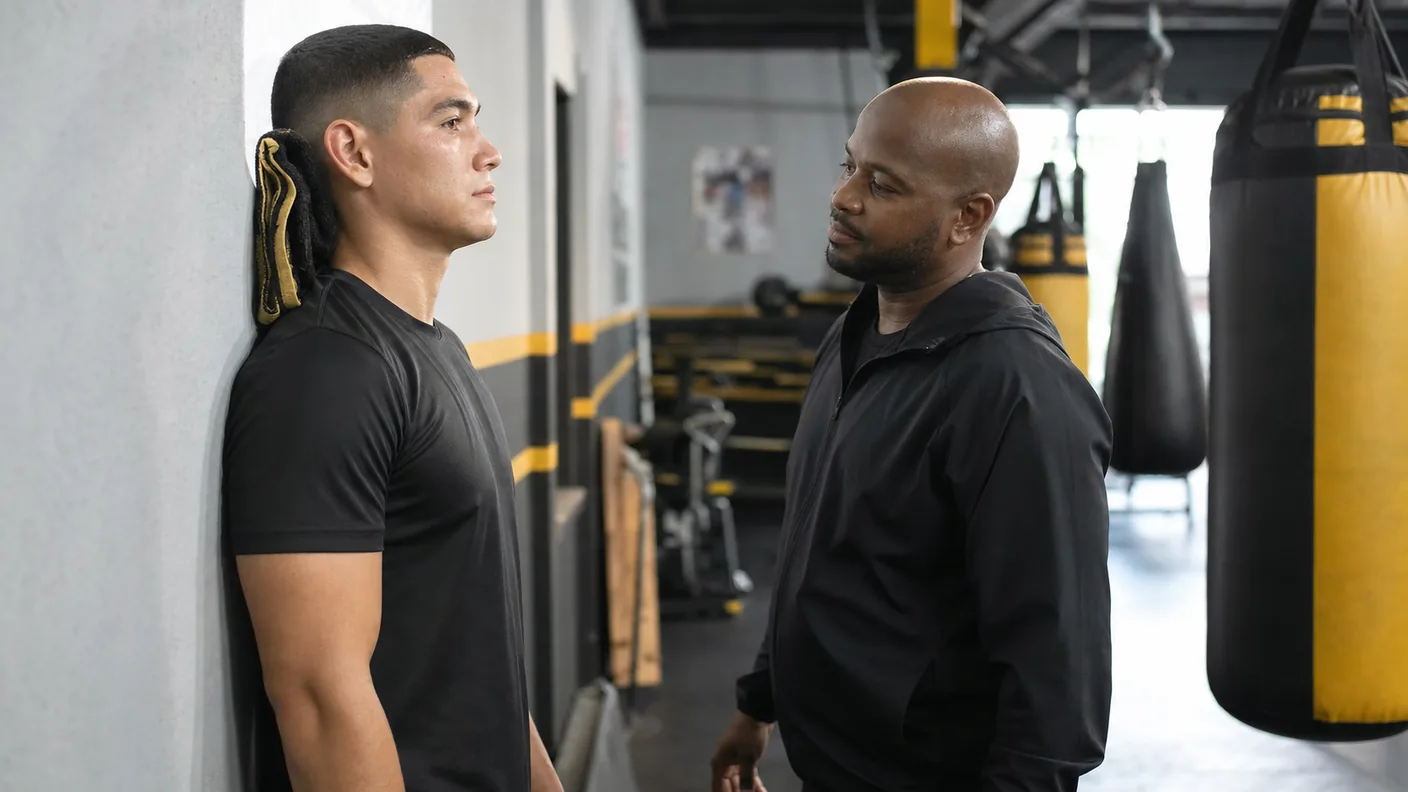
Neck strength matters in boxing, but it is easy to talk about it badly.
A stronger neck does not make you immune to concussion. It does not mean you can take clean shots safely. It will not fix poor defence, bad sparring habits or a coach who lets rounds get silly.
What it can do is more modest and more useful: help you hold posture, resist being pulled around, keep your head better controlled when force comes through the body, and reduce the feeling that every clinch, miss or bump leaves your neck sore for days.
That is why serious fighters pay attention to it. Gennady Golovkin has often been used as the obvious boxing example because footage of his neck training has circulated for years, and boxing coach Ross Enamait has written about Golovkin's habit of treating neck work as part of being a complete professional. Formula 1 drivers are another useful comparison. Carlos Sainz told Formula1.com that F1 neck preparation involved pulling and holding weights with the neck to resist G-force, plus karting and resistance-band work to mimic racing demands.
Different sport, same principle: the head is heavy, the forces are fast, and the neck has to control them.
**Health note:** this is general training information, not medical advice. If you have neck pain, arm pain, pins and needles, dizziness, headaches after contact, a recent concussion, or symptoms that are worsening or unusual, stop training and speak to a qualified clinician. For urgent symptoms, use NHS 111, A&E or 999 as appropriate.
The quick answer
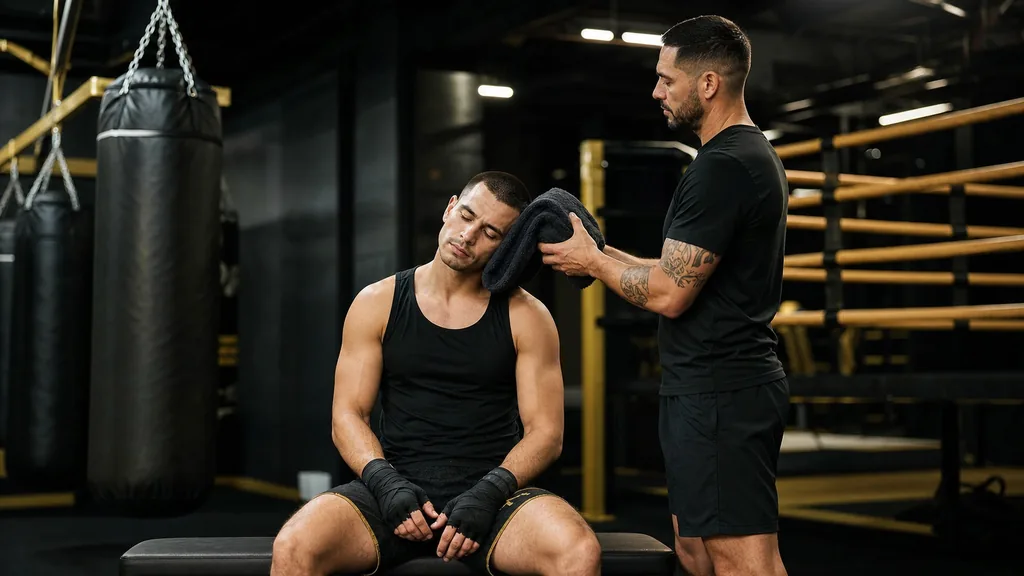
For most amateur boxers, neck training should be short, controlled and boring.
Start with:
- 2 sessions per week
- 8-12 minutes at the end of a gym or strength session
- light isometrics in four directions
- light band or towel resistance
- upper back and trap work such as rows, face pulls and farmer carries
- no max-effort neck bridges as a beginner
The goal is not to build a cartoon neck in four weeks. The goal is to make your neck stronger gradually without irritating the cervical spine.
If you already box two or three times a week, neck work should sit inside a sensible strength training for boxing plan, not become another hard session that competes with your boxing.
Why boxers train the neck
Boxing asks the neck to do several jobs.
First, it holds your head in position while you move. A boxer who gets tired and lets the head drift forward becomes easier to hit, easier to push around and easier to counter.
Second, it connects the head to the trunk during impact. When a punch lands, the head does not float independently. The neck, shoulders, trunk and feet all affect how force is managed.
Third, it matters in close-range boxing. Clinches, shoulder contact, missed hooks, leaning, wrestling for position and coming out of exchanges all load the neck in ways beginners do not expect.
Fourth, it supports guard discipline. When your upper back, traps and neck fatigue, your posture often collapses before your arms do. You start reaching, lifting the chin and losing shape.
None of this means neck strength replaces defence. The best way to protect your brain is still to avoid unnecessary head contact, spar intelligently, recover properly and stop when symptoms appear.
What the research actually says
The research is interesting, but it is not a magic shield.
A widely cited high-school athlete study published in the Journal of Primary Prevention found that weaker overall neck strength was associated with concussion risk, and that each one-pound increase in neck strength was associated with a 5 percent decrease in the odds of concussion after adjusting for sex and sport.
That sounds powerful, but it should be read carefully. It was not a boxing-specific adult intervention showing that neck exercises prevent knockouts. It was a screening and association study across school sports.
A 2021 systematic review in Journal of Functional Morphology and Kinesiology was more cautious. It looked for adult collision-sport evidence and found very little high-quality research. Only three eligible studies were included, and the review concluded that there was currently a lack of evidence that neck strengthening interventions reduce impact injury risk in adult sport populations.
So the honest position is this:
- stronger necks may help reduce head movement under some forces
- weaker necks may be one risk marker in some athlete groups
- neck training is sensible for boxers when done progressively
- it should not be sold as concussion prevention or permission to take shots
That is the responsible middle ground.
What GGG and F1 drivers teach us
Golovkin is useful because he shows that elite fighters do not only train what looks glamorous.
He already had power, timing, balance and a famous chin, yet still trained the neck. The lesson for amateurs is not "copy GGG's hardest drills tomorrow". It is the opposite: the best fighters do small physical preparation work consistently because they do not want weak links.
F1 drivers are useful for a different reason. They train the neck because the sport makes a specific demand on it. The car pulls the head and helmet through cornering and braking forces, so drivers prepare with isometric holds, resisted movements and sport-specific exposure.
Boxers can borrow the principle, not the exact loading.
You do not need a racing-driver harness or a professional fighter's bridge routine. You need neck strength in flexion, extension, side flexion and rotation, plus enough upper-back strength to keep your head sitting on a strong frame.
The beginner-safe neck routine
Use this two times per week for six to eight weeks.
Do it after training, not before sparring or hard pad work. You want your neck fresh when you box.
1. Neck warm-up
Do 1 easy round:
- chin tuck: 8 slow reps
- gentle left and right turns: 8 each way
- gentle side bends: 8 each way
- shoulder rolls: 10 forward, 10 backward
- band pull-aparts or face pulls: 15 reps
Keep it calm. You are preparing the area, not trying to stretch aggressively.
2. Four-way isometrics
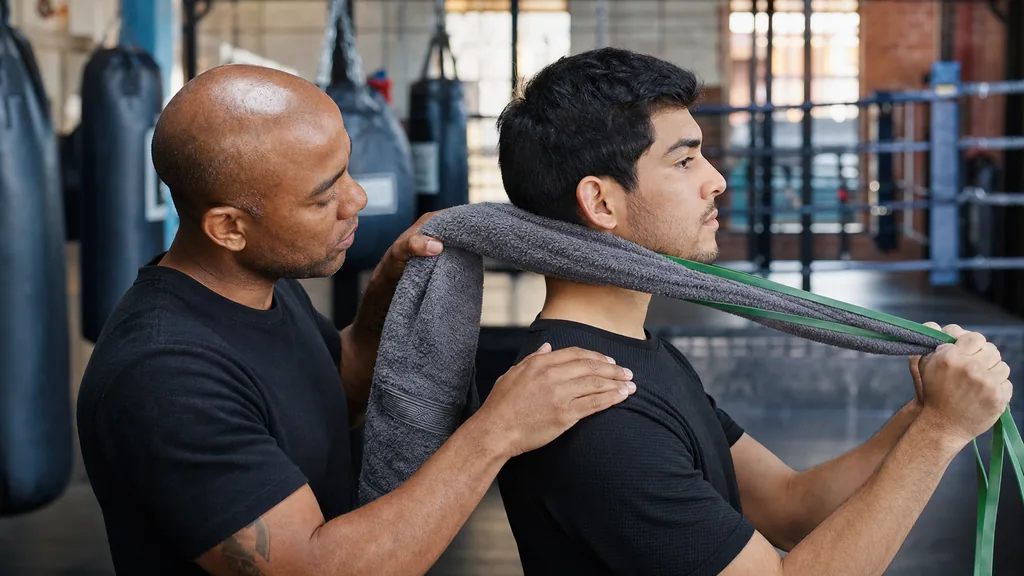
Sit or stand tall. Use your hand, a towel or a wall.
Push lightly into resistance without letting your head move.
- front of head into hand or towel: 3 x 8-10 seconds
- back of head into hand, towel or wall: 3 x 8-10 seconds
- left side into hand or towel: 3 x 8-10 seconds
- right side into hand or towel: 3 x 8-10 seconds
Effort should feel like 4 or 5 out of 10 in week one. If you are shaking, grimacing or holding your breath, you are doing too much.
3. Light band or towel resistance
After two or three weeks, add light movement if the isometrics feel easy and pain-free.
Use a light band or towel and move slowly:
- neck flexion: 2 x 10-12
- neck extension: 2 x 10-12
- side flexion each way: 2 x 10-12
- controlled rotation each way: 2 x 8-10
Keep the range comfortable. Do not chase end-range stretch under load.
4. Upper back and trap support
The neck is not just the neck. It sits on the shoulders and upper back.
Add two of these to your normal gym session:
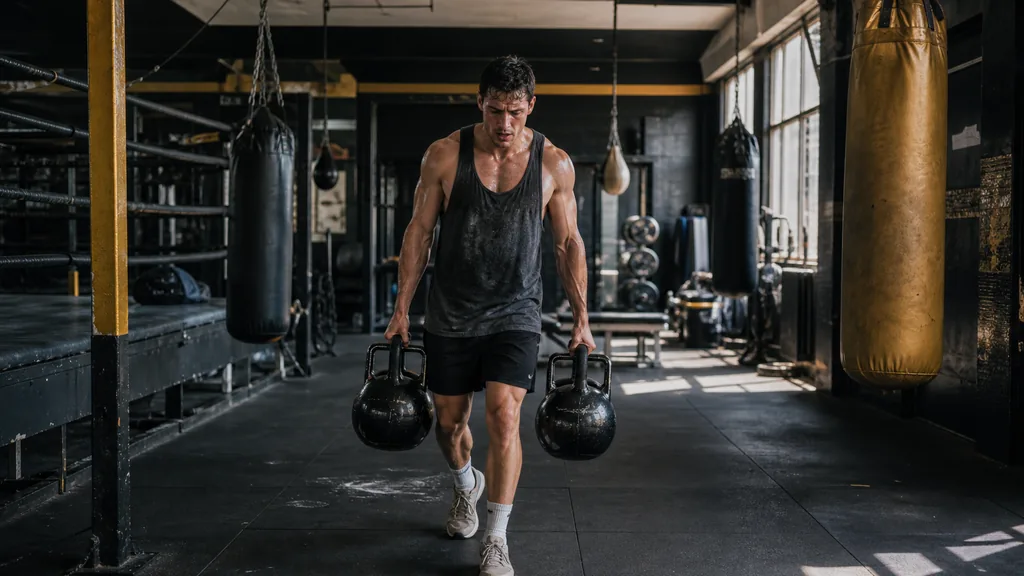
- farmer carries: 3 x 20-30 metres
- face pulls: 3 x 12-15
- chest-supported rows: 3 x 8-12
- band pull-aparts: 2 x 20
- shrugs with a pause at the top: 2 x 10-12
Farmer carries are especially useful because they train posture, grip, traps, trunk stiffness and breathing under load. They are simple, safe and hard to fake.
5. Boxing posture finisher
Finish with 2 x 30 seconds in stance:
- chin slightly tucked
- eyes level
- shoulders relaxed
- guard up
- breathe through the nose if possible
- do not let the head poke forward
This ties the gym work back to boxing. You are not building a strong neck for the mirror. You are building one that helps you keep shape when tired.
What about neck bridges?
Neck bridges are traditional in boxing and wrestling. Many great fighters have used them.
That does not make them the best starting point for an adult beginner.
A bridge can load the cervical spine heavily, especially if the athlete is stiff, tired, rushing, or trying to copy a pro clip online. Some experienced combat-sport athletes can bridge well because they have built the capacity gradually over years. That is different from a new boxer forcing their head into the floor because they saw it in a training montage.
Our view is simple:
- beginners should start with isometrics, bands and upper-back work
- bridges should only come later, if at all
- if you do bridge, learn from a qualified coach and progress slowly
- never use bridging to test toughness
There is no badge for injuring your own neck in the name of injury prevention.
A simple 8-week progression
Here is a practical version for amateur boxers.
Weeks 1-2: control
Twice per week:
- warm-up
- four-way isometrics only
- face pulls or band pull-aparts
- light farmer carries
Keep every rep easy and clean.
Weeks 3-4: light movement
Twice per week:
- four-way isometrics
- light band flexion and extension
- light band side flexion
- rows or face pulls
- farmer carries
Still no hard efforts. You should finish feeling like you could do more.
Weeks 5-8: build capacity
Twice per week:
- four-way isometrics at 6 or 7 out of 10 effort
- band movements for 2-3 sets
- farmer carries heavier or longer
- rows or face pulls
- boxing posture finisher
If you get soreness deep in the neck, headaches, nerve symptoms, dizziness or pain that lasts beyond normal muscle fatigue, stop and get advice.
Where to put it in your boxing week
For a recreational boxer training three times per week, this is enough:
Monday: boxing class
Wednesday: boxing class plus 8-12 minutes neck work after
Friday: gym strength session with farmer carries, rows and neck isometrics
Saturday or Sunday: optional light mobility, walking or easy shadow boxing
Do not do a hard neck session immediately before sparring. Do not train the neck hard the day after taking head contact. Do not add neck training on top of a week where you are already under-recovered.
If you are still in your first few months, keep strength and conditioning simple. The first priority is building a repeatable training habit, not adding every accessory exercise at once.
The mistakes to avoid
Going too heavy too early. The neck responds well to gradual work. It does not need ego loading.
Training through symptoms. Neck pain, arm symptoms, headaches, dizziness or concussion symptoms are not normal training soreness.
Only training front and back. Boxing loads the neck in multiple directions. Side flexion and rotation matter.
Forgetting the upper back. A strong neck on weak shoulders and a collapsed upper back will not solve posture.
Copying pros directly. Golovkin, wrestlers and elite combat athletes have years of preparation. Their advanced drills are not your starting dose.
Thinking neck work makes sparring safer by itself. Sensible sparring culture matters more than any exercise.
The H&G answer
If you box, your neck should be trained like any other useful athletic quality: patiently, progressively and without drama.
The sweet spot for most amateurs is not extreme. Two short sessions a week, done properly for two months, will do more than one reckless session copied from Instagram.
Build the neck. Build the traps. Build the upper back. Keep your defence sharp. Spar sensibly. Stop when symptoms appear.
That is how neck training belongs in boxing: not as a macho shortcut, but as one small part of becoming harder to move, harder to bully and better prepared for the physical demands of the sport.
If you are healthy enough to train and want to learn boxing in a coached environment, claim a free trial session at Honour and Glory Boxing Club. We are based in Kidbrooke and work with adult beginners across Greenwich, Blackheath, Lewisham and south east London.
Sources
- Collins et al., Neck strength: a protective factor reducing risk for concussion in high school sports, PubMed
- Daly, Pearce and Ryan, systematic review of neck strength protocols in collision sports, PMC
- TRAIN study protocol on traumatic brain injury reduction by neck strengthening, PMC
- Carlos Sainz on F1 neck preparation, Formula1.com
- RossBoxing on Gennady Golovkin's neck training
- NHS neck pain guidance
H&G Team
Writer at Honour & Glory Boxing Club, a community boxing gym in Kidbrooke, South East London.
KEEP READING
Strength and Conditioning for Boxing Beginners: What to Add
Boxing training provides fitness. Supplementary strength and conditioning work makes that fitness more effective. Here is what beginners should add and when.
Boxing for Older Adults: How to Start Safely
A practical guide to boxing for older adults: safe starting points, balance, confidence, strength, recovery and what to expect in the gym.
Why Beginners Gas Out in Boxing
Gas early in boxing even though you can run? Here is why beginners fade fast, and what usually fixes it quicker than more miles.
Was this page helpful?
It takes one tap, and it genuinely helps.
Choose your next step
Turn this article into the right action
Some readers are ready to book. Some need the class route first. Pick the route that matches what you actually want.