
A lot of beginners think they are unfit because they blow up in boxing after one hard round. That is usually the wrong diagnosis.
Boxing does expose weak fitness, but it also punishes tension, bad breathing, rushed pacing, and lazy footwork. You can run 5k without drama and still feel your shoulders fill with concrete after 90 seconds on pads. That does not mean your engine is terrible. It usually means boxing is asking your body to do work you have not learned to do efficiently yet.
A simulated Olympic boxing study found athletes spent roughly 60 per cent of the bout above ventilatory threshold 2, which tells you straight away that boxing is not a gentle cardio session (Open Access Journal of Sports Medicine). A review of England international amateurs reached the same basic conclusion: boxing performance depends on the overlap between aerobic and anaerobic systems, not one or the other in isolation (Journal of Sports Science & Medicine).
If you have asthma or regular exercise-triggered breathing symptoms, read what to check before boxing with asthma before you treat breathlessness as only a fitness issue.
If you are new, that mix feels brutal. Here is why.
It Is Not Just Your Cardio
The short answer is this: boxing is not steady work.
Running at one pace is predictable. Boxing is constant braking and accelerating. You move, set your feet, punch, tighten up, react, move again, then try to recover while still thinking. That stop-start pattern is what catches beginners out.
The people who struggle most are often not the least fit. They are the ones trying to win every second of every round. They punch hard when they should be touching. They hold their breath when they should be exhaling. They stand square when they should be stepping out.
That is why a beginner can look exhausted after two rounds while a better boxer seems oddly calm. The better boxer is not always fitter. Often they are simply wasting less.
If your work pattern already leaves you tired before class, our guide to boxing for shift workers with irregular rotas explains how to scale sessions without turning fatigue into a moral test.
Your Arms and Shoulders Are Doing Expensive Work
Your arms and shoulders are often the first part of the problem.
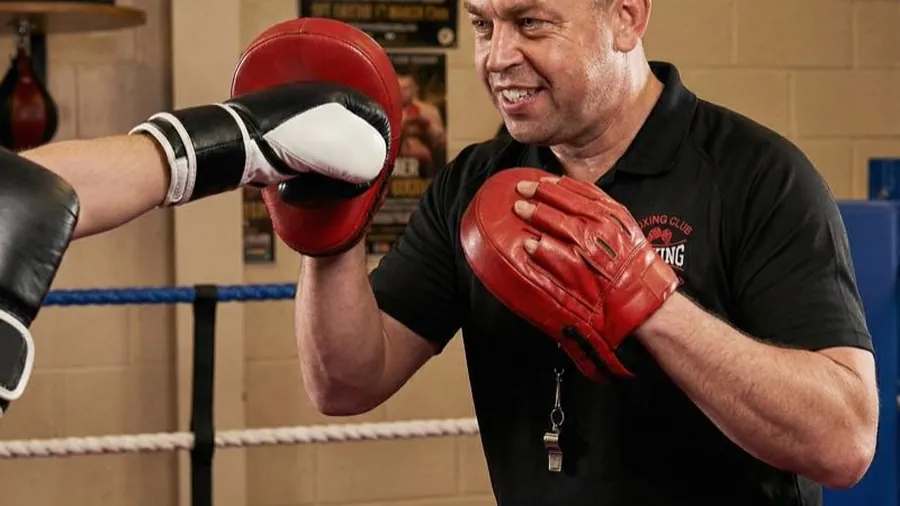
Beginners keep the guard too tense, throw every shot with bad intent, and carry that tension between combinations. After a minute, the shoulders start burning. After two minutes, the jab slows down. Then the whole round feels harder than it should.
That pattern is not in your head. A 2023 study in PLOS One found that upper-body exercise is perceived as harder than leg exercise at the same heart rate or oxygen uptake, and that local muscular strain tends to dominate during arm work (PLOS One). In plain English, when the arms are doing the work, fatigue feels more local and more immediate.
That matters in boxing because your arms are never truly off. Even when you are not punching, you are holding position, framing, catching, feinting, and resetting.
Tension Empties the Tank Fast
The quickest way to gas out is to stay tense when nothing is happening.
Watch a nervous beginner and you will see the same thing every time. Jaw tight. Hands squeezed into fists. Shoulders up by the ears. Every movement done at 100 per cent. That is exhausting before a clean punch has even landed.
The boxing community says the same. In one r/amateur_boxing discussion about conserving energy, the recurring advice was simple: keep breathing, stop trying to force every exchange, and relax between actions. In another thread about surviving three hard rounds, posters kept coming back to the same three faults - poor pacing, poor breathing, and not relaxing enough.
That matches what coaches see every week. Beginners think effort is the answer, so they spend too much of it.
Footwork Problems Turn Everything Into Hard Work
Bad footwork makes the round more expensive than it needs to be.
If your feet arrive late, the jab has to reach. If your stance is too tall, every defensive move feels like a panic. If you cross your feet, you waste energy recovering balance before you can throw again. Small footwork errors do not look dramatic, but they add up fast.
This is one reason running fitness does not transfer neatly. Roadwork helps, and our piece on why every boxer still runs explains why. But boxing-specific movement is different. You are not travelling smoothly in one direction. You are making sharp little adjustments under pressure.
If you are still new to stance, range and rhythm, read what to expect at your first boxing class. It helps people stop mistaking early awkwardness for failure.
What Usually Fixes It Fastest
The best fixes are technical before they are heroic.
Relax your shoulders between actions
Bring the hands back, but do not carry the guard like you are trying to shrug a wardrobe. The guard should be ready, not rigid. If shoulder burn is the part that keeps ruining your rounds, read our guide on why your shoulders burn in boxing.
Exhale on every punch
A clean sharp exhale stops breath-holding and helps rhythm. If you are silent for an entire combination, there is a fair chance you are suffocating yourself.
Stop loading up every shot
Most beginners throw too hard too often. Your jab does not need to be a finish every time. Touch, score, move, reset.
Let the feet do their share
If the feet place you properly, the hands do less desperate work. If the feet are wrong, the upper body starts compensating and everything feels heavier.
Build boxing fitness with rounds, not ego
Bag rounds, pads, shadowboxing, and controlled technical sparring teach you how to recover while still working. That is closer to the real demand than just adding another jog because you had one bad session.
The Honest Benchmark for Beginners
If you gas out in your first few weeks, that is normal.
You are learning a skill under fatigue. You are asking small upper-body muscles to stay switched on. You are making decisions while moving. Of course it feels rough.
What matters is the trend over six to eight weeks. Are you breathing better? Are the shoulders staying looser? Are you recovering between rounds faster? Can you keep the jab alive late in the session? Those are the real signs that boxing fitness is coming together.
Most people do not need a dramatic conditioning overhaul. They need cleaner habits and more rounds done properly. If the movement itself feels awkward, our guide to boxing when you feel clumsy explains why stance, footwork and rhythm improve with coached repetition.

Where to Start in South East London
If you are in Greenwich or nearby, the best place to start is a beginner-friendly class where nobody expects you to look polished on day one.
Our Recreational Adults boxing classes are built for exactly this stage. You will learn how to stand properly, breathe properly, and pace yourself so the round stops feeling like a sprint with gloves on.
Getting fitter matters. Getting calmer and more efficient matters just as much.
Book a free trial session at Honour and Glory Boxing Club.
Adult beginner route
If you are deciding where to start, use the main adult beginner boxing guide. It compares the normal group-class route, women-only classes, weight-loss intent and private coaching for nervous or time-constrained beginners.
H&G Team
Writer at Honour & Glory Boxing Club, a community boxing gym in Kidbrooke, South East London.
KEEP READING

Strength and Conditioning for Boxing Beginners: What to Add
Boxing training provides fitness. Supplementary strength and conditioning work makes that fitness more effective. Here is what beginners should add and when.

Heavy Bag Workout for Beginners
A complete heavy bag workout designed for beginners. This 20-minute routine builds technique, cardio, and power without requiring years of experience.

Your First Month of Boxing: A Week-by-Week Guide
The first month of boxing has a predictable arc. Knowing what to expect in each week makes the difficult early period manageable and the breakthrough moments recognisable.
Was this page helpful?
It takes one tap, and it genuinely helps.
Choose your next step
Turn this article into the right action
Some readers are ready to book. Some need the class route first. Pick the route that matches what you actually want.