'ABSOLUTE DISGRACE!' Spencer Oliver and Dev Sahni REACT To Hamzah Sh
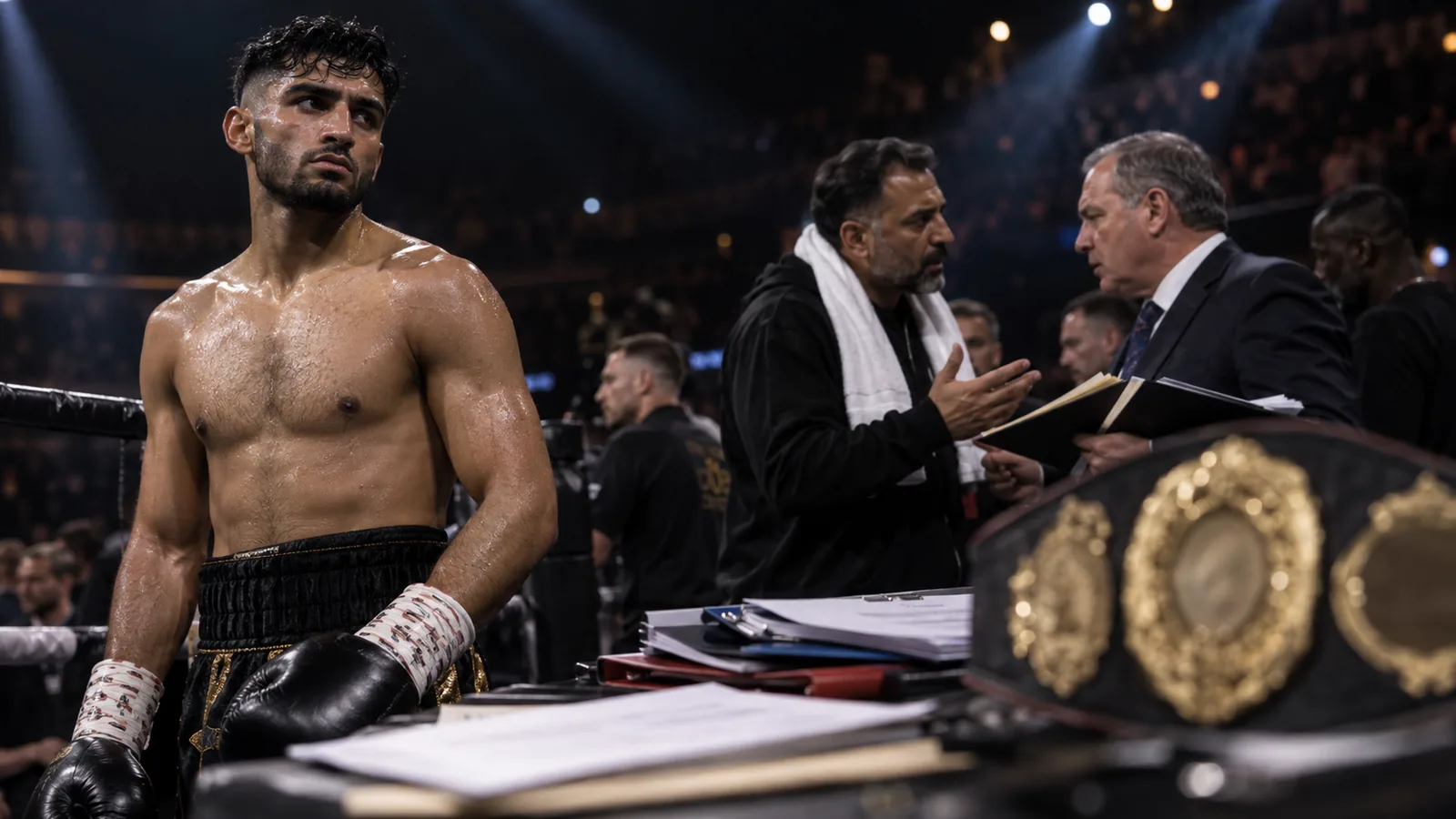
Hamzah Sheeraz vacating the WBO title is a bad look, but it exposes boxing’s real fault line
Hamzah Sheeraz has given up the WBO super-middleweight world title rather than meet mandatory challenger Janibek Alimkhanuly. The reaction from Spencer Oliver and Dev Sahni was blunt. You can understand why.
A world title is meant to carry responsibility as well as status. You win it, you defend it, and when the sanctioning body identifies the next man in line, you either fight him or surrender the belt. That is the basic bargain.
Calling the decision an “absolute disgrace” makes for a strong headline, but the more useful question is harder: what does the vacancy actually tell us about modern boxing?
It tells us that belts are not just shiny proof of achievement. They are pressure points. They determine who gets paid, who gets a career-changing opportunity, which promoter has negotiating power, and whether the best fighters are being pointed towards each other or carefully steered apart.
Sheeraz has every right to make the decision he believes best serves his career. A boxer has a short working life and takes all the physical risk. But fans have every right to judge the choice too. If a champion vacates rather than defend against the man officially placed in front of him, the belt becomes less about proving supremacy and more about controlling a route.
That is the uncomfortable bit.
What a mandatory challenger is supposed to prevent
A mandatory challenger is the contender a sanctioning body says the champion must face, or risk losing the title. The system is not glamorous, but it exists for a good reason: it stops champions treating a world belt like private property.
Without mandatories, a champion could repeatedly choose the safest available opponent, take fights that suit a broadcaster or promoter, and leave dangerous contenders waiting until they are old, inactive or no longer a problem.
An eliminator, ranking position or interim belt is supposed to create a route. Win enough, become unavoidable, and the champion must eventually answer your name.
That is why Janibek’s position matters. Whether you rate him highly, have doubts about him, or simply wanted a different fight, he was not asking for a favour. He was the mandatory. There is a difference.
As Betway’s explanation of boxing titles puts it, a champion who turns down a mandatory challenger is forced to vacate. That is not a technicality. It is the enforcement mechanism behind the whole idea of a ranking system.
The trouble is that boxing has never been governed by one clean, central ladder. The WBA, WBC, IBF and WBO each have their own rankings, deadlines, rules and commercial interests. A useful overview from CMBoxing explains the central problem: sanctioning bodies do not promote fights or control television deals, but their titles still shape the fights everyone can make.
That is why the paperwork becomes the story.

A title vacancy changes the balance of power
When a champion vacates, the belt does not disappear. It becomes an asset for the next stage of the division.
The WBO can now move Janibek and another eligible contender towards a vacant-title fight. Promoters can sell a new championship event. Broadcasters get a fresh main event. Contenders who were outside the title picture can suddenly find themselves one win from a world belt.
For the fighter who was mandatory, a vacancy can be both frustrating and useful.
Frustrating because he does not get the champion he earned the right to face. A win over Sheeraz would have carried sporting value, not just a belt. Useful because he no longer has to wait for a champion’s preferred plan, next payday or voluntary defence.
That is the key distinction fans should keep in mind. Winning a vacant belt can make a fighter an official world champion. It does not automatically give him the authority that comes from beating the reigning champion in the ring.
The next WBO champion will own a real title. But if Sheeraz remains active at super-middleweight and keeps beating top opponents, the division could still have a gap between official champion and the fighter many people consider the best. Boxing creates these arguments for itself.
Sidekick Boxing’s guide to the different belts makes the wider point clearly: four major bodies can recognise four champions in the same division. That is why the word “world champion” needs context. Which belt? Who was beaten for it? Who is mandatory? What did the route look like?
Those are not nerdy questions. They are the questions that tell you whether a title has real sporting weight.
The Janibek problem is the point
Nobody has to pretend Janibek Alimkhanuly is an easy night. He is a difficult, educated southpaw with a high-level amateur background, strong control of range and the sort of awkward confidence that makes fighters and promoters pause.
But hard is not the same as unfair.
Champions are allowed to choose their careers. They are not obliged to take every attractive fight a fan suggests. A mandatory is different. It is the cost of holding a world title.
If Sheeraz wanted freedom to pursue a bigger fight, a different direction or a move in weight, vacating is the honest administrative route. Better that than holding a belt hostage while everyone waits.
But it is still fair to say this: vacating a title to avoid a mandatory fight weakens the champion’s claim to be the division’s leading man. It may be sensible business. It is not a sporting statement of confidence.
That is why Oliver and Sahni’s anger lands with so many boxing people. The reaction is not really about a belt ceremony. It is about the repeated feeling that elite boxing asks fans to invest in rankings, title fights and number-one contenders, then treats those things as optional when the dangerous match-up arrives.
A broader mandatory-challenger explainer from Grokipedia describes the intended purpose as fairness and access for contenders. That is the theory. The reality is more political. Rankings can be disputed. Exceptions are granted. Unifications can take precedence. Promoters negotiate around deadlines. Fighters with market value have more choices than fighters with only a ranking.
That is fighter power, and it cuts both ways.

Why fighter leverage matters
Boxers deserve leverage. They are not employees in a neat league system, and they take the punches when a deal goes wrong. A fighter should not be shamed for making a financially sound choice, particularly when one defeat can change a career.
But leverage is also why the title system needs rules.
If the biggest names can always bypass mandatory challengers, while lesser-known contenders must fight eliminators and wait obediently, the rankings become theatre. The route only matters when the fighter at the end of it is easy enough to accept.
That is bad for fans, but it is worse for fighters on the way up. A contender can spend years building a position, taking risky fights and accepting low-profile opportunities. The mandatory slot is meant to be the reward.
At Honour & Glory, we teach boxers that position matters. You do not take space in the ring because you want it. You earn it with your jab, feet, composure and decisions under pressure. Professional boxing should work on the same principle. If a fighter earns his place in the queue, the champion should have to acknowledge him.
What fans should watch next
The next move matters more than the statement announcing the vacancy.
First, watch who the WBO orders for the vacant belt and whether the new champion is tested quickly. A vacant title should start a division moving, not create another holding pattern.
Second, watch Sheeraz’s next opponent. If he vacates to take an exceptional fight, one that is bigger, tougher or clearly meaningful for his career, the sporting argument changes. If he takes a low-risk alternative, the criticism will become much harder to dismiss.
Third, watch whether Janibek gets the opportunity his mandatory status was supposed to guarantee. If he is paired with a credible opponent for the vacant belt, the system has at least done its job after the fact. If the route suddenly becomes murky, then the frustration was justified.
The H&G view is simple. Sheeraz is entitled to choose his path, but a world title should not become a prop while the difficult obligations are avoided. Vacating is cleaner than stalling. It is still a disappointing outcome for anyone who wanted to see the champion prove himself against the mandatory challenger.
Belts matter because they are meant to create consequences. When they do not, boxing loses a little of the honesty that makes a title fight feel important.
If you want to learn the sport beyond the headlines, from distance and timing to what happens when pressure builds, book a trial at Honour & Glory Boxing Club in Kidbrooke.
H&G Team
Writer at Honour & Glory Boxing Club, a community boxing gym in Kidbrooke, South East London.
KEEP READING

Usyk Vacates Heavyweight Belts: What It Means
Oleksandr Usyk has vacated the WBC, WBA and IBF heavyweight titles. Here is why the decision matters for Kabayel, Joshua, Wardley and the whole division.

Usyk vacates three heavyweight belts: what changes next
A focused explainer on how Oleksandr Usyk giving up the WBC, WBA and IBF titles changes the heavyweight queue, why governing-body routes now matter, and why vacant belts create opportunities without proving who is the best heavyweight.

Usyk vacates titles: what it means for heavyweight boxing
A clear UK-club explainer on how Oleksandr Usyk giving up the WBC, WBA and IBF belts reshapes the heavyweight division, separates a vacant-title route from retirement, and explains why the contenders now matter.
Was this page helpful?
It takes one tap, and it genuinely helps.
Choose your next step
Turn this article into the right action
Some readers are ready to book. Some need the class route first. Pick the route that matches what you actually want.