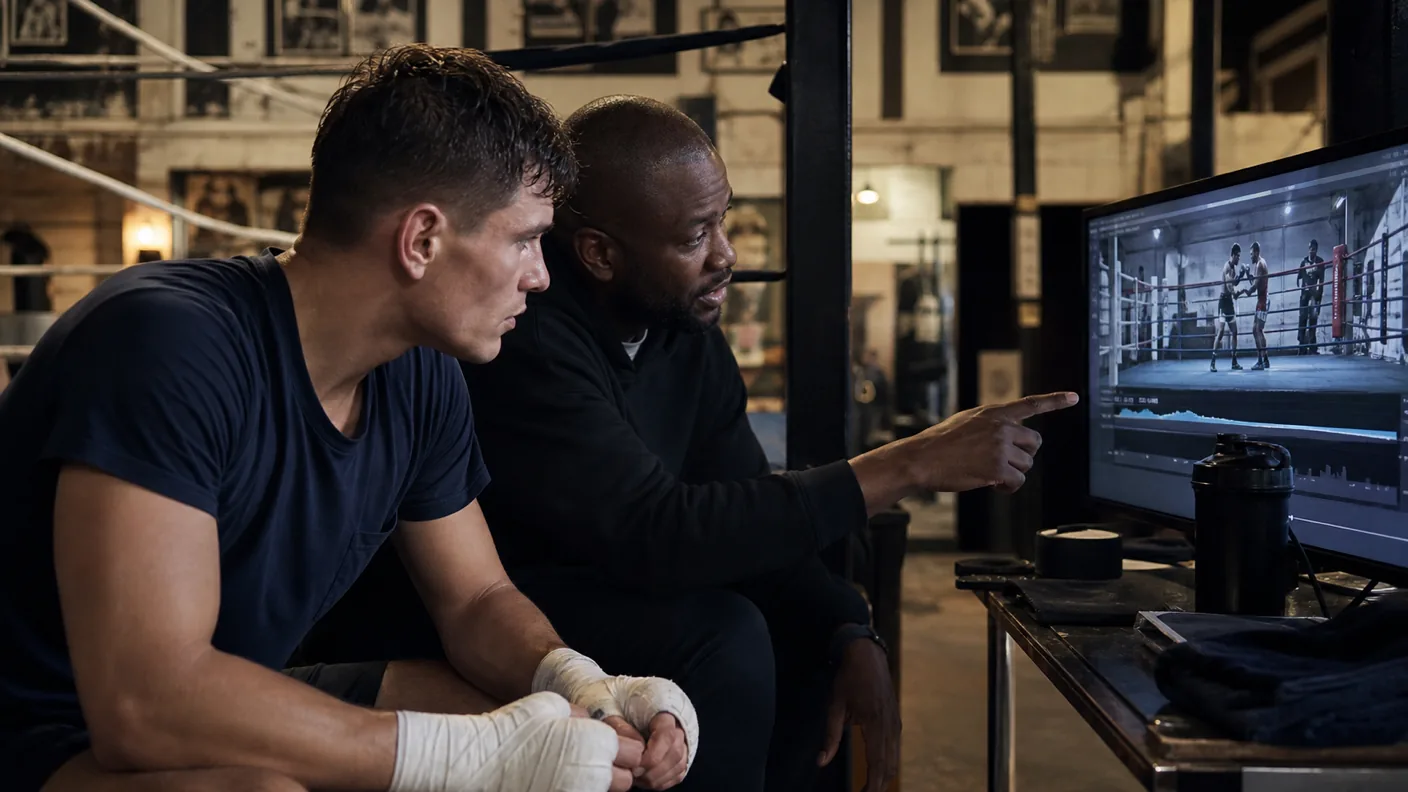
Knowing how to analyse boxing sparring footage is different from sitting back and watching yourself fight. The useful work starts when you stop judging whether you looked good and begin asking what kept happening, why it happened and what you can train next.
For a professional or competitive amateur, the review needs to be repeatable. One clean counter does not prove a tactic works. One awkward exchange does not mean the whole round was poor. Video earns its place when it helps boxer and coach find patterns that memory missed.
Our boxing video analysis in London page explains how this fits into coached development at H&G. This guide covers the actual review process.
How to analyse boxing sparring footage with a clear purpose
Before pressing play, write down the purpose of the round. Perhaps you were working behind the jab, preparing for a southpaw or trying to leave exchanges without backing straight out. Judge the footage against that task first.
Also note the round number, partner, stance match-up and any instruction given between rounds. Context matters. A boxer told to hold centre may appear less active than usual because the work was about position, not punch volume.
Poor footage can hide the very detail you want to study. If the ropes, a corner post or a moving camera block the action, mark the moment as unclear rather than inventing an answer. Use our guide to recording boxing sparring for video analysis before your next session if the angle needs work.
First pass: watch the whole round at normal speed
Do not pause every five seconds. Watch the round as the boxer experienced it and write a one-sentence account when it ends.
Who set the range? Where did the exchanges begin? Did either boxer dictate the pace, or did the round keep breaking into isolated bursts? This first pass should tell the story without pretending to score the round.
Then mark a handful of timestamps where the pattern changed. Good review points include the first successful entry, a repeated defensive error, a clean exit and the moment fatigue altered the boxer’s choices. Avoid saving only the most flattering clips.
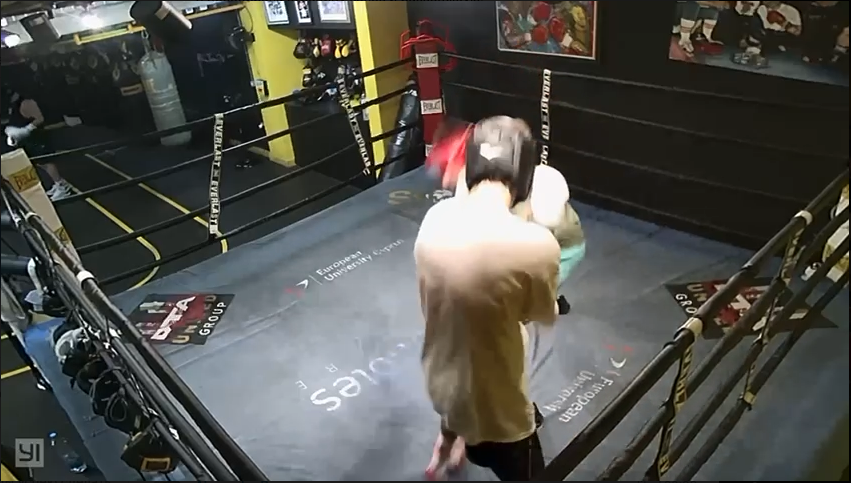
Partner-supplied AICO demonstration image. It shows the kind of elevated view that can make an exchange easier to revisit; it is not footage from an H&G session.
Second pass: break down the exchanges
Return to each timestamp and examine the exchange from its beginning, not from the punch that caught your eye. Most mistakes are prepared a beat earlier.
Use four parts:
- Entry: What put the boxer in range? Look for the jab, feint, step, slip or opponent’s mistake that opened the door.
- Action: Which punch or defensive movement was chosen, and did it suit the distance?
- Exit: Did the boxer angle away, smother the reply, defend in place or simply admire the work?
- Reset: Were the feet and guard ready for the next exchange?
Slow motion is useful here, but only after you have seen the exchange at full speed. Frame-by-frame playback can make an ordinary movement look like a long tactical decision. Boxing happens in real time, so return to normal speed before drawing a conclusion.
Sort what you see into useful categories
Random notes create random sessions. Put each observation under a coaching category so the repeated problem becomes obvious.
Distance and position: Was the boxer outside, at long range, in the pocket or smothered? Which foot position kept recurring? Did the boxer give up the centre without needing to?
Balance and shape: Could the boxer punch again after the first shot? Look for crossed feet, weight falling past the lead knee, a square stance or a head that drifts beyond the base.
Defence: Check what happened before and after punching. A glove held high in a freeze-frame means little if the boxer did not see the return or could not move after blocking it.
Decision-making: Was the correct option available but missed, or was the boxer forced into a bad choice by the earlier position? That distinction changes the training response. A technical correction will not fix a tactical problem on its own.
Ask questions that a coach can answer
“Why am I bad here?” is not a useful review question. It invites a verdict instead of an adjustment.
Ask narrower questions:
- What cue made me throw the rear hand?
- Why was I still in range after the combination?
- Which exit worked against this partner’s pressure?
- Did the same opening appear in more than one round?
- What should I repeat in pads before the next spar?
Bring the clip and your own answer to the coach. The aim is not to conduct a private trial of your technique. It is to make the coaching conversation specific.
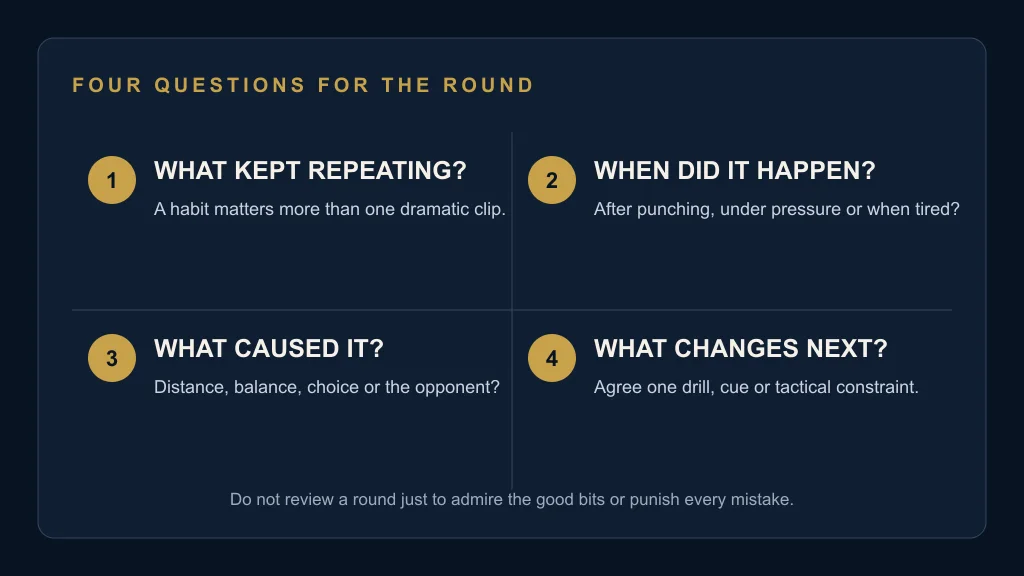
Use highlights without losing the round
Highlights save time, especially across a busy block of sparring, but they do not contain the whole performance. Quiet periods show who was controlling space. Missed punches show what a boxer believed was available. The seconds before a clean connection often explain it better than the connection itself.
At H&G, our installed AICO system can capture suitable sparring, create highlights and make patterns easier to revisit. For a visiting boxer, the point is simple: use the technology on your own round, then turn what you see into the next coaching action.
No system should be treated as perfectly accurate or as an automated scorecard. Camera angle, obstruction and image quality all affect what can be seen. Video analysis also does not make health, injury, matching or stoppage decisions. Those remain human responsibilities in the gym.
See how adult professional and competitive amateur boxers can visit H&G and try AICO. A parent or guardian must enquire for an under-18 boxer.
Turn the review into the next session
End with a small training brief, not a long list of faults. Choose one pattern to keep and one pattern to change. If everything becomes a priority, nothing is.
Make the change observable. “Be sharper” is useless. “After the jab-cross, finish outside the lead shoulder” gives boxer and coach something they can see on pads, in drills and in the next spar.
Keep the clip that best demonstrates the starting point. Review the same situation after several suitable sessions and compare like with like. A different partner or a different round objective can still be informative, but it is not a clean comparison.
The best analysis ends in the gym. Watch, decide, train, then film again when there is a reason to check the work.
Frequently asked questions
Should I count every punch in sparring footage?
Not by default. A manual count can answer a narrow question about activity, but it can also distract from range, balance and decision-making. Start with the purpose of the round and count only when the number helps test a specific coaching idea.
How many rounds should I review at once?
Review enough to confirm a pattern. One round can reveal a useful moment, while several comparable rounds show whether it repeats. Stop when your notes become vague or you are collecting faults without choosing what to train.
Can video analysis replace a coach watching live?
No. Footage gives a second view and allows replay, but the camera misses angles, instructions and what the boxer felt in the exchange. The strongest review combines the coach’s live judgement with the recorded evidence.
If you are an adult professional or competitive amateur who wants to use the latest boxing technology on your own round, ask about recording a session with AICO at H&G. A parent or guardian must make the enquiry for an under-18 boxer.
H&G Team
Writer at Honour & Glory Boxing Club, a community boxing gym in Kidbrooke, South East London.
Was this page helpful?
It takes one tap, and it genuinely helps.
Latest boxing technology at H&G
Come to H&G and put AICO to work on your boxing
Start with an AICO visit, or explore H&G's professional and competitive amateur pathways.