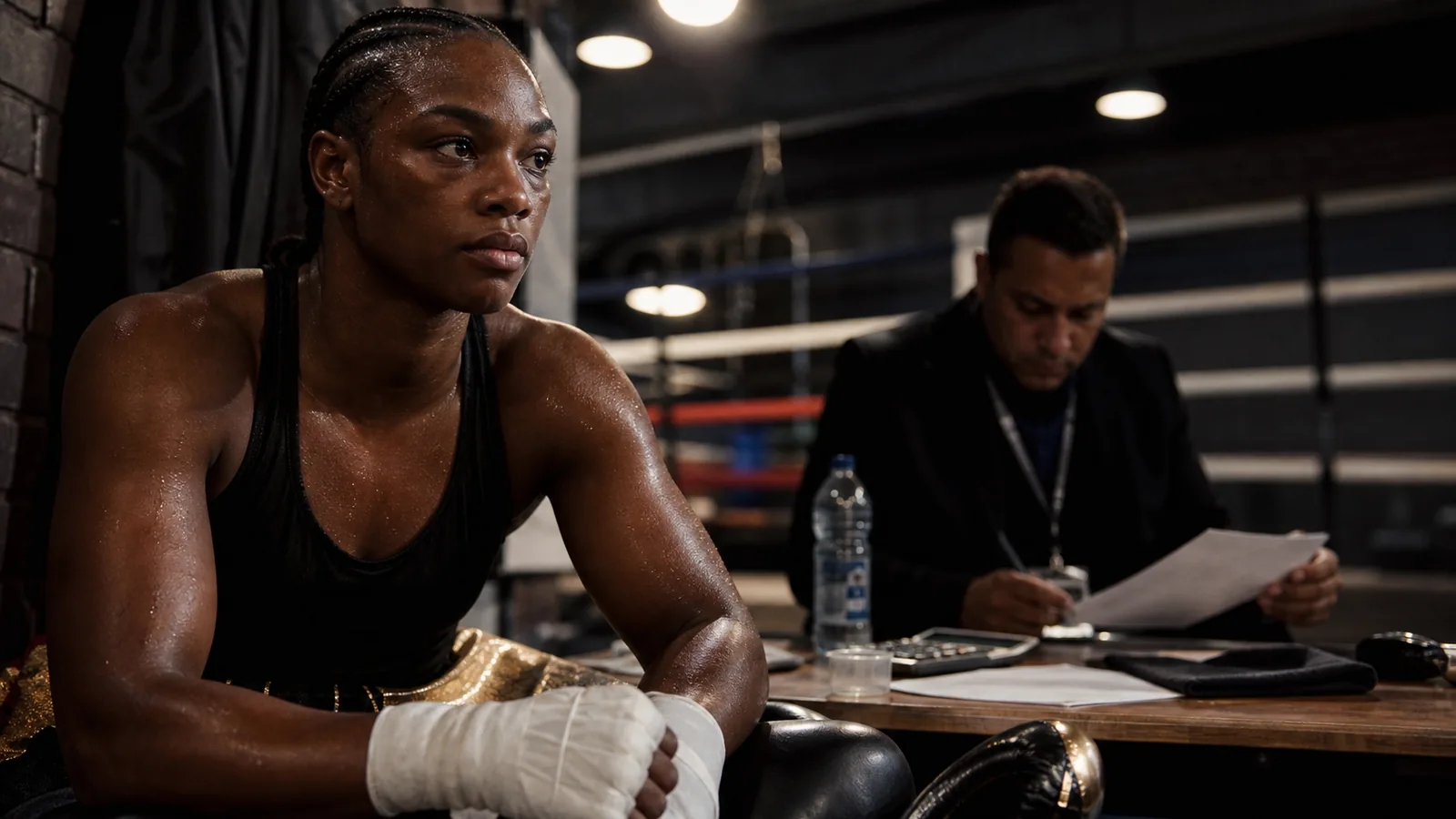
Claressa Shields and the $500,000 Purse Debate: Why Boxing Pay Needs More Than One Number
A reported $500,000 purse for Claressa Shields has created the usual mixture of disbelief, anger and bad arithmetic.
The figure came from disclosed purses linked to Shields’s August win over Kaye Scott in Atlanta. Georgia is one of the American jurisdictions that still makes fight purses public. In a post about the release, Cris Cyborg pointed out that Georgia remains unusually transparent and referenced a previous $2 million offer.
On its face, half a million dollars for the most decorated woman in boxing can look either insulting or excessive, depending on who is shouting. Both reactions miss the point.
A commission purse is useful information. It is not a complete set of accounts. It tells us something important about the guaranteed money declared for a bout. It does not automatically tell us what a boxer earned in total, what she kept after costs, what the promoter spent to stage the show, or what the event was worth commercially.
That distinction matters, especially when the fighter is Claressa Shields.
What was reported, and what happened in Atlanta
Shields stopped Australia’s Kaye Scott in the sixth round at State Farm Arena on 15 August, reclaiming the WBC and WBA middleweight titles after moving down from heavyweight.
The Guardian’s report described Shields cutting 38lb over a 14-week camp, then taking Scott apart before Scott’s corner threw in the towel. Shields moved to 19-0 and became a middleweight champion again after becoming undisputed at heavyweight.
The scale of the occasion should not be ignored. It was the first women’s boxing headliner at State Farm Arena. Forbes noted that the event was promoted by Salita Promotions in partnership with Wynn Records, Claressa Shields Promotions and Route 30 Promotions, with DAZN carrying the card.
It also had a serious crowd. The Guardian reported more than 16,000 spectators, while USA Today described a well-attended event with major boxing names in the building.
So when a disclosed $500,000 figure started circulating, the temptation was obvious: big arena, big champion, half a million dollars, therefore somebody has been robbed.
Slow down.

A disclosed purse is usually a guarantee, not the entire deal
The first question should be simple: what exactly was disclosed?
In boxing, the purse reported to a state commission is generally the contracted guarantee declared for regulatory purposes. That is real money, not a meaningless number. It can be an important safeguard against promoters pretending a fighter was paid nothing.
But it may not capture every element of the commercial arrangement.
A fighter’s income can include a guaranteed purse, a share of broadcast or pay-per-view revenue, sponsorship payments, performance bonuses, licensing arrangements and other separately agreed income. Sometimes those extras are documented. Sometimes the public does not know enough to state them as fact.
That is why the responsible wording is “reported” or “disclosed purse”, not “Claressa Shields made exactly $500,000”.
There is a difference.
Earlier Shields purse stories show why certainty is difficult. Before her heavyweight title fight with Danielle Perkins in 2025, EssentiallySports reported conflicting figures: Shields reportedly said the purse was around $1.5 million, while another outlet suggested $500,000. Those are not minor differences. They are entirely different accounts of the same commercial story.
For the 2024 Vanessa Lepage-Joanisse fight, Sportskeeda cited estimates rather than an official confirmation, placing Shields’s guaranteed purse in a range of roughly $650,000 to $700,000. Again, estimates are not audited accounts.
That is not an excuse to conceal fighter pay. It is an argument for being precise about what a public number proves.
The opponent matters, even when the champion is exceptional
The uncomfortable truth is that great fighters do not automatically create great purses on their own.
They need an opponent who can bring jeopardy, visibility and a reason for casual viewers to care before the first bell. Shields is one of boxing’s great modern champions, but her problem has rarely been ability. It has been the lack of a rival with comparable profile and a realistic path to the ring.
Scott was a legitimate titleholder and a decorated amateur, but she entered the fight aged 42 with only seven professional bouts behind her. Shields was heavily favoured, and the result followed the expected script.
That does not diminish Shields’s performance. Her weight cut was severe, her technique was sharp and her sixth-round stoppage was emphatic. Sky Sports reported that she controlled the contest before the corner intervention.
But a one-sided championship fight is not the same commercial proposition as a genuine 50-50 rivalry.
This is the wider issue in women’s boxing. The Guardian made the point directly: Shields has the medals, titles, unbeaten record and personality, but not yet the defining rival who can turn excellence into a must-watch sporting event.
Lauren Price is the obvious next conversation. It is a far stronger boxing match and, crucially, a clearer story for the public. A fight with meaning can make more money than a fight with four belts but no competitive tension.

Gross income is not take-home pay
Even if $500,000 were Shields’s full boxing income for the night, it would still not mean $500,000 in her bank account.
Professional fighters pay people.
There is training camp. Coaches, strength and conditioning staff, sparring partners, nutrition support, travel, accommodation, equipment, medical work and recovery all cost money. A long camp after a major weight cut is not cheap.
Then there are managers, advisers, lawyers, accountants and sometimes promoters or other commercial partners with contractual shares. Tax takes its own sizeable bite. The final figure depends on the deal, the fighter’s business structure, where income is earned and what expenses are deductible.
Nobody outside a fighter’s team should invent those figures. But nobody should look at a gross purse and pretend it is a net salary either.
This is not unique to Shields. It applies to every professional boxer, from a prospect fighting four rounds for modest money to a world champion topping an arena card.
The promoter has costs too
The same discipline should apply when judging the promoter.
A boxing card is not funded by headline emotion. It is funded by ticket sales, broadcast income, sponsorship, licensing and whatever commercial partners are willing to invest. Against that comes the cost of venue hire, production, television crew, insurance, ring and lighting, medical staff, security, travel, accommodation, marketing, undercard purses, commission fees and the endless operational costs supporters never see.
State Farm Arena is not a cheap room. A DAZN broadcast is not a cheap production. A card built around a world champion and a large live crowd does not appear by magic.
That does not mean promoters deserve automatic sympathy. Boxing has a long history of opaque deals, poor undercard pay and fighters being expected to accept risk without a fair upside. Public disclosure is valuable precisely because it gives journalists, fighters and fans something concrete to question.
But outrage should be aimed accurately. A disclosed guarantee can raise a legitimate question. It cannot answer every financial question by itself.
The real argument is not whether Shields deserves more
She does.
Shields has two Olympic gold medals, world titles across five weight classes, an unbeaten 19-0 record and a résumé that stands with anyone in women’s boxing. She has also taken difficult sporting decisions, including moving up to heavyweight and then making the hard return to middleweight.
The argument should not be whether she has earned the right to command major money. She plainly has.
The harder question is how boxing builds the conditions for her to earn it consistently. That means meaningful opponents, intelligent promotion, visible broadcasting, proper event planning and commercial partnerships that do not treat women’s boxing as an afterthought.
It also means recognising the difference between being a brilliant fighter and being the centrepiece of a self-sustaining market. Shields has done the first part. Boxing still needs to do more of the second.
A future Shields versus Price fight would test that proposition properly. It has sporting credibility, national interest on both sides of the Atlantic and a clear argument attached to it. That is how purses move from a debate about a filing to a debate about a major event.
Do not let the headline do all the thinking
The reported $500,000 figure is worth discussing because public purse disclosures are rare and because Shields is one of the sport’s most important athletes.
But it should be the beginning of the conversation, not the end.
Ask whether it is a guarantee or total compensation. Ask what was declared to the commission and what remains private. Ask whether there were bonuses, broadcast shares or sponsorship income. Ask what the fighter paid for camp. Ask what the promoter had to spend to put on the show. Ask whether the opponent and event had the competitive heat required to produce bigger revenue.
Then ask the question that matters most: what fight would make the next number impossible to ignore?
At Honour & Glory Boxing Club, we teach boxing as a sport with layers. The punch is the visible part, but footwork, preparation, judgement and timing decide what it becomes. Boxing finances work the same way. The headline number gets attention. The context tells you what it means.
H&G Team
Writer at Honour & Glory Boxing Club, a community boxing gym in Kidbrooke, South East London.
KEEP READING

Claressa Shields' activity plan and the opponent problem
Assess the tension between Shields' stated ambition to box frequently and the small pool of credible elite opponents available to her, without treating a commentator's verdict as fact.

Chris Cyborg calling out Claressa Shields: the crossover risk
Examine what a Cyborg call-out would mean for Shields’ sporting legacy, matchmaking risk and women’s boxing, without presenting an unmade fight as agreed.

Women's Boxing Classes - What to Expect
Thinking about women's boxing classes but not sure what happens? Here is exactly what to expect from your first session to your tenth.
Was this page helpful?
It takes one tap, and it genuinely helps.
Choose your next step
Turn this article into the right action
Some readers are ready to book. Some need the class route first. Pick the route that matches what you actually want.