Jaron Ennis and Vergil Ortiz: when career narratives move too fast

Jaron Ennis and Vergil Ortiz: when career narratives move too fast
Boxing is impatient with its labels.
A fighter is “avoided” until a proposed fight fails to materialise. Then he is “exposed” after one awkward performance. Then he is “stalled” because the calendar has moved slower than the conversation online. The label arrives first. The evidence is expected to catch up later, if it ever does.
The Jaron “Boots” Ennis and Vergil Ortiz Jr discussion is a useful example. It is an excellent fight, two unbeaten 154lb fighters with genuine finishing ability and different strengths. It is also a reminder that a fight being discussed, announced in principle or argued over in public is not the same as a fight being signed.
That distinction matters.
In October 2025, ESPN reported that Ennis versus Ortiz was being lined up for the first quarter of 2026, provided Ennis won his first bout at junior middleweight and Ortiz dealt with Erickson Lubin. Eddie Hearn called it one of the best fights in boxing. The ingredients were obvious: Ennis had arrived from welterweight with his reputation intact, while Ortiz had brought his heavy hands and relentless pressure into the division.
It sounded close. It was not a finished job.
The Ring’s report carried the more honest caveat: the fight could happen if everyone stuck to their word. That is a large “if” in a sport where contracts, broadcasters, promoters, titles and legal disputes sit between public intent and a first bell.
A delayed fight is not proof of avoidance
The temptation is to turn every delay into a moral verdict.
If Ennis does not box Ortiz immediately, somebody will say he does not want it. If Ortiz’s path becomes complicated, somebody will say he is protecting an unbeaten record. It makes for sharper posts and louder videos. It is also usually poor reporting.
Ortiz’s contractual dispute with Golden Boy was not ordinary matchmaking friction. Boxing News 24 reported that a Nevada ruling sent the dispute to arbitration and blocked Ortiz from negotiating with outside promoters while the issue was unresolved. That affects availability. It does not tell us who would beat whom, who lacks courage or who is ducking a challenge.
The later reporting is more encouraging, but still not a reason to declare the contest done. Ortiz’s manager said that only one final hurdle remained, while Robert Garcia described the fight as “very close”. Those are meaningful developments. They are not a signed date, venue, contracts exchanged and a press conference.
That may sound fussy. Boxing needs more fussiness around this subject.
Calling a man “avoided” should require more than a fight not happening on the first proposed timetable. There should be clear evidence of a viable offer, a fighter being free to take it and a refusal that cannot be explained by a mandatory, injury, contractual restriction or a sensible alternative opportunity. Without that, it is often just frustration dressed up as certainty.

Ennis should not be judged by old expectations
Ennis has carried a particular burden for years: the burden of being praised before he had enough elite opponents to settle every argument.
That is not his fault. His talent has always been obvious. He can switch stance without losing balance, throw sharp combinations from strange angles and hurt fighters with either hand. But boxing has a bad habit of treating potential as a contract. Once a young fighter is called a future pound-for-pound star, every ordinary round becomes a disappointment.
The move to 154lbs made that worse. ESPN’s original report carried Hearn’s view that Ennis would be stronger above welterweight after a difficult cut at 147lbs. That was a prediction, not proof. Ennis then earned serious credit by beating Xander Zayas for world titles, but one major win should not be used to pretend every remaining question has vanished.
A proper assessment asks better questions.
Did Ennis carry his speed and punch selection up in weight? Did he handle a young champion’s timing, body work and physical strength? Could he keep his shape when the fight became uncomfortable? Did he make adjustments rather than relying on athletic gifts?
Those are questions a fighter answers in the ring. A delayed Ortiz fight cannot answer them, and neither can a face-off.
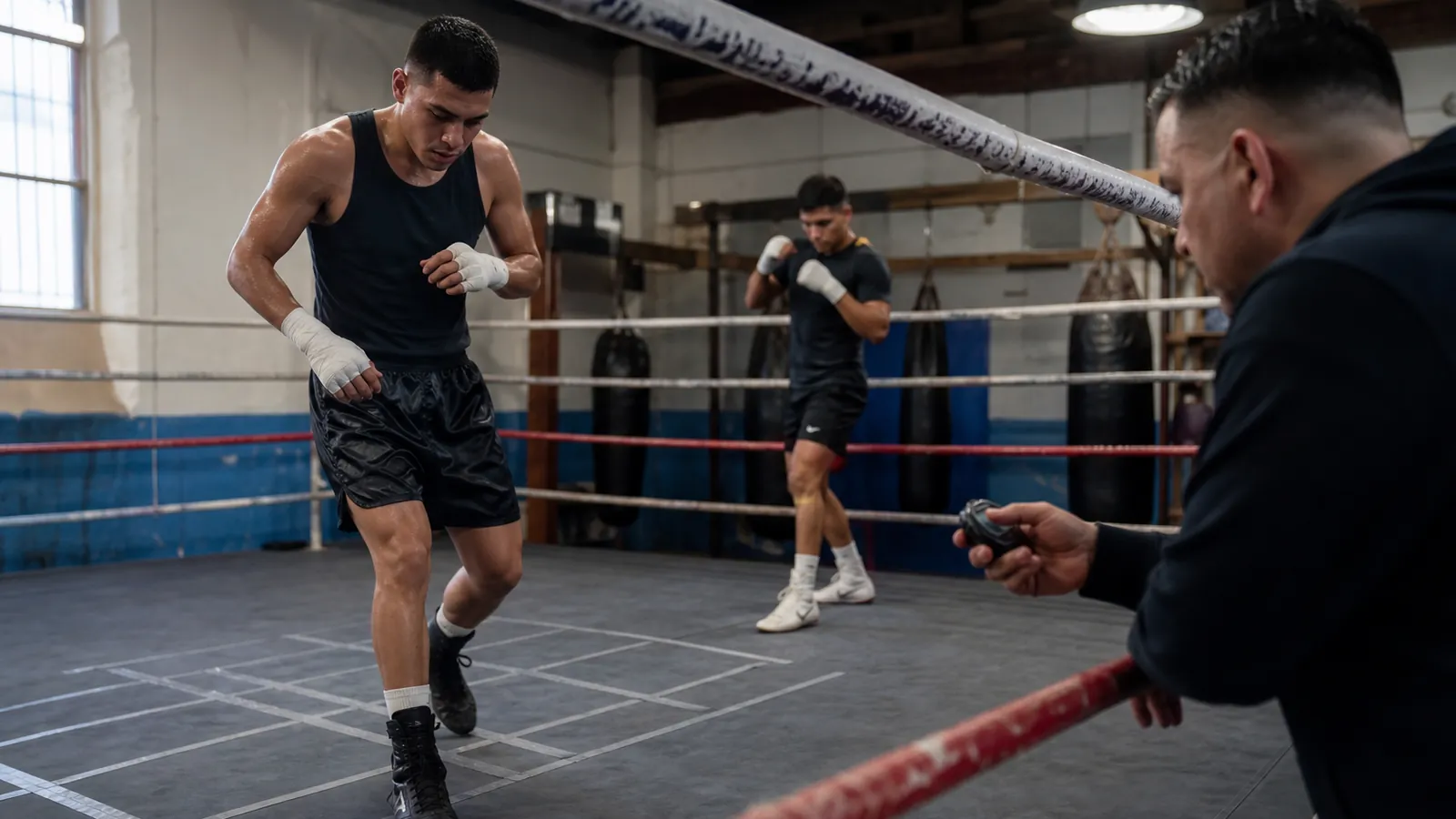
The footage is useful as a snapshot of confidence and ambition. It is not proof of the final result, or proof that a deal has been completed. In boxing, the camera loves certainty. The business rarely provides it.
Ortiz is more than pressure and punching power
Ortiz risks being simplified too. He is often presented as the aggressive Texan puncher who will walk Ennis down until the prettier boxer runs out of room. That misses the point.
Ortiz has shown he can deal with high-level technical opposition. BoxingScene’s report on the renewed Ennis discussion noted his points win over Israil Madrimov and his stoppage of Erickson Lubin. Those are not identical assignments, but together they tell us something useful. Ortiz can work through a tactical fight and he can apply pressure hard enough to force a finish.
He is also not obliged to prove himself from scratch every time social media refreshes. A gap between fights may be frustrating, but inactivity and decline are different claims. If a boxer returns rusty, slow, unable to take a shot or unable to pull the trigger against serious opposition, that changes his standing. A contract dispute does not.
The proposed contest is compelling because it tests both men honestly. Ennis would have to prove that movement, stance changes and counter-punching still function when an opponent keeps taking ground. Ortiz would have to prove that his pressure can be built behind patience rather than reckless entries against a fast, accurate switch-hitter.
That is evidence worth waiting for.
What should actually change a fighter’s standing?
Boxing needs to separate results from noise.
A fighter should rise in standing when he beats a strong opponent, particularly when he solves a style problem that was supposed to trouble him. A boxer who has struggled with pressure and then controls a relentless opponent has answered a real question. A fighter who has looked vulnerable to body shots and then handles a committed body attack has improved his case.
A fighter should fall in standing when a weakness becomes repeatable. One bad night can be illness, a difficult weight cut, poor preparation, an injury or simply a good opponent. Two or three performances showing the same technical fault are more serious. If a fighter cannot get off the ropes, cannot cope with a jab, cannot recover when hurt or has no answer once the pace rises, the criticism has substance.
“Exposed” is one of the laziest words in the sport. It should mean that an opponent revealed a flaw others can reliably exploit, not merely that an unbeaten fighter lost.
“Stalled” needs care too. A boxer can be held up by injuries, mandatory obligations, promoter disputes or a division waiting for its champions to sort themselves out. A stalled career is a pattern of lost momentum and poor decisions, not one postponed fight.
And “avoided” should be the hardest label of all. It needs evidence, not a screenshot and a comment section.
Let the ring settle it
The strongest part of the Ennis and Ortiz story is not the arguing. It is the possibility of a proper fight between two men who give each other difficult, specific problems.
Both trainers publicly pointed towards a 2026 meeting. That is promising. The legal and promotional details still matter until the bout is officially made. Until then, neither fighter should be condemned for a business problem that has not been settled with gloves on.
At Honour and Glory, from young boxers aged 7+ to adults learning the sport properly, we teach the simpler version of the same lesson: do not let the story around a round become bigger than the round itself. Watch the feet. Watch the reactions. Watch what happens after a fighter is hit clean, pushed back or forced to adapt.
Respect the evidence. Then make your judgement.
If you want to learn to read boxing from inside a proper gym, book a trial at Honour and Glory Boxing Club.
H&G Team
Writer at Honour & Glory Boxing Club, a community boxing gym in Kidbrooke, South East London.
KEEP READING
Zayas vs Ennis: press conference lessons
What Zayas vs Ennis fight week teaches boxers about pressure, body language and staying disciplined before a big night.

Terence Crawford vs Boots Ennis: why retirement talk matters
Assess Hearn’s claim of a possible Crawford retirement reversal against the practical question: does it create a credible route to Ennis, or only another speculative super-fight headline?
Zayas vs Boots preview: pressure before a big night
Zayas vs Boots is a pressure test. Here is what young boxers can learn from the build-up before 27 June.
Was this page helpful?
It takes one tap, and it genuinely helps.
Choose your next step
Turn this article into the right action
Some readers are ready to book. Some need the class route first. Pick the route that matches what you actually want.