Usyk Vacates: Why Champions Choose Their Exit
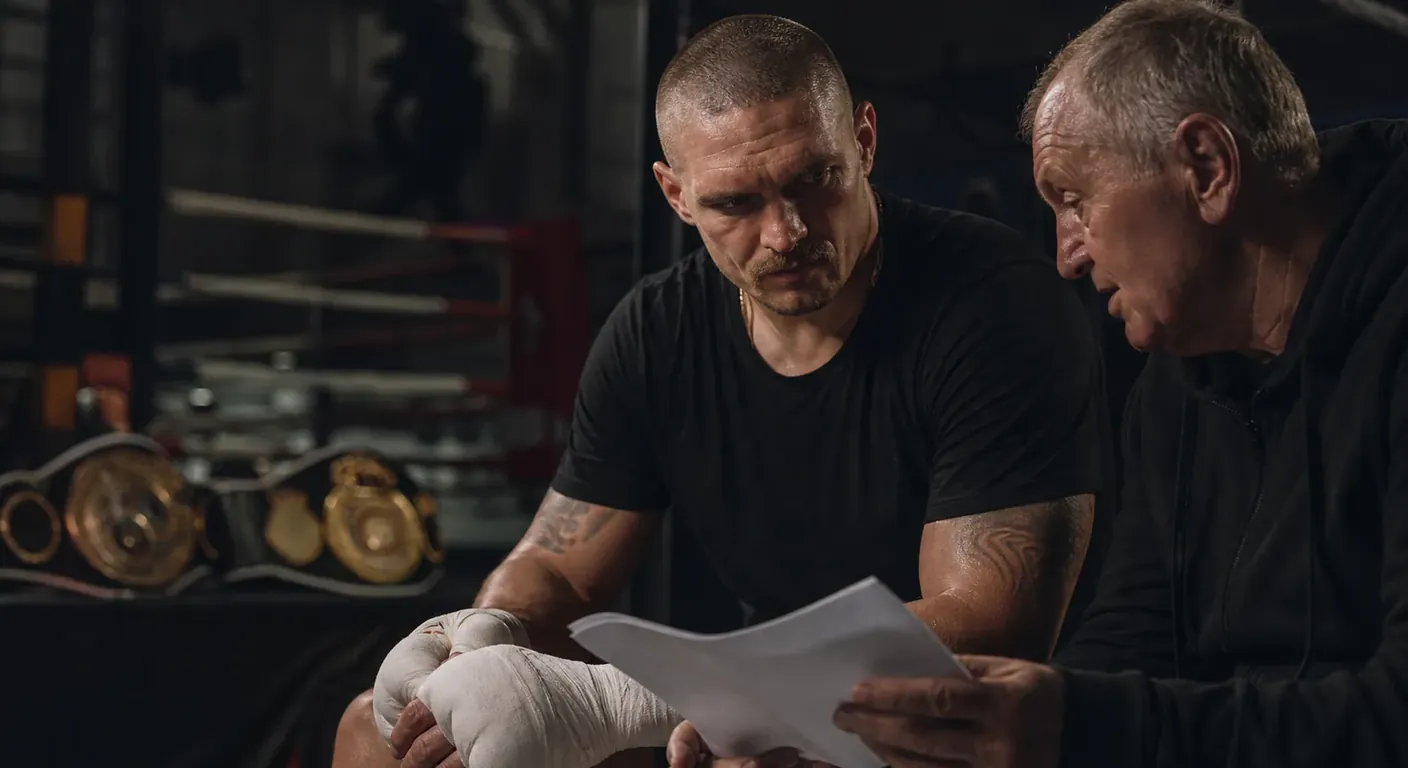
Oleksandr Usyk giving up heavyweight belts is not a surrender. It is a power move from a fighter who has run out of normal boxing errands.
That matters because boxing usually teaches champions the opposite lesson. Win a belt, defend it. Win several belts, defend them all. Keep the organisations happy. Keep the mandatories moving. Keep paying the fees. Keep proving, even when the proof has already been delivered in the ring.
Usyk has reached the point where that bargain no longer suits him.
According to Sky Sports, Usyk’s team say he wants to decide his final chapter himself rather than let mandatory defences make the decision for him. That is the whole story in one sentence, but it is worth sitting with it. This is not only a fighter giving up property. It is a fighter refusing to let the paperwork write his ending.
Belts are trophies, but they are also contracts
Fans see belts as symbols. Fighters know they are obligations.
A world title is not just a gold and green strap for the photographs. It comes with rankings, deadlines, mandatory challengers, sanctioning fees, purse bid threats, exception requests and political pressure. A champion with one belt has one boss. A unified champion can have three or four bosses at once.
That is why Usyk’s decision is more interesting than the usual “who gets the belt now?” reaction. We have already covered the title traffic in Usyk Vacates: The Heavyweight Title Queue Explained. This piece is about the other side of the same move: why a champion might decide that keeping control of his final fight is worth more than keeping control of every belt.
The BBC reported Usyk’s message clearly: he is leaving the belts, not the sport. The Guardian quoted him saying, “I’m leaving the belts but I’m not leaving the sport because I still have my last dance.” That phrase sounds romantic, but behind it is a hard business calculation.
A champion who keeps the belts has to answer to the bodies. A legend who gives them up can answer to himself.

The champion’s final camp is too valuable to waste
At club level, you learn quickly that every camp has a cost. Eight weeks of sparring, roadwork, dieting, timing drills, recovery and pressure is not abstract. It takes something out of you.
For a 39-year-old unbeaten heavyweight who has already been undisputed at cruiserweight, undisputed at heavyweight, and beaten Anthony Joshua and Tyson Fury twice each, one more camp is not something to hand over casually.
That is the part the belt argument often misses. Usyk is not a young champion building credibility. He is not looking for a first defence to prove he belongs. He has already done the hard work. His authority does not come from a committee meeting. It comes from what happened under the lights.
So if there is only one fight left, it makes sense that he wants it to be the right fight, not merely the next fight.
Sky’s earlier report said Usyk vacated the WBA, WBC and IBF titles while making clear the “last dance” was still to come. The difference between those two facts is the difference between retirement and authorship. He is not walking away from boxing. He is walking away from boxing’s filing cabinet.
Governance is not neutral
Sanctioning bodies like to present themselves as guardians of order. Sometimes they are. Without rankings and mandatories, powerful champions and promoters could freeze out dangerous contenders forever.
But boxing governance is never completely neutral. The bodies need champions. They need title fights. They need sanctioning fees. They need relevance. They also compete with each other, which means the best sporting route and the best political route are not always the same.
That is why unified champions face an odd punishment for success. The more belts you collect, the more compulsory business you inherit. One organisation wants its mandatory. Another wants an exception. Another wants a purse bid. Another wants to protect an interim champion. The champion becomes less like a king and more like a diary manager.
Usyk has chosen not to spend his final fight servicing that system.
There is a generosity in the public explanation. Usyk said he wanted to make the belts available so the guys next in line could fight for them. Coast FM’s syndicated report carried the same central line from the Sky story, that he relinquished the titles “to decide for himself” the final chapter of his career. Both things can be true. He can free the division and free himself at the same time.

This is not ducking. It is refusing a bad bargain.
There is a lazy criticism that any champion who vacates must be avoiding someone. Sometimes that is true. In boxing history, belts have been dropped to dodge risk, protect earnings or keep a promoter’s plan alive.
Usyk does not fit that pattern cleanly.
Who exactly is he supposed to be afraid of after beating Joshua twice, Fury twice and Daniel Dubois twice? Boxing247 framed the move around Usyk confirming one fight left. The Independent pointed to the likely consequence: scattered belts, a year of movement and potentially excellent heavyweight fights.
That is not a champion clogging the sport. That is a champion stepping aside from the title system after doing more than enough to prove his place.
The better criticism is not cowardice. It is whether boxing has built a system where the best fighter in the world decides the belts are no longer worth the trouble. That should worry the sanctioning bodies more than any single vacancy.
If the belts are supposed to define supremacy, the sport has a problem when supremacy can walk away from them and still feel obvious.
The final fight now becomes a statement
Once the belts are gone, Usyk’s next opponent does not need to satisfy the usual title logic. That is both freeing and dangerous.
It is freeing because a farewell fight can be honest about what it is. It might be a legacy event, an American stadium night, a high-risk name, a crossover attraction, or a final technical puzzle. It does not have to pretend that it is serving the WBC, WBA or IBF order.
It is dangerous because boxing will always try to sell spectacle as sporting necessity. If Usyk chooses a strange opponent, the promoters will dress it up. That is what promoters do. The job of serious boxing people is to separate the event from the claim being made about it.
If Usyk fights a ranked heavyweight, judge it as a heavyweight fight. If he fights a spectacle opponent, judge it as a spectacle. The key point is that, by vacating, he has reduced the harm. No mandatory challenger has to wait behind the theatre. No vacant belt is trapped while a farewell tour is planned.
That is why the move is cleaner than it first looks.
What young boxers should take from it
There is a useful lesson here for anyone training in the gym.
Control matters.
In Honour and Glory recreational adults classes, and in our junior sessions for families around Kidbrooke, boxers aged 7+ learn the physical version first. Keep your stance. Do not let someone else decide where your feet go. Do not punch just because the other person wants a tear-up. Box at your range, at your rhythm, with your choices.
At elite level, the same idea becomes career management. Usyk has spent years controlling distance, tempo and expectation. Now he is applying the same logic outside the ropes. He is not letting a sanctioning calendar drag him into a final fight that does nothing for his legacy.
That does not mean every champion should vacate when life becomes awkward. Belts need defending. Contenders need their chance. Fans deserve clarity. If a champion takes the status, money and platform that come with titles, he should normally accept the duties too.
But endings are different. Usyk is not midway through the climb. He is choosing how to step off the mountain.
The H&G view
Usyk’s decision is good governance by subtraction.
That sounds strange because boxing usually treats more belts as more legitimacy. In this case, fewer belts may produce a cleaner truth. The division gets movement. The sanctioning bodies get new champions to crown. The contenders get routes that do not depend on one ageing great accepting another mandatory. Usyk gets one last fight on terms that make sense to him.
The belts will still matter. Whoever wins them next has a chance to build authority the proper way, by beating serious heavyweights. But nobody should confuse possession with inheritance. Usyk’s belts can be reassigned. His wins cannot.
That is the heart of it. Champions do not only choose how they enter history. If they are good enough, brave enough and stubborn enough, they also choose how they leave it.
Usyk has earned that choice.
If you want to learn that same control in your own boxing, book a free trial session at Honour and Glory Boxing Club.
H&G Team
Writer at Honour & Glory Boxing Club, a community boxing gym in Kidbrooke, South East London.
KEEP READING

Usyk vs Kabayel Purse Bid: What Happens Next?
Explain what a WBC purse bid means, why it matters for Usyk’s next heavyweight move, and what fans should watch for before June 30.

Usyk vs Rico Verhoeven: boxing vs kickboxing explained
A beginner-friendly breakdown of what changes when an elite kickboxer enters a boxing-only heavyweight fight: stance, distance, clinch habits, footwork, defence, and why rule discipline matters.
Sheeraz World Title Fight: Usyk vs Verhoeven Undercard Announced!
Preview Hamzah Sheeraz's world title opportunity as the co-main event for Usyk vs. Verhoeven, analyzing his opponent and chances. Highlight the significance for UK boxing.
Was this page helpful?
It takes one tap, and it genuinely helps.
Choose your next step
Turn this article into the right action
Some readers are ready to book. Some need the class route first. Pick the route that matches what you actually want.