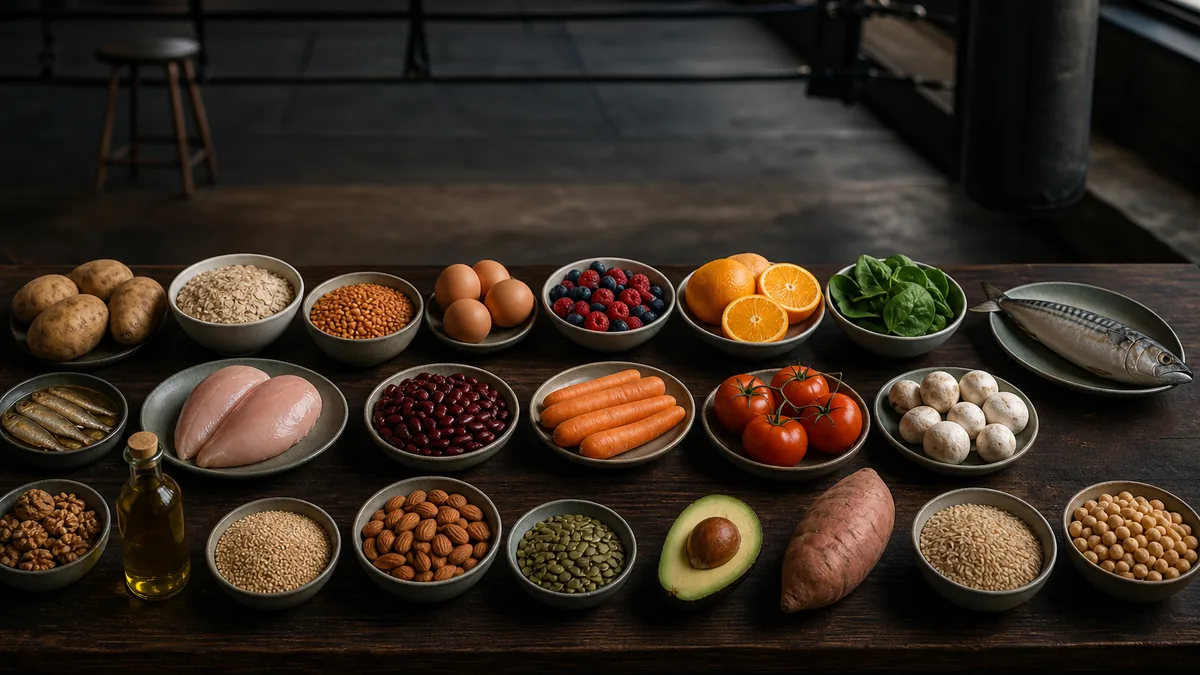
This is a thought experiment, not a diet plan.
If you want the five-food answer, I would pick potatoes, eggs, sardines, lentils and broccoli.
Not because that is perfect. It is not. I would pick them because each one does a different job: potatoes for training fuel, eggs for practical complete protein, sardines for protein plus omega-3 and B12, lentils for fibre and cheap slow energy, and broccoli for the green-vegetable slot.
The useful part is not the list itself. It is what breaks when the list gets too small. One food exposes survival gaps. Five foods gives you a rough base. Ten starts to look workable. Twenty-five finally lets you build something close to a normal boxing diet.
For this piece we used our own H&G boxing food rankings, built from the UK Government's McCance and Widdowson CoFID 2021 dataset, then checked the choices against broader guidance such as the NHS Eatwell Guide, the WHO healthy diet guidance, and sports nutrition research on athlete protein, carbohydrate, fat and micronutrient needs.
The short answer: the more foods you allow, the less clever you need to be. Restriction creates gaps. Variety closes them.
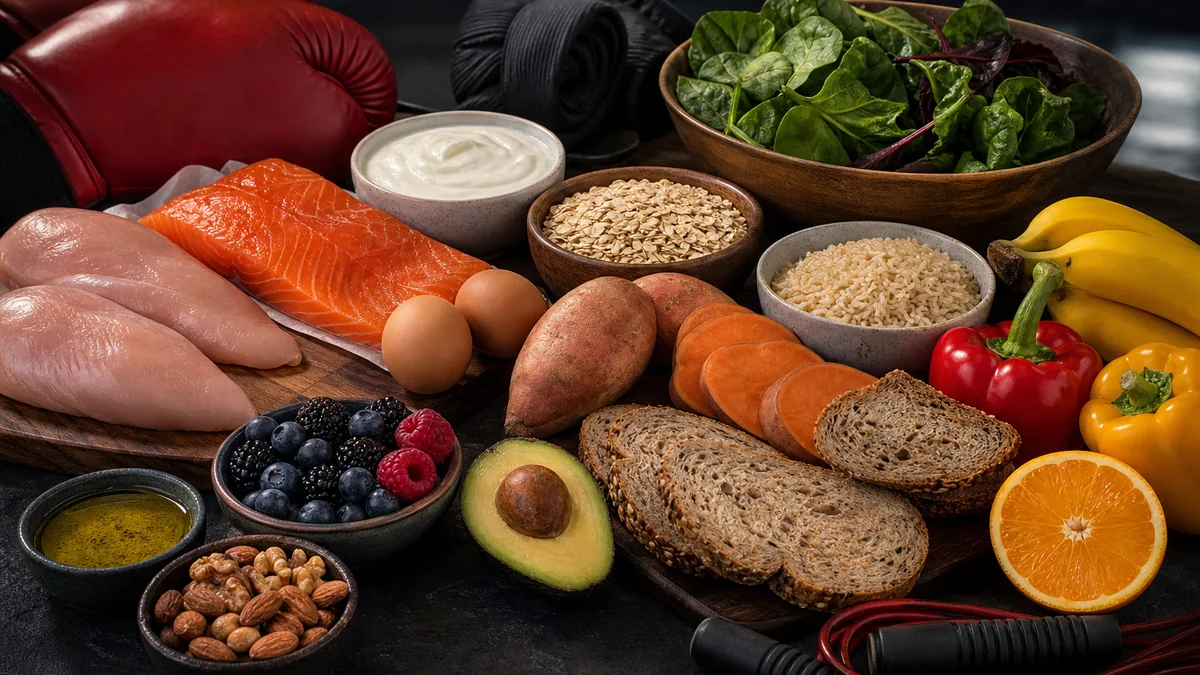
How I am judging the list
We are not trying to create the most exciting menu. We are trying to answer four questions:
- Does it cover the basics? Enough calories, protein, carbohydrate, fat and obvious micronutrient support.
- Could it support boxing training? Enough carbohydrate for hard rounds, enough protein for repair, and enough fat for normal health.
- Could an adult actually eat it repeatedly? Practical shopping, cooking, taste, cost and digestion matter.
- What do you lose out on? The missing nutrients, textures, colours, social foods and performance tools.
The sports nutrition context matters. Athlete guidance commonly puts protein around 1.2-2.0g per kg bodyweight per day, with many hard-training athletes also needing substantial carbohydrate, often around 5-7g per kg when training volume is high. Boxing is not fuelled by protein alone. You need glycogen for rounds, protein for repair, fat for normal health, and enough micronutrients to keep the system working.
So if a list is all lean meat, it fails. If it is all vegetables, it fails. If it is all oats and potatoes, it fuels the engine but leaves recovery gaps.
If you could only eat 1 whole food: potatoes
The single-food answer is not the highest ranked food in our boxing dataset. It is the least bad survival answer.
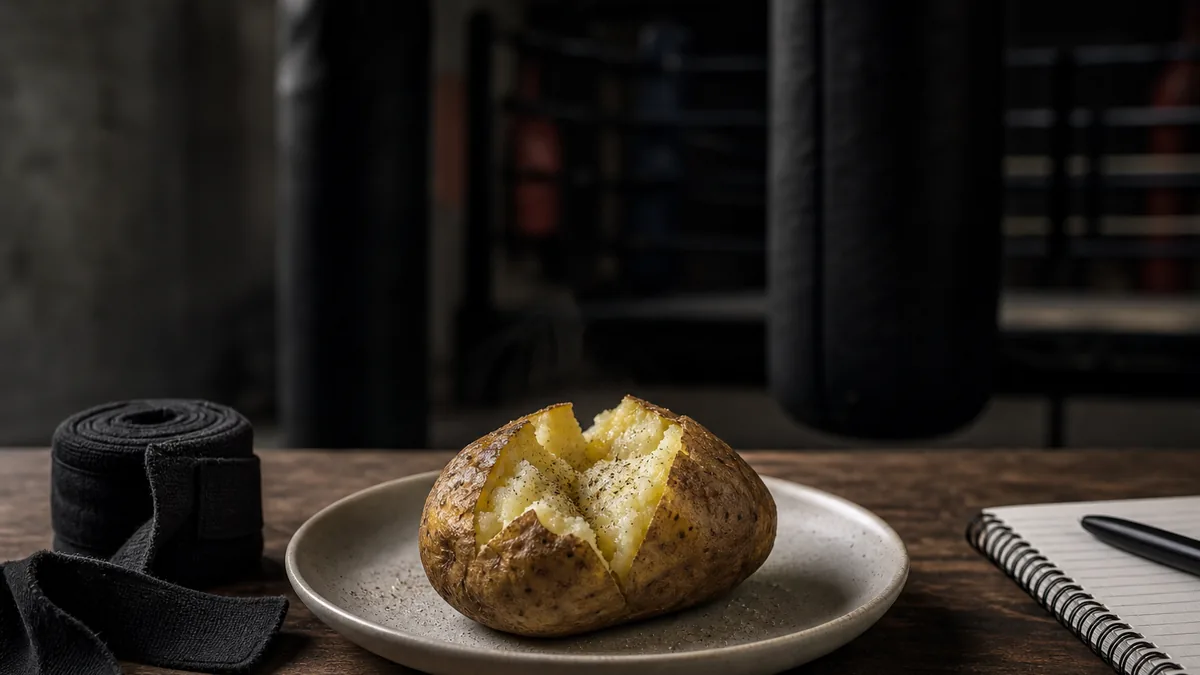
I would choose potatoes, cooked with the skin.
Our data has microwaved old potatoes with skin at about 95 calories per 100g, with roughly 87% of calories from carbohydrate, a low energy density, and a decent satiety score. That explains why potatoes are so useful in real diets: they give you training fuel, volume, potassium, some vitamin C, fibre if you keep the skin, and enough flexibility to roast, boil, mash or bake them.
But as a life plan, potatoes are still a bad plan.
What you gain:
- Reliable carbohydrate for boxing training.
- High food volume for the calories.
- Potassium and some vitamin C.
- Cheap, easy cooking, and better satiety than many refined carbs.
What you lose out on:
- Protein quality and total protein. Potatoes contain protein, but not enough to support serious training without eating silly quantities.
- Essential fats. There is almost no fat, so omega-3 intake and fat-soluble vitamin absorption become problems.
- Vitamin B12. Plant foods do not supply reliable B12.
- Vitamin D, calcium and iodine. These are hard enough in normal diets. A potato-only diet makes them worse.
- Food enjoyment. You would get bored long before the spreadsheet looked interesting.
The point is not that potatoes are magic. The point is that a survival food and a boxing-performance diet are different things.
For a boxer, potatoes are excellent as one carbohydrate tool in a wider plate. They are not a complete diet.
If you could only eat 5 whole foods: potatoes, eggs, sardines, lentils and broccoli
Five foods is where the game gets interesting. You can now build a crude but functional nutrition base.
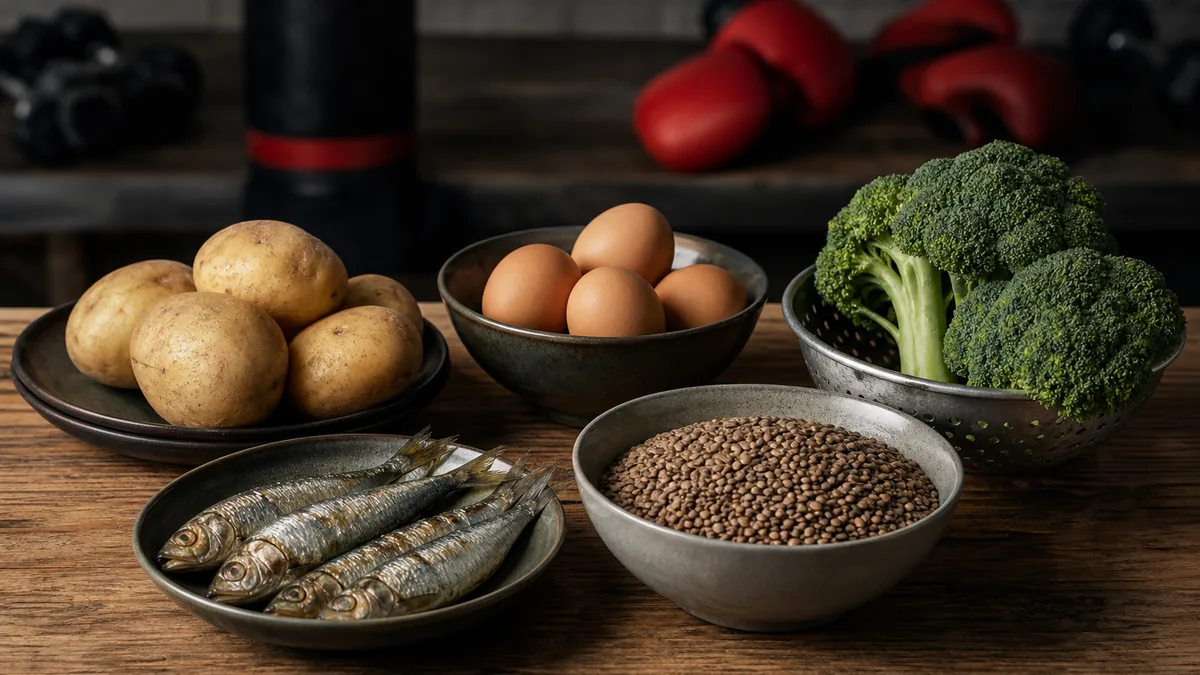
My five would be:
- Potatoes for carbohydrate, potassium and low-cost energy.
- Eggs for complete protein, fat, choline and practicality.
- Sardines for protein, omega-3 fats, B12 and, if you choose bones-in tinned sardines, useful calcium.
- Lentils for plant protein, carbohydrate, fibre and minerals.
- Broccoli for low-calorie volume, vitamin C, folate, fibre and a green vegetable anchor.
This is not glamorous. It is functional.
The H&G data backs up why these foods are doing different jobs. Grilled sardines score strongly as an all-round boxing food, with about 59% of calories from protein and a high nutrient density score. Boiled eggs bring a useful mix of protein and fat. Boiled lentils are less protein-dense than fish, but they bring carbohydrate and fibre. Raw broccoli scores well for protein share and satiety, even though it is too low-calorie to fuel training by itself.
What this covers well:
- Protein: Eggs, sardines and lentils give you repeated protein feedings.
- Training fuel: Potatoes and lentils provide carbohydrate.
- Fats: Eggs and sardines stop the list becoming too lean.
- Omega-3 and B12: Sardines do heavy lifting here.
- Fibre: Lentils, potatoes with skin and broccoli help.
- Practicality: You could batch cook most of this cheaply.
What you still lose out on:
- Fruit diversity. No berries, citrus or broader polyphenol mix.
- Dairy or alternatives. Calcium may be fine if sardines are bones-in, but less secure if not.
- Iodine reliability. Fish helps, but intakes would depend heavily on the exact sardines and total amount.
- Carbohydrate range. Potatoes and lentils work, but oats, rice and fruit are useful around different training windows.
- Social normality. Five foods becomes repetitive fast.
For an adult recreational boxer, this five-food list is closer to a rough emergency base than a sensible lifestyle. It has structure. It has protein. It has fuel. But it is still too narrow.
If you could only eat 10 whole foods: add oats, plain yoghurt, oranges, spinach and walnuts
At ten foods, the plate starts looking like real life.
Keep the first five:
- Potatoes
- Eggs
- Sardines
- Lentils
- Broccoli
Then add:
- Oats for breakfast fuel, slow-release carbohydrate, fibre and budget value.
- Plain yoghurt for protein, calcium and a simple recovery food.
- Oranges for vitamin C, fluid, carbohydrate and a fruit option.
- Spinach for leafy-green variety, folate, magnesium and low-calorie volume.
- Walnuts for energy density, fats and a different texture.
This is the first version I would call broadly workable for a healthy adult, assuming portions are sensible and the person has no medical or dietary restrictions.
It now has breakfast, lunch, dinner and snack logic. Oats and yoghurt before or after training. Potatoes and lentils for main meals. Sardines or eggs for protein. Broccoli and spinach for vegetables. Oranges for fruit. Walnuts when you need calories without another huge plate of food.
What this covers better:
- Calcium: Yoghurt improves the dairy gap.
- Carb timing: Oats, potatoes, lentils and oranges give different carbohydrate speeds and meal options.
- Micronutrient variety: Two green vegetables plus fruit is much better than broccoli alone.
- Energy flexibility: Walnuts help when training volume is high and appetite is low.
- Digestive rhythm: Fibre sources are more varied.
What you still lose out on:
- Meat variety and heme iron. Sardines and eggs help, but there is no poultry or red meat.
- Vegetable colour range. You still lack red, orange and purple plant variety beyond oranges.
- Culinary flexibility. Ten foods sounds generous until every meal has the same boundaries.
- Individual needs. Some people do badly with lots of pulses, dairy or fish.
- Vitamin D certainty. Food helps, but UK adults often need to think beyond diet for vitamin D, especially in winter.
This is also where the psychology becomes obvious. A diet can look adequate on paper but still fail because nobody wants to eat it for months. The best nutrition plan is not the cleverest one. It is the one you can repeat without resenting it.
If you could only eat 25 whole foods: now you can build an actual diet
Twenty-five foods is enough to stop playing survival games and start building a proper boxing diet.
Here is the list I would use:
- Potatoes
- Oats
- Brown rice
- Sweet potatoes
- Lentils
- Red kidney beans
- Eggs
- Plain yoghurt
- Sardines
- Mackerel
- Chicken breast
- Chicken liver
- Broccoli
- Spinach
- Carrots
- Tomatoes
- Mushrooms
- Oranges
- Blueberries
- Apples
- Avocado
- Walnuts
- Pumpkin seeds
- Peas
- Soya beans or edamame
Now the list has depth.
You have multiple carbohydrate sources for different sessions: oats before a morning class, rice after hard training, potatoes or sweet potatoes with dinner. You have several protein types: eggs, yoghurt, fish, chicken, pulses and soya. You have oily fish for omega-3. You have beans and lentils for fibre and budget protein. You have colourful plants: green, red, orange, blue and white. You have high-energy foods like avocado, walnuts and seeds for days when boxing pushes your calories up.
Chicken liver is the risky-looking choice, so it needs context. It is extremely nutrient-dense in the H&G data. Chicken liver appears with a very high all-round score, a high protein share and strong nutrient density. But liver is not a daily staple. It is a small-amount, occasional food because vitamin A can be excessive if you hammer it. That is the kind of detail a ranking cannot solve by itself. Data tells you it is powerful. Judgement tells you not to overdo it.
What this covers well:
- Protein distribution: Easy to build 25-40g protein meals without relying on supplements.
- Carbohydrate for boxing: Oats, rice, potatoes, sweet potatoes, beans, lentils and fruit cover hard training days.
- Fats: Oily fish, eggs, avocado, walnuts and seeds give a better fat profile.
- Micronutrient range: More colours, more minerals, more fibre types.
- Budget control: Pulses, oats, eggs and potatoes keep the diet affordable.
- Meal variety: You can cook stews, breakfasts, tray bakes, rice bowls, salads, omelettes and recovery meals.
What you still lose out on:
- Total dietary freedom. Twenty-five foods is still a restriction. You would miss herbs, spices, sauces, bread, pasta, cheese, tea, coffee and normal meals out.
- Personal fit. A good list for one adult may be wrong for someone vegetarian, pregnant, diabetic, allergic, underweight, highly active, or managing a medical condition.
- Precise micronutrient certainty. Iodine, vitamin D and calcium still depend on exact portions and choices. No article can replace proper assessment.
- Culture and enjoyment. Food is not just fuel. A plan that ignores family meals, religion, culture and pleasure will not last.
Twenty-five foods is enough to create a strong base. It is not a reason to limit yourself to twenty-five foods.
The real lesson: food rankings are tools, not commandments
Our boxing food rankings are useful because they make trade-offs visible.
White fish, chicken breast and prawns look brilliant when you care about protein per calorie. Oats, rice and potatoes look better when you care about training fuel. Vegetables look exceptional for satiety and nutrients per calorie, but they cannot carry an athlete's energy needs alone. Nuts look poor for cutting weight because they are calorie-dense, but they are useful when you need compact energy.
That is why nutrition arguments online go wrong. People pick one metric and pretend it is the whole answer.
- Protein per calorie matters, but not if you have no carbohydrate for hard rounds.
- Carbohydrate matters, but not if protein is too low to recover.
- Nutrient density matters, but not if the food is too low-calorie to sustain training.
- Satiety matters for weight management, but less when someone is struggling to eat enough.
- Cost matters, because the best diet you cannot afford is not a real diet.
For the value side, see our guide to the cheapest protein for boxers. For the weight-management side, see calorie density for boxing nutrition. For timing around sessions, see what to eat before boxing training and post-workout nutrition for boxing recovery.
A safe way to use this in real life
Do not copy the restricted lists. Use them as a mirror.
If your current diet is mostly one kind of food, ask what the missing category is:
- Plenty of protein but no carbs? Your rounds will feel flat.
- Lots of carbs but little protein? Recovery will lag.
- Lots of lean food but no fats? You have overcorrected.
- Lots of vegetables but not enough calories? You may feel virtuous and still underfuel.
- Lots of expensive health foods but no consistency? Simpler would be better.
A sensible boxing plate is much less dramatic:
- A protein source.
- A carbohydrate source matched to training load.
- A large serving of plants.
- Some fats.
- Enough fluid.
- Enough total food to recover.
For adults training recreationally, that is the game. For young athletes, weight loss and restriction should not be the goal. Our boxing nutrition programme is deliberately safeguarding-aware: it teaches fuelling, hydration and recovery, not dieting.
So, what is the answer?
If I had to pick one food, I would pick potatoes and be unhappy about it.
If I had to pick five, I would pick potatoes, eggs, sardines, lentils and broccoli.
If I had to pick ten, I would add oats, plain yoghurt, oranges, spinach and walnuts.
If I had to pick twenty-five, I would stop worrying about survival and build a proper whole-food boxing diet with enough variety to train, recover and enjoy eating.
But the honest answer is this: the best number is not 1, 5, 10 or 25. It is enough.
Enough protein. Enough carbohydrate. Enough fats. Enough colours. Enough calories. Enough variety that you can keep doing it.
That is boring compared with a viral thought experiment. It is also how good nutrition actually works.
H&G Team
Writer at Honour & Glory Boxing Club, a community boxing gym in Kidbrooke, South East London.
KEEP READING
The Boxing Diet - What Boxers Actually Eat
Forget the Hollywood montages of raw eggs. Here is what boxers really eat to fuel training, make weight, and perform at their best.
What Do Professional Boxers Eat?
Ever wondered what professional boxers eat to stay in fighting shape? Here is a detailed look at the diets behind elite fighters.
What to Eat Before Boxing Training
What you eat before boxing training directly affects your performance. Here is exactly what to eat and when for your best sessions.
Was this page helpful?
It takes one tap, and it genuinely helps.
Choose your next step
Turn this article into the right action
Some readers are ready to book. Some need the class route first. Pick the route that matches what you actually want.