Boxing in Your 60s: Sensible, Demanding, and Still Worth Doing

A lot of people in their 60s are not asking whether boxing looks exciting. They are asking whether it is sensible.
That is the right question.
Starting boxing in your 60s should not be framed as some heroic act of defiance. It should be framed as a training decision. Does it improve strength, balance, confidence, coordination, and cardiovascular health? Can it be coached safely? Can it fit around the realities of recovery at this age? If the answer is yes, then it is worth taking seriously.
What Matters More in Your 60s
The basic goals shift.
For most people in their 20s and 30s, boxing is often about challenge, fitness, or identity. In your 60s, those things can still matter, but the practical benefits become even more important: staying mobile, keeping muscle, maintaining balance, and retaining enough confidence in your body that daily life does not start shrinking around you.
That matters because the background changes are real. NHS guidance on physical activity for older adults emphasises strength, balance, and reducing time spent inactive. Research on sarcopenia in older adults shows that age-related muscle loss affects mobility, stability, and overall health. If you do nothing, the body makes the decision for you.
Boxing is useful here because it is not one-dimensional. Good recreational boxing trains foot placement, rotation, posture, reaction, rhythm, upper-body endurance, and cardiovascular effort in the same session. That is a rare combination.
What Needs Adapting
This is where honesty matters.
Your 60s are not your 30s. Recovery is slower. Joint irritation becomes easier to trigger. Warm-ups matter more. Technique matters more. Sleep, hydration, and rest days matter more.
That does not make boxing inappropriate. It just means the coaching has to be adult and sensible.
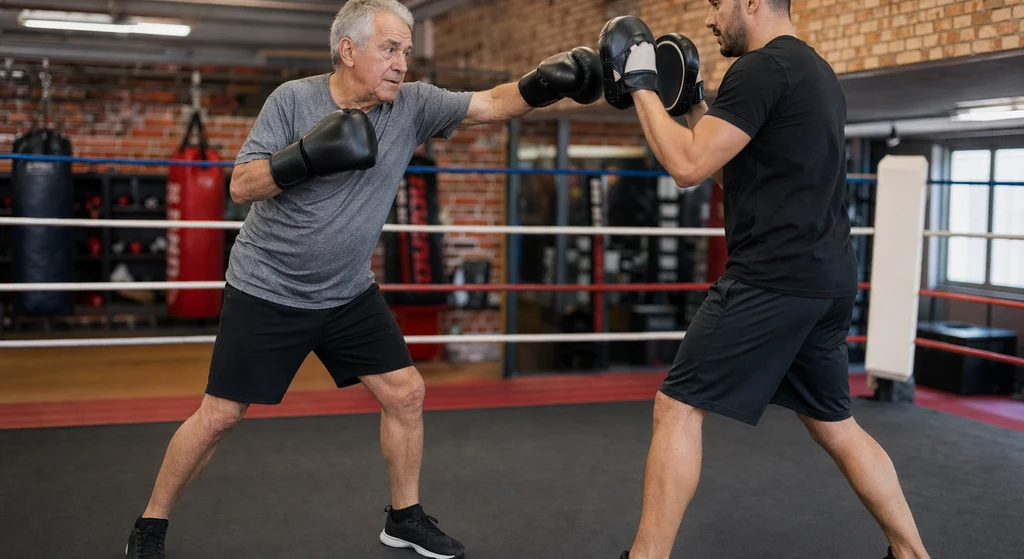
A good first session in your 60s is not about proving toughness. It is about seeing how you move, how well you rotate, how your shoulders tolerate straight punches, whether balance is an issue, and how quickly your heart rate settles between efforts.
At the same time, you do not need to younger juniorilise the age group. Plenty of people in their 60s are capable of training hard. The adjustment is not to remove challenge. It is to place the challenge where it belongs.
Why Boxing Can Work Better Than Generic Gym Training
Many people in their 60s know they should exercise but have already discovered the usual problem: a lot of conventional fitness is dull.
Walking is useful but limited. Machines in commercial gyms are often repetitive and detached from real movement. Group classes can feel generic. Boxing keeps attention because there is always something to learn. You are not just burning calories. You are solving problems in movement.
That matters for the brain as well as the body. Cleveland Clinic's work on boxing-style training for Parkinson's disease helped draw attention to the way boxing combines cognitive demand with physical effort. Not everybody in their 60s has a neurological condition, obviously, but the principle still holds: movement plus coordination plus reaction is different from passive exercise.
Another practical advantage is that non-contact boxing has a clear ceiling of risk. Bags, pads, and shadow boxing can be scaled. You do not have to spar. You do not have to compete. You can get most of the training benefits without pretending the contact side is compulsory.
What the First Months Usually Look Like
Month one is usually about adjustment.
Your shoulders may complain a bit until the punching pattern feels cleaner. Your calves may feel the footwork more than expected. You may realise quickly that balance on rotation needs work. None of this is failure. It is information.
By weeks three to six, most people notice the first useful shift: they feel more stable and less clumsy in the session. The movements stop feeling foreign. That matters more than whether the combinations look sharp.
By two or three months, the changes are often bigger outside the gym. Stairs feel easier. General energy is better. Coordination improves. You stop treating your body as fragile.
At Honour and Glory, the Adult Recreational class is the right starting point for adults in their 60s. The point is not to throw you into an intimidating room and hope for the best. The point is to coach you properly and let the adaptation build.
Common Questions
Is 60 too old to start? No. It is too old to train stupidly. That is different.
Do you need to be fit first? No, but you do need to accept that the first phase is about building capacity gradually rather than trying to leap to where you think you should be.
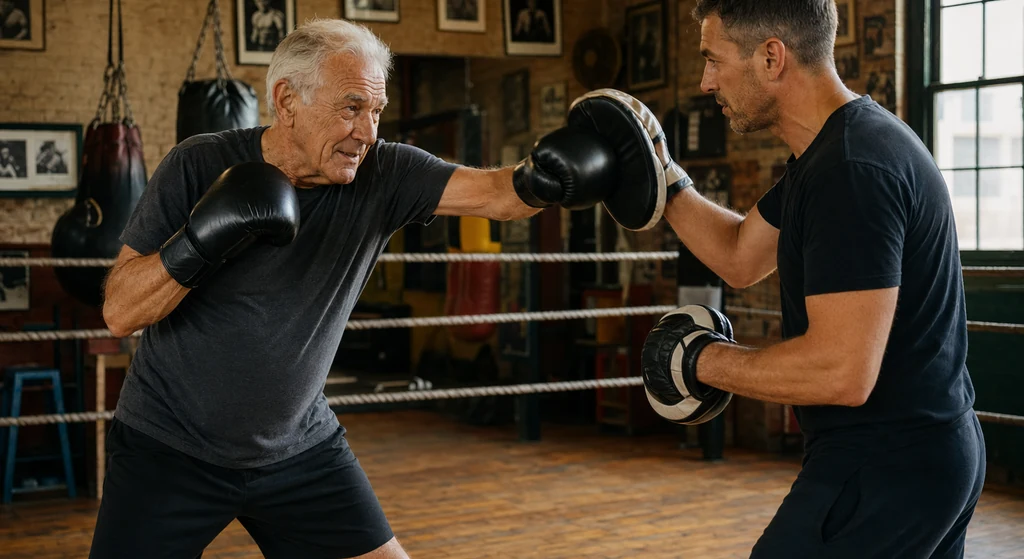
Should you spar? For most beginners in their 60s, no. Recreational boxing is already a complete practice.
How often should you train? Two sessions a week is a strong starting point. Three can work well once recovery proves it can handle the load.
Do you need medical clearance? If you have cardiovascular issues, uncontrolled blood pressure, joint problems, or any significant medical history, yes, speak to your GP first. That is basic common sense.
The Real Value
Boxing in your 60s is not about pretending age does not exist. It is about refusing to hand over more ground than age has actually earned.
You can still learn skill. You can still get fitter. You can still feel sharper, stronger, and more capable than you do right now. That is a serious return for two coached sessions a week.
For the wider picture, read our Boxing by Age guide. If you want the next step down the ladder, Boxing Over 50 is the closest companion piece. If you are looking ahead, read Boxing in Your 70s, and for the broader later-life guide read Boxing for Older Adults.
If you are local and want to see whether it fits you in practice rather than theory, the obvious next step is to try a session.
H&G Team
Writer at Honour & Glory Boxing Club, a community boxing gym in Kidbrooke, South East London.
KEEP READING
Boxing Over 50: What Changes and What Still Works
Boxing over 50 needs sensible pacing, recovery and coaching, but the fundamentals still work. Here is what changes and what remains possible.
Boxing in Your 70s: What Safe Training Really Looks Like
Boxing in your 70s is possible when training is measured, technical, and built around balance, confidence, mobility and safe movement.
Boxing, Fitness and Energy: A Sensible Note for Men
Boxing can support strength, fitness and routine. Hormone concerns should be discussed with a clinician.
Was this page helpful?
It takes one tap, and it genuinely helps.
Choose your next step
Turn this article into the right action
Some readers are ready to book. Some need the class route first. Pick the route that matches what you actually want.