Boxing in Your 70s: What Safe Training Really Looks Like
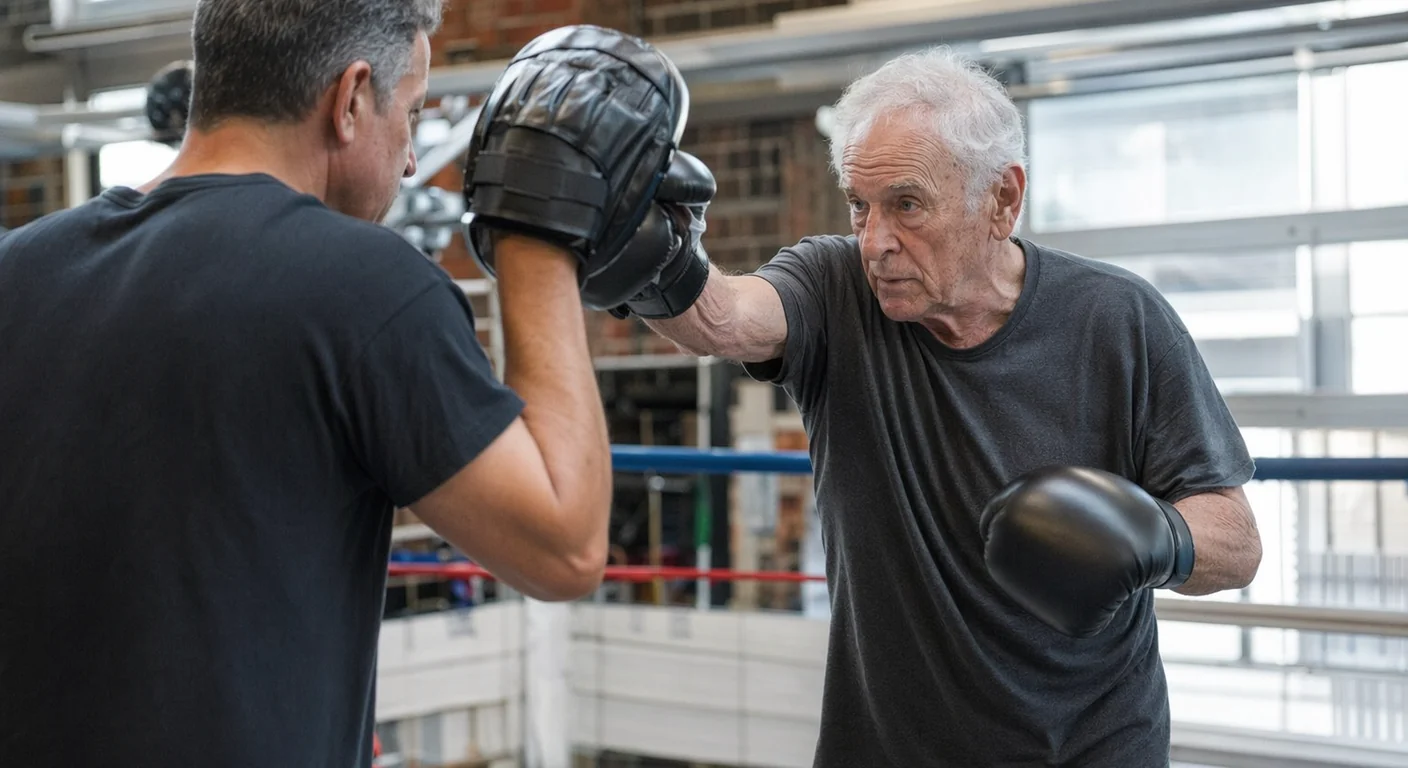
If you say "boxing in your 70s" to most people, they picture the wrong thing.
They picture contact, punishment, ego, and someone trying to prove a point. That is not the useful version.
The useful version of boxing in your 70s is technical, supervised, scaled properly, and built around the qualities that matter most at this age: balance, coordination, confidence, posture, cardiovascular effort, and the simple fact of staying capable.
Start With the Real Question
The real question is not whether somebody in their 70s can be turned into a fighter. For almost everyone, that is irrelevant.
The real question is whether boxing-style training can be used intelligently as exercise in your 70s. In many cases, yes.
That matters because the cost of inactivity at this age is high. NHS guidance for older adults places particular emphasis on strength, balance, and reducing sedentary time. Research on falls and older adults shows how closely mobility, confidence, and balance are tied to long-term independence.
A sensible boxing session touches all of those. You move your feet, stay organised through the trunk, coordinate hands and eyes, react to cues, and work in short bursts that challenge the heart without requiring endless impact.
What Has to Be True for Boxing to Make Sense in Your 70s
The coaching environment has to be right.
That means no macho nonsense, no pressure to keep up with younger adults, no assumption that being exhausted proves anything, and no confusion between recreational boxing and contact sport.
It also means being honest about starting point. In your 70s, boxing can be a brilliant tool, but it is not a magic trick. If balance is poor, if shoulders are stiff, if cardiovascular fitness is low, or if confidence has dropped after years of doing less, the first job is to rebuild capacity patiently.
The people who do best are usually the ones who accept that a smart session is better than a dramatic session.
What a Safe Version Actually Looks Like
A safe boxing session in your 70s usually includes some or all of the following:
- a longer warm-up than younger adults need
- simple footwork rather than rushed movement
- straight punches before wider, more rotational shots
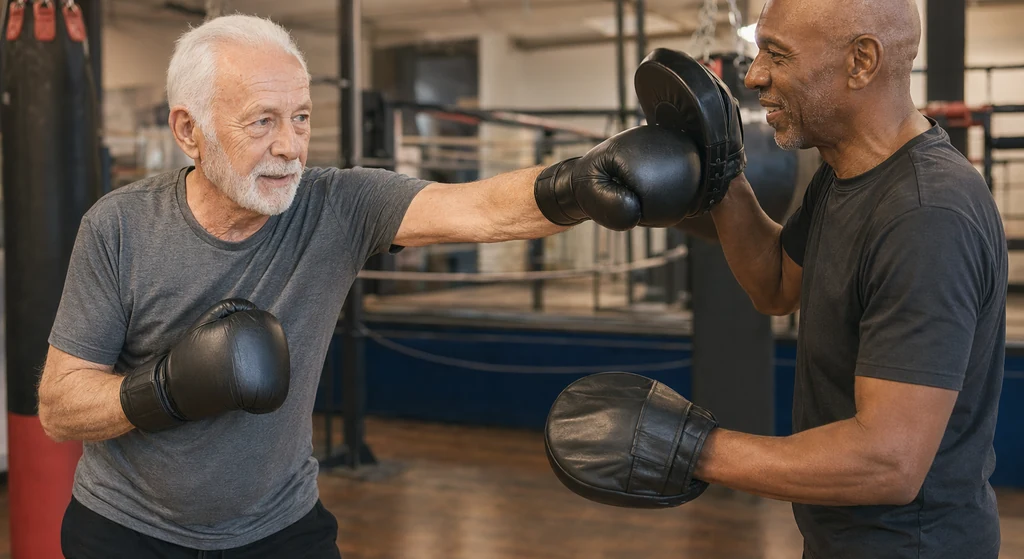
- pad work or controlled bag work rather than chaotic circuits
- shorter rounds with proper rest
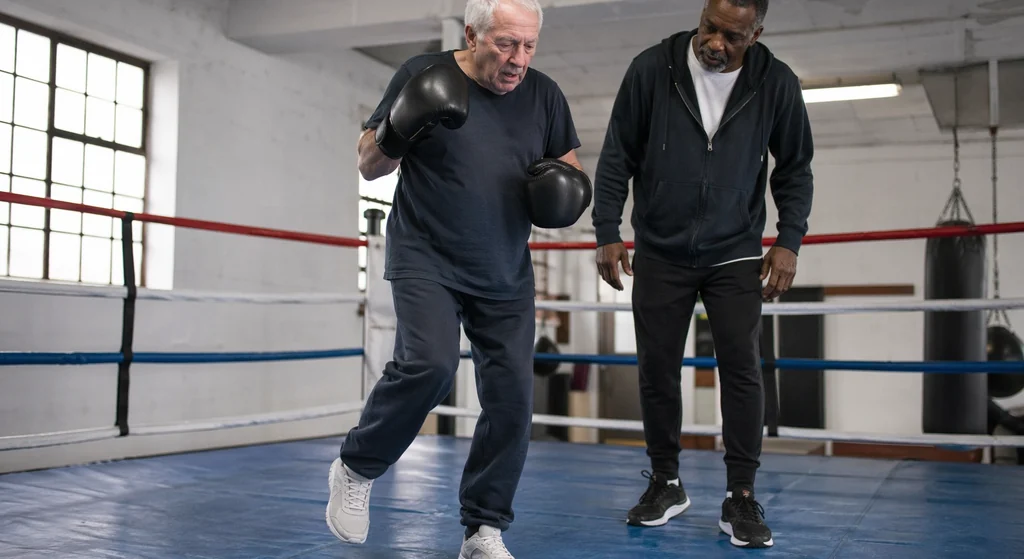
- close coaching attention to posture, breathing, and balance
That is not a watered-down version of training. It is just good programming.
Research on exercise and healthy ageing keeps finding the same thing: strength, balance, coordination, and cardiovascular effort are all trainable later in life. The mistake is assuming later in life means the training should become vague. Usually the opposite is true. It should become more precise.
Why Boxing Can Still Be Worth It
The most obvious benefit is physical. Better stamina, sharper foot placement, improved trunk rotation, stronger shoulders, and more confidence moving at speed all matter.
But there is another part people underrate: boxing gives adults in their 70s something challenging that is still learnable.
A lot of exercise options for older adults are framed in a slightly depressing way, as if the point is merely to prevent decline. Boxing is better when coached properly because it still feels like learning. You are not just preserving function. You are gaining skill.
That can change how people feel about training altogether. Instead of feeling managed, they feel engaged.
What to Be Careful About
This is not the section to skip.
If you are in your 70s and considering boxing, sensible caution matters. If you have cardiovascular disease, uncontrolled blood pressure, major balance problems, recent surgery, or significant joint pathology, get medical clearance first.
Even with clearance, some versions of boxing are still a poor fit. Hard sparring is the obvious example. So are badly run bootcamp-style sessions where fatigue destroys technique and nobody is watching movement quality.
The point is not to force boxing to fit every person. The point is to recognise that many adults in their 70s can benefit from boxing-style training if the session is built for them rather than against them.
What Progress Looks Like
Progress in your 70s is often more obvious in ordinary life than in the mirror.
You might notice that getting out of a chair is easier. Turning quickly feels less uncertain. You recover faster after climbing stairs. You feel less hesitant about movement in general.
In the gym, progress often shows up as composure. The stance looks steadier. The hands come back cleaner. The breathing settles faster between rounds. Those are serious wins.
At Honour and Glory, adults who start later in life belong in the Adult Recreational class, where the aim is coached improvement, not proving how hard you can suffer. If the fit is right, boxing can become one of the most useful things you do all week.
The Bottom Line
Boxing in your 70s is not absurd. It just needs the right definition.
If by boxing you mean contact, ego, and trying to keep pace with younger fighters, then no, that is not sensible. If by boxing you mean coached bag work, pad work, technical movement, and carefully scaled conditioning, then yes, for some adults it is a very good idea.
Read our broader Boxing by Age guide for the full picture. If you want the closest related article, Boxing in Your 60s: Sensible, Demanding, and Still Worth Doing is the next step down the same road. For the wider adult question, read Am I Too Old to Start Boxing?.
The useful question is not whether 70 is old. It is whether you still want to train in a way that keeps your body and mind switched on. Boxing can help with that.
H&G Team
Writer at Honour & Glory Boxing Club, a community boxing gym in Kidbrooke, South East London.
KEEP READING

Boxing in Your 60s: Sensible, Demanding, and Still Worth Doing
Boxing in your 60s can work well when the coaching is sensible, the pacing is honest, and the goal is long-term training rather than ego.
Boxing Over 50: What Changes and What Still Works
Boxing over 50 needs sensible pacing, recovery and coaching, but the fundamentals still work. Here is what changes and what remains possible.
Boxing and Alcohol: How to Balance a Social Life With Training
Boxing does not require you to be teetotal. But alcohol and training interact in specific ways that are worth understanding if you want to make consistent progress.
Was this page helpful?
It takes one tap, and it genuinely helps.
Choose your next step
Turn this article into the right action
Some readers are ready to book. Some need the class route first. Pick the route that matches what you actually want.