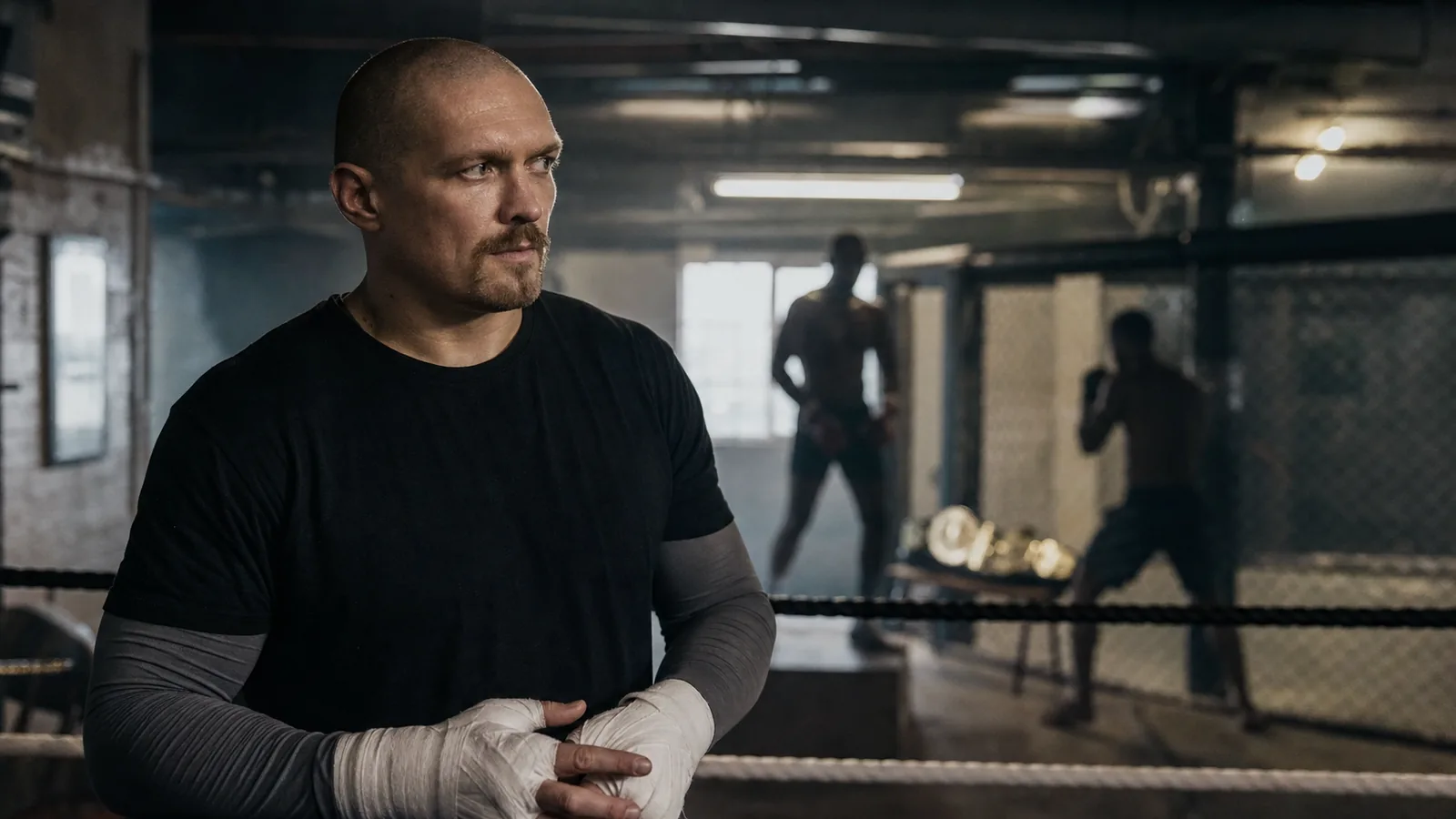
Usyk’s last dance is not about belts now. It is about control.
Oleksandr Usyk has already done the hard part.
He cleaned out cruiserweight. He moved up. He beat Anthony Joshua twice. He beat Tyson Fury twice. He became undisputed at heavyweight, then did it again in the modern four-belt mess. He has spent years making bigger men look as if they were boxing through bad Wi-Fi.
So when Usyk gives up the WBA, WBC and IBF titles, the interesting question is not only who gets the belts next. We covered that part when Usyk vacated the heavyweight belts and reset the division.
The sharper question is this: why would a fighter who still has the authority of the heavyweight king choose Deontay Wilder or Jon Jones for his final fight instead of simply defending against the next mandatory?
Because at this stage, Usyk is no longer chasing permission. He is choosing the ending.
Reports from theScore, MMA Mania, Boxing247 and Bloody Elbow all point in the same direction: Usyk’s team are looking at a farewell in the United States, likely late 2026 or early 2027, with Wilder the cleaner boxing option and Jones the shock crossover name.
That is not normal champion behaviour. But Usyk is no longer behaving like a normal champion.
Vacating the belts changed the whole meaning of the final fight
A champion with three belts is not just a boxer. He is a timetable.
The WBC had Agit Kabayel waiting. The IBF had its own route. The WBA had another. Every sanctioning body has rules, deadlines, challengers, exceptions and fees. A fighter can be the best in the world and still find his career being moved around by committee.
That is why the belt-vacating story matters. Sky Sports reported Sergey Lapin’s explanation that Usyk wants to decide his final chapter himself, rather than letting mandatory defences do it for him. BBC Sport also framed the move clearly: Usyk is leaving the belts, not the sport.
That distinction is everything.
If Usyk kept the titles, Wilder or Jones would look like an indulgence. With the belts gone, the final fight becomes something else. It becomes a farewell event rather than a title defence. That makes the matchmaking logic completely different.
Kabayel deserves his route. The IBF and WBA contenders deserve movement. The heavyweight division deserves belts that are not frozen behind a champion planning one more night.
But Usyk also deserves not to spend his last camp satisfying a sanctioning rotation that adds very little to his legacy.
That is the trade.

Wilder is the sporting spectacle
Deontay Wilder is the safer sell to boxing people because at least he belongs to boxing.
He is a former WBC heavyweight champion. He has one of the most frightening right hands the division has seen. Even faded, even technically limited, even after the hard miles, he gives any Usyk farewell one proper sporting hook: what happens if Wilder lands clean?
That question still works because Wilder’s danger was never built on winning minutes. It was built on ending nights.
Usyk would almost certainly be a heavy favourite. He is the better boxer in every ordinary category: feet, balance, timing, rhythm, defence, ring IQ, adaptability. Wilder would struggle with the angles. He would struggle with Usyk’s southpaw lead hand. He would struggle with being made to reset again and again.
But Wilder is not being mentioned because he can outbox Usyk. He is being mentioned because a last dance needs a threat the public can understand in one sentence.
Usyk versus Wilder is genius technician against the last clean bomb.
That is a marketable fight. It is also a fight that lets Usyk close a heavyweight-era loop. Joshua, Fury, Dubois, Verhoeven, maybe Wilder. That is a strange, impressive, very modern run through elite boxers, British stars, title fights and spectacle events.
Bad Left Hook made the key point after the titles were vacated: without belts attached, Usyk’s last dance could be freer, stranger and more personality-driven. Wilder fits that perfectly. He is still a name. He still has danger. He does not require Usyk to pretend this is about mandatory order.
The downside is obvious. Wilder in 2026 is not Wilder in 2018. The explosiveness may still be there, but the aura has taken punishment. His recent win over Derek Chisora, noted by theScore, helps keep him active, but it does not suddenly make him the division’s form contender.
So Wilder is credible, but not fresh. Dangerous, but not defining. Big, but not shocking.
That is where Jon Jones enters.
Jon Jones is the spectacle spectacle
Jon Jones against Oleksandr Usyk in a boxing ring is a mad idea.
It is also exactly the sort of mad idea that modern combat sport keeps rewarding.
Jones is one of the greatest mixed martial artists ever. He was a dominant UFC light heavyweight champion, moved to heavyweight, and spent years as the measuring stick for MMA greatness. But professional boxing against Usyk is not MMA with fewer tools. It is a different sport at the worst possible level of difficulty.
MMA Mania is right to stress the obvious problem: Jones has no professional boxing record. KarloBag also notes the practical complexity around Jones as a boxing opponent, especially compared with Wilder.
Against ordinary heavyweights, Jones would have size, reach, timing, combat intelligence and awkwardness. Against Usyk, most of that gets stripped back.
No elbows. No knees. No clinch wrestling. No kicks to freeze the feet. No threat of a level change. No fence. No MMA rhythm. Just gloves, rounds, judges, foot position and a southpaw who has spent his life punishing big men for being half a beat late.
That is why the Jones fight is not really about competitive purity. It is about status.
Usyk would be saying: I have beaten boxing. For my last act, bring me the greatest MMA fighter of his generation and let us sell the argument to the world.
That argument will annoy purists. Fair enough. It should. Boxing has spent too much time pretending crossover events are the same as elite contests.
But a farewell fight is different from a title defence. If no belt is trapped, no mandatory is blocked, and no contender is being told to wait, the moral problem shrinks. Then the question becomes simpler: is the event honest about what it is?
If Usyk versus Jones is sold as the hardest boxing test Jones could ever take, that is true. If it is sold as a 50-50 boxing match, that is nonsense.

Why this is materially different from the belt story
The belt story was about the heavyweight division.
This story is about Usyk’s authorship.
Those are not the same thing.
When Usyk vacated, the immediate consequences belonged to Kabayel, Frank Sanchez, Murat Gassiev, Moses Itauma, Anthony Joshua and the alphabet bodies. Sidekick Boxing, boxingnews.com and Yardbarker all covered the wider fallout because belts create new routes as soon as they are released.
But Wilder or Jones tells us what Usyk wants the final night to mean.
He is not asking, “Who is next in line?”
He is asking, “What kind of ending is worth one more camp?”
That is a very boxer’s question. At club level, we see a tiny version of it all the time. Fighters and beginners in our boxing classes learn quickly that boxing is not only about being brave. It is about choosing when to spend energy, when to take risk, and when the trade is worth it. Usyk has been making those choices better than anyone for years.
Now the choice is bigger.
A mandatory keeps the sport tidy. A Wilder fight gives boxing fans a final danger story. A Jones fight gives the wider combat-sports audience a one-night argument about greatness, rules and ego.
None of those options is perfect. That is why the story is interesting.
The Reddit temperature is split, but the real issue is simpler
There is already plenty of fan argument around the idea. Threads on r/Boxing have questioned whether Usyk versus Wilder makes sense in 2026, while others have discussed Usyk’s last dance and the heavyweight picture after the titles were vacated. On the MMA side, comparisons between Usyk and Jones have naturally spilled into debates about all-time greatness, including this r/ufc thread arguing that Usyk is what Jones thinks he is.
The noise is predictable. Boxing fans want sporting order. MMA fans want Jones in huge events. Casual fans want names. Promoters want a number big enough to justify the risk.
The cleaner way to judge it is this:
If Usyk still held the belts, Jones would be hard to defend. If Usyk has vacated and made room for the division, Jones becomes easier to understand, even if the fight itself is a mismatch on paper.
That does not mean it is the best option. It means it is not the same offence.
The right choice is Wilder, but the revealing choice is Jones
If I were advising Usyk as a boxing man, I would pick Wilder.
It keeps the final fight inside the sport. It gives Usyk a famous heavyweight name he has not faced. It carries real danger without turning the night into a pure celebrity crossover. It is easy to explain, easy to promote and still connected to heavyweight history.
But if I were trying to read Usyk’s mind, Jones would worry me more as a possibility.
Jones is not the better boxing opponent. He is the bigger statement about freedom. He represents a final event that does not care about the mandatory queue, the belt table or the old distinction between boxing audience and combat-sports audience.
That may be exactly the point.
Usyk has spent the serious part of his career doing things properly. Olympic gold. Undisputed cruiserweight. Away wins. Heavyweight belts. Fury twice. Joshua twice. No shortcuts.
If his last act is a spectacle, he has earned more right than most to choose it.
The division has its belts back. The contenders can move. The sport can argue. Usyk can look at Wilder, look at Jones, look at the final cheque, the final risk and the final memory, then decide what the last dance is for.
My preference is Wilder.
My suspicion is that Jones tells us more.
H&G Team
Writer at Honour & Glory Boxing Club, a community boxing gym in Kidbrooke, South East London.
KEEP READING

Usyk vacates heavyweight belts: the vacant-title routes
The defining heavyweight governance story: what surrendering the WBC, WBA and IBF belts changes, why it does not equal retirement, and how mandatory and vacant-title routes now shape the division.

Frank Warren’s Usyk hint raises Itauma stakes
Use Warren’s fresh suggestion as the hook: if Itauma beats Hrgovic, the conversation may jump from prospect-building to world-title timing. Good for explaining why matchmaking pace matters for young heavyweights.

Sikho Nqothole world title push after Edwards win
Use the Charlie Edwards vs Sikho Nqothole card as a current hook to explain how a fighter moves from a high-profile win into world-title contention, without making it a straight results report.
Was this page helpful?
It takes one tap, and it genuinely helps.
Choose your next step
Turn this article into the right action
Some readers are ready to book. Some need the class route first. Pick the route that matches what you actually want.