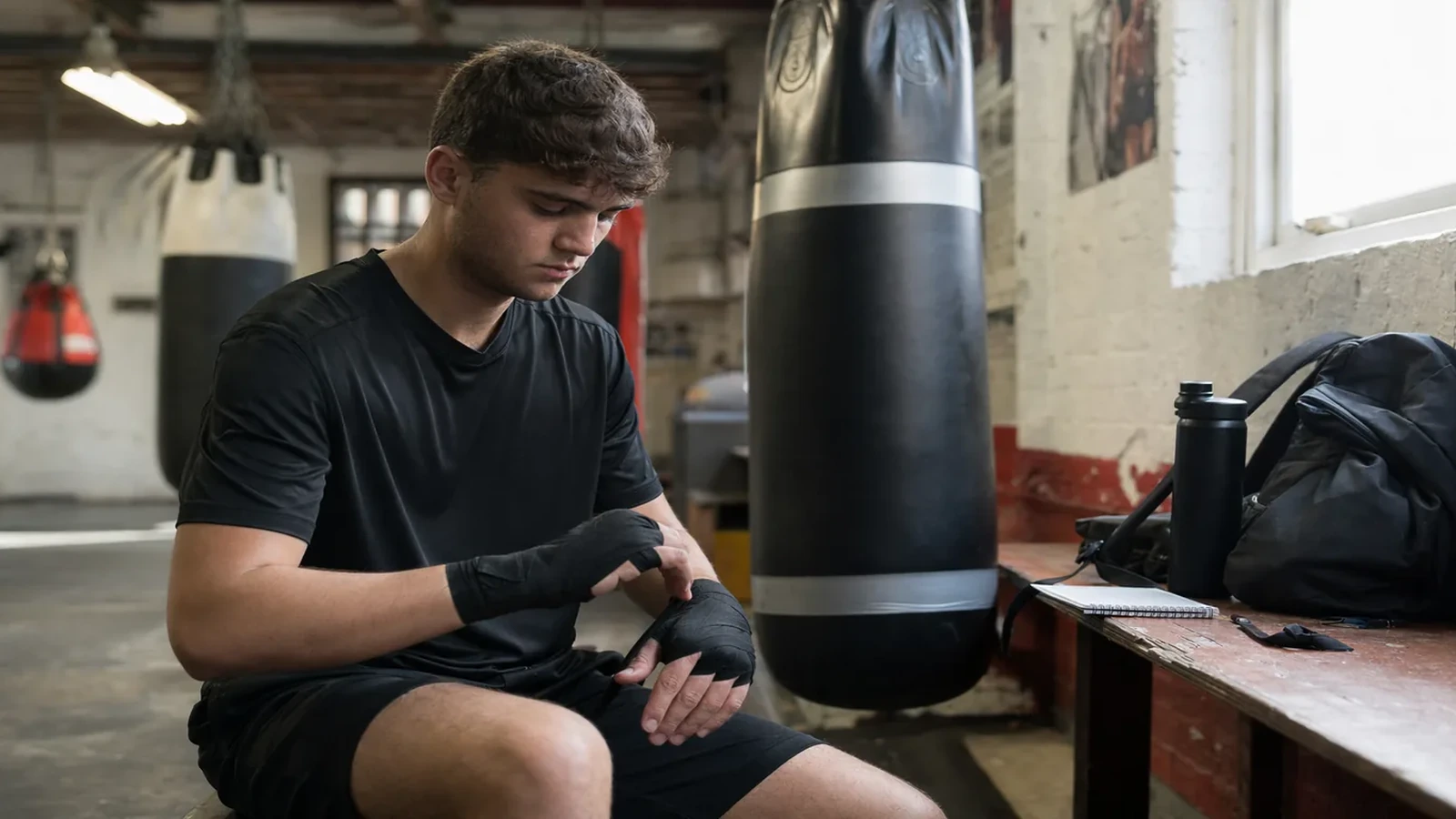
Best exercise for students? Boxing is a better answer than drifting around a gym pretending to know what to do.
Student life can look loose from the outside, but it is often messy in practice. Deadlines, part-time work, money pressure, poor sleep, social anxiety, lectures, screens, commuting, nights out and long stretches of sitting can all pile up. A normal gym membership does not automatically solve that.
The best exercise for students needs to build fitness, confidence and routine. It should help with stress without feeling like another chore. It should also give you a place to train properly, especially if you are not already a sporty person.
That is where boxing fits.
Student life needs structure, not another vague habit
A lot of students do not fail at fitness because they are lazy.
They fail because the week has no stable shape. One day starts early. Another ends late. A deadline ruins the plan. A shift changes. A night out writes off the next morning. Then the gym becomes another thing you technically pay for but do not really use.
Boxing works better because the session is already built for you. You turn up, warm up, learn a skill, work rounds and leave knowing you have trained properly. You do not need to invent a programme from scratch or pretend you understand every machine in a commercial gym.
That matters for students because routine is easier when the session has a clear start, middle and finish. Boxing gives you that.
It helps with stress without pretending stress is simple
Student stress is not always dramatic, but it can sit in the background for months.
Coursework. Exams. Money. Housing. Social pressure. Family expectations. Trying to work out what comes next. It is a lot to carry, especially when most of it happens on screens or in your own head.
The Mental Health Foundation says physical activity can help people manage stress, feel more confident and boost mood (Mental Health Foundation physical activity guidance). That is not a magic cure, but it is a useful base layer.
Boxing helps because it forces your attention into the room. You cannot spend a pad round thinking about an essay, a group chat or a result you are waiting for. You have to watch, move, breathe and respond.
If stress relief is the main reason you are interested, boxing for stress relief is the obvious next read.

Boxing builds confidence without gym posing
A lot of students want confidence, but not the fake version.
Not swagger. Not being loud. Not trying to look hard. Real confidence is quieter than that. It is knowing your body better, being able to handle effort, walking into a room without feeling completely out of place and learning something difficult without folding the first time you look bad at it.
Boxing is good for that because everyone starts awkwardly. The first jab feels strange. Footwork feels clumsy. Keeping your hands up while moving is harder than it looks. Then, slowly, it starts to click.
That process is valuable. You get proof that you can improve. You do not have to already be fit, strong or confident before you start.
For students who find normal gyms intimidating, that is a big difference. A coached boxing class gives you something to do from the first minute.
It breaks the screen-and-chair pattern
Student work can be surprisingly sedentary.
Lectures, reading, revision, laptops, commuting, gaming, streaming and phone scrolling can turn the body into an afterthought. You might be busy all day and still barely move properly.
The NHS warns that many UK adults spend around nine hours a day sitting and advises breaking up long sitting periods with activity (NHS sitting guidance). Students are not immune to that. In some courses, the physical pattern is basically office work without the office.
Boxing goes in the opposite direction. You use your feet, hips, trunk, shoulders, eyes and hands together. You rotate, brace, punch, reset and recover. The body gets a much richer movement diet than another day hunched over a laptop.
A recent study on university students found physical activity and sedentary behaviour were associated with mental-health outcomes (student physical activity and mental health study). The practical lesson is simple: your body and head are not separate systems.
It gives you a social setting without forcing the social bit
This is underrated.
Some students want more people around them. Others want to train without having to perform socially. Boxing can work for both.
You train in a group, but the focus is the work. You are not standing around trying to make small talk for an hour. You are warming up, drilling, hitting pads, moving around bags and listening to coaching. The social side happens naturally because people are doing the same hard thing together.
That is different from many sports teams, where you can feel late to the party if you did not grow up playing. It is also different from the gym, where you can be surrounded by people and still feel completely on your own.

What kind of boxing works best for students?
For most students, recreational boxing two or three times a week is the right starting point.
Not hard sparring by default. Not trying to become a fighter overnight. Just proper coached boxing: warm-up, footwork, bag work, pad work, technique and conditioning.
Our Adult Recreational boxing classes fit that well for students aged 17 and above. You get coaching and structure without needing previous boxing experience, and the sessions are challenging without being built around ego.
If you study, live or work around Greenwich, Kidbrooke, Blackheath or nearby parts of south east London, the club is practical enough to fit around lectures, shifts and revision blocks.
The NHS recommends adults do at least 150 minutes of moderate intensity activity a week or 75 minutes of vigorous activity, plus strengthening work on two days a week (NHS adult activity guidelines). Coached boxing can help cover both sides without leaving you to design the whole thing yourself.
The honest caveat
Boxing will not fix a bad course, money pressure, poor sleep or a social life that has gone sideways.
It will not replace proper mental-health support if you need it. It will not make deadlines disappear. And if you are injured, you should deal with that properly rather than trying to train through it.
But if the question is what exercise gives students better fitness, confidence, stress relief and a routine that feels worth keeping, boxing is one of the strongest answers.
It is physical enough to clear your head, technical enough to keep you interested and structured enough to stop fitness becoming another vague promise you keep putting off.
If you want the broader comparison, boxing vs gym: why people switch explains why many adults stick with boxing when normal gym training goes stale.

How to start if you do this job
For most students, the best first step is a normal coached group class, not a complicated programme. Start with Adult Recreational boxing or the broader adult beginner boxing guide if you want to understand what happens first.
If your rota, clients or working hours make set classes hard, use boxing personal training or private boxing lessons as the paid route. The free trial is for scheduled group classes.
Book a free trial session at Honour and Glory Boxing Club.
More job-specific boxing guides
If this article fits your work pattern, the full boxing for workers guide links the rest of the job-specific series, including desk workers, shift workers, trades, carers, drivers, teachers and busy professionals.
More student boxing guides
If you are training around exams or early adult life, these guides go deeper: boxing during GCSEs, boxing during A-levels, boxing for students and young adults, and boxing in your 20s.
H&G Team
Writer at Honour & Glory Boxing Club, a community boxing gym in Kidbrooke, South East London.
KEEP READING
Boxing Fitness for Nurses: When It Fits
Boxing can be a useful training option for nurses when you want coached movement, conditioning and a clear break from work. It is not the only answer, but it can fit well.
Boxing Fitness for HR Professionals: When It Fits
Boxing can be a useful training option for hr professionals when you want coached movement, conditioning and a clear break from work. It is not the only answer, but it can fit well.

Boxing, Exercise and Low Mood: What to Know
Exercise can support mood for some people, but boxing is not a treatment for depression. Here is a careful guide to where training may help and where professional support matters.
Was this page helpful?
It takes one tap, and it genuinely helps.
Choose your next step
Turn this article into the right action
Some readers are ready to book. Some need the class route first. Pick the route that matches what you actually want.