Boxing for Women Who Have Never Exercised: Where to Start

Research on inactive adults and exercise adoption identifies social support and skill progression as the primary factors that help previously inactive people sustain exercise. England Boxing's women's boxing programme has specifically targeted inactive women as a key growth audience.
Women who have never exercised consistently as adults are more common in boxing gyms than the sport's marketing suggests. The assumption that boxing is for the already-fit is wrong.
Starting from no exercise base is also the normal position for a large share of adult women, not the exception. Sport England's data on activity and gender records that 39 per cent of women aged 16 and over are not active enough to gain the full health benefits of physical activity, compared with 35 per cent of men. If you are in that group, you are arriving from the same place as a great many of the women already in the class.
Here is the reality of what starting from the beginning actually looks like.
The "Get Fit First" Trap
The most common reason women who want to try boxing do not try boxing: "I need to get fitter first."
This is circular. The way to get fit for boxing is to do boxing. Attempting to get fit enough before starting means doing some other form of exercise for weeks or months as a prerequisite to the thing you actually want to do.
Boxing coaches see this constantly and regard it as one of the most destructive pieces of self-talk women bring to the gym. You do not arrive fit. You arrive and begin to get fit. The two things happen in the same place.
What "Never Exercised" Actually Means in Practice
Women who describe themselves as having never exercised are almost always fitter than they think. Walking, carrying children, climbing stairs, managing a house and a job - these are all physical demands that maintain a baseline.
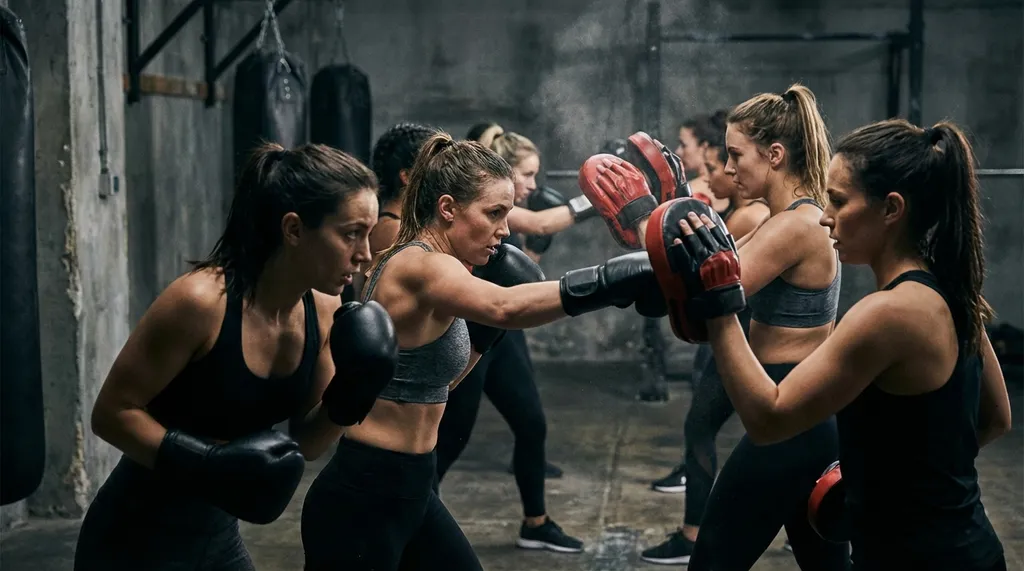
The gap between this baseline and what boxing initially demands is real but bridgeable. The first few sessions are hard. They are hard for everyone, including people who have been exercising regularly in other ways and whose bodies are not adapted to boxing's specific demands.
The fitness gap closes quickly with consistent attendance. Three sessions a week for four weeks produces significant cardiovascular improvement. Eight weeks produces a transformation in what the body can manage.
The First Session Expectation
For a woman who has never exercised consistently, the first boxing session will be physically challenging. This is worth knowing in advance rather than being surprised by.
The warm-up alone will raise your heart rate to a level you may not be accustomed to. The bag work will have your arms aching in minutes if your upper body is not conditioned for the repetitive movement.
You will be modified or allowed to rest where needed. Good coaches do not push absolute beginners to exhaustion. They push to effort - which is a different thing.
You will not be good at boxing in session one. You will be a beginner at boxing. This is not a judgment. It is simply where everyone starts.
What you will be at the end of session one: someone who has tried something really new and difficult and got through it.
How Boxing Fits the Weekly Activity Target
For a woman starting from nothing, it helps to know what a sensible weekly amount of exercise actually is. The NHS physical activity guidelines for adults recommend at least 150 minutes of moderate intensity activity a week, plus strengthening activities that work the major muscle groups on at least two days a week.
A boxing session does both jobs at once. The pad work and bag work raise your heart rate into the moderate-to-vigorous range, and the repeated punching, guarding and movement load the shoulders, back, core and legs. The same NHS guidance describes moderate intensity as the point where you can still talk but cannot sing, which is a useful self-check during your first sessions.
Two one-hour sessions a week, with a walk or two on other days, will put a previously inactive woman close to that 150-minute target inside the first month. You do not need to reach the full figure in week one. The target is achievable, and boxing is an efficient way to reach it.
What to Focus on in the Early Weeks
For women starting from no exercise base, the priority is not technique. It is consistency.
Show up for eight weeks. Attend at least twice a week. That is the assignment.
By week eight, your cardiovascular fitness will have improved significantly. Your technique will have started to develop. The physical confidence will have begun to build. You will know whether boxing is a sport you love, and you will be in a position to decide whether to continue.
Nothing useful can be decided before eight weeks of consistent attendance.
What to Bring to Your First Session
The practical questions stop many beginners before they start, so here are the plain answers. Wear comfortable training clothes you can move and sweat in, and trainers with a flat, supportive sole rather than thick running shoes. Bring a water bottle and a small towel.
You do not need to own boxing gloves or hand wraps for a first session. The club has gloves you can borrow while you decide whether boxing is for you. If you continue, your own gloves and wraps are a modest one-off cost, and your coach will tell you what to look for.
The Social Environment for Beginners
The Women's Boxing class at Honour and Glory on Saturdays is specifically designed as an inclusive space. Women at all fitness levels and experience levels train together.
New members are not expected to perform. They are expected to try. The coaches adapt the session to the individual. The other women in the class understand that you are new because most of them were new once and remember what it felt like.

The specific social dynamic of women-only boxing classes - the reasons they work and what they provide - is something our class demonstrates rather than describes. The best way to understand it is to experience it. If a group class feels like too big a first step, women's boxing personal training gives you the same boxing fundamentals with one coach focused on your pace.
The gym is in Kidbrooke, a few minutes from central Greenwich. If you are travelling in from that side, the women's boxing route from Greenwich sets out the journey and what a first visit involves.
Claim a free trial session at Honour and Glory Boxing Club.
Adult beginner route
If you are deciding where to start, use the main adult beginner boxing guide. It compares the normal group-class route, women-only classes, weight-loss intent and private coaching for nervous or time-constrained beginners.
Women's boxing route
If you are comparing women-only classes, beginner support, fitness, stress relief and private coaching, start with the women's boxing hub. It explains which route fits your goal before you book.
H&G Team
Writer at Honour & Glory Boxing Club, a community boxing gym in Kidbrooke, South East London.
KEEP READING
Does Boxing Make Women Bulky? The Honest Answer From the Gym
The fear of getting too muscular stops many women from trying boxing. The honest answer from coaches and experienced female boxers should settle this question permanently.

What to Wear to a Women's Boxing Class: The Practical Guide
The kit question is one of the first things women ask before trying boxing. Here is the definitive answer to what you actually need, what is optional, and what to avoid.

Boxing and Weight Loss for Women: What Actually Happens vs
Boxing is marketed for weight loss constantly. Here is what actually happens to women's bodies with consistent boxing training, versus the marketing claims.
Was this page helpful?
It takes one tap, and it genuinely helps.
Choose your next step
Turn this article into the right action
Some readers are ready to book. Some need the class route first. Pick the route that matches what you actually want.