Ankle Sprains and Achilles Pain in Boxing: Footwork, Warning Signs and Return to Training
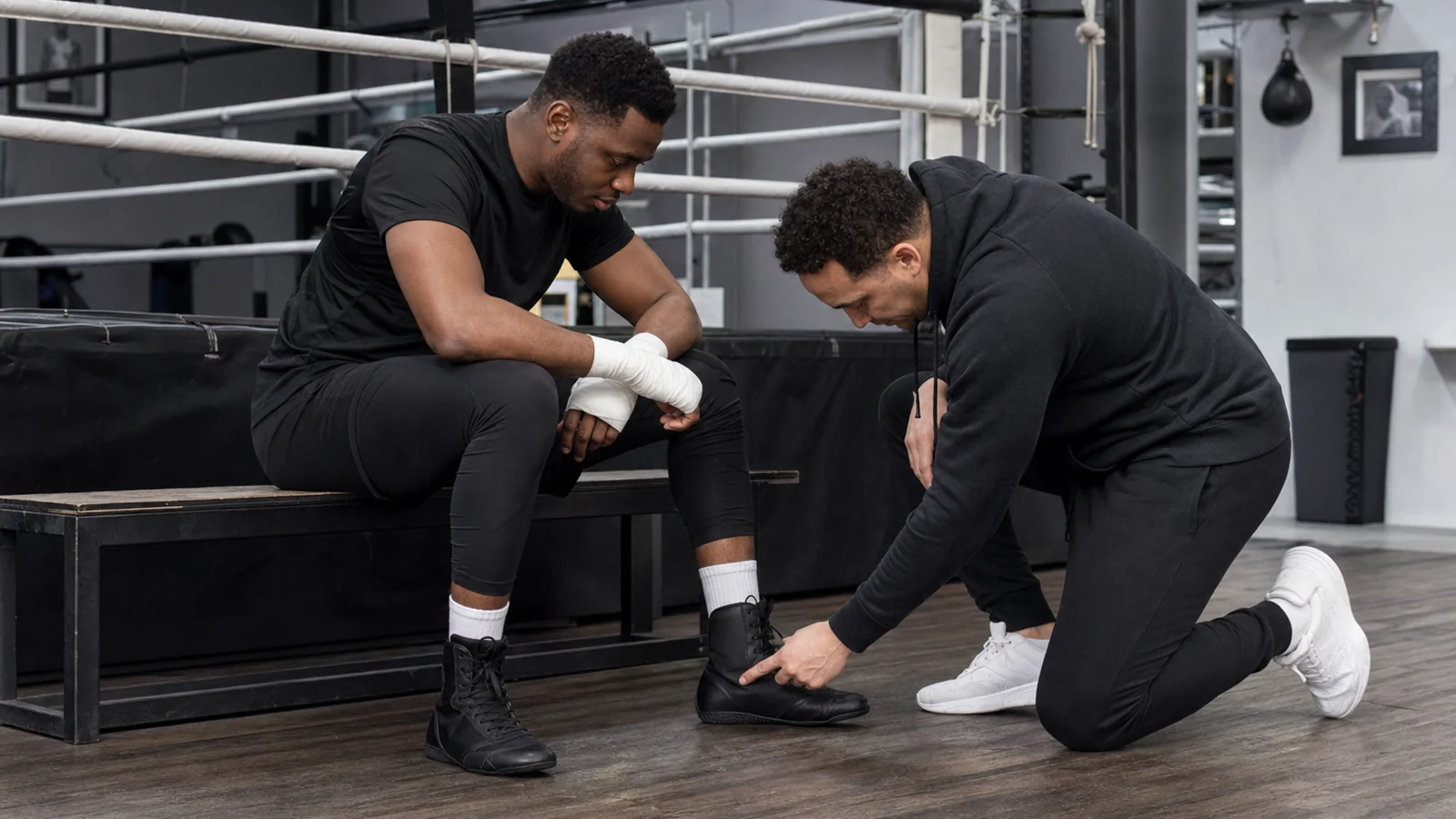
An ankle sprain can make a boxer feel clumsy overnight.
One awkward pivot, one foot landing half on the mat, one sticky shoe during a direction change, and suddenly the thing you trusted most in the gym does not feel trustworthy. Achilles pain is different but just as frustrating. It often creeps in around the tendon above the heel, warms up during movement, then reminds you afterwards that the load was too much.
This is general information for boxers, not a diagnosis or medical advice. Stop training and speak to a qualified clinician if symptoms are severe, worsening, unusual, or not improving. For urgent symptoms, use NHS 111, A&E or 999 as appropriate.
This guide is part of our common boxing injuries series. It explains why ankle and Achilles problems happen in boxing, how they differ from ordinary training soreness, which warning signs matter, and how return to boxing usually needs to rebuild walking, balance, footwork and push-off before hard rounds.
The short version: if your ankle rolls, swells, bruises, feels unstable, changes shape, makes you unable to walk, or you hear a snap, grinding or popping noise, stop training and get medical advice. If Achilles pain is sudden, severe, comes with a pop or snap, or you cannot push off or stand on tiptoes, treat it as urgent rather than stretching harder.
Why ankles and Achilles tendons matter in boxing
Boxing is built from the floor.
The ankle and Achilles tendon help you:
- hold stance without wobbling
- push off to close distance
- brake when you step out
- pivot without collapsing inward
- skip and bounce without losing rhythm
- cut small angles without crossing your feet
- absorb force when punches land through the body
- keep balance when tired, nervous or under pressure
The Achilles tendon connects the calf muscles to the heel. Cambridge University Hospitals NHS Foundation Trust describes it as the largest tendon in the body and explains that it helps bend the foot downwards, go onto tiptoes, and push the body forwards when walking or running (source).
An ankle sprain is usually a ligament problem. NHS Inform describes an ankle sprain as an injury to the ligaments on the outside of the ankle, where those ligaments become overstretched and tear. The severity can range from a small tear to a full rupture (source).
In boxing terms, the ankle is your platform and the Achilles is part of the spring. If either is unhappy, your stance, footwork, balance and punch mechanics can all change.
Why boxing can expose ankle and Achilles problems
Most ankle and Achilles problems in a recreational boxing gym are not dramatic fight injuries. They are usually load, surface, footwear and fatigue problems.
Common boxing scenarios include:
- too much skipping too soon
- bouncing on the toes for every warm-up and every round
- pivots on a sticky or uneven surface
- trainers that grip too much or let the foot slide inside the shoe
- boxing boots that are too loose, too stiff or new to the athlete
- stepping out of range while off balance
- crossing the feet during lateral movement
- adding running, sprints or plyometrics on top of boxing
- returning after time off and training at old volume
- sparring movement that is faster and less predictable than drills
- tired calves changing how the ankle controls landing and push-off
NHS Inform says Achilles tendinopathy can be linked with a sudden or gradual change in load, such as increasing exercise, taking up a new sport, or doing activity beyond usual strength or endurance. It also lists unsuitable or poorly fitting footwear as a contributing factor (source).
The NHS ankle pain page says ankle pain is often caused by exercising too much or wearing shoes that are too tight, while warning that ankle pain can also come from more serious causes such as a broken ankle (source).
A 2022 systematic review of amateur boxing injuries found that training injuries are much less frequent than competition injuries overall, but that training injuries were often sprains and strains (source). Ankle sprains and Achilles irritation are not the headline injury in boxing, but the mechanisms are familiar to anyone who has watched a tired boxer pivot badly.
Ankle sprain, Achilles tendinopathy and rupture are not the same
Boxers often use one phrase for everything below the calf: ankle, heel, tendon, lower leg, foot.
The difference matters.
Ankle sprain
An ankle sprain usually follows a twist or roll. The outside of the ankle is the classic area. NHS Inform says symptoms can include swelling and bruising, pain, mild heat and redness, loss of movement and strength around the ankle and foot, difficulty walking or using stairs, and tingling, numbness or pins and needles (source).
In boxing, an ankle sprain might happen when the foot rolls during a pivot, when the boxer lands from a small hop, or when a lateral step arrives before the body is balanced.
Achilles tendinopathy
Achilles tendinopathy is usually lower than a calf strain, around the tendon above the heel. NHS Inform says it can cause pain, stiffness and swelling, with pain worse during or after moving or exercise, stiffness worse in the morning or after rest, tenderness to touch, mild heat, and loss of movement or strength around the ankle and foot (source).
For a boxer, this may show up as discomfort during skipping, bouncing, pushing off the rear foot, climbing stairs after training, or feeling stiff when first walking the next morning.
Achilles rupture
A rupture is different. It is a tear of the tendon and needs urgent medical assessment.
Cambridge University Hospitals NHS Foundation Trust lists typical symptoms of Achilles rupture as sudden heel or calf pain, a snapping or popping sound, swelling and bruising around the calf or ankle, difficulty walking, difficulty pushing off from the ground, and inability to stand on tiptoes or climb stairs. It also notes that patients often describe the injury as feeling as if someone has hit them in the back of the leg (source).
Do not self-test this in the gym. If the story sounds like rupture, the boxing session is over.
What ankle and Achilles pain can feel like in a boxer
Symptoms overlap, so this section cannot diagnose you. But boxing gives these problems a few recognisable patterns.
An ankle sprain may feel like:
- a twist or roll during footwork
- pain on the outside of the ankle
- swelling around the joint
- bruising later that day or over the next few days
- difficulty trusting the foot during pivots
- pain going up or down stairs
- a feeling that the ankle might give way
- reduced range when pointing, flexing or circling the foot
Achilles tendinopathy may feel like:
- stiffness around the tendon first thing in the morning
- pain low at the back of the ankle or above the heel
- tenderness if you press along the tendon
- pain that warms up, then returns after training
- discomfort with skipping, bouncing or calf raises
- pain pushing off the back foot
- reduced spring in footwork
An Achilles rupture may feel like:
- a sudden pop, snap or hit-from-behind sensation
- sharp pain in the calf or heel area
- sudden difficulty walking normally
- inability to push off properly
- inability to stand on tiptoes on the affected side
- swelling or bruising around the calf or ankle
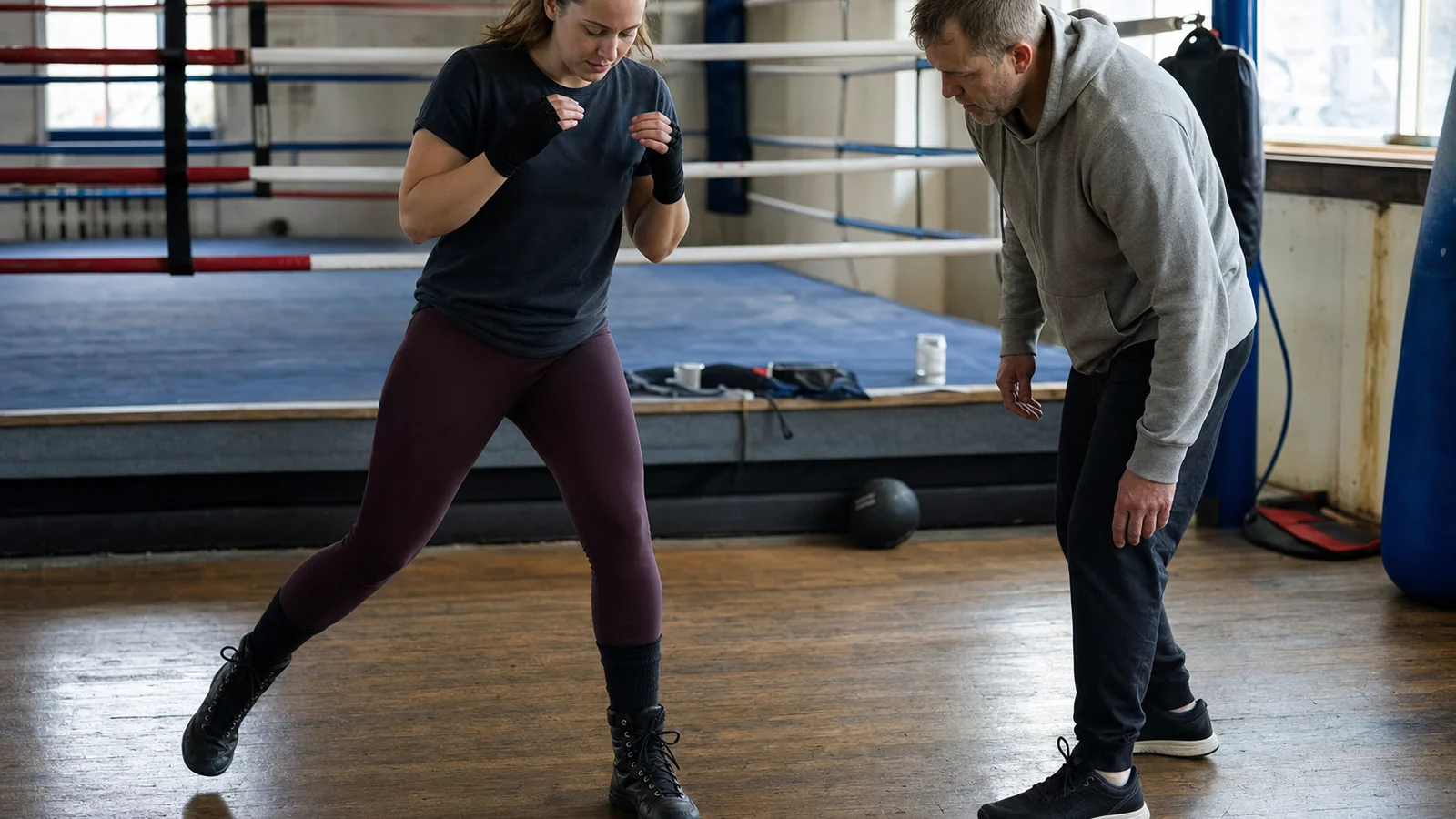
The gym clue is movement quality. If pain makes you shorten stance, flatten the foot, avoid pivots, bounce only on one side, stop pushing from the rear foot, or guard the ankle every time you move, the session has changed. Stop before the compensation becomes the next injury.
When to stop boxing immediately
Stop the round if ankle or Achilles pain:
- follows a twist, roll, snap, pop or sudden sharp pain
- makes you unable to walk normally
- makes you limp or avoid putting weight through the foot
- comes with rapid swelling or bruising
- makes the ankle feel unstable or unreliable
- makes pivots or direction changes unsafe
- gets worse as you continue
- causes numbness, tingling or pins and needles
- comes with a foot or ankle that has changed shape
- stops you pushing off or rising onto the toes
Do not keep skipping to see whether it loosens. Skipping is not a neutral test. It is a repeated ankle and Achilles load.
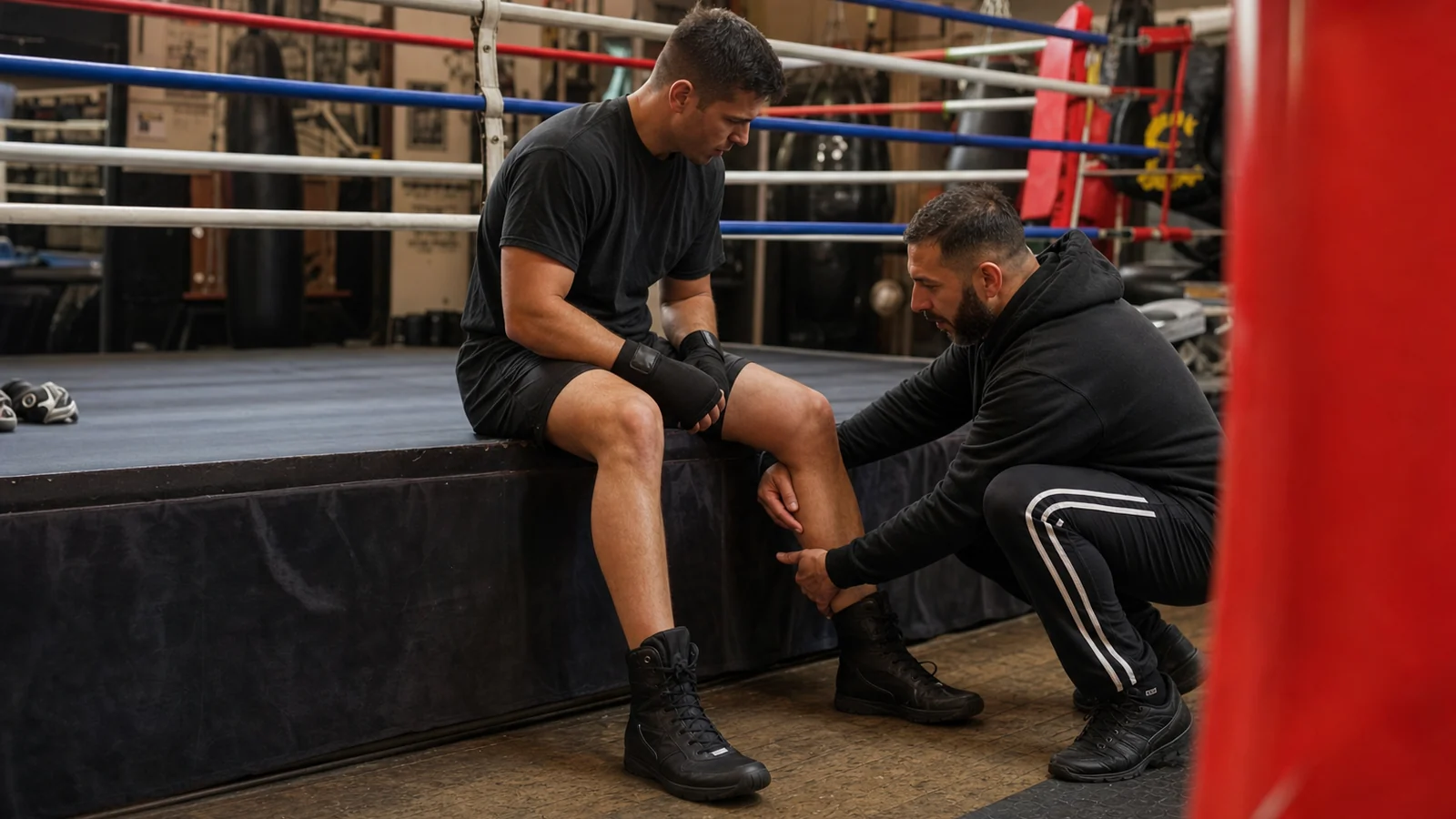
A coach can change the drill, take you out of footwork, switch to upper-body-only work if that is safe, or tell you to stop. A coach cannot rule out a fracture, tendon rupture, nerve issue or significant ligament injury from the side of the ring.
When to get medical help
Use NHS guidance first.
Contact NHS 111 if:
- ankle pain is severe
- you feel faint, dizzy or sick from the pain
- your ankle or foot has changed shape or is at an odd angle
- you heard a snap, grinding or popping noise at the time of injury
- you are not able to walk
Those signs come from the NHS ankle pain guidance, which says they may be signs of a broken ankle or infection (source).
Get help from NHS 111, an urgent treatment centre or medical care if you have had an injury and:
- the pain is very bad or getting worse
- swelling or bruising is large or worsening
- you cannot put weight on it or walk more than a few steps
- the joint feels very stiff or difficult to move
- it is not getting better after self-treatment
- you feel hot, cold, shivery or have a very high temperature
Those warning signs are from the NHS sprains and strains guidance (source).
See a GP, NHS MSK service, pharmacist or physiotherapist for ankle pain that:
- stops normal activity
- is getting worse or keeps coming back
- has not improved after two weeks of home care
- includes tingling or loss of feeling in the foot
- affects diabetes-related foot safety
That list follows the NHS ankle pain page (source).
For Achilles tendinopathy, NHS Inform advises talking to a healthcare professional if symptoms have not improved within 12 weeks, have got worse, or you are concerned about new or ongoing symptoms and need assessment or diagnosis (source).
For possible Achilles rupture, do not wait 12 weeks. Sudden severe pain, a pop or snap, major loss of push-off, or inability to stand on tiptoes needs prompt medical assessment.
What treatment often looks like
Treatment depends on the actual problem: mild ankle sprain, more significant ligament injury, Achilles tendinopathy, possible fracture, Achilles rupture, nerve symptoms, infection, referred pain or another foot problem.
For ordinary sprains and strains, the NHS recommends PRICE for the first two to three days:
- protect the injury
- rest from exercise and avoid putting weight through it if needed
- ice for up to 20 minutes every two to three hours, wrapped in a towel
- compression with a bandage for support
- elevation on a pillow as much as possible
The NHS also advises avoiding heat, alcohol and massage in the first couple of days because they may increase swelling (source).
For tendonitis, the NHS advises resting the tendon for two to three days, using ice, supporting the area with a bandage or soft brace where suitable, and gently keeping the area moving once pain is not stopping movement. It also says to avoid sport until the tendon has recovered, and to seek help from NHS 111 if you are in a lot of pain or think you have ruptured a tendon (source).
Achilles tendinopathy is not usually solved by doing nothing forever. NHS Inform says Achilles tendinopathy does not improve with rest alone, so it is important to keep up as much normal daily activity as possible while modifying activity by taking breaks, doing less or changing the type of activity (source).
That balance matters for boxers. Protect the tissue early. Keep safe movement where appropriate. Do not load the exact drill that is making it worse.
What rehab usually looks like for a boxer
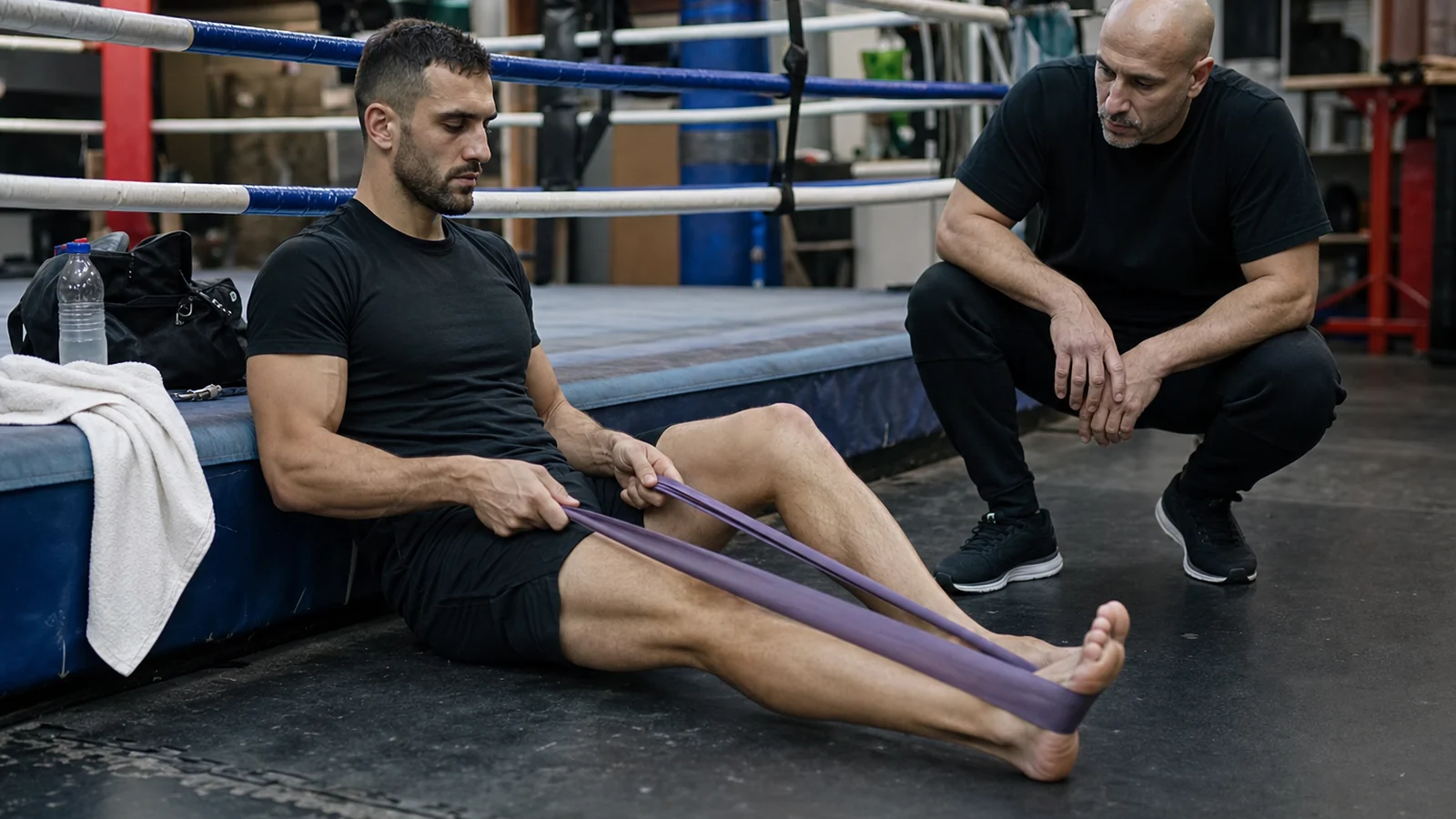
Rehab should be clinician-led if symptoms are significant, persistent, unusual or severe. The outline below is not a personalised plan. It is a boxing-specific way to think about progression.
Phase 1: settle symptoms and protect the area
The first job is to stop aggravating the ankle or Achilles.
That usually means no skipping, no bouncing footwork, no running, no hard pivots, no fast exits and no sparring movement. If walking is painful, boxing footwork is not the next test.
For a possible rupture, fracture, major sprain or severe pain, follow medical advice rather than using this article as a training plan.
Phase 2: restore normal walking and daily movement
Before boxing matters, walking matters.
Can you walk without limping? Can you go upstairs and downstairs without protecting the side? Can you stand in stance without shifting away from the sore ankle? Can you move around the gym floor without thinking about every step?
NHS Inform says ankle sprain recovery should generally show improvement in movement and swelling during the first 0-2 weeks, with standing and walking becoming easier. By 2-4 weeks, walking should be back to normal and movement should be almost 100 per cent, though every soft tissue injury can differ (source).
Those are not promises. They are reference points. If walking is not normal, footwork will usually be abnormal too.
Phase 3: rebuild strength, balance and ankle control
This is where many boxers rush.
A healthcare professional may use progressive strengthening, balance and co-ordination work. NHS Inform describes ankle sprain rehabilitation goals as improving muscle strength, joint stability, balance and co-ordination (source).
For a boxer, that matters because stance is not just strength. It is knowing where the foot is while the upper body moves, the head moves, and the opponent or coach gives new information.
Phase 4: reintroduce boxing stance without bounce
Start with quiet feet.
Short shadowboxing rounds can return before skipping. Use slow stance resets, step-and-slide movement, gentle weight transfer, straight punches without overreaching, and planned pivots only if the ankle and Achilles tolerate them.
If the first round changes how you walk afterwards, the load was too high.
Phase 5: add controlled pivots and light rhythm
When walking, strength, balance and slow footwork are comfortable, you can gradually rebuild boxing rhythm.
Useful stepping stones may include:
- low-bounce footwork rounds
- controlled forward and backward steps
- planned quarter-pivots
- short rope-free rhythm drills
- light shadowboxing with deliberate stance resets
- very small amounts of skipping only if tolerated
Skipping should be treated as training, not just a warm-up. For a recovering ankle or Achilles, every contact counts.
Phase 6: return to pads, bag work and sparring movement
Pads and bag work add reaction, impact and fatigue. Sparring adds unpredictability.
Return in layers:
- technical shadowboxing with no bounce
- light pads with controlled feet
- bag work with planned stance and low volume
- longer rounds before harder rounds
- controlled pivots before reactive pivots
- speed before power
- sparring movement last
If the ankle feels unstable, if Achilles pain rises during the session, or if symptoms are worse the next morning, step back. The body is giving you useful information.
Recovery timelines: useful, not guaranteed
NHS guidance gives broad reference points, not guarantees.
For sprains and strains, the NHS says most feel better after about two weeks, strenuous exercise may need to be avoided for up to eight weeks, and severe sprains and strains can take months to return to normal (source).
For ankle sprain, NHS Inform gives a general rehabilitation guide: 0-2 weeks for movement and swelling to improve, 2-4 weeks for walking to return to normal and movement to be nearly restored, and 8-12 weeks for day-to-day activities to begin returning to normal (source).
For Achilles tendinopathy, NHS Inform says managing it can take time, in most cases several months or more (source).
For Achilles rupture, Cambridge University Hospitals NHS Foundation Trust describes treatment pathways that can involve a boot and rehabilitation over weeks, with symptoms taking several months to fully settle (source).
The boxing takeaway is simple: pain-free walking is not the finish line. Boxing asks for push-off, braking, balance, rhythm, pivoting, reaction and fatigue. Build back to those in order.
How to reduce recurrence
No injury prevention list can make ankles and Achilles tendons invincible. But you can remove obvious risks.
Practical steps:
- Warm up before hard footwork.
- Build skipping volume slowly.
- Treat bouncing as load, not decoration.
- Learn to pivot on the ball of the foot without twisting the knee or collapsing the ankle.
- Keep stance width honest, especially when tired.
- Do not cross the feet during basic lateral movement.
- Use footwear that lets you pivot without sliding or gripping aggressively.
- Replace shoes when soles collapse or become unpredictable.
- Add running, sprints, hills and plyometrics gradually, not all in the same week.
- Tell the coach if your ankle feels unstable.
- Do not use sparring to test whether an injury has healed.
Our guide on whether beginners need boxing boots goes deeper on footwear. The simple version is that shoes should help you move, stop, pivot and feel the floor. If they fight the movement, the ankle usually pays before the hands do.
Return-to-boxing checklist
Before returning to full boxing movement, ask:
- Can I walk normally without limping?
- Can I go upstairs and downstairs without protecting the ankle?
- Can I stand in boxing stance without shifting away from one side?
- Can I slowly step forward, back and sideways without pain changing my movement?
- Can I pivot gently without the ankle feeling unstable?
- Can I push off without Achilles pain rising?
- Can I complete light shadowboxing without symptoms worsening later?
- Can I tolerate controlled pads before bag work?
- Can I finish the next morning without a flare-up?
- Have I followed medical or physio advice if the injury was significant?
Sparring movement comes last. It is reactive, messy and harder to dose. A boxer who cannot control planned footwork has no business testing an ankle or Achilles in unpredictable rounds.
Where H&G coaching fits
Good coaching cannot diagnose an ankle sprain or Achilles problem. It can reduce the chances of turning a small issue into a bigger one.
At Honour & Glory, that means watching how people move, not just how hard they work. If your footwork is becoming loose, if you are twisting instead of pivoting, if your stance is collapsing because you are tired, or if you are trying to skip through pain, the right answer may be a correction, a regression or stopping the drill.
If you are healthy enough to train and want coach-led boxing that builds footwork properly, start with our adult recreational boxing classes or book a free trial class. If your ankle or Achilles symptoms are severe, worsening, unusual or not improving, get medical advice first. The gym can wait. Your base matters.
H&G Team
Writer at Honour & Glory Boxing Club, a community boxing gym in Kidbrooke, South East London.
KEEP READING
Knee Pain in Boxing: Footwork, Squats, Pivots and Return to Training
A careful boxing guide to knee pain: why stance, pivots, skipping, running and conditioning can overload the knee, NHS-backed warning signs, rehab phases and return to boxing.
Lower Back Pain in Boxing: Rotation, Bag Work and Return to Training
A careful boxing guide to lower back pain: why rotation, fatigue, hip stiffness and load spikes can irritate the back, NHS red flags, rehab phases and return to boxing.
Elbow Pain in Boxing: Hyperextension, Bag Work and Return to Punching
A careful boxing guide to elbow pain: why missed punches, bag work, gripping, tendon overload and hyperextension can irritate the elbow, NHS-backed warning signs and return to boxing.
Was this page helpful?
It takes one tap, and it genuinely helps.
Choose your next step
Turn this article into the right action
Some readers are ready to book. Some need the class route first. Pick the route that matches what you actually want.