Knee Pain in Boxing: Footwork, Squats, Pivots and Return to Training
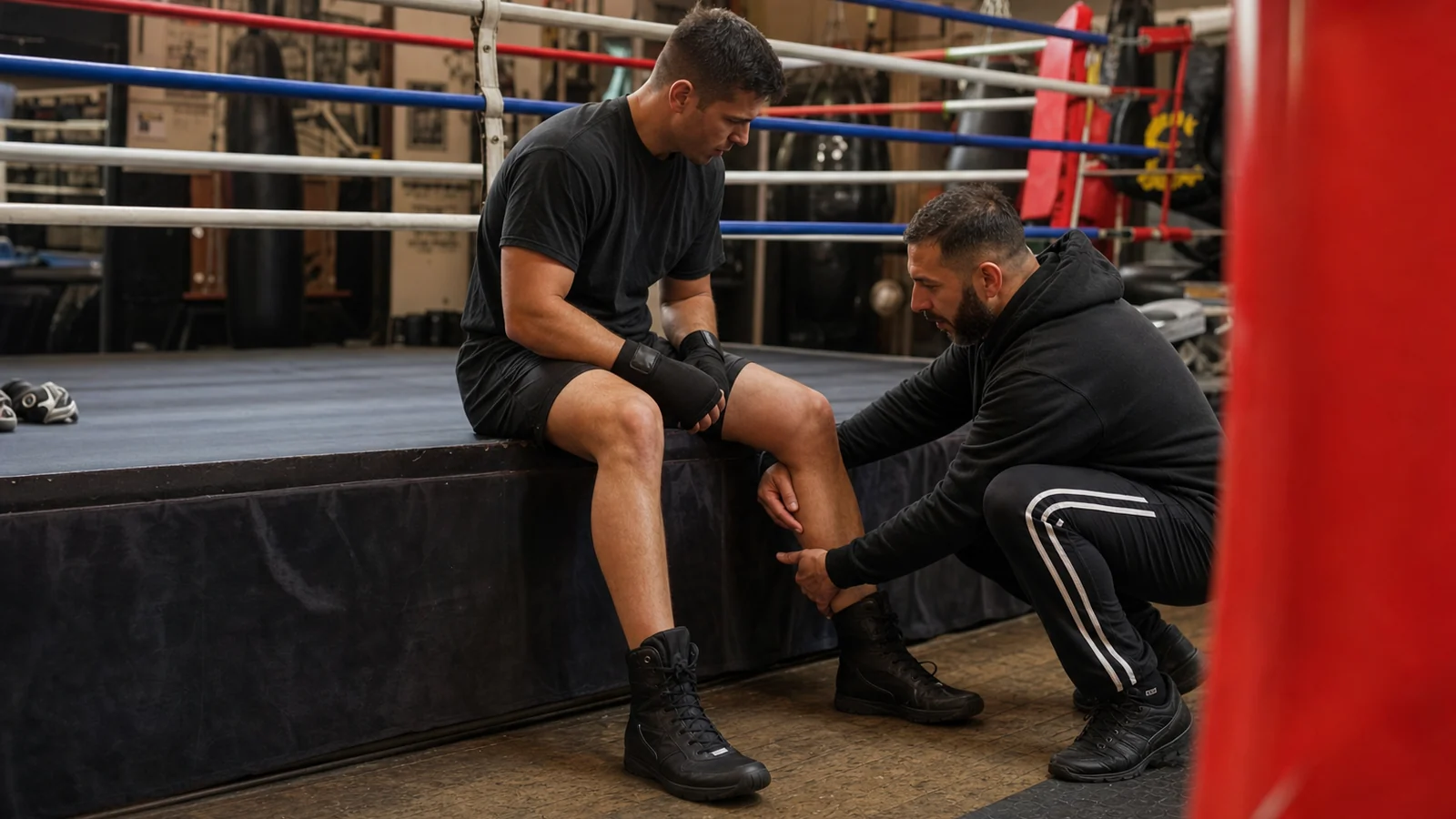
Knee pain in boxing can be confusing because the knee is rarely working alone.
A boxer might blame the knee after skipping, roadwork, squats, pivots, sparring movement or a single awkward twist. Sometimes the problem is a clear injury. Sometimes it is a training-load problem that has been building quietly: more running, deeper conditioning, more footwork rounds, more bag work on tired legs, and then a knee that starts complaining every time you bend, pivot or push off.
This is general information for boxers, not a diagnosis or medical advice. Stop training and speak to a qualified clinician if symptoms are severe, worsening, unusual, or not improving. For urgent symptoms, use NHS 111, A&E or 999 as appropriate.
This guide is part of our common boxing injuries series. It explains why knee pain can happen in boxing, what warning signs matter, how common knee problems differ, and why return to boxing normally needs to rebuild normal walking, stairs, squats, footwork and pivots before harder rounds.
The short version: if your knee is very painful, badly swollen, changed shape, locked, giving way, hot and red, cannot take weight, or swells quickly after a twist, stop training and get medical advice. Do not try to prove the knee is fine by doing one more round of skipping.
Why knees matter in boxing
Boxing is not a knee-dominant sport in the way football, netball or basketball can be, but the knee still works constantly.
In boxing, the knee helps you:
- hold stance without locking the legs
- bend and spring without bouncing wildly
- step in and out of range
- pivot without twisting the joint badly
- absorb force when you throw and miss
- squat, duck, slip and roll under control
- skip, run and condition outside class
- stay balanced when tired or under pressure
The knee sits between the hip and the ankle. If the hip is stiff, the foot collapses, the ankle is sore, or the boxer is tired, the knee often becomes the place where poor load shows up.
The NHS knee pain page says knee pain has many possible causes and warns readers not to self-diagnose. It lists sprains and strains after twisting or overuse, tendonitis below the kneecap, torn ligament, tendon or meniscus problems when the knee gives way, locks or cannot straighten, and dislocated kneecap after collision or sudden change of direction (source).
In boxing terms, that means the same symptom, "my knee hurts", can point to several different problems. Coaching can modify training, but diagnosis belongs with a qualified clinician.
Why boxing can expose knee pain
Most knee pain in a recreational boxing gym is not from one dramatic punch. It is often from the things around boxing: footwork, skipping, running, conditioning and sudden load jumps.
Common boxing scenarios include:
- too much skipping too soon
- adding roadwork or sprints on top of boxing
- deep squats, lunges or burpees when the knee is already irritated
- pivots on sticky flooring
- twisting the knee while the foot stays planted
- boxing boots or trainers that change how the foot grips
- stance too wide, too narrow or too upright for the athlete
- repeatedly ducking and rolling without hip control
- sparring movement that is faster and less predictable than drills
- returning after time off and training at old volume
- doing leg strength, running and hard boxing in the same week without recovery
NHS Inform says knee problems can cause pain, stiffness and swelling, and that new knee pain or a flare-up of a long-standing problem should often begin to settle within six weeks. It also says keeping the body moving is an essential part of treatment and recovery, while temporarily avoiding sports and heavy lifting until there is less discomfort and good movement (source).
That fits the boxing pattern. Complete rest is rarely the long-term answer for a minor irritation, but pushing through hard boxing too early can keep the knee angry.
A 2022 systematic review of amateur boxing injuries found that training injuries are much less frequent than competition injuries overall, but that training injuries were often sprains and strains (source). Knee pain is not the headline boxing injury, but sprains, strains and load-related problems are believable in the training room.
Not all knee pain is the same
Boxers often use one phrase for several different knee problems: sore knee, dodgy knee, twisted knee, jumper's knee, runner's knee, swelling, clicking.
The distinction matters because the safe next step changes.
Front-of-knee pain
Pain around or below the kneecap can show up during squats, stairs, skipping, lunges, stance work or getting up after sitting. It may be linked with how the kneecap and thigh muscles tolerate load, but it still needs context.
The NHS knee pain page lists pain between the kneecap and shin, often caused by repetitive running or jumping, as a pattern that can suggest tendonitis (source). NHS Ayrshire & Arran describes patellar tendinopathy, sometimes called jumper's knee, as a soft-tissue injury affecting the tendon at the front of the knee below the kneecap. It says recovery can vary, structured exercise can take around 12 weeks to show a great improvement, and some people may take over six months to improve (source).
For boxers, front-of-knee pain can be exposed by skipping, repeated bounce, running, squat-heavy conditioning, or trying to stay low in stance for longer than the legs can currently manage.
Twisting pain, locking or giving way
A sharp twist is different from a gradual ache.
The NHS meniscus tear page says a meniscus tear usually happens when you twist the knee while playing sport, though it can also happen from more minor twisting. Symptoms can include knee pain or tenderness, stiffness or swelling, difficulty bending or straightening, the knee giving way, and crunching or clicking (source).
In boxing, this might happen when the foot sticks and the body turns, when a boxer pivots late, when they slip awkwardly under a shot, or when sparring movement forces a sudden direction change.
A painless click is common and not automatically a crisis. A knee that locks, gives way, swells or painfully clicks is different.
Sprain or strain around the knee
The NHS says sprains and strains can affect the knee and are likely when there is pain, tenderness, weakness, swelling or bruising, difficulty using the area normally, or muscle spasm. It says sprains are torn or twisted ligaments, while strains are overstretched or torn muscles (source).
For boxing, this can follow a twist, poor landing, awkward footwork, tired legs, or a conditioning movement done past control.
Kneecap dislocation or major trauma
A dislocated kneecap is not a gym decision.
The NHS says a dislocated kneecap is where the kneecap moves out of place, usually after injury, and advises medical advice as soon as possible if you think it has happened. It advises 111 if an injured knee is very painful, swollen or bruised, cannot be stood on or moved, or if you think the kneecap dislocated and moved back. It advises A&E if the knee has changed shape, becomes very swollen very quickly, a pop or snap was felt, bone is visible, or there is heavy bleeding (source).
That is not something to tape up and test on the bag.
When to stop boxing immediately
Stop the session if knee pain changes how you move.
That includes:
- limping
- guarding the knee during stance
- avoiding pivots because they feel unsafe
- pain that gets sharper as the round continues
- swelling during or after training
- a twist followed by pain or instability
- the knee locking or giving way
- inability to put normal weight through the leg
- a pop, snap or crack during injury
- heat, redness or feeling unwell with knee pain
A useful coaching rule: if the knee changes your footwork, the boxing session has already changed. Do not pretend it is still a normal class.
You can usually modify a session before it becomes a bigger problem. That might mean no skipping, no running, no sparring, no pivots, no squats and no bag rounds where the stance collapses. But if the knee is severe, unstable, swollen or traumatic, modification is not enough. Stop and get advice.
When to get medical help
Use NHS guidance, not gym bravery.
See a GP, physio or MSK service if
The NHS advises seeing a GP if knee pain does not improve within a few weeks (source). The meniscus tear page advises GP help if knee pain stops normal activity, affects sleep, is getting worse or keeps coming back, symptoms have not improved after home care, or the knee is stiff for more than 30 minutes after waking (source).
NHS pages also note that in many areas you may be able to refer yourself to community MSK services such as physiotherapy without needing a GP referral.
For a boxer, that means recurring knee pain is worth taking seriously even if you can still train. If the same knee complains every week, the answer is not just a stronger mindset.
Use NHS 111 or urgent care if
The NHS knee pain page advises 111 if the knee is very painful, cannot move or take weight, is badly swollen or has changed shape, locks, gives way or painfully clicks, or if there is a very high temperature with redness or heat around the knee (source).
NHS Inform advises 111 for significant trauma within the last seven days, a misshapen knee after injury, inability to put any weight through the leg, immediate swelling after a twisting injury, or infection signs such as very high temperature, shivering, redness or heat around the knee (source).
Go to A&E or call 999 if
The NHS meniscus tear page advises A&E if the knee has moved out of place, changed shape or points at an odd angle, if you heard a crack during injury, or if there is tingling or no feeling in the knee, leg or toes (source).
For suspected kneecap dislocation, the NHS says to go to A&E if the knee has changed shape, becomes very swollen very quickly, you felt a pop or snap, bone is visible, or bleeding is heavy, and to call 999 if you cannot get to A&E because you cannot move the injured leg due to pain (source).
If you are unsure, use NHS 111.
What treatment often looks like
Treatment depends on the cause.
For minor sprain or strain patterns, the NHS recommends PRICE for the first two to three days: protection, rest, ice, compression and elevation. It says most sprains and strains feel better after about two weeks, but strenuous exercise such as running may need to be avoided for up to eight weeks because of the risk of further damage, and severe sprains and strains can take months to return to normal (source).
For tendon problems, the NHS tendonitis page says mild tendon injury can usually be treated at home and should feel better within two to three weeks. It advises rest from aggravating tendon movement for the first two to three days, ice, support, then gentle movement once pain is not stopping you. It also says to avoid playing sport until the tendon has recovered and to get 111 help if you are in a lot of pain or think you have ruptured a tendon (source).
For meniscus tears, the NHS says some can get better on their own, but physiotherapy may be recommended to reduce pain and improve movement and strength, and severe damage may need arthroscopy surgery (source).
For a boxer, the practical point is simple: treatment is not the same for every knee. A gradual front-of-knee load problem, a twist with swelling, and a kneecap that changed shape are different situations.
What rehab often looks like for boxing
Rehab should be led by an appropriate clinician when symptoms are significant, persistent or uncertain. The boxing side is about respecting stages.
A sensible return usually moves through phases like this:
- Normal daily walking without a limp.
- Stairs and getting up from a chair without the knee feeling unsafe.
- Basic range of motion and strength work within clinical guidance.
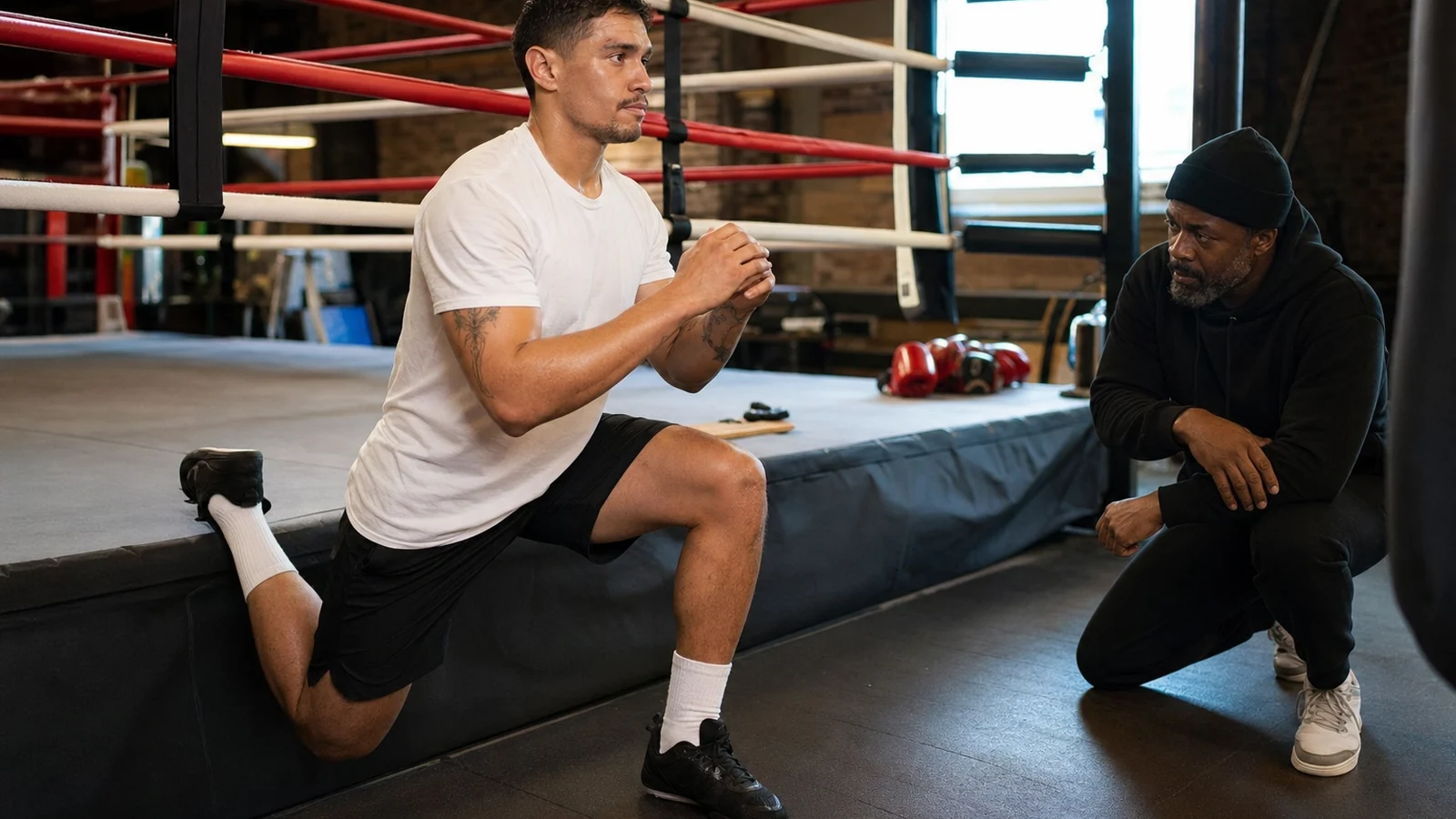
- Controlled squats, step-downs or split-stance patterns if appropriate.
- Shadowboxing without pivots or bounce.
- Slow step-and-slide footwork.
- Gentle pivots, only when the knee tolerates rotation.
- Light pads without hard drive through the legs.
- Controlled bag work with reduced round length and intensity.
- Faster direction changes and conditioning, introduced carefully.
- Sparring or contact only after the knee tolerates the earlier steps reliably.
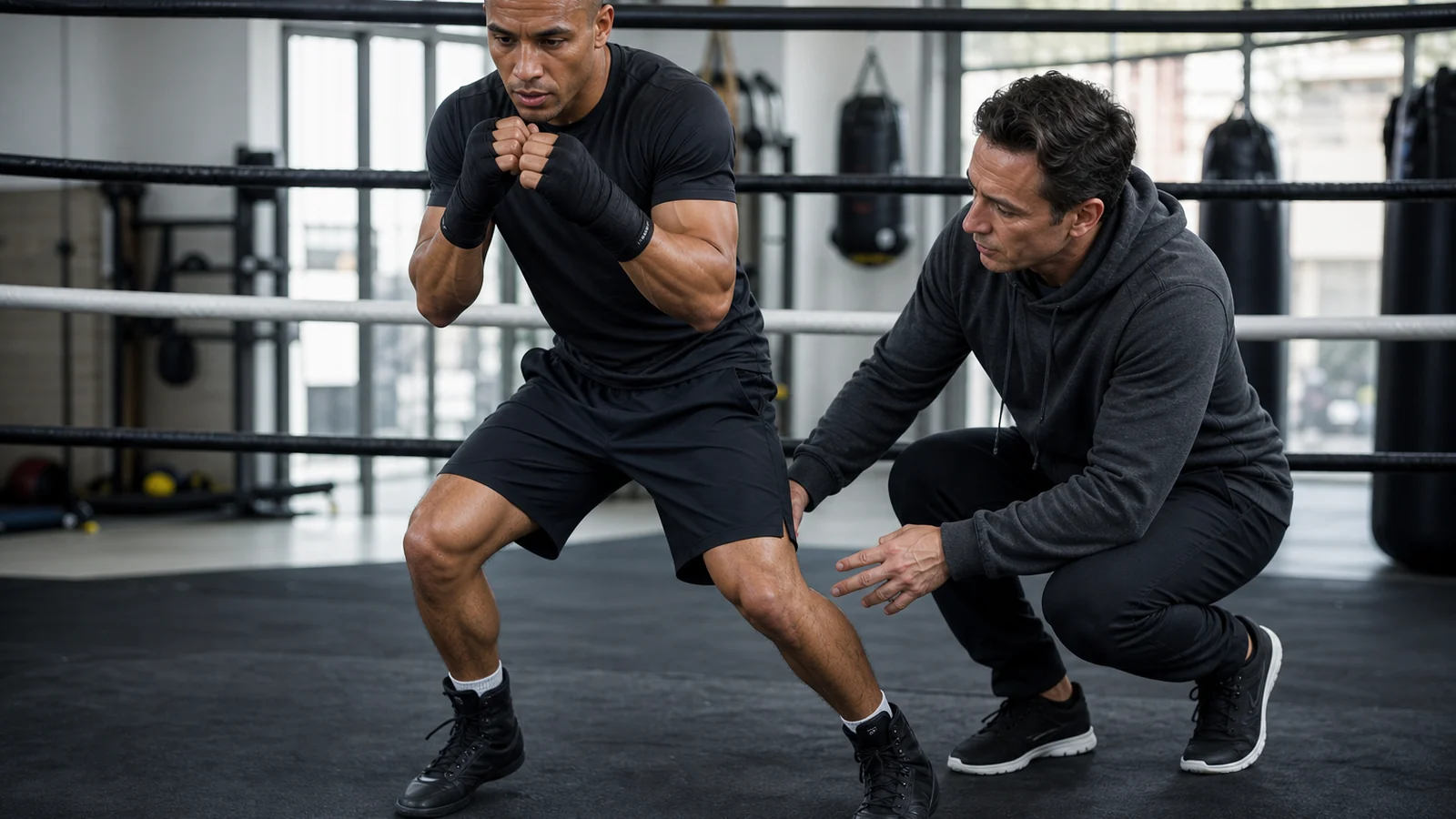
The mistake is returning when straight-line walking feels fine but boxing movement is not ready. Boxing asks the knee to bend, rotate, brake, absorb and push. That needs more than "it does not hurt sitting down".
Boxing modifications while the knee settles
If symptoms are mild and you have no red flags, a coach may be able to modify training while you get the right advice.
Useful modifications can include:
- no skipping for now
- no running warm-up
- no burpees, squat jumps or lunge circuits
- no fast pivots
- no sparring
- no deep slips or rolls
- shorter rounds
- more upper-body technical work
- shadowboxing with small steps only
- pads from a stable stance, not chasing the pad holder
- focus on guard, punch path, breathing and rhythm rather than power
This is not a workaround for serious symptoms. It is a way to keep suitable people training safely while reducing the load that is irritating the knee.
How to reduce the chance of knee pain coming back
You cannot remove every injury risk from boxing, but you can reduce avoidable knee load.
Start with these basics:
- increase skipping gradually
- do not add running, sprints and hard boxing all at once
- warm up before fast footwork
- keep stance athletic, not locked out
- let the hip and ankle move rather than twisting only through the knee
- avoid pivoting hard on sticky surfaces
- wear shoes or boots that suit the session
- build leg strength gradually
- keep conditioning quality high rather than chasing exhaustion
- tell the coach early if the knee starts changing your movement
Our broader guide to how to prevent boxing injuries covers warm-ups, equipment, sparring control and technique habits. Our guide to boxing and injury prevention long term goes deeper on how to train consistently without stacking too much load too quickly.
Return-to-boxing checklist
Before returning to harder boxing after knee pain, you should be able to answer yes to the right questions for your situation.
A conservative checklist:
- Can you walk normally without a limp?
- Can you go up and down stairs without the knee feeling unsafe?
- Can you bend and straighten the knee without pain stopping you?
- Has swelling settled?
- Does the knee feel stable rather than giving way?
- Can you squat or sit-to-stand within your current range without flare-up?
- Can you shadowbox from stance without guarding the knee?
- Can you step forward, back and sideways slowly without symptoms increasing?
- Can you pivot gently without the knee feeling twisted or unstable?
- Can you do light pads before bag work?
- Can you do bag work before conditioning or sparring?
- Have you had medical or physio clearance if the injury was significant, traumatic or persistent?
Only then should harder rounds, faster footwork, conditioning and sparring come back into the conversation.
What a good boxing coach should do
A coach does not diagnose knee pain, but a good coach should notice when movement changes.
They should be willing to:
- stop a round when the boxer starts limping
- remove skipping, running, pivots or sparring when appropriate
- reduce impact and intensity
- check whether stance or footwork is contributing
- encourage medical advice when symptoms are not normal
- keep ego out of injury decisions
They should not tell you to "run it off", test a swollen knee on the bag, or keep sparring when the knee feels unstable.
At Honour & Glory, beginners and recreational adults can train in a coached environment where technique, pacing and sensible progression matter. If you are healthy enough to train and want to build boxing skill without guessing your way through every session, our adult recreational boxing classes are a good place to start. You can also book a free trial and speak to a coach before class about any training limitations.
If your knee is currently painful, swollen, unstable, locked or not improving, deal with that first. The gym will still be here when the knee is ready.
H&G Team
Writer at Honour & Glory Boxing Club, a community boxing gym in Kidbrooke, South East London.
KEEP READING
Lower Back Pain in Boxing: Rotation, Bag Work and Return to Training
A careful boxing guide to lower back pain: why rotation, fatigue, hip stiffness and load spikes can irritate the back, NHS red flags, rehab phases and return to boxing.
Ankle Sprains and Achilles Pain in Boxing: Footwork, Warning Signs and Return to Training
A careful boxing guide to ankle sprains and Achilles pain: why footwork, pivots and skipping can overload the lower leg, NHS-backed warning signs, rehab phases and return to boxing.
Elbow Pain in Boxing: Hyperextension, Bag Work and Return to Punching
A careful boxing guide to elbow pain: why missed punches, bag work, gripping, tendon overload and hyperextension can irritate the elbow, NHS-backed warning signs and return to boxing.
Was this page helpful?
It takes one tap, and it genuinely helps.
Choose your next step
Turn this article into the right action
Some readers are ready to book. Some need the class route first. Pick the route that matches what you actually want.