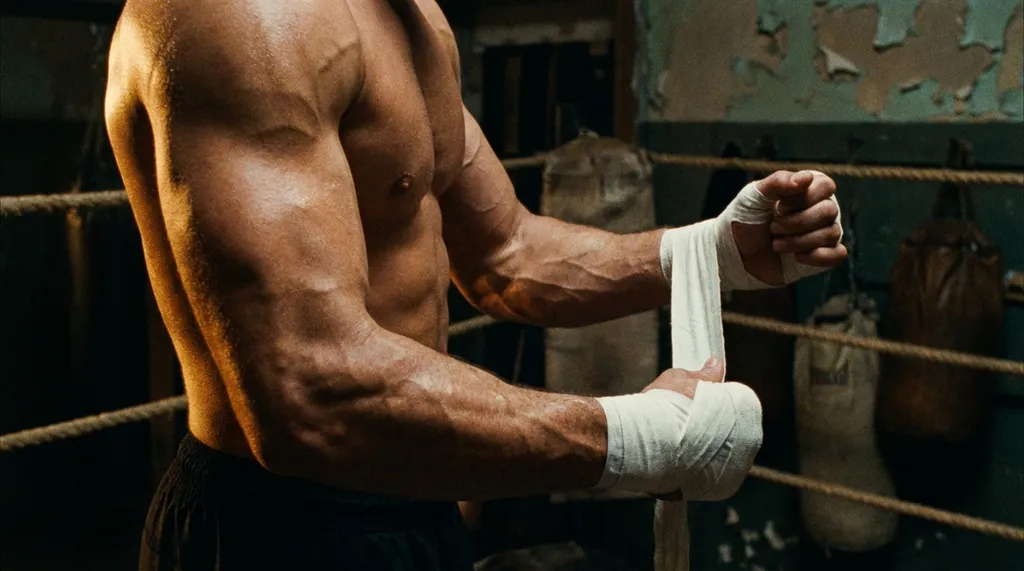
The question comes up constantly: will boxing give me bigger arms? The answer is more interesting than a simple yes.
Boxing will not give you bodybuilder arms. It will give you arms that are defined, functional, and visibly athletic. The kind of arms that look like they belong to someone who actually uses them. The difference matters, and understanding it will save you from training the wrong way.
How boxing uses your arms
When you throw a punch, the power starts in your legs and travels through your core. The arm is the delivery system, not the engine. This means your arms are doing something very different from a bicep curl.
Triceps: the punch muscle
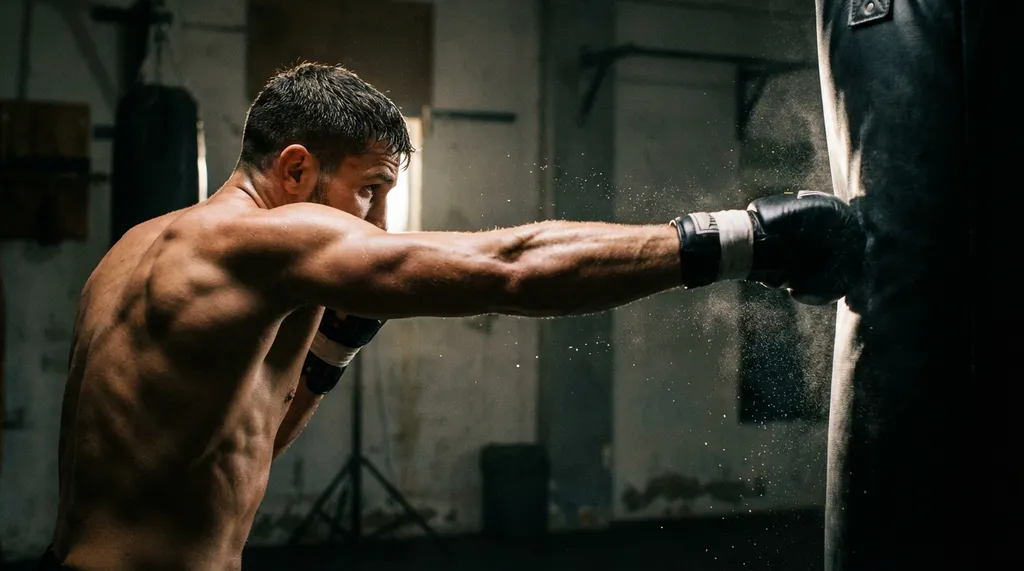
Your triceps extend your arm. Every jab, cross, hook, and uppercut involves rapid tricep extension. A straight right cross is essentially a horizontal tricep extension under load, delivered at speed, against resistance.
A 2016 study in the Journal of Strength and Conditioning Research found that punching movements produced significant tricep activation, with the rear hand cross generating the highest levels. The tricep is the primary arm muscle in boxing.
This means boxers develop defined, hard triceps without ever doing a tricep pushdown. The training stimulus comes from hundreds of full-speed arm extensions per session, which builds endurance-strength rather than bulk.
Shoulders (deltoids): the guard muscle
Hold your hands up at chin height for three minutes. Now do it while moving, throwing, and defending. That is a boxing round, and your deltoids are the muscles keeping your guard in position.
The anterior (front) deltoid fires on every punch. The medial (side) deltoid stabilises the arm during hooks and uppercuts. The posterior (rear) deltoid decelerates the arm after each punch to prevent hyperextension.
Boxing shoulders are distinctive. They are capped, rounded, and defined without being massive. This comes from the combination of sustained isometric work (holding the guard) and dynamic work (throwing). No isolation exercise replicates this combination.
Biceps: the overlooked role
The biceps are not the primary movers in boxing. They do not extend the arm (that is the triceps) and they do not rotate the torso (that is the core). But they do two things that matter:
First, they decelerate the arm after a punch. When you throw a jab at full speed, something has to stop your arm from hyperextending at the elbow. That is your bicep, contracting eccentrically at high speed. Eccentric contractions are the most effective stimulus for muscle growth, which is why boxers develop lean, defined biceps despite never doing curls.
Second, they contract during uppercuts. The uppercut is essentially a standing bicep curl delivered with force and rotation. It is the one punch where the bicep is a primary mover.
Forearms: the grip and snap
Forearm development in boxers is distinctive and comes from two sources. First, making a fist: clenching your hand hundreds of times per session builds the finger flexors and wrist stabilisers. Second, the wrist snap on impact, which develops the forearm extensors.
Combined, this produces forearms that are visibly corded and functional. Grip strength in experienced boxers is significantly higher than in untrained individuals, which has carry-over to every other physical activity.
Boxing arms vs gym arms
The difference is visible. Gym arms are typically larger in circumference because hypertrophy training (heavy weights, low reps) maximises cross-sectional muscle area. Boxing arms are leaner, more defined, and more balanced between the muscle groups.
A bodybuilder typically has dominant biceps because most gym routines are curl-heavy. A boxer has dominant triceps and shoulders because the sport demands extension and stabilisation, not flexion.
Neither is better. They are different training outcomes. But if your goal is arms that look athletic, defined, and proportional rather than inflated, boxing produces that result naturally without ever picking up a dumbbell.
The speed bag effect
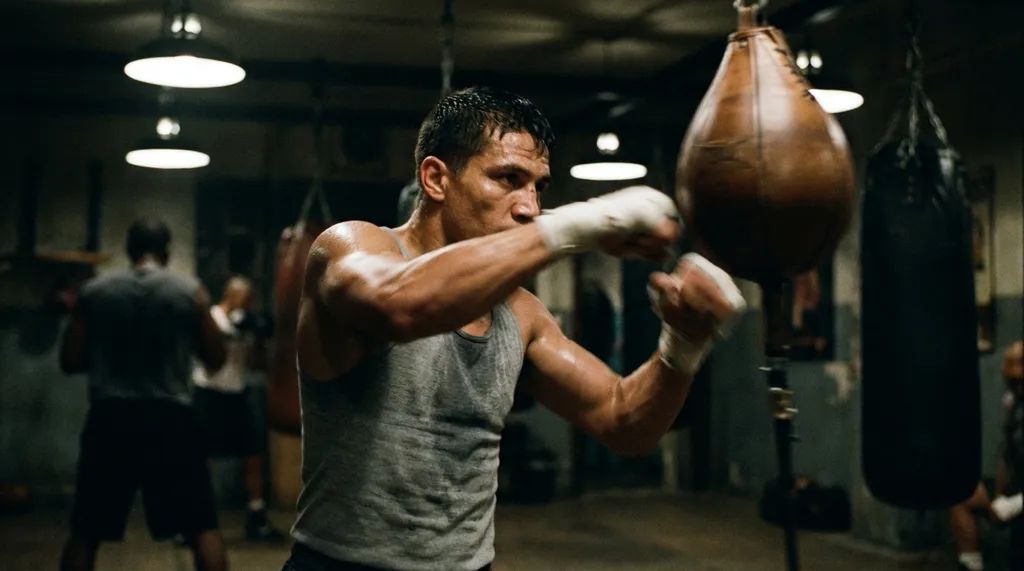
The speed bag is worth mentioning specifically. Three minutes of speed bag work is one of the most effective shoulder endurance exercises available. Your arms are elevated, moving rapidly, and sustaining constant tension. The metabolic burn in the deltoids is intense.
Over weeks, this develops the round, capped shoulder shape that is characteristic of boxers. It also builds forearm endurance and hand-eye coordination, making it one of the most efficient exercises in any sport.
What you can expect
If you train boxing three times per week for 12 weeks:
- Weeks 1-3: Your shoulders ache after every session. This is the guard muscles adapting. Forearms feel tight from making a fist repeatedly.
- Weeks 4-6: Shoulder definition becomes visible, particularly the anterior deltoid. Triceps start to feel harder. Forearms develop visible tendons.
- Weeks 8-12: Arms look noticeably different in a mirror. More defined, leaner, with clear muscle separation. Shirt sleeves fit differently.
This happens without a single bicep curl, tricep pushdown, or lateral raise. The training itself provides the stimulus.
The practical path
Honour and Glory runs boxing sessions for all levels. If you have never boxed before, your first session is free. You do not need equipment, experience, or a gym background.
If you want arms that look like they belong to an athlete rather than a gym ornament, come and throw some punches. Most people feel the difference in their arms after a single session. The sustained shoulder work and the tricep activation from punching are unlike anything a weights routine provides. Your arms will figure out the rest.
For overall conditioning alongside arm development, our strength and conditioning article covers what to add outside the gym. And our nutrition programme covers fuelling for muscle development properly.
H&G Team
Writer at Honour & Glory Boxing Club, a community boxing gym in Kidbrooke, South East London.
KEEP READING
Boxing Body Transformation: What 12 Weeks Actually Changes
Twelve weeks of boxing does not produce one kind of result. It produces several, arriving at different times and in an order that surprises most beginners.
Boxing and Abs: How Boxing Builds a Six Pack
Boxing works your abs harder than most gym routines. Here is exactly how it happens, which muscles are involved, and why crunches are the wrong approach.
Does Boxing Build Muscle? What to Expect
Will boxing training build muscle? Yes, but probably not the kind you are imagining. Here is what actually happens to your body when you train boxing regularly.
Was this page helpful?
It takes one tap, and it genuinely helps.
Choose your next step
Turn this article into the right action
Some readers are ready to book. Some need the class route first. Pick the route that matches what you actually want.