Plyometric Training for Boxing: Build Punch Power From the Ground Up

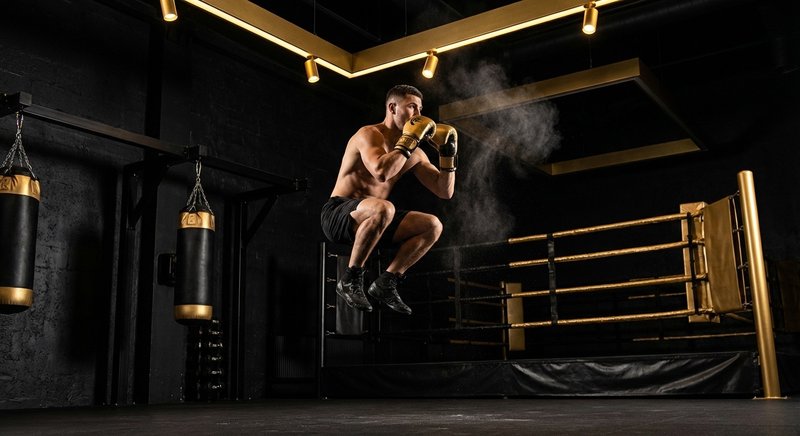
If you've ever watched a boxer land a shot that drops someone, the power didn't come from big arms. It came from the ground up - legs, hips, core - all firing in one explosive chain. Plyometric training for boxing is how you build that chain.
Most gym members skip plyometrics. Either they don't know what they are, or they assume they're only for professional fighters. Neither is true. These exercises work by training your nervous system to produce force quickly - which is exactly what boxing demands every time you throw a punch.
What plyometrics actually do for punch power
Plyometrics exploit what's called the stretch-shortening cycle. When you jump down from a box and immediately spring back up, your muscles load like a spring on the way down, then release that stored energy on the way up. The faster you can do that transition - the amortisation phase - the more power you generate.
Boxing Science, a UK sports science organisation that works with professional fighters, found that jump height correlates strongly with punch force. The higher you can jump, the harder you tend to punch. Both require the same explosive quality from your legs and hips, delivered through the same kinetic chain.
Research backs this up. An 8-week plyometric programme produced a 25% increase in punch impact force in one study. A separate trial with adolescent boxers recorded a 17.54% increase in punching force using high-intensity plyometric work. The same 8-week programme improved punch velocity by around 12%. Those are real numbers for anyone who spars or competes.
For fitness boxers who just want to get more out of their sessions, the benefits show up differently - faster hands on the pads, better movement around the ring, snappier starts to combinations.

The exercises worth adding to your training
You don't need specialist equipment. Most plyometric drills need nothing more than your bodyweight and a bit of space - though a plyometric box helps if you have access to one.
Box jumps are the best starting point. Stand in front of a box roughly knee height, bend your knees, and jump onto it with both feet landing softly. Step back down, reset, repeat. The key is landing soft - you're absorbing force, not smashing the box. Start with 3 sets of 8. Once comfortable, progress to depth jumps: step off the box, land, and immediately spring upward. That's where the real stretch-shortening cycle work happens.
Squat jumps are simpler to set up. Start in a squat, explode straight up as high as you can, land soft, reset. Three sets of 10 is a solid starting target. These train the same leg and hip chain that drives your rear-hand cross.
Clap push-ups move the work to your upper body. Lower yourself, then explode hard enough for your hands to leave the floor. You're building reactive strength in your chest and shoulders that contributes to punch speed. Not there yet? Use an elevated surface to reduce load while you build up.
Medicine ball slams are often overlooked. Hold a ball overhead, step slightly forward, and throw it into the ground as hard as you can. The rotational version - swinging the ball diagonally from hip to floor - trains the rotation pattern of a cross or hook directly. Three sets of 8 per side.
Lateral bounds mimic the side-to-side footwork used constantly in the ring. Jump from one foot to the other, covering as much ground laterally as possible per bound. Land on a single foot, stabilise briefly, then go again. These build reactive strength in your hips and ankles - the same qualities that help you cut angles and change direction sharply.
Pogo jumps are a warm-up staple. Short, fast, springy jumps using mostly your ankles and calves. Think of them as waking up your nervous system before heavier work.
How to fit plyometric training into a boxing programme
The most common mistake is doing too much too soon. Plyometrics are demanding on tendons and joints even when exercises look simple. The loading is higher than it appears.
Two sessions a week is enough for most people starting out. Keep volume low: 3 sets of 6-8 reps for power-focused exercises, slightly more for speed drills. Rest 60-90 seconds between sets. The goal is maximum quality on every rep, not chasing tiredness.
Do plyometrics at the start of a session - after a warm-up but before boxing work. Your nervous system performs best when fresh. Doing them after pads or bag rounds drops quality and raises injury risk.
After 4-6 weeks of consistent training, progress by increasing box height, reducing ground contact time, or adding single-leg variations. Single-leg work matters for boxers because so much of ring movement involves pushing off one foot. A single-leg box jump challenges hip stability in ways that double-leg work can't replicate.
What to expect
Progress takes time. You probably won't feel your punch change after week one. After 8 weeks of consistent work - two sessions a week, done properly - most people notice it in their pad sessions. Combinations start with more snap. You move faster off the mark. Your legs recover more quickly between bursts.
At H&G in Kidbrooke, members who add plyometric work to their regular training tend to move better and punch crisper after a couple of months. Not because they've suddenly developed stronger arms, but because the ground-to-fist chain is working more efficiently. The power was always there - the plyometrics just helped access it.
One thing worth knowing: plyometrics don't replace the fundamentals. They sit alongside heavy bag work, pad sessions, skipping, and general strength training. They're a useful addition to solid boxing training, not a shortcut around it.
A simple starting plan
If you're new to boxing or the gym, hold off on plyometrics for the first couple of months. Build a base of strength, movement, and technique first. Adding explosive load before you've got basic control tends to entrench poor mechanics.
Once you've got a couple of months of consistent training, this is a workable starting protocol:
- 2 minutes skipping warm-up
- Pogo jumps: 2 x 15
- Squat jumps: 3 x 8
- Box jumps: 3 x 6 (full reset between each rep)
- Lateral bounds: 3 x 8 per side
That's about 20 minutes of work, twice a week. Done consistently over two to three months, it makes a noticeable difference to how you move and punch.
Plyometric training for boxing works. The research is solid, the application is straightforward, and the results show up in the ring. It just takes doing it consistently - which, honestly, is the same story with most good training.

H&G Team
Writer at Honour & Glory Boxing Club, a community boxing gym in Kidbrooke, South East London.
Was this page helpful?
It takes one tap, and it genuinely helps.
Choose your next step
Turn this article into the right action
Some readers are ready to book. Some need the class route first. Pick the route that matches what you actually want.