
Walk into any boxing gym and within thirty seconds you will hear music. Not background music - present music. Music that is part of the training environment, not decoration.
This is not arbitrary. The connection between boxing and music is functional, not aesthetic, and understanding it makes you a better user of both.
The Neurological Basis
Costas Karageorghis has spent thirty years studying the relationship between music and exercise at Brunel University. His research, summarised in the phrase "music is a legal drug," has quantified what gym-goers have always felt intuitively (source).
Key findings: synchronising movement to music tempo reduces the oxygen cost of that movement by up to 7 per cent. Put differently, you use less energy to do the same work when you are moving in rhythm with music. The mechanistic explanation is that rhythmic audio cues reduce neural noise in the motor system - your brain coordinates movement more efficiently when it has an external timing signal (source).
For boxing specifically, this has direct implications. Throwing a combination is a rhythmic activity. Jab-cross-hook has a tempo. If that tempo is matched by the music in the room, the combination flows more naturally and with less conscious effort.
Punch rhythm is not something coaches typically teach explicitly. They demonstrate it, they model it, they count rounds and call combinations. The underlying rhythm is absorbed. Music that matches the intended rhythm accelerates this absorption.
The Historical Connection
Before the neurological research, boxers already understood this intuitively.
Jack Johnson, the first Black heavyweight champion of the world, performed bass viol and played it for relaxation. Joe Louis had a specific record he listened to before every fight. Muhammad Ali's relationship with music was well documented - he famously used Sam Cooke's music as motivational background to his morning runs.
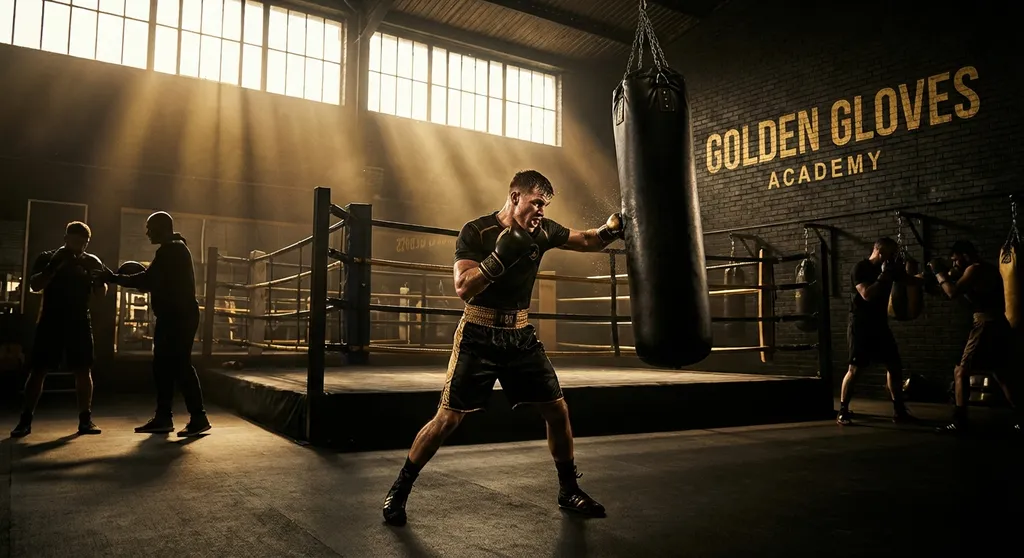
The gym culture that evolved in the twentieth century - the heavy bag, the speed bag, the skipping rope - is all rhythmic. Skipping to music that matches your skip tempo is categorically different from skipping in silence. The music synchronises the drill without your having to think about it.
The Emotional Function
Beyond the mechanical, music in a training environment serves an emotional regulation function.
Aggressive music during hard rounds increases what psychologists call "associative attention" - you focus on the feeling of the training, the physical sensations, the effort. This is desirable during high-intensity work because it reduces the temptation to think about stopping.
More relaxed music during recovery periods and cool-downs shifts attention toward "dissociative" processing - your mind drifts away from the physical effort, which is helpful when recovery is the goal.
The best-designed training playlists intuitively follow this pattern: building through the warm-up, peaking through the hard rounds, declining through the cool-down. Coaches who manage their own playlists usually do this naturally. The gyms where all fifteen rounds sound identical are wasting an available tool.
The Social Function
Music in a shared training space serves a social function that is rarely discussed.
When the same music plays for everyone in a room, it creates shared temporal experience. You are all in the same moment, moving to the same beat, under the same emotional influence. This is one of the mechanisms by which group training creates group cohesion.
The phenomenon of synchronised movement creating social bonding has been studied outside of exercise contexts - marching, dancing, religious ritual. The neural explanation is that moving in sync with others activates mirror neuron systems and promotes feelings of connection.
A boxing gym where twenty people are hitting bags in approximately the same rhythm, to the same music, generates a social cohesion that silence would not. This is part of why gym culture is so powerful - the shared physical experience, amplified by shared audio environment.
The Entry Point Effect
Music also serves a specific function for people entering a gym for the first time.
Walking into a boxing gym for the first time is intimidating for most people. The sounds - leather on leather, rope on floor, coaches calling numbers - are unfamiliar and associated with a world many people feel excluded from.
Music that is familiar provides a bridge. If the gym is playing music you know, from a culture you recognise, it signals something about who is welcome there. Gyms that play an eclectic mixture - grime, hip-hop, rock, R&B - without settling on one subcultural soundtrack tend to have more diverse memberships. This is not a coincidence.
At Honour and Glory, the playlist reflects the community. South London gym, south London music, alongside everything else.
What This Means for Your Training
Use music intentionally.
If you train at a gym with a managed playlist, trust the structure. If you train at home or supplement with your own music, build the playlist to mirror the session structure - not just choose your favourite songs.
For technical work - pad work, shadow boxing where you are working on a specific skill - consider lower-tempo music or silence. High-arousal music during technical learning can interfere with concentration on the specific movement pattern you are developing.
For conditioning work, for bag rounds, for intervals - that is when the high-tempo, high-arousal music earns its place.
The connection between boxing and music is not about vibe. It is about using every available tool to train more effectively.

H&G Team
Writer at Honour & Glory Boxing Club, a community boxing gym in Kidbrooke, South East London.
KEEP READING
The Best Boxing Warm-Up Songs: What to Play Before You Hit
A warm-up playlist needs different qualities from a training playlist. These are the tracks that build energy gradually without blowing everything before the session starts.
Best Boxing Training Songs 2026: BPM Playlists for Real Rounds
A coach-led boxing playlist guide: warm-up tracks, skill-round music, HIIT songs, endurance tempo work and recovery music, built around BPM, round structure and exercise research.
Best Boxing Walk-Out Songs
The best boxing walk-out songs do a job before the first bell. These are the tracks that still feel right in a real ring, not just on a playlist.
Was this page helpful?
It takes one tap, and it genuinely helps.
Choose your next step
Turn this article into the right action
Some readers are ready to book. Some need the class route first. Pick the route that matches what you actually want.