
England Boxing's membership data shows 36,000+ registered members, with boxing remaining a distinct and growing discipline despite the growth of mixed martial arts. UFC's statistics reflect the parallel growth of MMA in the UK.
People often compare boxing and MMA like they are rival products doing the same job. They are not. These are different sports with different rules, different training methods, and different goals.
Understanding those differences will help you pick the right one for you.
What Boxing Actually Is
Boxing is punching, defence against punches, and the footwork that ties it all together. That is it.
The sport has existed in roughly its current form for over a hundred years. The rules are simple: hit your opponent with your fists, do not get hit, do not hold, do not use anything below the belt.
This simplicity creates depth. When punching is all you are allowed to do, the skill level required to compete at high levels becomes extraordinary. Watch two elite boxers and you will see a chess match played at high speed.
What MMA Actually Is
MMA combines techniques from multiple martial arts. Striking, wrestling, grappling, and submissions all play a role.
A fight can happen standing, in the clinch, or on the ground. You can punch, kick, knee, elbow, take your opponent down, and submit them with chokes or joint locks.
This variety makes MMA closer to a "real fight" in some ways. But it also means spreading your training across many disciplines rather than mastering one.
The Training Difference
This is where the two sports diverge most significantly.
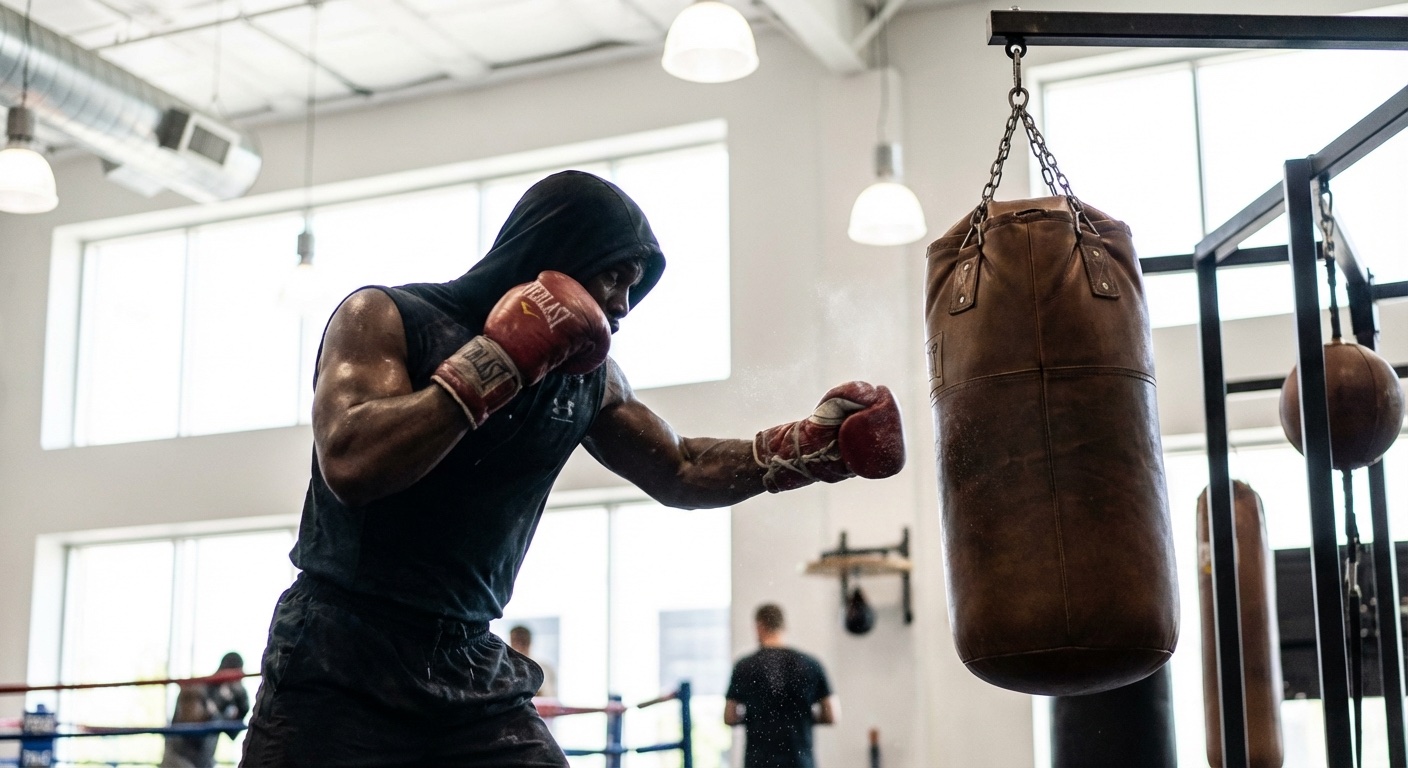
A boxer trains boxing. Every session focuses on hands, movement, and defence. You might do strength and conditioning work, but your skill training is entirely boxing.
An MMA fighter trains multiple disciplines. A typical week might include stand-up striking, wrestling, Brazilian jiu-jitsu, and MMA-specific sparring that combines everything. Some sessions focus on one area, others combine them.

Neither approach is wrong. They are optimised for different sports.
A boxer after five years of training will have better hands than an MMA fighter who is trained the same amount of time. That is just maths. The boxer spent five years on punching while the MMA fighter split time across multiple skills.
But the MMA fighter can do things the boxer never trained for.
Skill Specialisation vs Versatility
This is the real trade-off.
Boxing makes you a specialist. Your punching technique, defensive movement, and ring craft will be more refined than someone who trains multiple arts. You will read punches better, counter better, and move better when punching is the only thing happening.
MMA makes you a generalist. You will be competent across more situations but will not reach the same depth in any single area. Your punches will be less polished, but you will know what to do when someone shoots for your legs.
Which matters more depends on your goals.
For Fitness
Both sports provide excellent workouts. The type of fitness differs slightly.
Boxing training builds cardio endurance, shoulder stamina, core strength, and leg endurance from footwork. Classes typically involve continuous movement with periods of high intensity.
MMA training is more varied. You will develop similar cardio from striking work, but wrestling and grappling add different physical demands. Takedowns require explosive power. Ground work builds grip strength and a different kind of core endurance.
If pure calorie burning is your goal, they are roughly equal. Both will leave you exhausted.
MMA training might give you a more "complete" physical development because you are using your body in more diverse ways. But boxing's focused conditioning has its own benefits for heart health and coordination.
For Self-Defence

This is where arguments get heated online. Let us be balanced.
MMA training covers more scenarios. If a fight goes to the ground, an MMA fighter knows what to do. They can take someone down if needed or stay standing if they choose. The versatility has real-world application.
Boxing training makes you very good at staying on your feet and hitting without getting hit. In a pub fight where no one's trained, a boxer's speed and accuracy often end things quickly. The defensive skills help you avoid damage.
The honest answer: both put you far ahead of untrained people. Most self-defence situations involve someone with no training whatsoever. Either art gives you a massive advantage.
The argument about which is "better for the street" usually ignores the fact that avoiding fights entirely is the best self-defence. And if you cannot avoid it, any trained fighter beats an untrained one most of the time.
Injury Risk
MMA carries more injury risk. That is not a criticism - it is just reality when you combine more contact types.
In MMA training, you are dealing with strikes to more body parts, takedowns that stress joints, and submissions that can injure if partners are not careful. Good gyms manage this well, but the potential for injury is higher.
Boxing has its own risks. Concussion from sparring is a genuine concern, and hand injuries are common. But the overall injury variety is lower because fewer things are happening.
If you are training for fitness rather than competition, both sports can be made reasonably safe. It is about gym culture and how hard you train. But MMA's wider range of techniques means more ways things can go wrong.
Competition Paths
Both sports offer competitive opportunities, structured very differently.
Boxing has a well-established amateur system in the UK. Amateur Boxing Alliance runs a formal structure with regional and national competitions. The path from amateur to professional is clear and has existed for decades.
MMA competition in the UK is less formalised but growing. Amateur MMA shows exist, and the professional scene has expanded significantly. The path is less traditional but opportunities are there.
If competing matters to you, look at what local gyms offer. A gym that regularly puts fighters on shows will prepare you better than one that just does fitness classes.
Accessibility
Boxing gyms are easier to find in most UK locations.
The sport has deeper historical roots here, meaning more clubs exist across more areas. Many are community-based with reasonable costs. You can probably find a boxing gym within a few miles of wherever you live.
MMA gyms require more searching outside major cities. The sport is newer here, and quality instruction is less evenly distributed. You might need to travel further or pay more.
This matters for consistency. The best martial art is the one you actually train regularly. An excellent boxing gym nearby beats a theoretical MMA gym you will rarely visit.
Our View
We are a boxing gym, so obviously we think boxing is worth learning. But here is our honest perspective.
Boxing is the better starting point for most people.
The learning curve is manageable. You are not overwhelmed with multiple disciplines at once. The fundamentals of movement, timing, and defence apply to all combat sports. And you will develop clean technique faster when you are not splitting focus.
MMA is excellent if you specifically want to fight under MMA rules or want the broadest possible self-defence preparation. Many great MMA fighters started with a boxing base before adding other skills.
But if you are new to combat sports and wondering where to start, boxing gives you a solid foundation. You can always add wrestling or jiu-jitsu later if you want them.
Try It and See
Reading comparisons only gets you so far. At some point, you need to actually train and see what clicks.
If you are in South East London and curious about boxing, book a free trial with us. Come see what a boxing class actually feels like.
H&G Team
Writer at Honour & Glory Boxing Club, a community boxing gym in Kidbrooke, South East London.
Was this page helpful?
Your feedback helps us improve this page
Got questions about what you just read?
ASK OUR AI ASSISTANT ✨MORE LIKE THIS



WANT TO JOIN US?
Book a free trial session and see what we're all about.
Book a Free Trial