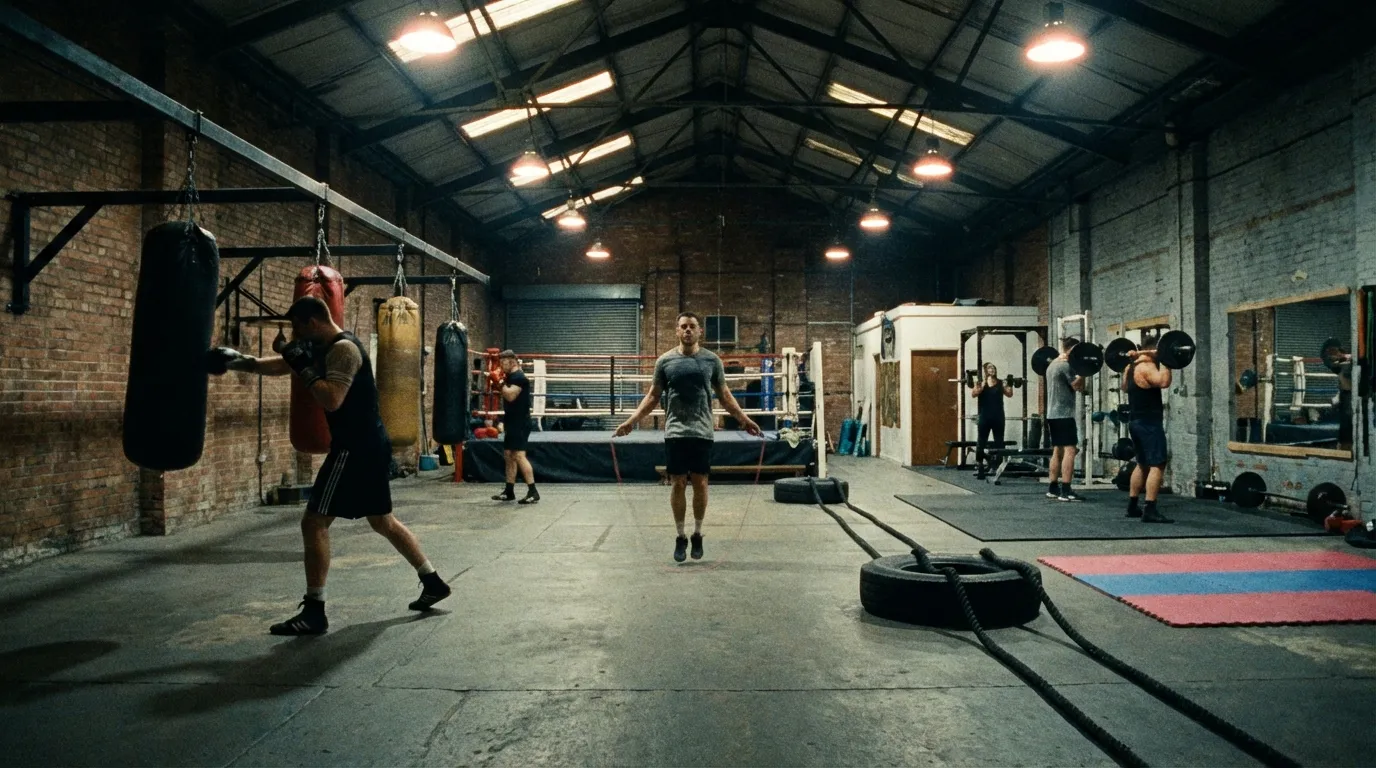
Boxing circuit training shows up in almost every serious gym programme at some point. If you have trained at H&G or a similar club, you have probably done something resembling it without realising there was a name for it - a bag round, then press-ups, then skipping, then something that makes your legs burn. That is the basic structure. Done properly, it is one of the most time-efficient ways to develop the specific fitness that boxing actually demands.
Worth understanding why before we talk about what to do.
Why boxing fitness is different
The demands of a boxing round are genuinely unusual. Three minutes does not sound long. But those three minutes require short explosive bursts, periods of controlled movement, sudden changes of pace, and the ability to think clearly while your heart rate is through the roof.
Standard cardio - running, cycling, the elliptical - does not replicate that. It builds your aerobic base, which matters, but it does not train your ability to go hard, recover slightly, and go hard again, repeatedly. Boxing is an interval sport. You need to train like it.
Circuit training mimics fight-pace conditioning better than almost anything except sparring itself. It takes you through different types of effort back to back, keeps the heart rate elevated while working different muscle groups, and forces your body to recover between efforts - exactly what you need when you are two minutes into a hard round and the other person is not slowing down.
A 2019 study in the Journal of Strength and Conditioning Research found that boxing-specific circuit training improved VO2 max, anaerobic capacity, and punch velocity in amateur boxers over eight weeks. Those are not marginal gains.

What boxing circuit training actually looks like
A circuit is a sequence of exercises done one after another with minimal rest. You complete the full set, take a proper break, then repeat. The "boxing" part matters - at least some stations should involve punching, movement, or boxing-specific skills. Without that, you are doing a general fitness class, which is fine but is not boxing circuit training.
A basic structure to work from:
Circuit length: 3 minutes (matching round length)
Stations: 4-6 exercises, 30-40 seconds each
Rest between circuits: 1 minute
Rounds: 4-6 circuits depending on your level
A beginner circuit (4 stations, 3 rounds) might look like:
- Heavy bag - combinations at pace
- Press-ups
- Skipping or footwork drills
- Squat jumps
Rest one minute, then repeat three times.
At intermediate level, you'd extend to 6 stations and 4 rounds:
- Heavy bag - combinations
- Pull-ups or resistance band rows
- Shadow boxing with head movement
- Burpees
- Medicine ball slams or sit-ups
- Skipping at pace
The ratio within each circuit matters. Aim for roughly 2:1 or 3:1 work-to-rest ratio, then take the full break between circuits. Going too hard with no micro-recovery turns the session into a grind with no adaptation benefit. Too easy and you are not actually training the energy systems boxing needs.
The calorie question
Boxing circuit training burns a significant amount - estimates sit between 600 and 900 calories per hour depending on intensity and body weight, which is comparable to running at a solid pace. The difference is that you are building sport-specific fitness and skill at the same time, which running does not give you (source).
The other factor worth knowing: high-intensity work creates excess post-exercise oxygen consumption (EPOC), meaning your metabolism stays elevated for several hours after training. It is not a dramatic effect but it is real, and it makes the net impact of a boxing circuit session higher than the session alone.
If weight loss is part of why you are training, combining circuit work with bag rounds two or three times a week makes a genuine difference. At H&G in Kidbrooke, members who've come to boxing for fitness reasons regularly see noticeable changes within six to eight weeks when they are doing circuits alongside their regular class sessions.
Common mistakes
The most common error with new people doing circuit training is going full effort from station one. By station three you are coasting. Aim for around 80-85% - hard enough that you feel it, not so hard that you blow up before you are halfway through (source).
The second is leaving boxing out of the boxing circuit. A circuit that is just burpees, press-ups, and squat jumps is fine conditioning but it is not boxing-specific. Keep at least two stations boxing-related - bag work, shadow boxing, or footwork drills. Otherwise you might as well just do a HIIT class.
The break between circuits matters more than people give it credit for. One minute of actual rest - standing, breathing under control, heart rate coming down - not chatting, not light jogging, actual recovery. Your ability to maintain quality in the next circuit depends on it.
Finally, the same circuit every week stops working after about four weeks. Your body adapts. Change one or two stations, increase the duration slightly, add a round, or cut the rest period. Small adjustments keep it effective.

Building up if you are just starting
If you have never done circuit training, start shorter than you think you should. Two circuits of four stations, 30 seconds each, is a reasonable starting point for someone who is been training less than three months. It might not feel like enough during the session. It will feel like enough the day after.
Build to three circuits over two weeks, then four. Add a station every few weeks rather than adding everything at once. The goal is finishing the session having worked hard throughout, not just surviving it.
What equipment do you need
Not as much as you might think. The minimum for boxing circuit training at home:
- Boxing gloves and hand wraps (for bag work)
- A heavy bag, or a free-standing bag
- A skipping rope
Bodyweight exercises fill the rest - press-ups, squats, lunges, planks, mountain climbers, burpees. If you have access to a full gym, great - medicine balls, resistance bands, and a pull-up bar all add variety. But the kit is not what makes circuit training work. The structure and the intensity are what matter.

Pad work in circuits
Pad work rounds are the highlight of any boxing circuit for most people. Working with a partner or coach on the pads develops timing, accuracy, and combination fluency under fatigue. In a circuit format, you might do 2 minutes of pad work followed immediately by press-ups or burpees, then back to pads. This replicates the demands of actual boxing far better than steady-state cardio ever could.
The key is maintaining technique as your fitness levels drop during the session. Sloppy punching under fatigue builds bad habits. Focus on keeping your guard up, turning your hips on every shot, and returning to stance between combinations. Your training method should always prioritise technique first, power second.
Frequently asked questions
Is boxing circuit training a full body workout?
Yes. A well-designed boxing circuit hits every major muscle group. Punching works your shoulders, back, and core. Footwork and stance transitions load your legs. The conditioning stations (burpees, press-ups, squats) fill any gaps. It is one of the most complete full body training methods available.
How many calories does boxing circuit training burn?
Between 500 and 800 calories per hour depending on your weight and intensity. The interval format with short rest periods keeps your heart rate elevated throughout, which drives higher calorie burn than steady-state exercise (source).
Can beginners do boxing circuits?
Absolutely. The structure scales to any fitness level. Beginners work at their own pace with longer rest periods and fewer stations. As your fitness levels improve, you increase intensity and reduce rest. Our coaches adjust circuits for every ability in the session.
How often should I do circuit training?
Two to three times per week is the sweet spot for most people. This gives enough stimulus to improve while allowing recovery between sessions. Combine with regular boxing technique sessions for the best results.
Getting the most from it
Boxing circuit training works because it is honest. You cannot coast through it, and three weeks in you will notice the difference in your bag rounds - more gas in the tank, able to push the pace when it matters. That carryover to actual boxing is the point.
At H&G in Kidbrooke, circuit elements are built into class sessions regularly. If you are unsure how to pace yourself in those sections, ask one of the coaches. Getting the intensity right early saves a lot of wasted sessions and means you actually improve faster.
The basics are straightforward. Build it into your training two or three times a week and it will do its job.
H&G Team
Writer at Honour & Glory Boxing Club, a community boxing gym in Kidbrooke, South East London.
Was this page helpful?
It takes one tap, and it genuinely helps.
Choose your next step
Turn this article into the right action
Some readers are ready to book. Some need the class route first. Pick the route that matches what you actually want.