
Most adults who ask whether they are too old to start boxing are not really asking about age.
They are asking whether they will look stupid. Whether the room will be full of people half their age. Whether their knees, shoulders, lungs, or confidence will cope. Whether they missed the window years ago and should now choose something safer, quieter, and less exposing.
The honest answer is this: you are probably not too old to start boxing, but you may need the right version of boxing.
That difference matters.
The Question Is Not Age, It Is Training Type
If by boxing you mean competitive sparring, fight preparation, and trying to keep pace with younger boxers chasing bouts, then age, injury history, and training background matter a lot.
If by boxing you mean coached recreational training - stance, footwork, pads, bags, combinations, conditioning, and movement - the age barrier is much lower than most people assume.
That is the version most adult beginners need. You can learn technique without getting hit. You can work hard without being thrown into sparring. You can build fitness without pretending you are 19.
The NHS adult activity guidance recommends both aerobic activity and strengthening work. Boxing covers both when it is coached properly. Your heart works, your legs work, your core works, and your brain has to stay switched on because the movements are not mindless.
What Changes as You Get Older
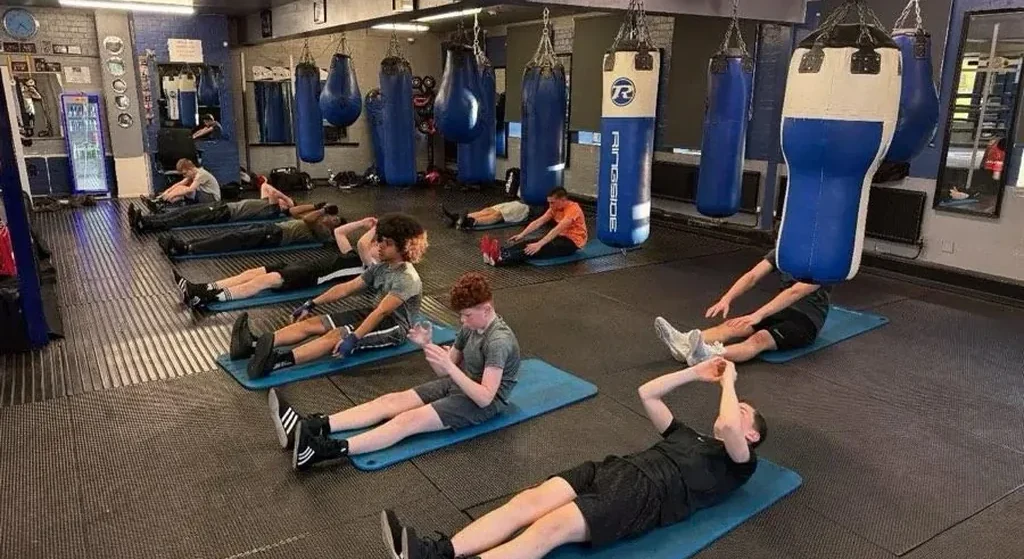
Age changes recovery. That is the first honest point.
A 22-year-old can often train badly, sleep badly, eat badly, and still come back quickly. A 52-year-old usually cannot. Warm-ups matter more. Rest days matter more. Technique matters more. Sharp pain matters more. None of that means boxing is off the table. It means ego is a poor coach.
Age also changes why people train. Someone in their 20s may want intensity, confidence, and identity. Someone in their 40s may want stress relief, strength, and a way out of boring gym routines. Someone in their 60s or 70s may care more about balance, coordination, confidence, and staying capable.
Those are all valid reasons.
The mistake is treating boxing as one fixed thing. Recreational boxing is adjustable. Rounds can be paced. Combinations can be simplified. Footwork can be coached carefully. Conditioning can be scaled. A good coach does not need every adult to train the same way.
What Does Not Change
Beginners are beginners at every age.
A 24-year-old beginner still drops their guard. A 37-year-old beginner still gets their feet tangled. A 61-year-old beginner still forgets the combination halfway through. That is not an age problem. That is learning.
Boxing is awkward at first because it asks the body to coordinate several things at once: feet, hips, shoulders, hands, eyes, breathing, and balance. That awkwardness is not evidence that you are too old. It is evidence that you are doing something new.
There is also a useful upside for older beginners. Adults often listen better. They ask better questions. They are less interested in showing off and more interested in doing it properly. In a technical sport, that helps.
The Health Case Is Strong, but It Needs Honesty
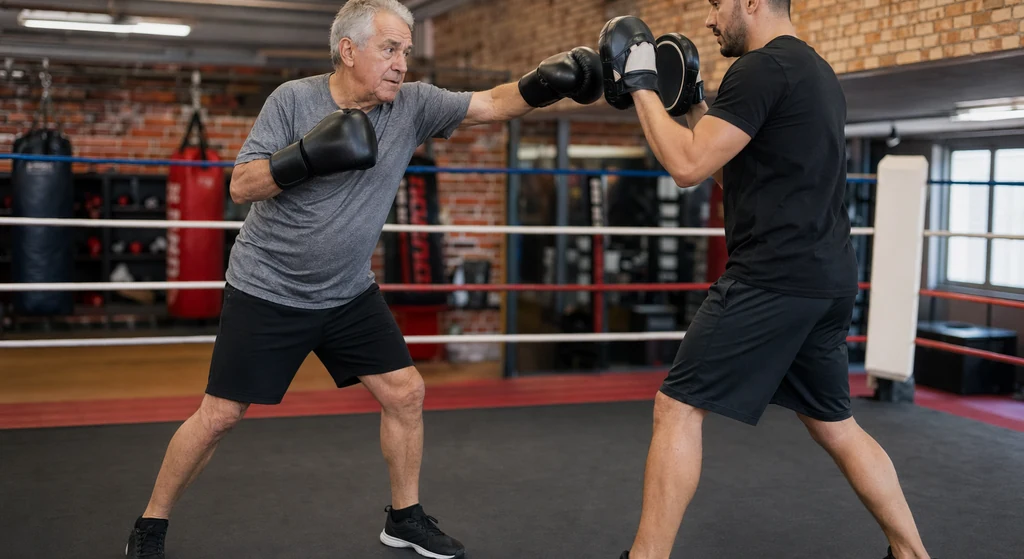
Boxing is demanding exercise. That is why it works.
A review of exercise and ageing in the British Journal of Sports Medicine supports the role of physical activity in preserving function and reducing health risk as people get older. That does not mean every form of exercise suits every person. It means the case for staying active is very strong, and boxing can be one useful route if it is coached sensibly.
There is also evidence that boxing-style training can help older adults with balance and coordination. Research on boxing training for people with Parkinson's disease has found improvements in functional mobility and quality of life measures in some groups (study). That does not mean boxing is a medical treatment for everyone. It does show why coordinated, challenging movement can be valuable beyond simple calorie burning.
The sensible rule is straightforward: if you have heart disease, uncontrolled blood pressure, serious joint problems, neurological issues, or any condition your doctor monitors, get medical clearance before starting. Then tell the coach. A good coach would rather know early than guess late.
What Age Means in Practice
In your 20s, the risk is usually inconsistency. You recover well, but you may waste that advantage by training in bursts and disappearing for weeks. Read Boxing in Your 20s: The Best Decade to Build Proper Habits if that sounds familiar.
In your 30s, boxing often fits very well. You are old enough to take coaching seriously and young enough to adapt quickly. Boxing in Your 30s: Is It Too Late to Start? covers that stage in detail.
In your 40s and 50s, the question becomes recovery, stress, strength, and consistency. You may not want to train like a teenager, but you can still learn properly and get a serious workout. The pieces on boxing for men over 40, boxing for women over 40, and boxing for people over 50 go deeper.
In your 60s and 70s, the useful version is measured and technical. It should be coached, controlled, and honest about boundaries. See Boxing in Your 60s and Boxing in Your 70s for the sharper later-life version.
The Red Flags to Avoid
You are not too old for boxing. You may be too old for a bad boxing gym.
Avoid any gym where beginners are pushed into sparring before they understand basic defence. Avoid coaches who treat pain as weakness. Avoid classes where everyone is expected to move at the same pace regardless of age, injury, or experience. Avoid places where the only visible route is competition.
A good adult beginner environment looks different. Coaches explain. People are allowed to rest. Technique is corrected before intensity is increased. Nobody laughs at beginners. Nobody needs to prove they are hard.
At Honour and Glory, most adult beginners start in the Adult Recreational class. It is proper boxing training, but not a fight camp. You learn to move, punch, defend, work pads, use the bags, and build fitness without needing to spar.
So, Are You Too Old?
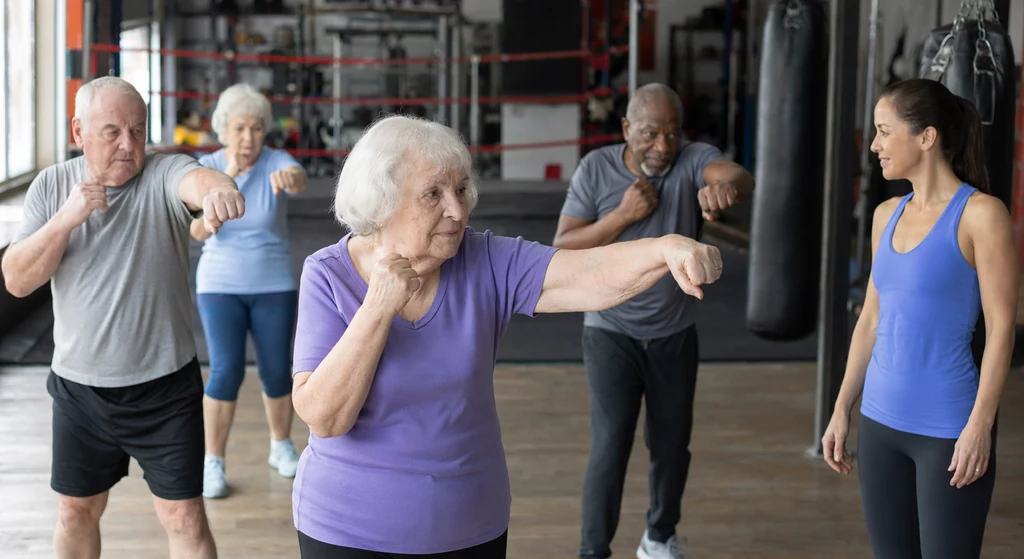
Probably not.
You may need to start slower than you would have done ten years ago. You may need a longer warm-up, more rest, better sleep, and clearer boundaries. You may need to ignore the part of your brain that thinks everyone is watching you. They are not. They are trying to remember the combination too.
The real question is not whether you are too old. It is whether you are willing to be a beginner for a few weeks.
If you want the full decade-by-decade breakdown, start with our Boxing by Age guide. If you are in Greenwich, Kidbrooke, Blackheath, Eltham, or nearby, the simplest way to answer the question is to try one session and see how your body responds.
H&G Team
Writer at Honour & Glory Boxing Club, a community boxing gym in Kidbrooke, South East London.
Rate this article
Your feedback helps us write better content
Got questions about what you just read?
ASK OUR AI ASSISTANT ✨MORE LIKE THIS


WANT TO JOIN US?
Book a free trial session and see what we're all about.
Claim a Free Trial