Boxing for Men Over 40: Fitness, Stress and Skill

Men over 40 who walk into a boxing gym for the first time share one consistent reaction: they wish they had done it ten years earlier.
That is not a sales pitch. It is something coaches hear repeatedly from this demographic, and it reflects something real about what boxing provides at this life stage that most other exercise options do not.
What Is Actually Happening to Your Body After 40
The physiological changes that affect men in their forties are well-documented and specific.
Testosterone levels begin declining at roughly 1-2% per year from the mid-thirties. By the time most men notice the effect - reduced energy, slower recovery, changes in body composition - the decline has been running for years. The NHS acknowledges this process and its downstream effects on muscle mass, mood, and metabolic rate.
Muscle mass decreases through a process called sarcopenia. Research published in Current Opinion in Rheumatology describes muscle mass declining from around the fourth decade of life, with the losses accelerating with age. This is not just a cosmetic issue. Loss of muscle mass affects strength, balance, metabolic rate, and injury risk.
Cardiovascular fitness declines too, particularly if your forties involve desk work, long commutes, and the kind of sedentary routine that most professional lives enforce.
The practical result: men in their forties often feel worse than they did at 30 despite not making dramatic changes. The changes are happening regardless of what they do. The question is whether they counter them or accept them.
Why Boxing Specifically Addresses This
Most forms of exercise address one or two of these issues. Boxing addresses all of them at once, and does it in a way that most men in their forties find genuinely engaging rather than a chore they maintain through willpower.
The testosterone effect. High-intensity interval training and resistance exercise are the two exercise modalities most consistently shown to support testosterone levels in middle-aged men. A 2022 systematic review in Frontiers in Physiology confirmed that exercise training - particularly high-intensity work - raises testosterone in both acute and chronic measures. Boxing training resembles HIIT in structure and intensity, which is why it produces similar hormonal responses. The sessions are genuinely hard in short bursts, followed by recovery. That pattern is exactly what the research identifies as most effective.
Muscle stimulus. The punching movements in boxing - jabs, crosses, hooks, uppercuts - load the shoulders, chest, back, and arms with high-repetition, resistance-generating effort. Footwork and defensive movement engage the legs and core continuously. The muscle stimulus is wide and well-distributed in a way that running or cycling is not.
Cardiovascular improvement. A pilot study on adults with abdominal obesity found that high-intensity boxing training significantly improved body fat percentage, reduced systolic blood pressure, and increased VO2 max (source). Cardiovascular fitness improvements happen quickly in deconditioned adults, and boxing training drives these improvements efficiently.
The Part Nobody Advertises: The Mental Health Effect
The physical benefits are real but they are also achievable through other routes. What boxing provides that most other exercise does not is a specific psychological benefit that matters particularly to men in their forties.
Boxing requires your full attention. You cannot be thinking about your inbox while working on the pads with a coach. The concentration required by technique work, by the physical demands, and by the coordination involved creates a complete mental break from the cognitive load that characterises professional and family life in this decade.
The NHS notes that exercise is one of the most effective non-pharmacological interventions for stress and mood. For boxing specifically, the combination of physical exhaustion, the meditative quality of technical drilling, and the social environment of a boxing gym produces outcomes that men in this age group describe in consistent terms: they feel less stressed, they sleep better, and they feel more like themselves.
One member at Honour and Glory, a project manager in his late forties, put it plainly: "Every problem I brought into that gym felt smaller when I left."
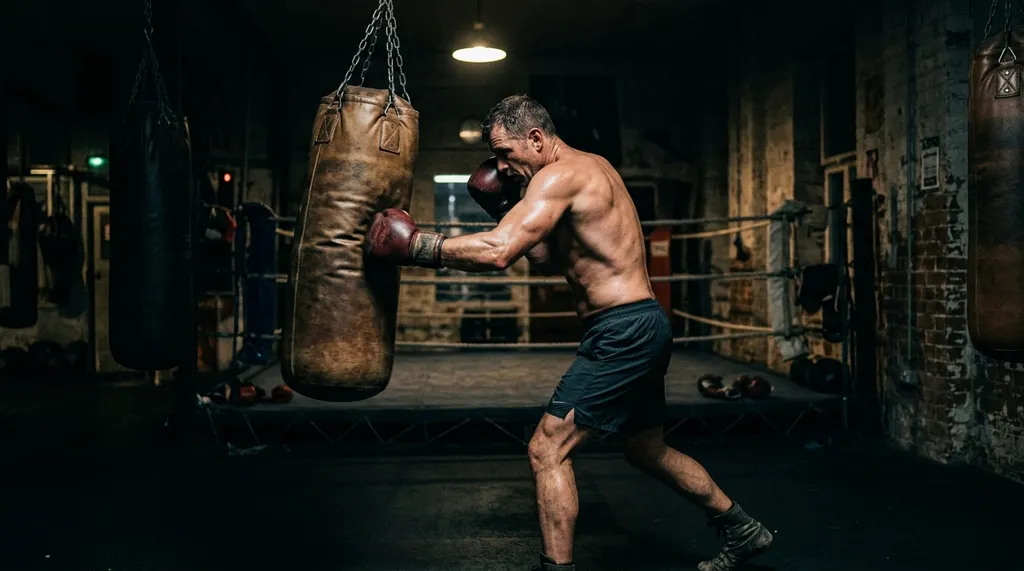
What to Expect When You Start
Men over 40 starting boxing for the first time face one practical challenge: the first few sessions are humbling. Boxing is a skilled sport. The technique is not intuitive and progress requires patience.
Good coaches understand this and manage it well. The early sessions at Honour and Glory focus entirely on stance, guard, basic punches, and footwork. Nobody expects a beginner to have good technique. The expectation is that you show up, try, and let the instruction work.
The second practical reality is recovery. Recovery takes longer after 40. A tough session may leave you sore for two or three days rather than one. This is normal and it improves as fitness develops. It means starting with two sessions per week rather than five, eating enough protein, and treating rest as part of training rather than an absence of it.
Neither of these things are reasons not to start. They are simply adjustments to expectation.
Within six to eight weeks, most men over 40 who train consistently report the same changes: they are sleeping better, their work stress feels more manageable, their body composition has shifted noticeably, and they have found something they want to keep doing.
The Gym Culture Question
Men who have not been in a boxing gym often assume the environment will be intimidating - filled with fit young people who have trained since childhood and who will be dismissive of a middle-aged beginner.
The reality at most established boxing clubs is different. Boxing gyms have a culture of respecting effort regardless of level. The coach does not care that you have no background. What matters is whether you are trying.
At Honour and Glory, the adult beginner boxing route is specifically designed for people starting from zero, including men over 40 returning to exercise after years away. The age range is broad, the atmosphere is not competitive in the way that might feel exclusionary, and the coaches are experienced at working with beginners. If you want more privacy, faster technical correction, or a programme around stress, weight loss, and recovery, see boxing PT for over 40s.
The gym is in Kidbrooke, just off the South Circular, accessible from much of south-east London.

A Note on What You Will Not Get
Boxing training at a recreational level does not mean sparring or fighting. The vast majority of people who train boxing never compete, never spar, and have no interest in doing either. The training itself - the bag work, pad work, drilling, conditioning - is the product.
If you want to go further and enter amateur competition at some point, that path is open. But it is entirely optional and many men who train at Honour and Glory have no interest in it. They are there for the fitness, the technique, and the mental reset.
FAQ
Is boxing safe for men over 40?
Recreational boxing training - bag work, pad work, technique drilling, conditioning - is appropriate for most men over 40 in reasonable health. Contact sparring carries more risk and is entirely optional. Any new training programme should be discussed with a GP if you have existing cardiovascular or joint conditions.
How many sessions per week should I start with?
Two sessions per week is appropriate for most men over 40 starting boxing. This allows recovery time while building fitness progressively. You can increase frequency as conditioning improves.
Do I need to be fit before I start?
No. The Adult Recreational class at Honour and Glory is designed for beginners at any fitness level. The fitness comes from the training.
How long before I see results?
Most men notice changes in sleep, energy, and mood within three to four weeks. Physical changes in body composition typically become visible after six to eight weeks of consistent training.
---
If you want the wider picture, read our Boxing by Age guide. It also helps to read Boxing in Your 30s, Boxing for Women Over 40, and Boxing for People Over 50. For private coaching, compare the personal training options.
Book a free trial session at Honour and Glory Boxing Club.
Adult beginner route
If you are deciding where to start, use the main adult beginner boxing guide. It compares the normal group-class route, women-only classes, weight-loss intent and private coaching for nervous or time-constrained beginners.
Stress relief route
If stress, confidence or anxiety is the reason you are looking at boxing, start with the boxing for stress relief hub. It explains the group class, beginner and PT routes so you do not have to guess where to begin.
H&G Team
Writer at Honour & Glory Boxing Club, a community boxing gym in Kidbrooke, South East London.
KEEP READING

Boxing, Fitness and Energy: A Sensible Note for Men
Boxing can support strength, fitness and routine. Hormone concerns should be discussed with a clinician.
Boxing Over 50: What Changes and What Still Works
Boxing over 50 needs sensible pacing, recovery and coaching, but the fundamentals still work. Here is what changes and what remains possible.
Boxing for Dads: Work, Family and Fitness
A practical guide for dads who want fitness, stress relief and skill without pretending they have six free evenings a week.
Was this page helpful?
It takes one tap, and it genuinely helps.
Choose your next step
Turn this article into the right action
Some readers are ready to book. Some need the class route first. Pick the route that matches what you actually want.