Boxing for Runners: Why Your Marathon Training Is Missing a Heavy Bag

The TCS London Marathon is four weeks away. If you're on the start list, you're probably deep in taper anxiety - doing your long runs and questioning every small tweak in your left knee. What you're probably not doing is hitting a heavy bag twice a week.
You should be. Not this cycle - it's too late to add intensity now. But if you're a regular runner, adding boxing to your training between race blocks might be the most useful thing you do for your performance. Here's the case.
What Boxing Does That Running Doesn't
Running is repetitive almost by design. You move in one plane - forwards - and you do it for a long time. That builds base aerobic fitness brilliantly and trains your running-specific muscles to handle load over time.
But that same repetition is why runners get injured so often. Overuse injuries - shin splints, IT band syndrome, stress fractures, plantar fasciitis - happen when the same structures absorb the same stress, over and over, without enough strength work to compensate.
Boxing breaks that pattern.
In a boxing session you're moving laterally, pivoting, squatting in your stance, rotating through your hips and core on every punch. You're working muscles that running barely touches: the obliques, the lats, the hip flexors, the posterior chain in a completely different context. That variety isn't just good for injury prevention - it builds genuine athleticism that makes you a better runner.
The Core Strength Problem Every Runner Has
If there's one area where boxing for runners pays off most directly, it's the core.
Most runners have a weak core relative to the load they're putting through their bodies. After about 20km, form starts to collapse. Hips drop, shoulders round, stride shortens. You know the feeling. It's not just tiredness - it's that the stabilising muscles have given up.
Boxing builds rotational core strength specifically. Every punch requires you to drive through your hips and rotate your torso, braced against your stance. The obliques and deep stabilisers get trained in a way that no amount of planks quite replicates.
What that means in practice: better posture in the final miles. When your torso stays upright, your breathing stays efficient and your stride mechanics stay intact. That alone is worth a few sessions a month.

Breathing Control and Cardiovascular Efficiency
Boxing teaches you to breathe with intention. You exhale sharply on every punch - it's not optional, it's baked into the mechanics. That training of forced, controlled exhalation has a direct parallel to running: the ability to regulate your breathing under effort is one of the clearest predictors of endurance performance.
Beyond technique, boxing's interval structure - three-minute rounds with a minute's rest - closely mirrors the HIIT protocols that sports scientists consistently find improve VO2 max more efficiently than steady-state cardio alone. An 8-week study using sprint intervals comparable to boxing rounds found VO2 max increases of up to 7.2%. For a runner targeting a personal best, that matters.
If you are currently running five days a week and doing nothing else, swapping one of those recovery jogs for a boxing session could actually lift your aerobic ceiling faster than another slow 10km. Cyclists face a similar cross-training problem, which we break down in our boxing for cyclists guide.
Footwork, Agility, and Ground Contact
This one is less obvious but worth flagging.
Good running form involves quick ground contact, responsive stabilisation on landing, and the ability to adjust stride dynamically - around potholes, other runners, cambered road surfaces. Boxers drill footwork constantly. The weight transfer, the pivot, the ability to move quickly in any direction - those neuromuscular patterns carry across sports.
Runners who add boxing often comment that their feet feel lighter and more responsive. It's not mystical - it's that you've trained the fast-twitch fibres that running mostly ignores.
The Mental Side
There's something else that doesn't show up in any study.
Marathon training is long and solitary. Long runs build mental endurance, but they're monotonous in a way that quietly wears you down. By January, most club runners are going through the motions on easy days.
Boxing demands your full attention. You can't think about your mortgage while working the pads - the focus required is total. That psychological refresh, one or two sessions a week among all those miles, keeps motivation alive in a way that cross-training on a stationary bike doesn't.
How to Add It Without Disrupting Your Running
If you're in a race block, don't introduce boxing now. Save it for the off-season or early base phase of your next cycle.
When you do add it:
Start with one session a week. A beginner boxing class of 60 minutes is a significant workout. Your shoulders and core will be sore in ways you haven't felt before. That's adaptation - let it happen before adding more.
Treat it as a non-running day or a recovery-style day. Boxing isn't a rest day, but it's also not the same stress as road miles. Done right, it complements a recovery day without adding cumulative joint impact.
Focus on technique, not intensity. The cardiovascular benefit comes naturally from the session structure. You don't need to go flat out on the bag to get the core, breathing, and footwork benefits - learn properly first.
Aim for two sessions a week in the off-season. That's enough to see meaningful changes in core strength, posture, and breathing mechanics over six to eight weeks.

What to Expect in Your First Class
If you've never been in a boxing gym before: it's nothing like what you're imagining.
Most beginner sessions involve bag work, skipping, pad work with a coach, and some conditioning drills. Nobody is throwing punches at you. The atmosphere at H&G in Kidbrooke is genuinely welcoming - we get plenty of runners, cyclists, and footballers using boxing as cross-training, and they tend to progress quickly because they already have a solid aerobic base to build on.
The things that will surprise you: how hard skipping is for the first two weeks, how much your shoulders burn, and how quickly sixty minutes passes when your brain is fully engaged.
The Relationship Goes Both Ways
It's worth noting that the running-boxing relationship is well-established from the boxing side too. Boxers have run as part of their conditioning for as long as the sport has existed. Road work builds aerobic base, improves recovery between rounds, and develops mental resilience. The best boxers tend to be the ones who take their running seriously.
What's newer is the direction of travel - runners discovering that boxing is excellent cross-training rather than a distraction from mileage. Replacing one or two weekly runs with boxing sessions costs you very little, and potentially gains quite a lot: core stability, variety, better breathing mechanics, and the kind of resilience that comes from learning something genuinely difficult.
After the Marathon
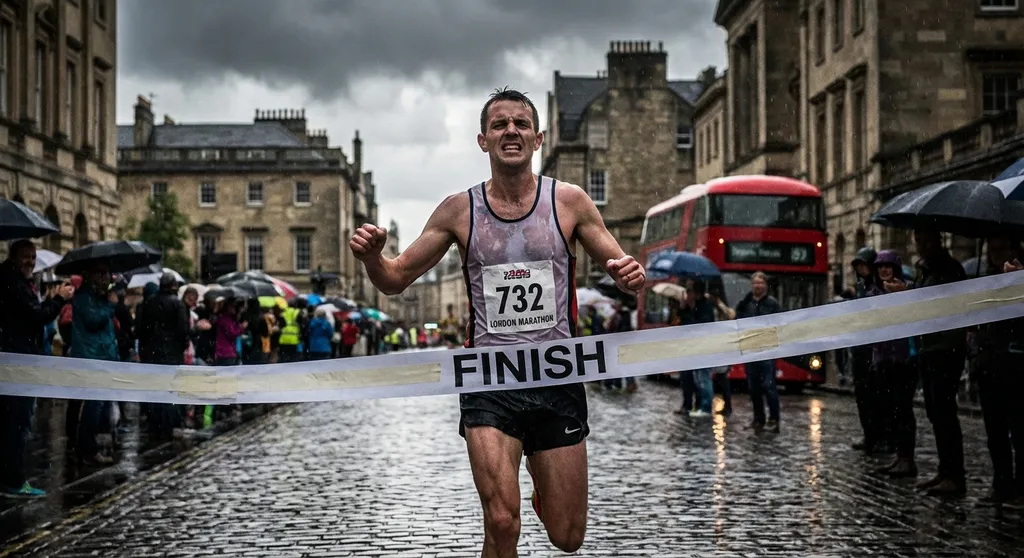
If you're running London on April 26 - good luck. Put in your long run this week, trust your training, and don't do anything new.
But when you cross the finish line and start wondering what to do with yourself when the marathon structure disappears, think about what your next training cycle could look like. A few months of boxing work while you rebuild your mileage base could make year two look quite different from year one.
We offer pay-as-you-go sessions at H&G - no contracts, no pressure. Come in, try it, see how your body responds. Many of our best regulars started as runners looking for something different.
H&G Team
Writer at Honour & Glory Boxing Club, a community boxing gym in Kidbrooke, South East London.
Was this page helpful?
It takes one tap, and it genuinely helps.
Choose your next step
Turn this article into the right action
Some readers are ready to book. Some need the class route first. Pick the route that matches what you actually want.