Women's Defence - Confidence Under Pressure
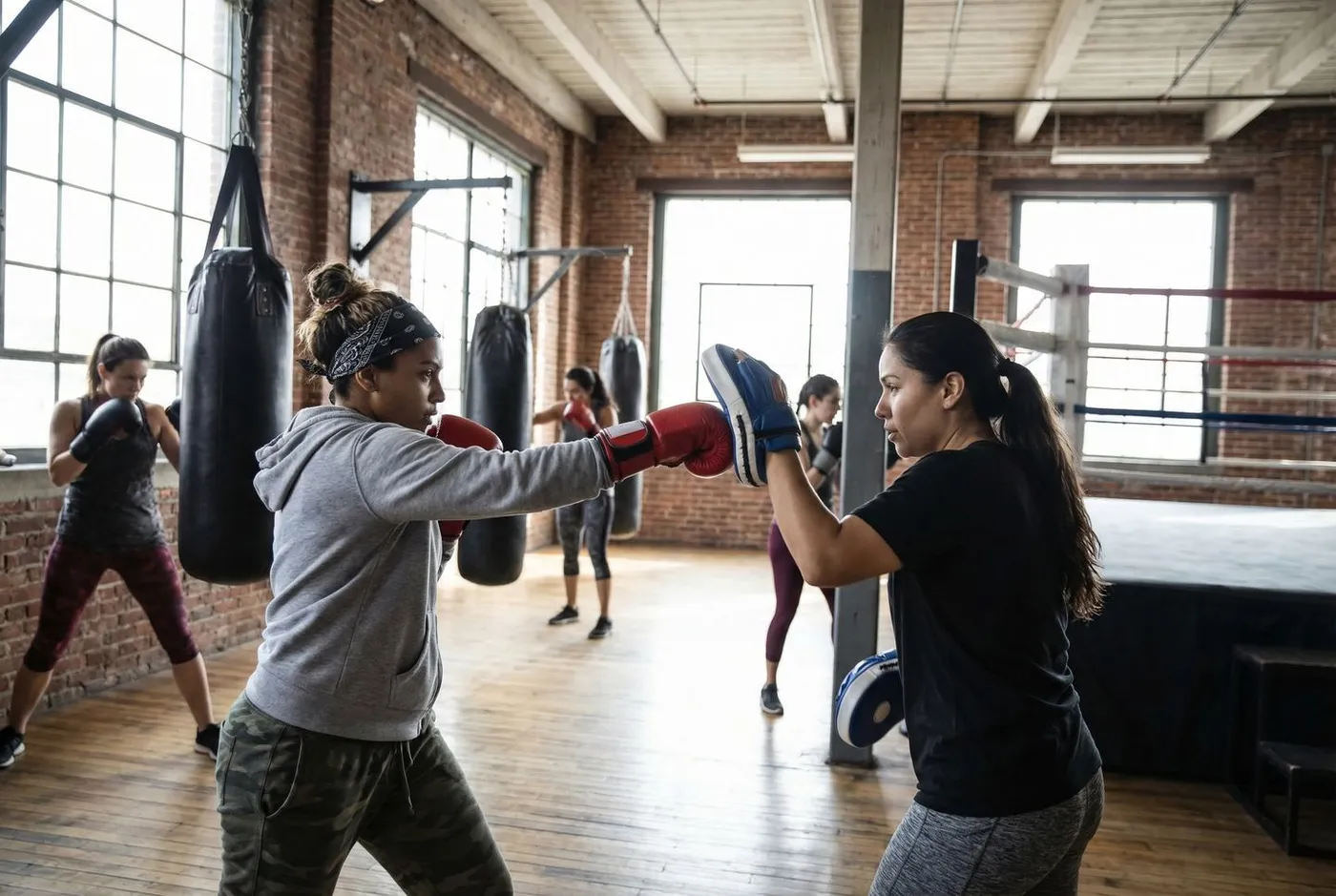
Non-contact defensive session for the women's class building the confidence to stand ground, react to incoming punches, and overcome the flinch response.
Equipment Needed
- Focus pads
- Heavy bags
- Slip bag
- Timer
Session Info
- Duration: 60 minutes
- Class size: 6-12 members
- Level: intermediate
Mobilisation (5 minutes)
- Neck rolls: 10 each direction (slow and deliberate)
- Shoulder circles: 10 forward, 10 back
- Thoracic rotation: 10 each side
- Hip circles: 10 each direction
- Bodyweight squats: 10 reps
- Wrist rotations: 10 each direction
- Light bouncing in stance: 30 seconds
Warm-Up Drills (8 minutes)
Defensive shadow boxing (4 mins)
2 x 1.5-minute rounds. Coach calls defensive movements mixed with punches:
- "Jab!" "Slip!" "Cross!" "Block!" "1-2!" "Weave!"
The alternation between offence and defence primes both systems. Members should be moving between guard, slipping, and punching fluidly.
Partner trust drill (4 mins)
Pairs. Partner A places a glove gently on B's forehead, then removes it. B keeps eyes open throughout. Repeat 10 times. Then: A places the glove quickly (but still gently). B keeps eyes open.
"This drill is about trust and control. The instinct to close your eyes when something comes at your face is strong. We are going to override that instinct today."
Main Session (38 minutes)
Block 1: Slow-Motion Attack and Defend on Pads (12 mins)
Pairs. Partner A holds one pad and uses it to throw slow punches toward B. Partner B defends using the techniques they know.
Drill 1: Slow jab, catch defence (4 mins)
A pushes the pad slowly toward B's face (simulating a jab). B catches it with the rear hand (palm meeting the pad). The contact is controlled. B can see the pad coming, has time to react, and catches it cleanly.
2-minute rounds, swap.
Coaching cue: "Watch the pad the entire way. Do not look away. Your rear hand meets it. Catch, do not slap."
Drill 2: Slow hook, block defence (4 mins)
A swings the pad slowly from the side (simulating a hook). B raises the arm on that side, elbow up, forearm protecting the head. The pad lands on the forearm.
2-minute rounds, swap.
"The block is a wall. You are not swatting the punch away. You are putting a shield up and letting the punch land on it."
Drill 3: Mixed slow attacks (4 mins)
A alternates between slow jabs and slow hooks. B must read which is coming and use the correct defence. Catch the jab, block the hook.
2-minute rounds, swap.
"Now you have to think. Is it coming straight or from the side? Read it and respond."
Celebrate every clean defence loudly. "Excellent catch! Perfect block! You did not flinch at all."
Block 2: Block and Roll Drill (8 mins)
The roll: after blocking a hook, the body rolls under to the other side, loading the legs for a counter. It is a defensive movement that transitions to offence.
Coach demonstrates: block the left hook (right arm up), then roll the body under and to the left, coming up in position to throw a left hook.
Partner drill (6 mins):
A throws a slow hook with the pad. B blocks, then rolls under. After the roll, B throws a hook of their own (into the air, not at A).
3-minute rounds, swap.
"The roll feels strange at first. Your head goes down and across. Keep your eyes up. Chin tucked. Hands in guard. When you come up on the other side, you are loaded and ready to counter."
Adding confidence (2 mins):
Same drill but A increases the speed of the hook slightly. Still slow by sparring standards, but faster than before. B must block and roll without hesitation.
"Did you notice you reacted faster that time? Your body is learning. The more you practise, the more automatic the defence becomes."
Block 3: Standing Your Ground - Progressive Pressure (12 mins)
This is the core confidence-building section.
Phase 1: Single slow punches (4 mins)
A throws one slow punch (pad held in hand) at B. B defends. A pauses. B resets. A throws another.
One at a time. B stands their ground. No backing up. Eyes open.
2-minute rounds, swap.
Phase 2: Two consecutive punches (4 mins)
A throws two slow punches in succession (jab then hook, or jab then cross). B defends both. The increase from one to two punches is significant mentally because B must sustain the defence.
2-minute rounds, swap.
Phase 3: Continuous slow attacks (4 mins)
A throws slow punches continuously. B defends continuously. Neither person stops. This is sustained defensive pressure for the full 2 minutes.
The instinct to back away will be strong. "Stand your ground. You are defending every punch. You are safe. Your hands are protecting you. Trust your defence."
Between every phase, acknowledge the group: "How many of you flinched less in phase 2 than phase 1? That is progress. Real, measurable progress."
Block 4: Slip Bag Confidence (6 mins)
Individual work on the slip bag. 3 x 1.5-minute rounds. 30 seconds rest.
The slip bag swings at head height. Members slip the bag as it comes toward them. The bag is not dangerous, but the movement of something coming at the face triggers the same defensive instincts.
- Round 1: just slip. Head goes left, then right. Find the rhythm.
- Round 2: slip and throw a jab after each slip.
- Round 3: slip, throw a jab-cross, slip again. Continuous.
"The slip bag is the best confidence builder in the gym because it comes at you over and over. Every time you slip it cleanly, your brain learns: I can handle this."
Conditioning Finish (5 minutes)
Light conditioning. The session was mentally intense.
- 2 x 1.5-minute rounds on the heavy bag. Moderate pace. Throw everything. Let the aggression out after a defensive session.
- 20 press-ups
- 30-second plank
Cool Down and Reflection (3 minutes)
Shoulder stretch: 15 seconds each. Neck stretch: 15 seconds each side. Hip flexor stretch: 15 seconds each. Deep breathing: 30 seconds.
"Defence is about trust. Trust in your hands to protect you. Trust in your reactions to move in time. Trust in your training. Today you proved to yourselves that you can stand in front of a punch and deal with it. That is not a small thing. That is courage."
Coaching Notes
- This session is about confidence, not perfection. A member who flinched 10 times in phase 1 and 5 times in phase 3 has made real progress. Celebrate the reduction, not the remaining flinches.
- The progressive pressure structure (single punch, then two, then continuous) is deliberate. Do not jump ahead. Each phase builds on the previous one. Rushing creates anxiety.
- Celebrate every successful defence loudly and publicly. "Brilliant block!" "You did not flinch!" "Your eyes were open the whole time!" The positive reinforcement rewires the fear response.
- Some members will find this session emotionally intense. Defence work touches on deeper feelings about vulnerability, control, and confidence. Be sensitive to that without making it therapeutic. This is a boxing session, not a therapy session.
- If a member is genuinely struggling and backing away consistently, do not force them. "Work the slip bag for this round. We will try again in a few minutes." Give them a lower-pressure option and return to the partner work when they are ready.
- Pair members with care. The person throwing slow punches must be patient, controlled, and encouraging. Pair nervous members with the calmest partners.
- This session is non-contact but prepares members for the first sparring women's session. Members who can stand their ground and defend slow punches are mentally closer to being sparring-ready.
- After the session, check in individually. "How did today feel? Anything you want to work on more?" Personal follow-up reinforces that the coaching is attentive and supportive.
Coach reference
Video demos for this plan
Use these as quick visual references before class. They are not a replacement for H&G coaching judgement, but they are more useful than a bare source link when a drill name is unfamiliar.
Boxing defence: parry, slip, block, bob and weave
Broad defensive reference for slipping, parrying, blocking, and head movement sessions.
Jab sparring drill
Safe progression reference for early sparring, jab-only sparring, and controlled contact.
How to bob and weave in boxing
Useful focused demo for bob-and-weave and head movement plans.