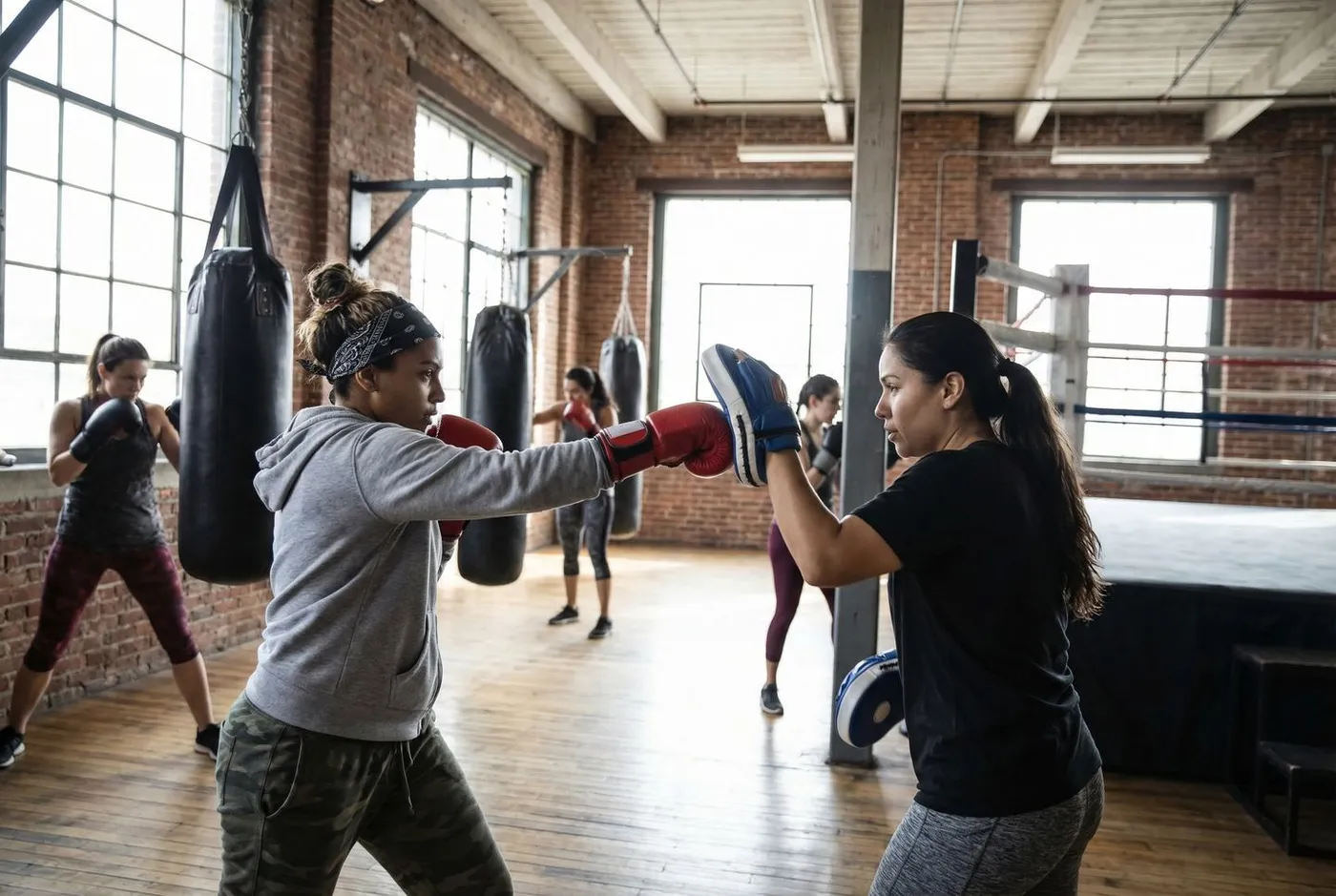
Headguard-Only Session - Beginner Contact
Carefully controlled first contact session for members transitioning from non-contact, with jab-only rounds building to jab-cross, clear stop signals, and extended debrief.
Equipment Needed
- Focus pads
- Heavy bags
- 16oz sparring gloves
- Head guards
- Gumshields
- Timer
Session Info
- Duration: 60 minutes
- Class size: 6-12 members
- Level: beginner
Mobilisation (5 minutes)
- Neck rolls: 10 each direction
- Shoulder circles: 10 forward, 10 back
- Thoracic rotation: 10 each side
- Hip circles: 10 each direction
- Bodyweight squats: 10 reps
- Light jogging on the spot: 30 seconds
- Shadow boxing footwork: 30 seconds each direction
Warm-Up Drills (8 minutes)
Confidence-building shadow boxing (4 mins)
2 x 1.5-minute rounds. Jab and cross with movement. Coach sets the tone: "This is your session. You have been learning these techniques for weeks or months. Today you get to use them for real, at a pace you control."
Partner range-finding (4 mins)
Pairs. Partner A extends their jab to full reach. Partner B stands at the end of A's fist. Both move in stance, maintaining that distance. 1 minute each. This teaches the contact distance without any punching.
"That is jabbing range. When we start, that is how far apart you will be. It is further than it looks."
Main Session (38 minutes)
Safety Briefing (8 mins)
This briefing is longer than usual because these members have never experienced contact.
The rules:
- Light contact only. Touch, do not hit. Your partner should feel the punch land. It should not sting, mark, or move their head.
- Headguards and gumshields are mandatory. No exceptions. If a gumshield falls out, the round stops until it is back in.
- The coach's voice overrides everything. If you hear "stop," you stop. Immediately. Gloves down.
- The stop signal for you: raise your glove above your head or say "stop." The round is over for your pair. No shame, no judgement.
- No body shots today. No hooks today. Jab only for round 1. Jab and cross from round 2.
- If you feel panicked, overwhelmed, or upset, signal to the coach. We pause, we check in, we decide together whether to continue.
Pairing:
Coach assigns pairs. Matched by size first. If an experienced member is available and trusted, pair them with the most nervous beginner.
Demonstrate the contact level:
Coach puts on gloves and demonstrates on a volunteer. Throw a light jab. "Did that hurt? No. Could you feel it? Yes. That is the level."
Jab-Only Contact (10 mins)
Round 1: One jab each, taking turns (3 mins)
Partner A throws one jab. Partner B blocks it. Then Partner B throws one jab. Partner A blocks. Take turns. One punch at a time.
This is the absolute minimum entry to contact. Each member knows when the punch is coming. There is time to prepare.
Coach watches every pair. Walk between them. "Good block. Nice jab. That was clean."
Round 2: Jab-only sparring (3 mins)
Both members can jab freely now. Still light. Still touch contact. The difference: they do not take turns. Both can jab at any time.
This is a significant step up mentally. Members must now defend while looking for opportunities to jab. The dual-task load is what makes it feel like sparring.
Rest and check-in (4 mins)
Stop. Ask the group: "How did that feel?" Let people speak. Common responses: "My heart is racing." "I kept closing my eyes." "It was easier than I expected."
Address the eye-closing issue specifically: "Closing your eyes is instinct. It will get better every time you do this. Try to keep your eyes open, even if it feels unnatural."
Add the Cross (10 mins)
Round 3: Jab and cross, taking turns (3 mins)
Same format as round 1 but with jab-cross. Partner A throws a jab-cross. Partner B blocks both. Swap. Taking turns.
The cross is a bigger punch and members may instinctively throw it harder. "The cross is the same light touch as the jab. Do not load up on it."
Round 4: Jab-cross sparring (3 mins)
Both members can throw jab and cross freely. Light contact. Move the feet. Use what they know.
Round 5: New partner if possible (4 mins)
Rotate pairs (keeping size-matched). A new partner feels different. Different reach, different speed. 3-minute round.
Between rounds, one tip: "After you throw, move. Do not stand in front of each other trading. Punch, step, reset."
Extended Debrief (10 mins)
This is deliberately long. First contact needs processing.
Gear off. Sit in a circle.
Question 1: "How did it feel?"
Let everyone answer. Do not rush this. Some members will be buzzing. Others will be processing something they did not expect to feel.
Question 2: "What surprised you?"
Common answers: "It is harder to think when someone is punching at you." "I forgot my footwork completely." "It hurt less than I expected."
Question 3: "What do you want to work on before the next contact session?"
This gives members agency. They identify their own areas for improvement.
Coach's closing message:
"What you just did takes courage. Most people never put on gloves and spar. You did. The first time is always the hardest. The technique you forgot today will come back with practice. The nerves will reduce. The confidence will grow. Be proud of what you did."
Conditioning Finish (5 minutes)
Very light. This session is emotionally and physically draining for beginners.
- 2 x 1.5-minute rounds on the heavy bag. Moderate pace. Let them decompress by hitting something that does not hit back.
- 20 press-ups
- 30-second plank
Cool Down and Reflection (3 minutes)
Neck stretch: 15 seconds each side. Shoulder stretch: 15 seconds each. Hip flexor stretch: 15 seconds each. Deep breathing: 30 seconds.
"Next time will be easier. And the time after that, easier again. The hardest step is the one you just took."
Coaching Notes
- This session can make or break a member's relationship with boxing. A positive first contact experience keeps them coming back. A negative one loses them.
- Watch every pair at all times. First-timers can panic when hit and respond with unexpected force. Step in before it escalates.
- The most common issue: members freezing when a punch comes at them. They stop moving, stop punching, and stand still. Talk them through it: "Keep your hands up. Jab back. You are fine."
- If a member is clearly panicking (hyperventilating, backing into a corner, wide eyes), stop their round immediately. Pull them aside privately. "Take a breath. You are safe. Do you want to continue or do you want to watch the rest?" Both options are valid.
- Never pair two complete beginners together. Neither knows how to control the situation. One experienced, trusted member per pair makes the session safer for everyone.
- Some members will want to go harder because the contact feels exciting. "Keep it light. You have not earned hard sparring yet. Control first. Power comes later."
- The debrief is not optional. Do not skip it to run more rounds. Processing the experience verbally helps members integrate what they felt and reduces the chance of negative associations forming.
- Follow up individually in the next session. "How did you feel after last week's contact session? Ready to go again?"
Coach reference
Video demos for this plan
Use these as quick visual references before class. They are not a replacement for H&G coaching judgement, but they are more useful than a bare source link when a drill name is unfamiliar.
Basic sparring practice for beginners
Useful for beginner contact, sparring introduction, and low-pressure sparring plans.
Jab sparring drill
Safe progression reference for early sparring, jab-only sparring, and controlled contact.
Boxing defence: parry, slip, block, bob and weave
Broad defensive reference for slipping, parrying, blocking, and head movement sessions.