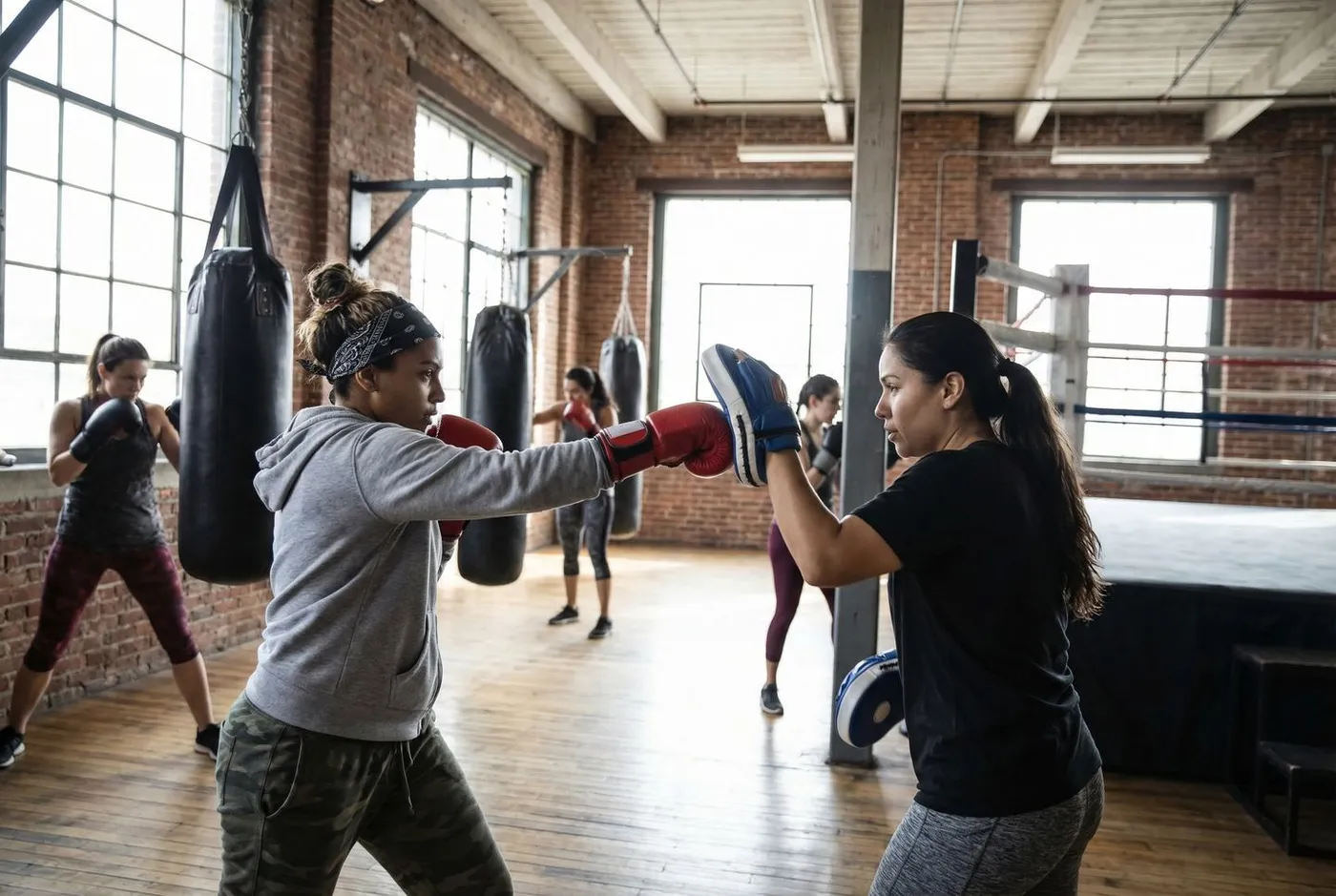
Head Movement - Bob and Weave
Non-contact defensive session dedicated to bob and weave mechanics, building the head movement that separates decent boxers from good ones.
Equipment Needed
- Heavy bags
- Focus pads
- Slip bag
- Cones
- Timer
Session Info
- Duration: 60 minutes
- Class size: 8-16 members
- Level: intermediate
Mobilisation (6 minutes)
- Neck rolls: 10 each direction, slow and deliberate (extra attention here - the neck works hard in this session)
- Shoulder circles: 10 forward, 10 back
- Thoracic rotation: 10 each side
- Hip circles: 10 each direction
- Bodyweight squats: 15 reps (bob and weave demands strong legs)
- Lateral lunges: 5 each side
- Ankle circles: 10 each foot
Warm-Up Drills (8 minutes)
Shadow boxing with slips (4 mins)
2 x 1.5-minute rounds. Members work jab, cross, and basic slips. "Throw a 1-2, slip right, throw a 1-2, slip left." This gets the head moving before introducing the bob and weave.
Squat hold drill (4 mins)
Stance position. Hands in guard. Drop into a half squat and hold for 10 seconds. Stand back up. Repeat 8 times. The bob and weave is essentially a controlled squat with lateral movement. Members who cannot hold a half squat will struggle with the full technique.
Main Session (38 minutes)
Bob and Weave Mechanics - No Rope (10 mins)
Coach demonstrates the bob and weave in slow motion.
The movement pattern:
- Start in guard position
- Bend the knees and drop the head below the incoming punch line (this is the "bob")
- Move the head in a U-shape: down, across, and back up on the other side (this is the "weave")
- The chin stays tucked throughout. Eyes stay on the opponent
- The back stays relatively straight - the bend comes from the knees, not from folding at the waist
Key coaching cues:
- "Think of the letter U. Your head traces the bottom of the U."
- "If you are bending at the waist, your head is going forward. That is where the uppercut lives. Stay on your legs."
- "Keep your hands up the entire time. The weave moves your head. Your hands stay in guard."
Members practise the bob and weave motion without any stimulus. 10 to the left, 10 to the right. Coach corrects individually.
Common mistakes: bending at the waist (head goes forward), dropping the hands to the knees for balance, closing the eyes, going too deep (they do not need to touch the floor).
Rope Drill - Weave Under the Line (10 mins)
String a rope (or use a resistance band) across the gym at shoulder height between two fixed points. Members line up and weave under the rope from one end to the other, moving in stance.
Round 1 (3 mins): walk pace. Focus on the U-shape. Head goes under the rope cleanly without ducking straight down.
Round 2 (3 mins): moderate pace. Add hands in guard position. The rope should not touch their head or back.
Round 3 (4 mins): add a jab or hook after each weave. Weave under, come up throwing a lead hook. Weave the other way, come up throwing a rear hook.
"The bob and weave is not just defensive. The best version of it puts you in position to counter. When you come up from the weave, you are loaded and ready to throw."
Partner Drill - Slow Punch and Weave (8 mins)
Pairs. Partner A throws a slow, controlled hook to Partner B's head (not making contact - stopping 6 inches short). Partner B bobs and weaves under the punch.
2-minute rounds, swap. Run 4 rounds.
Progression:
- Round 1-2: single hook, single weave. Partner A throws a lead hook, B weaves.
- Round 3-4: alternating hooks. Partner A throws lead hook, then rear hook. Partner B weaves under both in succession.
"Partner A, go slowly and predictably. This is not about catching Partner B off guard. It is about giving them a punch to practise weaving under. If you speed up and they get hit, you have failed as a training partner."
Bag Work with Weave Integration (10 mins)
4 x 2-minute rounds on the heavy bag. 30 seconds rest.
- Round 1: throw a 1-2, then bob and weave to the left. Reset, 1-2, weave right. Repeat.
- Round 2: throw a 1-2-3 (jab-cross-lead hook), then bob and weave. The weave is the exit after the combination.
- Round 3: double weave. 1-2, weave left, weave right, then throw a lead hook. This is the full defensive-to-offensive cycle.
- Round 4: freestyle combinations, but every combination must be followed by at least one bob and weave before the next combination starts.
Coach watches for members who throw their combinations and then stand still. "The combination is not finished until you have moved your head. Punch, weave, reset. That is the full sequence."
Conditioning Finish (5 minutes)
- 30-second weave-only drill (continuous bob and weave, no punches, fast as possible), 15 seconds rest x 4
- 20 squat jumps
- 20 bicycle crunches
- 30-second wall sit
Cool Down and Reflection (3 minutes)
Neck stretch: tilt the head to each side, 15 seconds. Quad stretch: 15 seconds each leg. Hip flexor stretch: 15 seconds each side. Lower back stretch: lie flat, pull knees to chest, 15 seconds.
"Head movement is what separates a boxer who can hit from a boxer who is hard to hit. If you can weave under punches and come up throwing, you become a nightmare to deal with. Practise the U-shape in the mirror at home. Ten minutes a day will change your defensive game."
Preview: the next session builds on this with slipping and rolling combined with counters.
Coaching Notes
- Bob and weave is one of the hardest defensive skills to learn because it demands leg strength, coordination, and the confidence to move toward a punch rather than away from it. Be patient.
- Members with lower back issues should reduce the depth of the weave. A shallow bob that moves the head off the centre line is still effective.
- Members with knee problems should talk to the coach before this session. The repeated squatting motion can aggravate existing issues. Offer a reduced-depth version or substitute with slipping.
- The slip bag is excellent for solo weave practice between pad rounds. If the slip bag is free, direct members there during rest periods.
- Advanced members can add the Philly shell weave: weave under with the lead shoulder high, rear hand at the chin. This is a stylistic variation but builds defensive awareness.
- Watch for members who close their eyes during the partner drill. They need to see the punch to weave under it. If someone keeps closing their eyes, slow the partner's punch down further until they can watch it.
- The rope drill is the best diagnostic tool in this session. If a member can weave under the rope smoothly in stance without touching it, the mechanics are correct.
Coach reference
Video demos for this plan
Use these as quick visual references before class. They are not a replacement for H&G coaching judgement, but they are more useful than a bare source link when a drill name is unfamiliar.
How to bob and weave in boxing
Useful focused demo for bob-and-weave and head movement plans.
Boxing defence: parry, slip, block, bob and weave
Broad defensive reference for slipping, parrying, blocking, and head movement sessions.
Learn boxing footwork in seven minutes
Good broad demo for step-and-slide, balance, movement, and footwork-first classes.