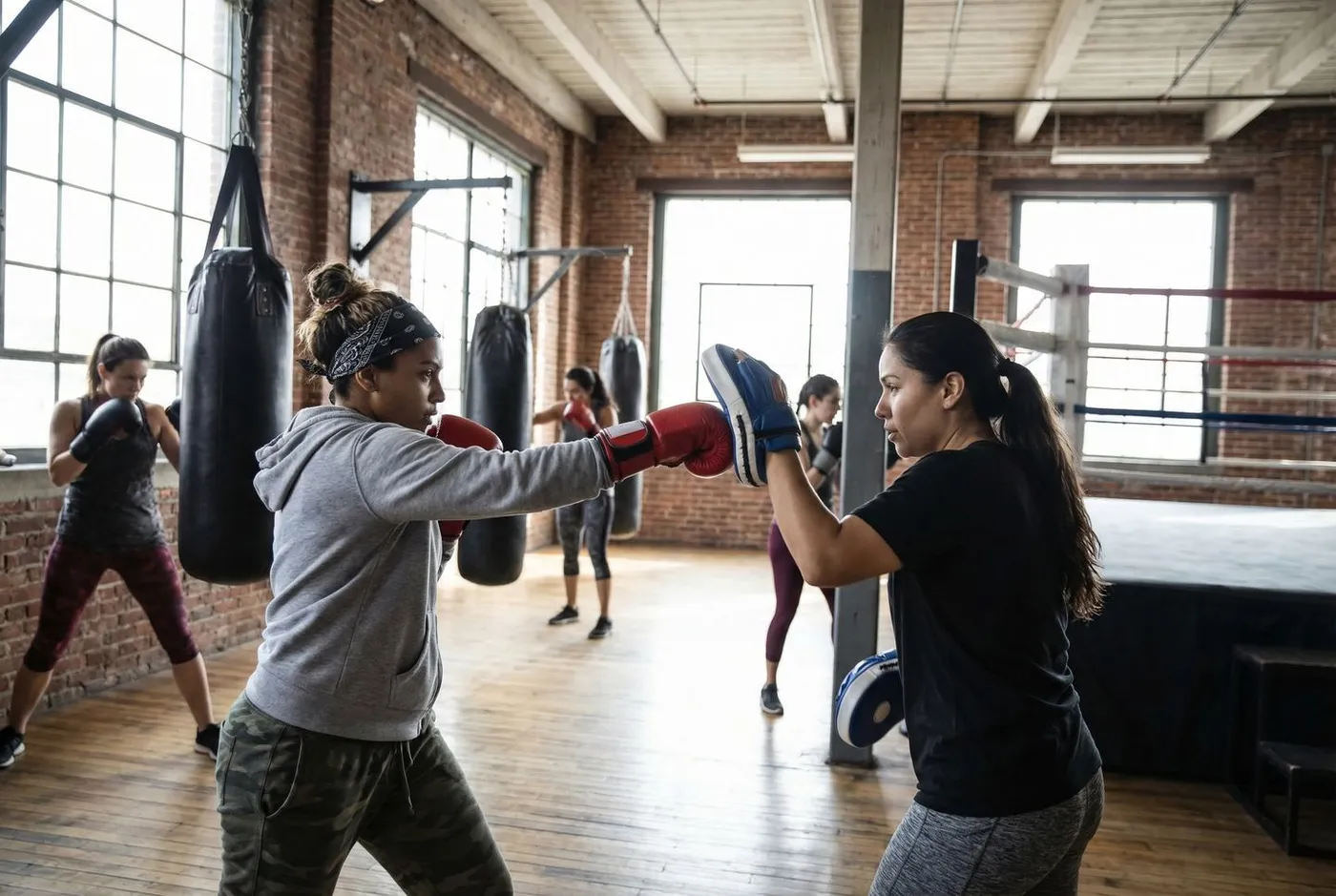
First Sparring - Women's Class
Structured first contact session for the women's class with extended safety briefing, consent-based pairing, controlled drill sparring, and group debrief.
Equipment Needed
- Focus pads
- Heavy bags
- 16oz sparring gloves
- Head guards
- Gumshields
- Timer
Session Info
- Duration: 60 minutes
- Class size: 6-12 members
- Level: intermediate
Mobilisation (5 minutes)
- Neck rolls: 10 each direction, slow and controlled
- Shoulder circles: 10 forward, 10 back
- Thoracic rotation: 10 each side
- Hip circles: 10 each direction
- Bodyweight squats: 10 reps
- Light jogging on the spot: 30 seconds
- Shadow boxing footwork: 30 seconds forward-back, 30 seconds lateral
Warm-Up Drills (8 minutes)
Confidence shadow boxing (4 mins)
2 x 1.5-minute rounds. Jab, cross, movement. Encourage members to own the space. Move around the gym. Throw punches with intent. "You have been practising these punches for weeks. They are yours. Today you use them with a partner."
Pad work review (4 mins)
Quick pairs. 2-minute round: jab-cross on pads, then the pad holder taps the worker's shoulder lightly and the worker slips. Swap. This introduces the idea of reacting to something coming toward you, which is the mental bridge to sparring.
Main Session (38 minutes)
Pre-Sparring Conversation (8 mins)
Sit or stand in a circle. Gear is not on yet. This conversation is not optional.
Normalise the nerves:
"If you are nervous, that is completely normal. Everyone is nervous the first time. The people who have sparred before were nervous their first time too. Nerves are not weakness. They are your body preparing to do something new."
Set expectations:
"This is not a fight. It is practice. Light contact only. If something does not feel right, you stop. Raise your hand or say 'stop' and the round ends. No questions, no judgement."
Consent and communication:
"Before every round, you and your partner agree on what you are comfortable with. If someone says jabs only, it is jabs only. If someone says light, it is light. You check in with each other between rounds."
Demonstrate the intensity level:
Coach puts on gloves and demonstrates the contact level with a volunteer or assistant. Show what "light" looks like. "This is too hard (demonstrate a firm jab). This is the level we want (demonstrate a touch jab). Can you feel it? Yes. Does it hurt? No. That is the standard."
Gear Up and Pairing (5 mins)
Everyone puts on 16oz gloves, headguards, and gumshields.
Pair by size first, then by confidence level. If someone is visibly more nervous, pair them with the calmest, most controlled member in the group. Do not pair two nervous members together.
If the numbers are odd, the coach fills in as a sparring partner for the odd member.
Drill Sparring - 1 for 1 Trading (10 mins)
Drill 1: Jab only, take turns (5 mins)
Partner A throws one jab. Partner B blocks or slips it. Then Partner B throws one jab. Partner A blocks or slips. One punch each, taking turns. Not simultaneous.
This is the gentlest introduction to contact. Each member knows when the punch is coming and has time to prepare.
3-minute round. Then switch partners if possible (keep size-matched). 2-minute round.
"How did that feel? It is just a jab. You have been throwing jabs for weeks. Now you know what it feels like on the other end."
Drill 2: 1-2 trading (5 mins)
Same format but now Partner A throws jab-cross. Partner B defends. Swap. Two punches each, taking turns.
3-minute round. The contact is still light. The coach moves between every pair checking the intensity.
Light Controlled Sparring (10 mins)
3 x 2-minute rounds. 1 minute rest between rounds. Both members can punch at the same time now. Jab and cross only. No hooks, no body shots.
Round 1: jab only. Both can jab freely. Light contact. Find range, find timing. "Move your feet. Do not stand in front of each other."
Round 2: jab and cross. Same partner. The cross adds a new dimension. "When your partner throws the cross, your lead hand should block it. Keep your guard up."
Round 3: new partner if possible. Jab and cross. Freedom to use footwork and defence. This round should feel the closest to real sparring.
Between every round, ask: "Everyone alright? Anyone need to adjust anything?" Give members the opportunity to speak up. Some will not say anything but their body language will tell you if something is wrong. Watch for tense shoulders, watery eyes, or someone shaking their hands.
Group Debrief Circle (5 mins)
Gear off. Circle up.
"How was that?" Let every member speak, not just the confident ones. Go around the circle if needed.
Common responses: "It was scary at first but then it was fun." "I forgot to breathe." "I could not remember any technique." "It hurt less than I expected."
Validate all of it. "Every single one of those feelings is normal. The technique comes back the more you spar. The nerves reduce every time. You just did something that most people never do. Be proud of that."
Conditioning Finish (5 minutes)
Light conditioning. Sparring is draining. Do not overload a session that was already emotionally demanding.
- 2 x 1.5-minute rounds on the heavy bag. Moderate pace. Let them release any remaining tension.
- 20 press-ups
- 30-second plank
Cool Down and Reflection (3 minutes)
Shoulder stretch: 15 seconds each. Neck stretch: 15 seconds each side. Hip flexor stretch: 15 seconds each. Hamstring stretch: 15 seconds.
"What you did today took courage. Sparring is where boxing becomes real. If you want to do it again, we will make it a regular part of the class. If you want to take a week and think about it, that is fine too. No pressure."
Coaching Notes
- This is the most important session you will run for the women's class. A negative experience here can lose members permanently. Every decision should prioritise safety and comfort.
- Spend more time on the pre-sparring conversation than feels necessary. The extra 3-4 minutes of talking is worth it. Members who understand the rules and feel heard before starting are calmer during the sparring itself.
- Watch every pair simultaneously. In a first sparring session, things can change quickly. A member who was calm in round 1 may panic in round 2 if they get caught with a punch they did not expect. Step in immediately if you see distress.
- If a member does not want to spar after the pre-sparring talk, respect that completely. Have an alternative ready: they can hold pads for you, work the bag, or watch. Never pressure anyone into contact.
- If someone gets upset during sparring, stop their round, check on them privately (not in front of the group), and offer choices: "Do you want to take a minute and try again, or would you rather work the bag for the rest of the session?" Both options are presented as equally valid.
- The debrief circle is not optional. First-timers need to process the experience verbally. Skipping the debrief leaves emotional responses unresolved.
- After this session, check in with members individually over the next week. A quick "How are you feeling about last week's sparring?" goes a long way.
Coach reference
Video demos for this plan
Use these as quick visual references before class. They are not a replacement for H&G coaching judgement, but they are more useful than a bare source link when a drill name is unfamiliar.
Basic sparring practice for beginners
Useful for beginner contact, sparring introduction, and low-pressure sparring plans.
Jab sparring drill
Safe progression reference for early sparring, jab-only sparring, and controlled contact.
Boxing defence: parry, slip, block, bob and weave
Broad defensive reference for slipping, parrying, blocking, and head movement sessions.