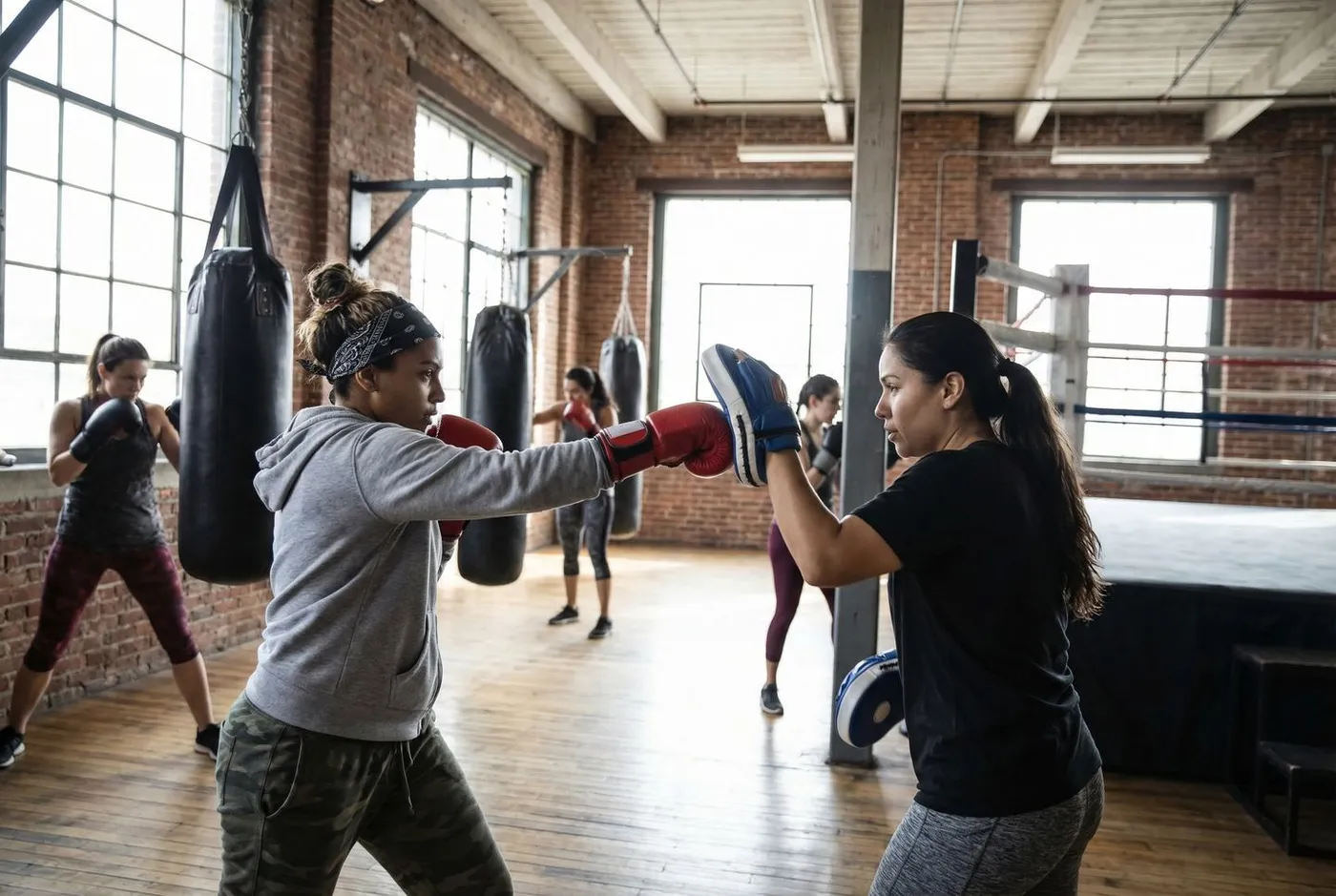
Counter-Punching off the Back Foot
Developing the counter-punching style with slip-and-counter pads work, pull counters, roll-under-hook counters, and sparring where you can only punch after being attacked.
Equipment Needed
- Focus pads
- Heavy bags
- 16oz sparring gloves
- Head guards
- Gumshields
- Timer
Session Info
- Duration: 60 minutes
- Class size: 8-14 members
- Level: advanced
Mobilisation (5 minutes)
- Neck rolls: 10 each direction
- Shoulder circles: 10 forward, 10 back
- Thoracic rotation: 10 each side
- Hip circles: 10 each direction
- Bodyweight squats: 10 reps
- Calf raises: 15 reps (back-foot fighters live on the balls of their feet)
- Ankle circles: 10 each foot
Warm-Up Drills (8 minutes)
Retreat shadow boxing (4 mins)
2 x 1.5-minute rounds. Members shadow box while moving backwards. Step back, jab. Step back, jab-cross. The emphasis is on maintaining balance and throwing clean punches while moving away from an imaginary opponent.
"Most of you default to moving forward. Today we are working the other direction. Backwards does not mean defensive. It means choosing when to engage."
Slip and return drill (4 mins)
Solo. Stand in front of the mirror. Slip right, throw a jab. Slip left, throw a cross. Repeat for 2 minutes. Then: slip right, throw a cross (slipping and countering with the rear hand). Slip left, throw a lead hook. 2 minutes.
This connects the defensive movement directly to the counter-punch.
Main Session (38 minutes)
Slip-and-Counter on Pads (10 mins)
Pairs. Pad holder feeds a slow jab to the worker. The worker slips the jab and counters.
Counter 1: Slip outside, return cross (4 mins)
Slip to the outside of the jab (head moves to the right for orthodox fighters). Throw the cross immediately. The slip puts the head off line and loads the rear hand.
2-minute rounds, swap.
Counter 2: Slip inside, return lead hook (3 mins)
Slip to the inside of the jab (head moves to the left). Throw the lead hook. This is riskier because the slip goes toward the opponent's rear hand, but the hook lands clean on the open side.
2-minute rounds, swap.
Counter 3: Slip outside, cross, lead hook (3 mins)
The combination counter. Slip the jab, fire the cross, follow with the lead hook. Three movements in quick succession: defensive, offensive, offensive.
2-minute rounds, swap.
Coaching cue: "The counter must be immediate. Slip and punch are one motion, not two separate actions. If there is a gap between the slip and the punch, the opening closes."
The Pull Counter (8 mins)
The pull counter is one of the most effective techniques in boxing. The fighter pulls their head back to make the jab miss, then immediately fires the straight right while the opponent is still extended.
Demonstration: Coach feeds a jab. Worker pulls the head and torso back 4-6 inches (weight shifts to the back foot). The jab misses. The worker immediately drives forward with the cross while the opponent is out of position.
Pad drill (6 mins):
Pad holder throws a slow jab. Worker pulls back, then drives the cross to the presented rear pad. 3-minute rounds, swap.
"The pull counter is about timing, not distance. You only need to pull back enough to make the jab miss. If you pull too far, you are out of range to counter."
Common mistake: leaning back at the waist instead of shifting the weight. "The weight goes to the back foot. The torso stays relatively upright. If you lean back at the waist, you are off balance and the counter has no power."
Adding the follow-up (2 mins):
Pull counter (cross), then step forward with the lead hook. The cross catches them extended. The hook catches them retreating. 1-minute round each.
Roll Under Hook and Counter (8 mins)
Demonstration: Partner throws a hook to the head. The worker rolls under the hook (bending the knees, moving the head in a U-shape under the punch). As the worker comes up on the other side, they throw a hook of their own.
"Rolling under a hook and coming up with your own hook is beautiful boxing. It is also terrifying for the person who threw the first hook because their punch missed and they are now exposed."
Pad drill (6 mins):
Pad holder throws a slow, controlled hook. Worker rolls under and throws a lead hook to the presented pad. 3-minute rounds, swap.
Progression: after the counter hook, add a cross. Roll, hook, cross. Three movements.
Bag integration (2 mins):
On the heavy bag, throw a 1-2, then roll (imagining the counter hook coming), come up with a hook. Repeat for 2 minutes. This builds the roll-and-counter into combination flow.
Counter-Punching Sparring (12 mins)
4 x 2-minute rounds. 1 minute rest. The rule: Fighter B (the counter-puncher) can only throw punches after being attacked. They cannot initiate. Fighter A attacks freely. Fighter B defends and counters.
Swap roles after 2 rounds.
Round 1-2: Fighter A attacks, Fighter B can only counter. This forces B to be patient, read the attack, and choose their moment.
Round 3-4: swap roles.
Between rounds:
- After round 1: "Counter-punchers, are you waiting too long? The counter must come within half a second of the defence. If you wait, the opening disappears."
- After round 2: "Attackers, you are walking onto counters. If your opponent is stepping back and slipping, stop chasing. Reset your range."
- After round 3: "How does it feel to counter? Is it easier or harder than leading? Most people find it easier because you are reacting to a target, not creating one."
Conditioning Finish (6 minutes)
- Slip the bag (push the heavy bag so it swings, slip it as it comes back, counter with a cross): 1 minute
- 30 seconds rest
- 30-second fast counters on pads (pad holder feeds jabs rapidly, worker slips and counters each one): swap after 30 seconds x 4
- 20 press-ups
- 30-second plank
Cool Down and Reflection (3 minutes)
Calf stretch: 15 seconds each. Quad stretch: 15 seconds each. Shoulder stretch: 15 seconds each. Neck stretch: 15 seconds each side. Hamstring stretch: 15 seconds.
"Counter-punching is not passive. It is the most efficient style in boxing. You let the opponent do the work, then you punish them for it. The best counter-punchers in history won fights by being patient, reading their opponent, and making them pay for every mistake."
Preview: the next session will look at combining counter-punching with aggressive offence for fighters who can switch between styles.
Coaching Notes
- Many members default to a forward-pressing style because it feels more active. Counter-punching requires patience and confidence in defence. Some members will find it frustrating. Encourage them to stay with it.
- The pull counter is the most accessible technique in this session. If the group is less experienced, spend extra time on the pull counter and reduce the roll-under-hook section.
- In the sparring rounds, watch for the counter-puncher backing up too far. Backing up without punching is retreating, not counter-punching. They must stay within range to counter.
- Watch for the attacker who gets frustrated and increases power when they keep getting countered. Remind them: "Light contact. This is a skill session."
- For competitive members, counter-punching scores very well with judges. A clean counter after a defensive movement is scored higher than a punch thrown in an exchange. Frame this as a tactical advantage.
- This session pairs well with the aggressive offence session. Members who can both press forward and counter-punch from the back foot become very difficult to prepare for.
Coach reference
Video demos for this plan
Use these as quick visual references before class. They are not a replacement for H&G coaching judgement, but they are more useful than a bare source link when a drill name is unfamiliar.
Boxing defence: parry, slip, block, bob and weave
Broad defensive reference for slipping, parrying, blocking, and head movement sessions.
How to throw the perfect jab in boxing
Useful when the plan is built around jab quality, range, rhythm, and distance control.
Learn boxing footwork in seven minutes
Good broad demo for step-and-slide, balance, movement, and footwork-first classes.