
Shoulder burn is one of the quickest ways to make a boxing session feel harder than it should.
People describe it the same way every week. The first round feels manageable, then the delts start screaming and the jab slows down. Most beginners assume this means their shoulders are weak. Usually it means they are doing too much work for no real return.
That matters because boxing is already physiologically demanding. In a simulated Olympic boxing bout, athletes spent roughly 60 per cent of the contest above ventilatory threshold 2 (Open Access Journal of Sports Medicine). Add a tense guard and breath-holding on top of that, and the shoulders are often the first thing to complain.
Here is what is usually behind that burning feeling, and what fixes it quickest.
The burning usually comes from tension, not weakness
The short answer is this: most beginners keep the shoulders switched on when nothing useful is happening.
They hold the guard like a military drill. They squeeze their fists between combinations. They lift the shoulders towards the ears and leave them there. It looks serious for about thirty seconds. After that, it just becomes unpaid labour.
That is one reason boxing fatigue feels so local. A 2023 study in PLOS One found that upper-body exercise is perceived as harder than leg exercise at the same heart rate or oxygen uptake, with local muscular strain often dominating the experience (PLOS One). In plain English, arm and shoulder work can feel brutally tiring even when your overall engine is not fully cooked.
So if your shoulders are on fire in round two, do not jump straight to the idea that your conditioning is terrible. Start with the more obvious question: are you making the shoulders work when they do not need to?
A rigid guard turns your shoulders into a shelf
This is probably the biggest culprit.
A good guard is ready. A bad guard is rigid. There is a difference.
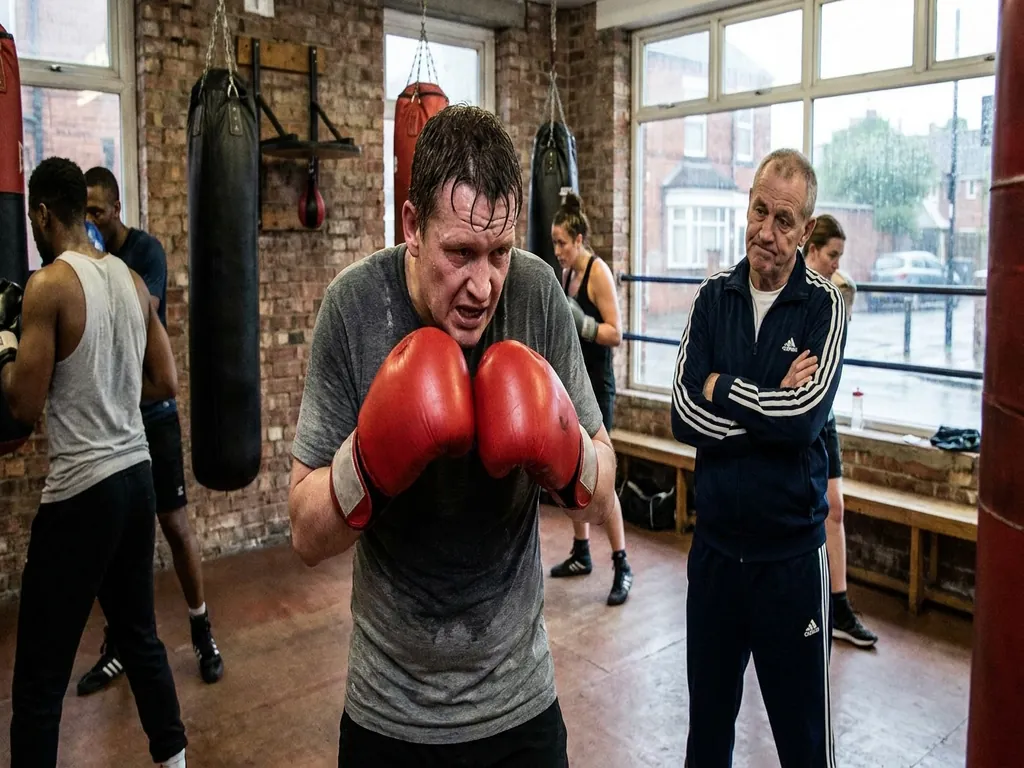
When beginners are nervous, they often carry the hands too high, let the elbows drift, and hold the whole position with constant muscular tension. Instead of moving with the rhythm of the round, the guard becomes a static load.
That usually makes defence worse, not better. Tight shoulders slow the return to guard, slow the jab, and make head movement clumsy. If your guard feels heavy after one round, you probably need a calmer position, not more grit.
Boxing asks a lot from the shoulder complex
The shoulder burn is not imaginary. The sport really does demand a lot from that area.
Punching is a full-body action, but the shoulder still has to stabilise, accelerate, decelerate, and reset the arm over and over again. Research comparing punching mechanics in boxing and sanda found shoulder joint strength was significantly associated with straight punching force, which is another way of saying the shoulders are not passengers in the action (PMC comparative punching analysis).
That is why sloppy punching catches up with you so quickly. If the legs and trunk do not help enough, the shoulders end up doing more of the job than they should. They start the punch, drag it through the air, and then haul it back on the recovery. That is a bad trade.
If you are in that pattern, read our guide on why beginners gas out in boxing. A lot of what feels like cardio failure is really local fatigue caused by waste.
Bad breathing and bad pacing make the shoulders worse
The shoulders do not suffer alone. They usually suffer alongside poor breathing and poor pacing.
A lot of beginners throw combinations in silence, then wonder why everything tightens up. If you hold your breath while punching, the neck and shoulders often tense with it. The round feels frantic, the arms feel heavier, and recovery between exchanges gets worse.
Pacing creates the same problem. Some people try to win every second of a beginner session. Every jab is loaded and every cross is thrown as if someone owes them money. That approach cooks the shoulders fast.
The better boxers in the room are usually calmer because they waste less. They know when to touch, when to sit down on a shot, and when to reset.
If your shoulders are burning, check whether you are punching hard all the time when half the round only needed clean straight shots and controlled movement.
Four habits that usually cook the shoulders
These are the common mistakes coaches see again and again.
1. Clenching the fists between punches
Your fists do not need to be crushed shut every second of the round. Tight fists create extra forearm and shoulder tension, and that tension climbs upwards quickly.
2. Throwing from the shoulder instead of from the floor
If the punch starts with a shrug and an arm swing, the shoulder takes too much load. Clean punches start from the feet, travel through the hips and trunk, and only then arrive through the hand.
3. Leaving the elbows too wide
Wide elbows make the guard heavier and the return path longer. The shoulders have to work harder to tidy up every punch.
4. Trying to look busy when nothing is on
Nervous bouncing, fake twitching, random arm movement, and overactive feints all cost energy. Better boxers are active with a reason. Beginners are often active because silence makes them anxious.
A related combat-sport study found both upper- and lower-body fatigue worsened striking response time, which is useful here because it shows fatigue does not just make you tired. It makes you later and sloppier too (PubMed). Once the shoulders start to go, technique usually follows.

What fixes shoulder burn fastest
The good news is this usually improves quickly once the habits improve.
Relax the shoulders between actions
Bring the hands home, but do not carry them as if you are trying to hold two suitcases at head height. The guard should feel ready, not frozen.
Exhale on every punch
A short sharp exhale keeps rhythm and stops the upper body locking up. Silent combinations are often tense combinations.
Punch at the level the round actually needs
Not every shot is a statement punch. Most beginners need more clean jabs and fewer dramatic crosses.
Let the legs and trunk do their share
If your feet are underneath you and the hips turn properly, the shoulders stop trying to do a full-body job on their own.
Build shoulder endurance honestly
Bag rounds, pads, and controlled shadowboxing will help. So will regular attendance. What will not help is pretending that one savage round a week counts as conditioning.
Our Recreational Adults boxing classes are built around exactly this sort of correction. Most adults do not need motivational speeches. They need better mechanics and sensible coaching.
When shoulder burn is not normal
Normal burn is broad, bilateral, and tied to effort. Sharp pain is a different conversation.
If the pain is one-sided, pinching, shooting down the arm, or still hanging around when you are trying to sleep, stop acting like it is just part of the sport. That is not the same as ordinary fatigue.
The same goes for numbness, repeated clicking with pain, or a shoulder that feels unstable on straight punches. A coach can help with habits. A clinician helps with symptoms that look beyond normal training fatigue.
What beginners should expect instead
Some shoulder fatigue in your first few weeks is normal. Endless shoulder burn is not.
The useful benchmark is whether the feeling improves as your technique improves. Are your shoulders staying looser by week four than they were in week one? Is the jab returning quicker? Can you do more rounds without feeling your arms fill with concrete? Those are the signs that your boxing is getting cheaper.
If you are in Greenwich or nearby, the best answer is not more guesswork in the mirror. It is proper coaching, proper pacing, and rounds where somebody actually corrects what your shoulders are doing.

Shoulder burn is usually a technique problem wearing a fitness disguise.
H&G Team
Writer at Honour & Glory Boxing Club, a community boxing gym in Kidbrooke, South East London.
Rate this article
Your feedback helps us write better content
Got questions about what you just read?
ASK OUR AI ASSISTANT ✨MORE LIKE THIS



WANT TO JOIN US?
Book a free trial session and see what we're all about.
Claim a Free Trial